

In the medical system, there’s a famous saying, “Prevention is better than Cure”. To adhere to this principle, healthcare facilities must always have enough stock of essential medical supplies. The shortage of even a single item may have major repercussions on patients’ health. Therefore, well-established hospital inventory management becomes a necessary requirement.
Today, hospital inventory management has not remained just about basic stock tracking. It has become technologically advanced and plays a major role in ensuring medical compliance, operational efficiency, inter-departmental collaboration, and many more. As a result, the Hospital Inventory Management Systems market, valued at $3.42 billion in 2025, is projected to grow to $7.55 billion by 2034, reflecting a 9.2% CAGR. Healthcare Software Development Companies are continually seeking ways to develop the best hospital inventory management systems for healthcare facilities.
In this blog, we’ll get deep into hospital inventory management, learning its types, advantages, limitations, and best practices to develop quality software to achieve the expected results.
What is Hospital Inventory Management?
Hospital inventory management is a workflow that tracks inventories, transactions, bookings, payments, and other important details. An effective inventory management system is essential for healthcare firms that need to monitor medical products, order and administer drugs, or sell health items to patients. Inventory management solutions help major organizations avoid financial losses and product shortages by maintaining accurate and up-to-date records of items and resources.
Managing hospital inventory can be challenging because it involves monitoring everything from medical supplies and healthcare equipment to spare medications. Hospital staff must handle numerous tasks, and managing them using outdated methods is hectic and time-consuming. Hospital inventory management software is designed to simplify the difficult task of handling large inventories.
Types of Hospital Inventory
Numerous healthcare facilities lack a uniform inventory management system. Implementing a consistent approach can substantially reduce expenditures. Hospital inventory management falls into two distinct categories, each requiring a thorough understanding of its advantages and drawbacks. Healthcare institutions can employ many strategies for managing their inventories, which include the following:
Periodic Inventory
The periodic inventory system is an accounting method used to track and manage inventory by conducting physical counts at specific intervals. This process requires staff to manually update inventory data through periodic inventory-taking. For instance, organizations commonly perform inventory checks every week or at the end of a similar time frame. Although this approach may be adequate for minor healthcare establishments, it is suboptimal for hospitals and more extensive healthcare institutions.
This inventory management method carries a significant risk of errors and diverts time away from other critical responsibilities.
Perpetual Inventory
Perpetual inventory management is a system that continuously and automatically updates inventory data. Implementing a perpetual inventory system requires sophisticated software, which may incur higher expenses compared to the traditional manual periodic inventory approach. However, the advantages offered by the perpetual inventory system outweigh the associated costs. However, the benefits of a perpetual inventory system outweigh these costs. Such systems include essential functions like recording orders, shipments, additions, and removals. Medical personnel can continuously monitor the utilization of equipment, ensuring that all supplies are consistently documented and accurately recorded.
Benefits of Healthcare Inventory Management Software
Hospital inventory management provides a wide range of benefits that can significantly improve the efficiency of healthcare.
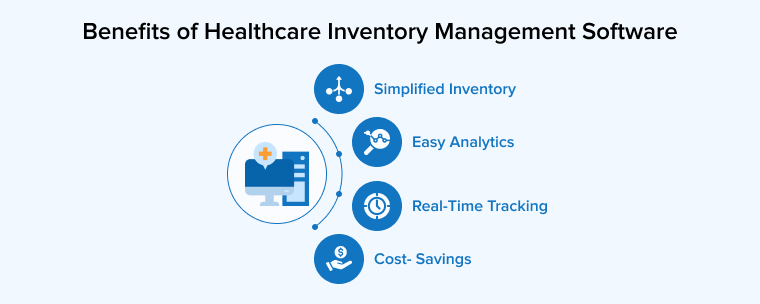
Simplified Inventory Management – Tracking Asset
To make inventory management seamless, you need to use hospital inventory management software. Healthcare stocks and supplies fluctuate significantly due to the present unpredictable scenario. An ideal medical inventory management software can automate these tedious procedures and reduce human effort, allowing staff to focus more on patient care.
Reducing Inaccuracies, Easy Analytics & Maintaining the Supply
Inventory & stock management is not a one-time procedure. It is an ongoing process that occurs throughout the year. Earlier, when all these tasks were performed manually, the process was prone to errors, leading to improper or faulty stock management.
With the adoption of an inventory management system, there is no room for error. Data is being recorded and tracked with great precision. Also, almost all your orders can be synchronized, and stock levels are automatically adjusted whenever a sale is made.
Real-Time Tracking
The program built into the software enables real-time tracking, which means the inventory is continuously updated to remain current. This gives you access to a precisely counted inventory whenever you add or sell items.
Additionally, you can manage inventory transactions and have supplies automatically reordered when supplies run low. If the goods do not arrive at their location, you will be notified.
Cost- Savings
Effective hospital inventory management helps healthcare facilities control expenses without affecting the availability of essential supplies. With proper monitoring of stock levels, hospitals can purchase the right amount of medicines, equipment, and consumables and avoid overstocking. This reduces the risk of products becoming unusable due to expiration and avoids the extra cost of urgent last-minute purchases.
Better inventory planning also improves storage efficiency and supports informed purchasing decisions, helping hospitals make the best use of their budgets. As a result, hospitals can operate more efficiently, reduce unnecessary costs, and give healthcare staff more time to provide quality care to patients.
Challenges of Hospital Inventory Management
Hospital inventory management faces several challenges. The complexities and difficulties are explained in detail below.

Sorting Pharmaceuticals
Managing pharmaceutical inventory in hospitals requires careful organization to ensure medicines are stored and identified correctly. Hospitals handle multiple varieties of drugs, each with different storage conditions, shelf lives, and usage requirements. It’s essential to keep track of these details to avoid dispensing the wrong medication or using expired products. In addition, hospitals must follow strict regulations for storing and monitoring controlled medicines.
The inventory system must be well-organized and equipped with modern technology to help hospital staff locate medicines quickly, maintain accurate records, reduce unnecessary waste, and ensure that essential medications are available whenever patients need them.
Tracking Expiry Date of Pharmaceuticals
Monitoring the shelf life of medical supplies is an essential part of hospital inventory management. Medicines, surgical items, and other healthcare products must be used before they expire to protect patient safety and avoid unnecessary losses. A digital inventory system using barcode or RFID technology can simplify this process by recording expiry dates and alerting staff when products need attention.
Hospitals can also reduce waste by following organized stock rotation methods so that older items are used before newly received supplies. Regular inventory checks and proper coordination between departments further help maintain accurate stock levels and ensure essential medical products remain available when required.
Manual Data Entry
Accurate record-keeping is essential for effective hospital inventory management because healthcare activities depend on reliable information every day. When inventory updates are handled manually, the process becomes slow and increases the risk of mistakes. Incorrect records can result in inaccurate stock levels, making it difficult to plan future purchases or track item usage.
The above limitations can be overcome using a digital inventory management system that helps automate record updates, improves data accuracy, reduces administrative work, and supports better decision-making across the hospital.
How Hospital Inventory Management Software Helps in Solving these Challenges?
Hospitals often face challenges with overspending and under-saving due to difficulties in controlling inventories. Keeping track of all their stock can be time-consuming for hospital staff.
Hospital software provides a simple way for staff to track their inventories. It also facilitates order administration and the purchasing process, making these tasks simpler than they would be without the software.
A key advantage of this software is its ability to customize features according to the specific demands of each institution. The challenges hospitals face can be mitigated by using hospital inventory management software by following these points.
- Identifying consumables that are running low and placing new orders in a timely manner.
- Assisting in determining what should be ordered and how much should be kept on hand.
- Eliminating unnecessary expenditures by slowing the rate at which stock is consumed.
- Keeping workers from wasting time searching for materials they need.
Hospitals rely on effective inventory management to guarantee that all necessary supplies and medications are available to patients at all times.
Hospital Inventory Management Best Practices to Follow
By implementing these best practices, healthcare organizations can enhance their operations, reduce human error, and provide security to patient data.
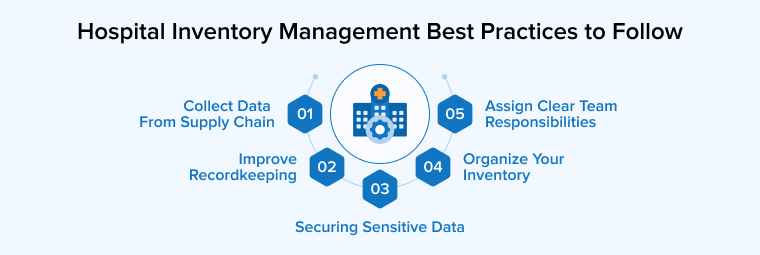
1. Collect Data From Supply Chain
With the help of the supply chain, healthcare businesses can save a significant amount of money and use that data to determine whether their inventory management techniques are cost-effective.
Failure to use supply chain data effectively may lead to millions of dollars in lost revenue. Rather than that, one must analyze the data to determine whether the inventory management system is performing as efficiently as intended.
With increasing concern for society’s health and the easy wonders of IT innovations, more firms are striving to establish IT platforms that support value-based models. By adopting these practices, healthcare ventures may establish a more precise correlation between the required materials and clinical outcomes.
2. Improve Recordkeeping
With hospital inventory management software, detailed recordkeeping is essential. You must have enough information on hand to make an informed decision. However, obtaining information is not enough; you must continually update it to eliminate any discrepancies. So, you need a software solution with robust analytical capabilities that can review past data and accurately predict future requirements.
3. Securing Sensitive Data
Each healthcare practitioner is acquainted with HIPAA, which safeguards patients’ health information from unauthorized access. It is equally important to maintain the same level of security for your inventory system, as your stock enables you to offer service to the patients you treat.
If unauthorized staff enter incorrect inventory counts or other data inconsistencies, it may cause significant problems in hospitals and other facilities that rely on discipline and accuracy to function successfully. Therefore, maintaining security is essential.
4. Organize Your Inventory to Avoid Redundancies
An essential strategy for effectively managing inventory is maintaining a high level of organization. An untidy or disorganized storage area can provide challenges in maintaining correct inventory records. Several issues may arise in the context of inventory management, including the misplacement of items, the risk of undiscovered shortages, and the potential for over-ordering due to poor organization. For example, healthcare personnel are advised to prioritize placing items approaching their expiration date at the front of shelves rather than the back. This practice facilitates these items being used before those with a more distant expiration date. It is advisable to utilize and extensively require products that should be positioned in proximity to the entrance of supply rooms for easier access.
5. Assign Clear Team Responsibilities
Adopting an inventory management solution is not enough. Staff members must also perform their duties properly, which requires a clear understanding of their responsibilities. Assigning clear job responsibilities to each team member enables them to perform their roles efficiently. When everyone is aware of how they contribute to the inventory management process and what they will be held accountable for, the work discrepancies and the margin of error are reduced.
Conclusion
A hospital inventory management system facilitates smooth and reliable healthcare operations. With the help of modern tools and real-time tracking, hospitals can ensure an adequate stock of essential supplies and equipment. This would not only reduce unnecessary costs and prevent wastage but also allow healthcare staff to focus more on patient care rather than administrative tasks. As technology continues to improve, adopting a smart and efficient inventory system is becoming a requirement for better performance, improved productivity, and higher-quality healthcare services.

Itesh Sharma is core member of Sales Department at TatvaSoft. He has got more than 6 years of experience in handling the task related to Customer Management and Project Management. Apart from his profession he also has keen interest in sharing the insight on different methodologies of software development.



You are great at conveying the content in a brief and understandable manner. I liked how you busted the myths which were clogging the inventory management best practices. I clearly agree that implementing the points and inputs mentioned by you will uplift the efficiency of healthcare inventory management.