


When developing modern applications, the way a system is structured plays a critical role in its performance, scalability, and maintainability. This structure, known as software architecture, defines how the system as a whole meets its goals. Over the years, software engineers have discovered proven approaches, known as software architecture patterns, that guide the design of complex systems. These patterns are tried-and-tested blueprints that address common challenges while aligning with specific needs, whether achieving high availability, enabling flexibility, or supporting rapid scalability.
Understanding this architecture is essential for software development companies because it lays the foundation for an application’s long-term success. Whether you’re building a small application or a large enterprise solution, choosing the right pattern can help you create systems that are efficient, reliable, and easier to evolve over time. In this blog, we’ll explain what software architecture is, why it matters, and how it differs from design patterns. We’ll also review various architectural patterns, highlighting their strengths and limitations.
Software Architecture Overview
Software architecture is the high-level blueprint that defines how a software system is organized, how its components interact, and how it will meet both functional and non-functional requirements. It describes the system’s core concepts, structural layout, and the relationships among its parts, along with the guiding principles and patterns that shape its design. This architectural foundation influences critical factors like performance, scalability, reliability, and maintainability throughout the software’s lifecycle.
You can compare software architecture to planning or designing a city. The city has different areas, for example, residential zones, commercial districts, roads, parks, and utilities. While each area serves its own purpose, it is the way they are planned, connected, and organized that determines how smoothly the city functions. Similarly, software architecture defines how different parts of a system work together to ensure efficiency, stability, and long-term growth. A well-thought-out architecture acts as a roadmap for development, helping the system remain efficient, adaptable, and able to handle future demands. It provides clarity for all stakeholders, streamlines communication, and supports decision-making during the development process. Architecture significantly affects the efficiency, maintainability, and scalability of software systems by providing a clear structure and separation of concerns.
Architectural patterns, on the other hand, are established solutions to recurring design challenges. They are not the architecture itself but conceptual models that guide how an architecture can be structured. Different systems can implement the same pattern in unique ways. Ultimately, choosing the right software architecture is crucial.
Importance of Software Architecture Patterns
Let’s discuss specific reasons why understanding software architecture patterns is important in software development:
Defines the Fundamental Features of the Application
The underlying software architecture majorly influences the core characteristics of the application you’re developing. For example, if you know the application will need to scale in the future to meet changing demands, you should choose a scalable pattern to support those future enhancements.
Consistent Quality and Efficiency
Quality issues are a major concern in software development. An application may behave as expected for some initial years, but start to degrade thereafter. Choosing an appropriate architectural pattern that balances efficiency and maintainability can help prevent this.
Get Agility
A software delivery project goes through iterations and modifications both during development and after deployment. The selected architecture should provide enough flexibility to support changes at any stage of the application’s lifecycle.
Increasing Productivity
There are a set of standard principles that must be followed regardless of how skilled you are in any programming language, framework, or tool. With an appropriate application pattern in place, the company can quickly assess a project’s status. Architectural patterns also help clarify the project scope.
Problem Solving
Knowledge of the underlying software architecture helps developers understand how applications and their components work. As a result, the development team can apply relevant best practices to handle future irregularities and errors.
Software Architectural Pattern vs Design Pattern
Software architectural patterns and design patterns are often used interchangeably in software development. While related, they represent different concerns. The table below highlights the main differences.
| Aspect | Software Architectural Pattern | Design Pattern |
|---|---|---|
| Definition | High-level structure of the entire system. | Smaller-scale solutions are applied within individual modules or services. |
| Scope | System-wide | Component or module level |
| Purpose | Establish the overall system layout. | Provide reusable solutions to recurring design challenges during implementation. |
| Focus | System stability and structural organization. | Behavioral and structural aspects within components. |
| Problems Addressed | Distribution of functionality, communication protocols, reliability, interfaces, system partitioning, scalability, security, etc. | Implementation-level issues such as object creation, interaction between objects, and class responsibilities. |
| Example | Microservices, client-server, serverless, layered | Singleton, Factory, Observer |
| Documentation | Architectural diagrams and high-level design documents. | UML diagrams, sequence diagrams, and code examples. |
| Role | Translate software features into high-level structures. | Describe and guide the design of software units to support coding. |
Architectural patterns define the major components of a system and their interaction, while design patterns address implementation details within those components.
Types of Software Architectural Patterns
We’ll discuss different architectural patterns used in software development to help you select the one you need.
Layered Architecture (N-Tier Architecture)
Layered architecture is a traditional and widely used software architectural pattern. It provides a common approach for structuring applications by offering a clear separation of concerns and a modular organization. The application is divided into hierarchical layers, with each layer performing a specific function and serving the layers above it. There is no fixed number of layers, but the following are the core layers:
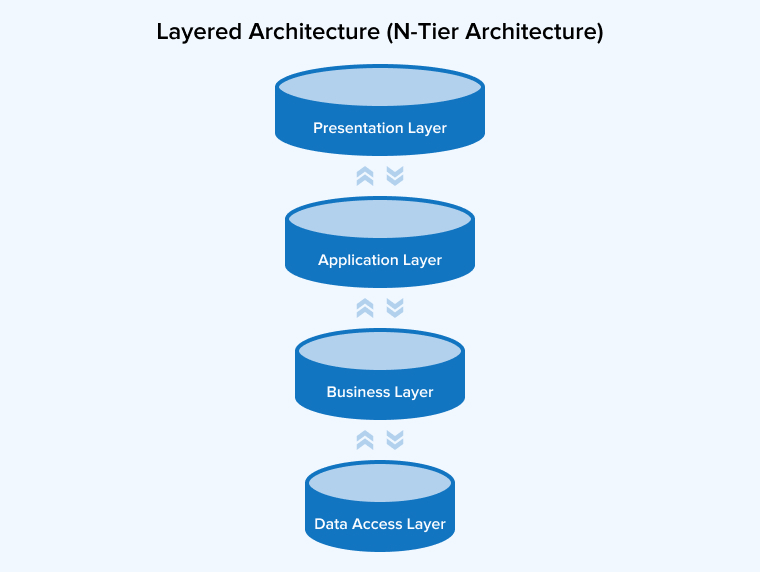
- Presentation Layer: The layer with which end users interact; they provide input and view the displayed results.
- Application Layer: Acts as a bridge between the presentation and data layers. It processes user requests, coordinates interactions with other layers, and enforces business rules.
- Domain/Business Layer: Encapsulates business functionality and executes domain logic in response to requests.
- Data Access Layer: Communicates with databases or external APIs and abstracts data storage and retrieval from the rest of the application.
Advantages of Layered Architecture
- Separation of Concerns: Each layer handles a specific responsibility, increasing the modularity and maintainability of the application.
- Testability: Layers are independent, so each can be tested separately to identify and resolve issues.
- Encapsulation: Each layer hides its internal workings and exposes a simplified interface to other layers, reducing the likelihood of errors when modifications are made.
Disadvantages of Layered Architecture
- Performance Overhead: Adding layers increases inter-layer communication, which can raise latency and reduce performance.
- Rigidity: The tiered structure can hinder features or optimizations that require interaction across multiple layers.
- Difficult Scaling: While individual layers can be scaled, the overall architecture can be hard to scale efficiently, especially when layers are tightly coupled.
Client-Server Architecture
The client-server architecture is a common pattern in which an application is divided into two components: the client and the server. The client is the user interface that collects user input and displays requested information. Client can be web browsers, mobile applications, or desktop apps that request specific information. The request is then sent to the server.
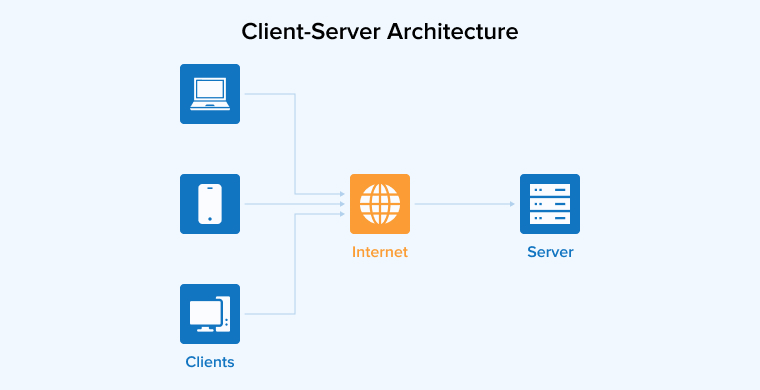
The server holds the central repository of information, processes incoming client requests, and sends responses. It fetches data from the database, performs calculations, and takes other actions to respond to the client. The response can be the requested data, a confirmation message, or an error message if a failure occurs. This request-response communication takes place over a network.
Advantages of Client-Server Architecture
- Centralized Management: The server is the central point for data and resources, facilitating easy management and maintenance.
- Resource Sharing: Multiple clients can simultaneously access shared resources like databases or applications hosted on a single server.
- Security: You can effectively implement security measures such as data encryption by utilizing the centralized controls of the server.
Disadvantages of Client-Server Architecture
- Single Point of Failure: Centralizing services in one location can disrupt all connected clients if the server goes down at any point in time.
- Cost: Hardware, software, and maintenance expenses can be high, depending on the system’s scale and requirements.
- Server Workload: A single server handles many client requests, so robust hardware and regular maintenance are required to prevent performance degradation.
Event-Driven Architecture
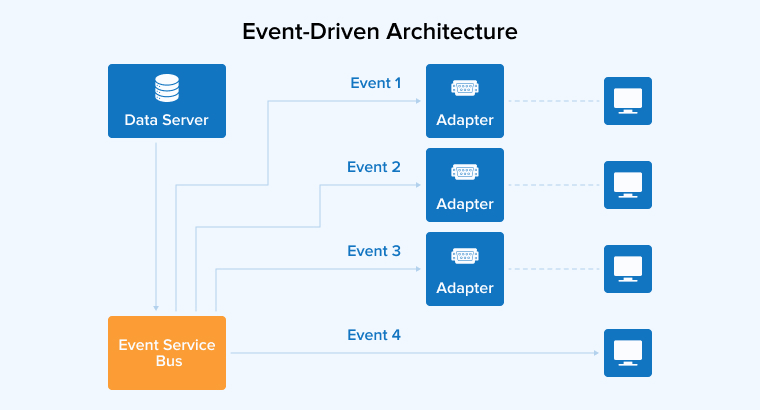
An event, a change in state resulting from user actions or data updates, is the central principle of event-driven architecture. The components in a loosely coupled system communicate through asynchronous events.
The operation of an event-driven architecture is according to the roles of three components:
- Event Producers: Produce events that trigger an action or a change in the system state and publish those events to the router.
- Event Router: Acts as middleware (often known as an event broker). It manages, controls, and routes events to target consumers.
- Event Consumers: Receive and process events. Here, processing can include updating a database, generating additional events, or initiating a new process. Based on the system design and business logic, processing an event may trigger operations, such as refreshing the UI, starting a workflow, or persisting data.
Advantages of Event-Driven Architecture
- Loose Coupling: Components are loosely connected; they interact only through events, which increases modularity, flexibility, and autonomy.
- Asynchronous Processing: Components can independently process events and concurrently, improving throughput and responsiveness.
- Easier Integration: Components can listen for and respond to events from multiple sources, making it simpler to integrate with other systems.
Disadvantages of Event-Driven Architecture
- Event Ordering: Tracking the event sequence can be difficult in distributed systems, which makes maintaining consistency challenging.
- Messaging Overhead: Introducing events and components adds overhead for message transmission, processing, and serialization.
- Event Latency: Processing events individually can introduce a delay between an event occurring and the system’s response. This can be a drawback for situations requiring immediate response.
Microkernel Architecture
The microkernel architecture, also known as the plug-in pattern, divides the system into two components:
- The microkernel core system handles basic operations and minimal functionality, such as memory management, to ensure the system remains operational.
- Plug-ins, extensions, or modules implement additional features and functionalities as separate and independent components.
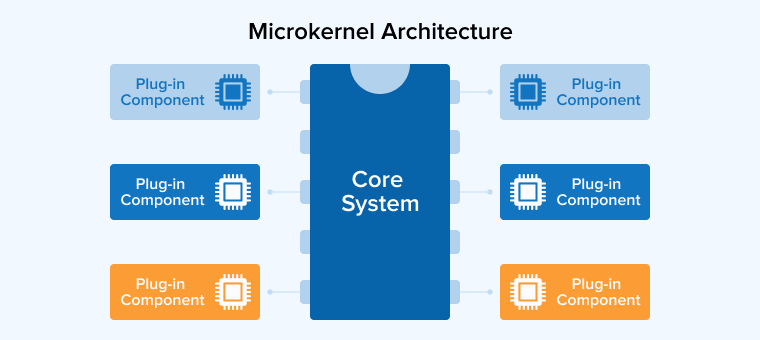
In this architecture, extensions interact with the core microkernel and possibly with each other through well-defined interfaces provided by the microkernel. Plugins can be added, removed, or updated without a full system reboot or modifications to the microkernel.
Advantages of Microkernel Architecture
- Scalability: Due to the flexibility of plug-in addition and removal, scaling the system is easy to meet changing requirements.
- Portability: The architecture is platform-independent, so you can migrate the system to different environments, providing deployment flexibility.
- Maintainability: You can easily identify and fix issues in individual components as they are isolated from the core system, increasing system efficiency.
Disadvantages of Microkernel Architecture
- Performance Overhead: Frequent context switches between the microkernel and user-space services can degrade system performance. Additional delays may arise from inter-process communication between user-space services and kernel processes.
- Microkernel Size: Adding features to meet evolving demands can increase the size of the microkernel, which contradicts the core principle of keeping the kernel minimal and lightweight.
- Compatibility Issues: Because many services run in the user space rather than in the kernel. Hence, a microkernel-based OS may not support some kernel-level APIs expected by certain applications.
Microservices Architecture
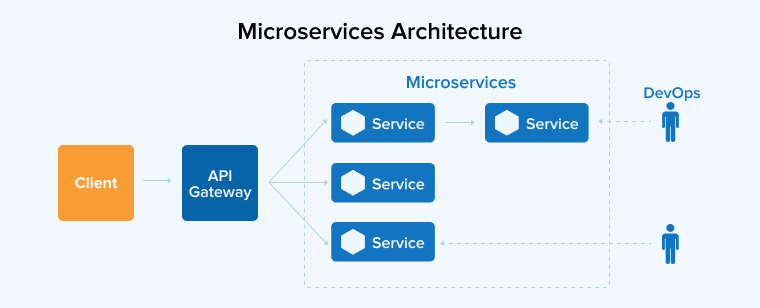
In a microservices architecture, an application is divided into small and independent services. Each microservice performs a specific functionality and communicates with other services using APIs. These microservices work together to form the complete application while operating independently. Microservices architectures are an alternative to monolithic applications and to traditional service-oriented architectures (SOA).
Advantages of Microservices Architecture
- Fault Tolerance: In a microservices setup, the failure of one service usually doesn’t bring down the whole application, because each service runs independently and is isolated from the others.
- Scalability: Each microservice can be scaled independently, allowing resources to be allocated precisely according to the needs of that specific service.
- Simplified Maintenance: With smaller codebases and well-defined responsibilities, identifying issues, implementing updates, and performing upkeep becomes more straightforward and efficient.
Disadvantages of Microservices Architecture
- Communication Overhead: Microservices interact with each other through APIs and network calls, which can introduce latency and complexity.
- Security: Strong security measures need to be implemented to secure the distributed microservices and the communication between them.
- Increased Costs: Initial setup costs may be high as you need robust infrastructure, management and monitoring tools, and expert engineers and software architects.
Space-Based Architecture
Space-based architecture is a cloud-based or grid-based design where processing and storage loads are spread across multiple nodes in a grid-like manner. All the nodes access a distributed shared memory or a tuple space. The architecture resembles with distributed computing architecture known as the Shared Nothing architecture.
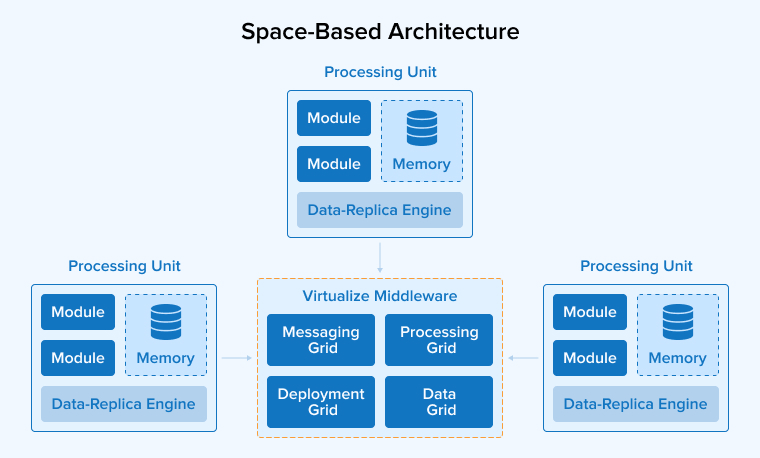
There are two basic components in the space-based architecture:
- Processing Units: They are independent, self-sufficient units containing sections of application functionality such as backend business logic.
- Virtualized Middleware: The custom-written or third-party components that handle request routing, load balancing, data synchronization, and other cross-cutting concerns.
Advantages of Space-Based Architecture
- Scalability: The architecture can inherently scale linearly. As the demand increases, you can add processing units to meet it.
- High Performance: Space-based systems overcome the limitations of centralised systems due to the distribution of processing and storage across various units.
- Fault Tolerance: As every unit is independent, the failure of one or more units does not affect the entire system; the system remains available all the time.
Disadvantages of Space-Based Architecture
- Resource Consumption: Scaling typically requires more processing units and high memory capacity, resulting in higher infrastructure costs.
- Limited in Scope: The space-based architecture is best suited for applications requiring high read/write throughput and relaxed consistency requirements. It is less suitable for applications with less throughput demands and a strict data consistency need.
- Maintenance: Synchronization, data partitioning, and coordination across various independent units increase operational and development complexity.
Service-Oriented Architecture
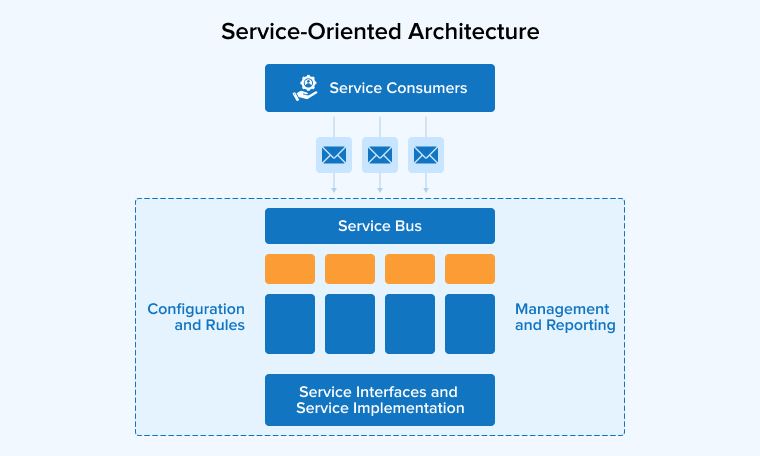
An application implementing service-oriented architecture is made up of a group of loosely coupled, self-sufficient, and modular services. Each service has its own interface and performs a specific business task. Services communicate with each other over a network using a communication protocol. All the services are listed in a service registry, from which other applications can discover and access the required services.
Advantages of Service-Oriented Architecture
- Maintainability: Updates, modifications, and replacement of individual services are possible without affecting other components due to the independent nature of services.
- Interoperability: The SOA architecture enables easy integration and communication between different services regardless of the technologies they are built with.
- Reusability: You can reuse services across multiple applications, thus increasing productivity and efficiency.
Disadvantages of Service-Oriented Architecture
- Security Challenges: The distributed nature of SOA exposes multiple entry points and communication channels, increasing vulnerabilities and requiring robust security measures.
- Cultural Shift: SOA demands expertise in disturbed systems, networking, security, etc. Also, it’s an implicit need to adopt Agile and DevOps practices, marking a shift in the organization’s culture.
- Operational Costs: Managing and maintaining a service-based architecture can also be expensive due to added complexity and increased resource consumption.
CQRS Pattern
CQRS stands for Command Query Responsibility Segregation, it is an architectural pattern that separates read (queries) and write (commands) operations. The read and write sides have distinct models and interfaces. The respective data will also be stored in separate locations, for example, different tables in the same database or even different databases.
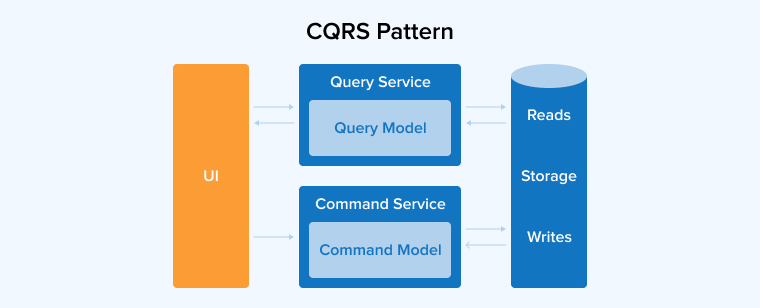
The application, after getting user input, sends it to the command service, which further retrieves necessary information from the command database. It then processes the command, updates the write-side data, and saves the changes. After this, it sends a notification to the read service to update the read model.
Advantages of the CQRS Pattern
- Flexibility: You can optimize read and write models according to requirements, increasing the adaptability of applications with changing demands.
- Event Sourcing Compatibility: CQRS pairs well with event sourcing, providing a robust system for auditing, versioning, and reconstructing application state.
- Independent Scalability: Read and write operations can be scaled independently, allowing more efficient use of resources.
Disadvantages of the CQRS Pattern
- Steep Learning Curve: Proficiency in the CQRS pattern requires a deep understanding of advanced concepts like event sourcing and distributed messaging, making it tough for beginners and new team members.
- Eventual Consistency: Read and write models in the CQRS may not always be synchronized due to the coupling of CQRS with event sourcing. It makes CQRS less suitable for systems with strict consistency requirements.
- Complexity: The requirement of separate reading and writing models increases development and maintenance overhead.
Pipe-Filter Architecture Pattern
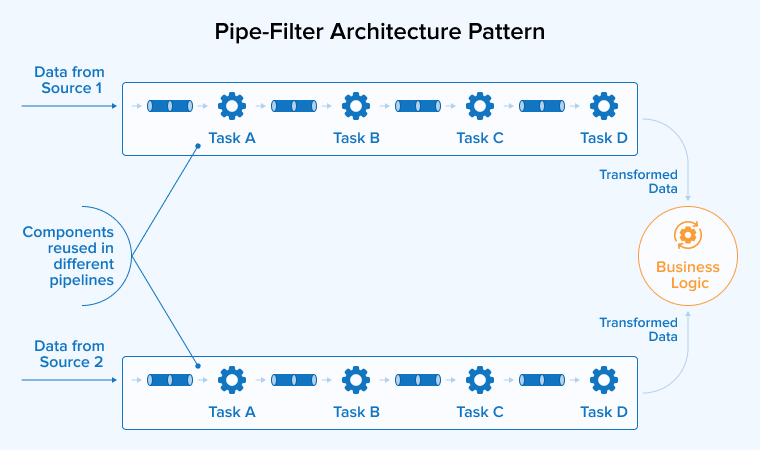
The system is structured as a pipe connected to a series of data processing filters. Each filter processes data and passes it to the next filter through the pipe. The pipe works as a channel for data transmission between filters. Each filter performs a dedicated function and is self-contained.
Advantages of Pipe-Filter Architecture Pattern
- Fault Isolation: Each filter is independent, hence faults or errors remain localized and do not propagate through the pipeline, increasing the reliability of the system.
- Reusability: Filters can be reused in other pipelines, decreasing the development time and code duplication.
- Scalability: It’s simple to add or remove filters in the pipeline to meet changing requirements, increasing the system’s adaptability.
Disadvantages of Pipe-Filter Architecture Pattern
- Performance Overhead: If there are too many filters in the pipe, or the data requires frequent transformations, the data transfer speed may slow down, negatively affecting the overall application speed.
- State Management: Managing the state of filters may increase the design complexity to ensure consistency and correctness.
- Complexity: The complex interdependencies and numerous filters within a pipeline can make implementation and debugging challenging.
Model-View-Controller Pattern
The MVC or Model View Controller pattern is one of the most popular architectural patterns implemented by modern web development frameworks like Angular, Laravel, and Django. It divides the application into three logical, interconnected components:
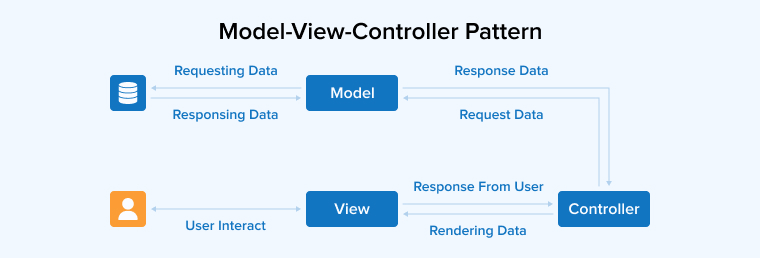
- Model: Handles all the data-related logic by interacting with the database and providing data to the controller.
- View: The user interface that accepts user input and displays the results. It receives data via the Controller.
- Controller: It’s a bridge between Model and View. It receives the input from the view, processes it, and updates the model accordingly. It also retrieves data from the model and passes it to the view for display.
Advantages of the MVC Pattern
- Flexible UI Updates: The model and controller are independent of UI updates; hence, simple and quick updates can be made with minimal impact on the other components.
- Parallel Development: Multiple developers can work on the model, view and controller simultaneously, increasing development speed.
- Enhanced Testability: The separation of concerns makes it easier to test components independently.
Disadvantages of the MVC Pattern
- Inefficient Data Flow: Strict separation may lead to data to pass through extra layers, where a more direct path may be possible, increasing complexity in data flow.
- Steep Learning Curve: It can be difficult for developers unfamiliar with the MVC pattern to get hold of the responsibilities and interactions of the components.
- Excessive Boilerplate Code: You need to write a lot of code for even simple tasks in the MVC pattern compared to other architectures.
Peer-to-Peer Architecture Pattern
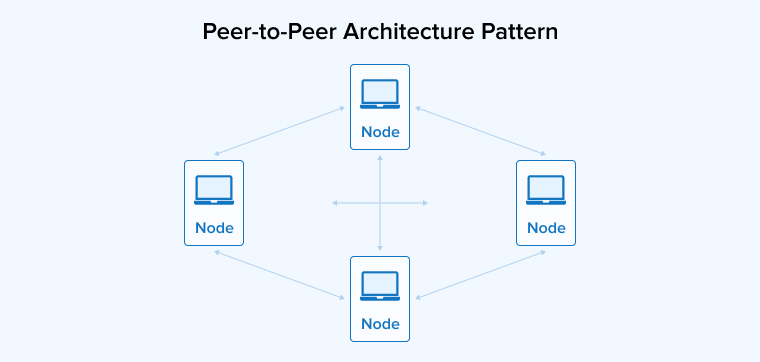
In the peer-to-peer pattern, every node, known as a peer, can become a client, server, or both. Here, there is no centralized or dedicated server for processing requests; instead, this responsibility is distributed among all peers. After joining the decentralized network, a peer connects with other peers using a bootstrap process and can then directly communicate with them.
Advantages of Peer-to-Peer Architecture Pattern
- Faster Content Delivery: Direct communication between nodes increases the speed of file transfer and real-time interaction.
- Efficient Resource Utilization: The elimination of the intermediary allows load distribution across multiple peers, sharing resources like storage and bandwidth, resulting in less wastage.
- Cost Reduction: The infrastructural and operational costs are reduced, as there is no setting up of a centralized server and contribution of resources by all the peers.
Disadvantages of Peer-to-Peer Architecture Pattern
- Lack of Centralized Control: As there is no dedicated server, coordination and management become difficult across the network.
- Peer Dependent: The active participation of all the peers is necessary for resource availability. If a specific count of peers becomes inactive, resource availability and system function can be affected.
- Security: The decentralized nature imposes security concerns for the peers, making them vulnerable to malicious activities and security attacks.
Broker Architecture Pattern
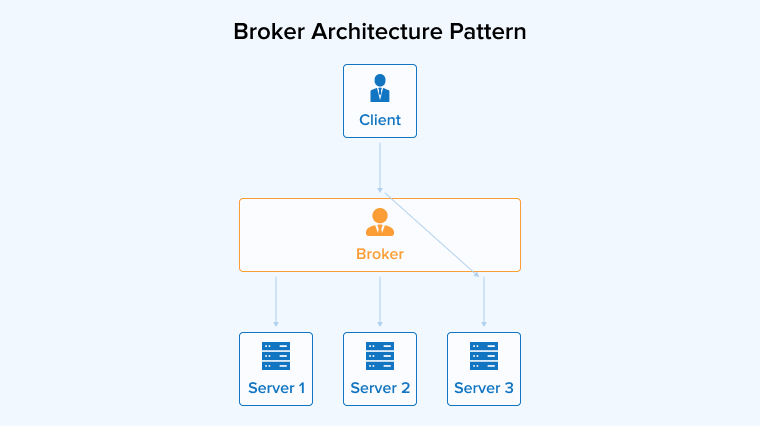
The broker pattern is used in distributed systems with decoupled components. Broker works as an intermediary between the client and server. When it receives a request from the client, it redirects it to the specific service for further processing. All the components in this pattern interact using remote services.
Advantages of Broker Architecture Pattern
- Interoperability: Heterogeneous components can easily integrate in a distributed environment by communicating through standardized message formats and protocols.
- Flexibility: You can add, remove, or modify components in the broker pattern without disturbing the other working components.
- Reliability: The pattern can use queues or topics to store messages temporarily for asynchronous processing, decreasing the chances of data loss in case of failures.
Disadvantages of Broker Architecture Pattern
- Single Point of Failure: If the broker fails, communication between components that depend on it will be affected, which can cause downtime or even data loss.
- Message Ordering: Tracking or maintaining the order of messages is difficult in distributed systems, increasing design complexity and performance overhead.
- Data Consistency and Integrity: Maintaining data consistency and integrity in a distributed environment requires the implementation of event sourcing patterns, distributed transactions.
Final Thoughts
We learnt about many architectural patterns prevalent in software development. There are multiple factors to be taken into consideration while selecting a particular pattern. Nowadays, companies hire software developers to produce a proven design solution. They deeply analyze the product requirements and evaluate suitable architectural pattern options to select the best one. Get a thorough understanding of the architecture patterns and choose the most appropriate one that can get along with future evolutions.

Itesh Sharma is core member of Sales Department at TatvaSoft. He has got more than 6 years of experience in handling the task related to Customer Management and Project Management. Apart from his profession he also has keen interest in sharing the insight on different methodologies of software development.



Comments
Leave a message...