

Software sustainability is no longer a side conversation. Every application handling your business workflow consumes resources, occupies infrastructure, and determines operational efficiency. As enterprises depend more heavily on software, the pressure on software development companies to build efficient, long-lasting, and well-maintained applications has increased.
Inefficient code drives up cloud bills, slow systems frustrate users, and poorly maintained applications turn into technical debt that drains budgets year after year. Sustainability directly shapes cost, performance, and how long your software stays useful.
This blog is about software sustainability metrics, what they are, why they matter, and how you can measure them.
What Are Software Sustainability Metrics?
Software sustainability metrics are measurable indicators that show how efficient, maintainable, and long-lasting a software system is over time. They provide data regarding the application’s resource consumption, code maintainability, scalability, and operational reliability to help you track, compare, and act on them accordingly. Some focus on technical aspects such as defect density and modularity, while others look at how well the system handles growing demand or how easily it adapts when requirements shift.
For engineering teams, these indicators work as practical KPIs that guide architecture choices, code reviews, and release decisions. For business stakeholders, they translate into outcomes like lower infrastructure costs, fewer outages, faster delivery cycles, and applications that stay useful for years without repeated overhauls. We can say that software sustainability metrics give organisations a structured view of how dependable their software is today and how well it will hold up tomorrow.
Different Types of Software Sustainability Metrics
Software sustainability metrics fall into the following three core types, and each one focuses on a different layer of how your application performs and holds up over time.

Efficiency Metrics
Efficiency metrics measure how well your software uses the available resources. It includes indicators like CPU utilisation, memory consumption, response time, throughput, and energy used per transaction. A well-optimised application keeps these numbers low while still delivering strong performance, which directly reduces infrastructure costs and improves user experience. Tracking efficiency early in the lifecycle helps engineering teams spot wasteful processes, inefficient queries, and oversized workloads before they become expensive operational problems.
Maintainability Metrics
Maintainability metrics show how easy it is for developers to update, fix, and extend the codebase. Common indicators include the maintainability index, cyclomatic complexity, code duplication, defect density, and code churn. High maintainability means smaller learning curves for new engineers, faster bug resolution, and lower risk when introducing new features. Teams that already track metrics usually find it easy to extend that practice into deeper code-quality measurement, giving the application a longer and healthier life.
Scalability Metrics
Scalability metrics assess how your software handles growth in users, data, and transactions. These metrics include load handling capacity, latency under peak demand, horizontal and vertical scaling efficiency, and architectural elasticity. Strong scalability metrics indicate that your system is ready for handling future demand without requiring expensive rebuilds. It also helps leaders to make confident decisions about when to invest in microservices best practices or restructure parts of the architecture to support long-term business growth.
How Do You Measure Software Sustainability Metrics?
Measuring software sustainability metrics works best when treated as a continuous engineering practice, and not a one-time audit.
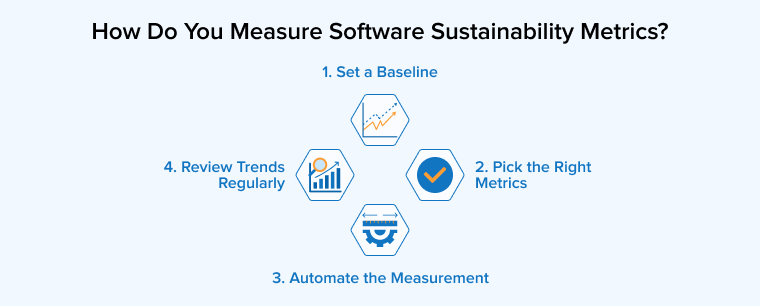
The process usually follows four clear steps.
- Set a baseline: Before improving anything, you need to know how your software performs today. Collect data from your application performance monitoring tools, cloud dashboards, and code-quality platforms to capture current numbers across efficiency, maintainability, and scalability. This becomes your reference point for every future release.
- Pick the right metrics: Not every indicator matters for every business. A high-traffic ecommerce platform leans on throughput and latency, while an internal enterprise tool focuses more on maintainability and defect density. Choose the right metrics to avoid dashboard noise and keep the focus on what affects cost and longevity.
- Automate the measurement: Manual tracking falls apart quickly. CI/CD pipelines can run static analysis, performance benchmarks, and resource checks on every build, while monitoring tools stream live data from production. Application performance monitoring tools help identify bottlenecks, memory leaks, and inefficient queries before they impact users.
- Review trends regularly: A single reading may not convey the complete details. Monitoring trend lines over weeks and months shows whether your software is improving or quietly drifting toward technical debt. Reviewing these trends, alongside delivery and incident data, turns measurement into a decision-making tool.
When these four steps run as a continuous loop, software sustainability metrics do not just remain numbers but become useful for teams in making real engineering choices.
Tools for Measuring Software Sustainability
Below are the best software sustainability measuring tools that most enterprises rely on.
- Application Performance Monitoring (APM) tools: Platforms like New Relic, Datadog, and Dynatrace track resource usage, response time, and error rates in real time, helping teams catch inefficient code and slow queries early.
- Code quality and static analysis tools: SonarQube, CodeClimate, and ESLint measure maintainability, complexity, and technical debt directly in the codebase, which gives developers fast feedback during reviews.
- Cloud provider dashboards: AWS, Microsoft Azure, and Google Cloud offer built-in efficiency reports that show how workloads consume resources across regions and services.
- Energy measurement tools: Options like PowerAPI, Scaphandre, and cloud provider energy dashboards give process-level visibility into how applications use compute resources, useful for data-heavy or AI workloads.
- DevOps monitoring platforms: Prometheus, Grafana, and the Elastic Stack collect data from infrastructure metrics and applications, supporting trend analysis and anomaly detection.
Best Practices for Enhancing Software Sustainability
The following best practices help teams build software that stays efficient, maintainable, and dependable over time.
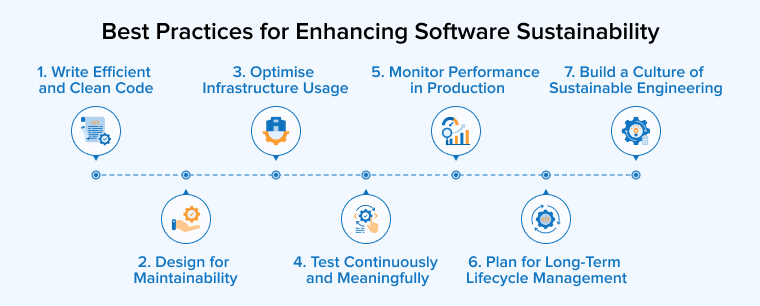
1. Write Efficient and Clean Code
- Use lightweight logic: Choose algorithms and data structures suited to the workload to reduce unnecessary computing resources.
- Remove the clutter: Eliminate unused dependencies, dead code, and redundant computations during reviews.
- Apply coding standards: Use consistent style and patterns across the team to reduce complexity and improve readability.
2. Design for Maintainability
- Use modular architecture: Keep components loosely coupled so changes in one area do not break others.
- Document key decisions: Capture architectural choices, APIs, and workflows so future engineers can pick up quickly.
- Refactor on a schedule: Tackle small improvements regularly instead of letting technical debt pile up.
3. Optimise Infrastructure Usage
- Right-size resources: Match cloud resources to real consumption patterns rather than worst-case assumptions.
- Adopt elastic scaling: Use auto-scaling and serverless options for workloads that fluctuate during the day.
- Modernise legacy components: Apply cloud modernization strategies to retire underused or outdated systems.
4. Test Continuously and Meaningfully
- Automate testing in CI/CD: Run unit, integration, and performance tests on every build to catch regressions early.
- Track quality with metrics: Use software testing metrics like defect density and test coverage to measure progress.
- Validate under real load: Run stress and load tests before production to confirm the system scales.
5. Monitor Performance in Production
- Set real-time alerts: Watch for memory leaks, latency spikes, and CPU overuse the moment they appear.
- Review dashboards weekly: Spot slow drifts in efficiency before they turn into bigger issues.
- Use anomaly detection: Let monitoring tools flag unusual resource consumption automatically.
6. Plan for Long-Term Lifecycle Management
- Keep dependencies updated: Refresh libraries and frameworks to close security and performance gaps.
- Schedule architecture reviews: Run periodic assessments to catch ageing components before they cause outages.
- Retire what no longer fits: Replace or remove modules that have outlived their business purpose.
7. Build a Culture of Sustainable Engineering
- Include metrics in reviews: Bring sustainability indicators into code reviews and sprint retrospectives.
- Train on efficient coding: Help developers learn how to write resource-aware, maintainable code.
- Share the responsibility: Make sustainability a shared goal across product, engineering, and operations teams.
Small, ongoing improvements to code quality, infrastructure usage, and team habits compound over time, keeping software healthy long after its initial release.
Conclusion
Software sustainability metrics give engineering teams a clear, structured way to measure how efficient, maintainable, and scalable their software really is. They help leaders move past guesswork and make confident decisions about cost, performance, and long-term reliability. The teams that benefit most are the ones that treat these metrics as part of daily engineering work rather than a yearly report.
FAQ
Sustainable software development is the practice of building software that stays efficient, maintainable, and reliable throughout its lifecycle. It focuses on clean code, smart use of infrastructure, and architecture designed for long-term scalability.
It directly affects cost, performance, and reliability. Sustainable software keeps cloud bills lower, reduces technical debt, scales with business growth, and stays useful for years without expensive rewrites.
The key sustainability metrics fall into three groups. Efficiency metrics like CPU usage, memory consumption, response time, and throughput. Maintainability metrics such as the maintainability index, cyclomatic complexity, code duplication, and defect density. Scalability metrics, such as load capacity, latency under peak demand, and scaling efficiency.

Itesh Sharma is core member of Sales Department at TatvaSoft. He has got more than 6 years of experience in handling the task related to Customer Management and Project Management. Apart from his profession he also has keen interest in sharing the insight on different methodologies of software development.



Comments
Leave a message...