


The main purpose of software testing is to identify bugs and fix them in the developed application before delivering it to the clients. For this, every software testing company follows different types of software testing approaches. Regression testing is the most popular process because it enables the QA team to ensure that once the bugs are fixed, no new issues arise, and the software continues to function correctly. This is why regression testing is executed by software development companies while checking the application, fixing the bugs, and retesting the areas affected by the fixes. To get a clear idea of what regression testing is and learn more about it, let’s go through this blog.
What is Regression Testing?
Regression testing is a type of testing technique that ensures recent code or program changes have not adversely affected existing functionality. It involves executing all or a subset of previously run test cases to verify the continued performance of current features.
This testing is conducted to ensure that changes to the program do not affect its functionality. It ensures that the existing software continues to operate correctly after the latest code modifications and updates.
When to Perform Regression Testing?
Regression Testing is often conducted once the alterations or new features have been validated. However, it is not always the case. Regression tests must be integrated into the regular testing process for launches that take several months to complete. Additionally, regression testing may be conducted for weekly updates after functional testing of the modifications is complete.
Regression testing is a subset of retesting. There can be various reasons to perform a retest. Assume you were evaluating a particular feature, but by the evening, you were unable to complete the test and were instructed to close the procedure without verifying whether the test was successful. When you return, you repeat the test, which means you are redoing a test you had already performed. Retesting is simply the process of redoing a test, and regression testing is not fundamentally different.
Something within the program or code has only been modified on rare occasions. This could involve programming, layout, or any aspect related to the environment’s overall architecture.
The regression test is a retest performed to ensure that the recent modification has not affected any functionality that was previously working correctly.
This is often performed when new releases have been generated or issues have been resolved.
Advantages of Regression Testing
The following are the several benefits of the Regression Test.
Ensuring Software Stability and Reliability
Regression testing is a method to verify whether the application still works as it should after code updates and changes. It’s possible that existing features may not work like before after modifying the code. These tests check that everything continues to run as expected. Manual regression testing is possible, but it’s quite time-consuming and may result in errors. Automated testing tools execute multiple test cases simultaneously and produce consistent results. In this manner, teams ensure software reliability while improving it.
Structure Conformance
Automation offers an effective way to run regression tests regularly and with less effort. It allows teams to repeat tests quickly whenever new changes appear in the code. By using a suitable automation framework, developers can reuse test cases and run them often. Repeated regression tests help to reveal and analyze unseen defects before users use the application.
Efficiency Through Automation
Automation tools make it efficient to perform regression testing, allowing for quick and repeatable test execution. Automation saves time and resources, especially in large, complex applications with frequent code changes.
Supports Continuous Integration and Delivery (CI/CD)
Regression testing plays an important role in CI/CD environments. Teams add automated regression tests to the pipeline, which runs on the execution of the commit command. These tests quickly check whether recent changes affect existing features. Fast feedback helps developers detect problems early and fix them before release. As a result, the development process moves faster while the software remains stable and reliable throughout continuous updates.
Maintain High Quality of the Software
Regression testing helps protect software quality when developers update or modify the code. Since different modules connect with each other, even a small change can affect other features. Regular testing checks that all parts still work correctly after updates. It also helps teams detect problems early, when they are easier to fix. By running these tests frequently, teams maintain reliable software and build stronger user trust in the product.
Disadvantages of Regression Testing
Following are the disadvantages of regression testing:
Test Case Maintenance
As software grows and changes, regression tests also need regular updates. New features, modified functions, or removed components can make old test cases outdated. Teams must review and adjust these tests to keep them useful and accurate. This process requires time and careful attention. If teams ignore maintenance, the tests may no longer reflect the current state of the application. Keeping test suites organized and updated helps ensure testing remains relevant and efficient throughout development.
Limited Test Data Strategy
Poor or inconsistent test data often leads to misleading regression test results. When the data used in testing does not reflect real production conditions, teams may see incorrect failures or passes. To avoid this problem, teams should create a well-planned test data strategy. Using synthetic data that follows real patterns and maintaining proper relationships between datasets helps produce reliable outcomes. Regularly refreshing test data also keeps testing environments consistent and trustworthy.
Dependency Between Features
A small change in one feature can sometimes affect other parts of the software. Because many components connect with each other, teams must identify possible impacts before testing begins. Agile teams often perform risk analysis to locate the affected areas. This approach helps them run only the most relevant tests, saving time while still checking important functionality.
Resource Allocation
Managing resources effectively is important during regression testing because the process often requires both tools and skilled testers. When the workload grows, testing can take longer and affect project timelines. Teams can improve efficiency by running tests in parallel, which allows multiple checks to happen at the same time. Using cloud-based testing environments also helps because teams can scale resources as needed. These methods reduce delays, control costs, and support faster and more reliable testing cycles.
How to Perform Regression Testing?
There is typically no standard strategy for performing regression testing. Nonetheless, a QA analyst should be aware of various regression testing techniques.
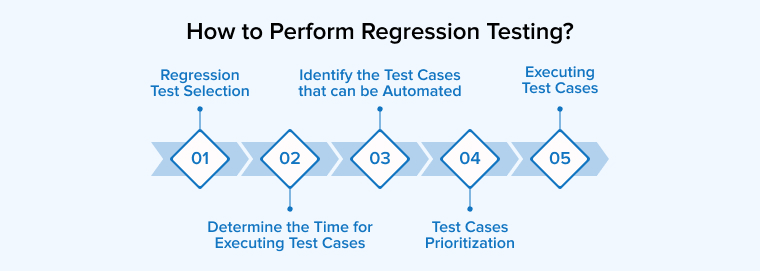
Step 1: Regression Test Selection
Thus, as the title indicates, certain test cases are shortlisted for retesting. You will not test the entire existing test suite; instead, the selection of test cases will depend on the modified source code modules.
These are then classified as Reusable Test Cases and Obsolete Test Cases. Reusable test cases are considered for potential regression testing cycles, whereas obsolete test cases are excluded from future software testing cycles.
Here are some tips for identifying all the test cases that may be reused:
- Are particularly prone to mistakes.
- Check the functioning of an application.
- Include features that users can see.
- Have recently modified the source code.
- Have been undertaken effectively in the previous phase.
- Have failed previous testing phases.
- Are associated with amalgamation.
- Are associated with limit-value.
Step 2: Determine the Time for Executing Test Cases
In this regression testing process, this stage determines the execution time of the specified test cases. Preparation of test data, design of regression tests by the QA team, and evaluation of all test scenarios are a few factors that impact the test execution duration.
Step 3: Identify the Test Cases that can be Automated
Based on the requirements of exploratory testing, quality assurance engineers can identify which test cases are suitable for automation at this stage. Automated test cases execute faster than manual testing, and reusable code can be leveraged multiple times. Therefore, test cases should be categorized into manual test cases and automated test cases.
Step 4: Test Cases Prioritization
Furthermore, you collect all test cases and rank them by importance, i.e. high, medium, and low. Depending on this judgment, you will execute the test cases with the highest priority first, followed by those with medium and low priority. The priority is determined by the product’s usefulness and user engagement.
The hierarchical structure of test case prioritization is shown below:
- Priority 0: The most important test cases cover all essential features.
- Priority 1: Features that are important but not part of the fundamental functioning.
- Priority 2: Test cases related to technical complexity.
Step 5: Executing Test Cases
Lastly, it is time to execute each test case individually to determine whether the product functions as expected. You may choose between manual testing and automated testing based on your needs. Using automated regression testing tools such as Selenium, QTP, Watir, etc., enables quicker test case execution.
You should now have an understanding of how to perform regression testing. Nevertheless, the issue remains: what are the most common regression testing methods? Therefore, let’s study this issue in the next part.
Types of Regression Testing
There are 8 main types of Regression Testing:
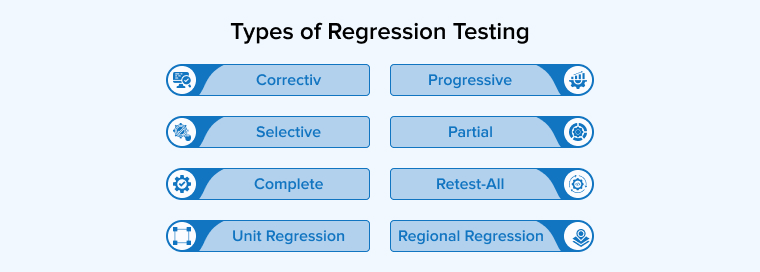
Corrective
Corrective regression testing is appropriate when the software’s source code has not changed. In this case, you verify that the existing system is functioning properly by analyzing the current features and their associated test cases rather than creating new ones.
Progressive
Progressive regression testing is the optimal method for adjusting testing objectives and developing new test cases. It is typically used when introducing a new system component, as it ensures modifications do not negatively impact the existing components.
Selective
In selective testing, the test scope is limited to a chosen subset of pre-existing test scenarios, as the term suggests. Therefore, rather than retesting the entire system, only a few selected components are retested.
Partial
To assess the impact of introducing new features to the system, partial testing is conducted. For instance, when inserting a new line of code into the source, it is important to determine whether it will affect the existing functionality. In contrast to selective testing, the new functions are evaluated alongside the existing ones. This allows you to assess their impact.
Complete
This requires testing the overall structure simultaneously. Similar to acceptability testing, complete regression testing determines whether the UI is affected by the addition of one or more components. Well before the product’s final launch, it undergoes exhaustive testing.
Retest-All
The purpose of this analysis is to re-execute every test scenario in the test set to ensure that no issues have been introduced by modifications to the software’s source code. Opposed to other kinds of assessment, this process requires a significant effort and resources from the quality assurance team.
Since you are aware of the various regression testing solutions that the quality assurance team can implement, you can plan accordingly. Moreover, in the current era of automation, numerous technologies are used for regression testing.
Unit Regression
During the Unit Testing phase, analysts perform unit regression testing, during which they test each unit of code independently from all others..
Regional Regression
Regional regression testing focuses on testing the areas affected by a change or modification. This process analyzes improvements to determine whether any stable modules have been broken.
Regression Testing Tools
Here are the top testing tools that allow you to execute regression test cases:
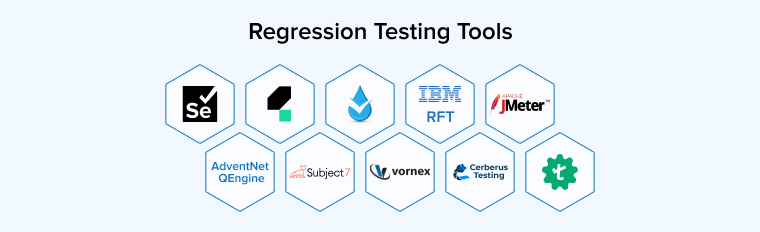
Selenium
Selenium is one of the best automation tools for regression testing. Selenium is hence among the main names that may spring to mind when discussing browser-based or cross-platform regression testing. The program offers test automation scripts for sizable QA testing with experienced professionals.
Katalan Studio
Katalan Studio offers a comprehensive automated regression test solution. It seeks to simplify and facilitate the functional tests and regression testing process for beginner engineers. Katalan Studio is a one-stop platform for testing web services, online applications, and mobile applications. In addition to these features, the product provides detailed reporting and sophisticated analytics.
Watir
Ruby-based Watir is an open-source regression testing tool. This application allows engineers to create regression test cases that are easily readable and understandable test cases. It features a versatile and compact user interface. Additionally, due to its innovative elements for website testing, Watir has become extremely popular among users.
IBM Rational Functional Tester
IBM’s Rational Functional Tester (RFT) is an automated testing tool used for automating regression test cases and supporting various types of testing, including regression, operational, statistics testing. This technology is effective for testing several types of apps, including web, .NET, Java, SAP, and emulator-based applications, among others. In addition, RFT streamlines the testing process for engineers worldwide.
Apache JMeter
Apache JMeter is an open-source tool developed by Apache for monitoring effectiveness test cases. The software is developed entirely in the Java programming language. JMeter’s key functions include providing tools for load and performance, and supporting client-side regression testing.
AdventNet QEngine
AdventNet QEngine is among the most widely adopted regression testing automation solutions for online applications. The program is comprehensive, user-friendly, and easy to understand without requiring platform-specific knowledge. AdventNet QEngine supports multiple platforms, allowing Windows scripts to be recorded and subsequently replayed on Linux.
Subject7
Subject7 is a corporate-level, online regression testing automation platform for desktops, web, and smartphone applications. The instrument provides large-scale concurrent processing and is accessible for commercial, personal, and hybrid cloud-capable applications. Whether viewed from a technological or economic perspective, the platform excels in all these areas.
TimeShiftX
TimeShiftX is among the most cutting-edge regression testing automation solutions that quality assurance teams will adore using. This tool’s unique selling proposition assists businesses in gaining a competitive edge by shortening test cycles and decreasing resource needs. In addition, it enables companies to deliver software rapidly, which makes TimeShiftX extremely useful among reviewers.
Cerberus Testing
Cerberus Testing is another complete open-source regression testing automation solution that supports online and mobile APIs and involves far less code. The cloud-based software is simply approachable via a web browser and does not require advanced programming abilities. This instrument is favored among engineers due to its customizable test components and testing dataset.
Test Sigma
Test Sigma is among the most widely accepted regression testing tools present in the market. This tool facilitates the creation of test scenarios in plain English without the need for scripts. In particular, this tool is compatible with Jenkins, JIRA, Slack, etc. for supporting CI/CD processes. Furthermore, Test Sigma allows you to develop customized functions and set regression test case requirements.
Understanding the techniques for regression testing is only academic knowledge. You must discover the best practices for utilizing regression testing methods to achieve the appropriate results.
Challenges in Regression Testing
Here are some major testing challenges for performing regression testing:
- Determining the frequency of regression testing after each modification or a series of bug fixes is a challenging task.
- With subsequent regression runs, test suites are likely to be large. Due to limited budget and time, it is not possible to execute the entire regression test suite.
- Facilitating the test suite while achieving the highest test coverage remains a challenge.
Software Regression Testing Techniques
The three most common approaches to implementing regression testing include re-testing everything, selecting only the most important regression tests, and ranking the test cases in order of importance.
Complete Regression
Here, all preexisting test suites undergo regression testing. Even though this approach is the most reliable for identifying and fixing every fault, it requires a significant time and effort to implement.
For this reason, a complete regression strategy is more appropriate in certain situations, such as when the program is adapted for a new platform or language or when a major upgrade is released for the operating system.
You do not want to miss this! Reduce the time spent creating a suite of tests by using Parallel Testing.
Regression Test Selection
To perform regression testing, you may pick and choose which sections are potentially impacted by the modifications. Time and energy spent on regression testing may be cut down significantly by focusing on only the connected parts of the system and running the necessary tests.
Test Case Prioritization
Regression testing should always be conducted, but you may prioritize which test cases to run first. The failure rate, business effect, and most frequently used features should be utilized to rank the importance of these test cases.
There should also be a strong emphasis on test cases related to features and improvements directly related to the end user.
Selecting Test Cases for Regression Testing
Based on industrial data and information, it was discovered that a significant number of defects reported by customers were due to last-minute bug fixes, which created major side effects. Due to this reason, selecting the right test case for regression testing is an important and even challenging task. So, to make it easy for you, make sure to follow the test cases as mentioned below:
- Boundary value test cases.
- All Complex Test Cases.
- Test cases that verify core features of the product.
- A sample of Failure test cases.
- Functionalities that are more visible to the users.
- All Integration Test Cases.
- A sample of Successful test cases.
- Test cases that have frequent defects.
- Test cases of Functionalities which have undergone more recent changes.
Best Practices for Regression Testing
Here are the best practices of regression testing:
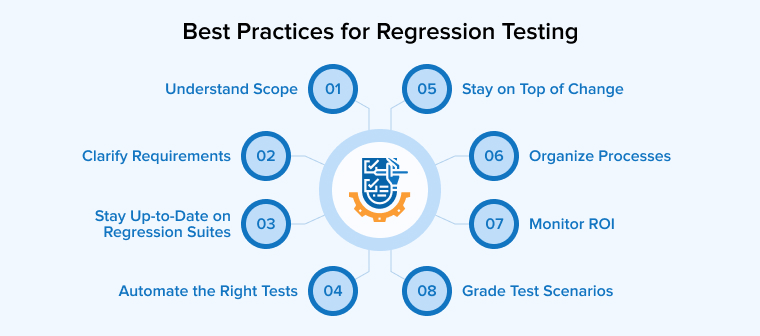
1. Understand Scope
The scope, timeframe, system coverage, and goals of testing might differ. If you’re doing segment-wise regression tests or entire regression test suite cycles, it’s crucial to comprehend the distinctions between these perspectives.
2. Clarify Requirements
To construct an effective regression testing suite, it is crucial to define what is critical to you, the business team, the users, and other partners.
You must ask yourselves the following while focusing on requirements:
- Frequency of regression testing suite executions.
- Ways to determine significant modifications.
- Timelines for achieving comprehensive regression analysis.
3. Stay Up-to-Date on Regression Suites
As with other forms of testing, you must keep your regression tests fully updated. Keeping both high-value practical and non-practical cases in consideration. Manage your regression test suite depending on its priority and value at all times. Ensure that your whole testing team understands which test cases hold the highest importance.
4. Automate the Right Tests
If a test is challenging to execute or expand, the entire cycle is at stake, and you should exclude it. If a test cannot be automated, it should be seriously considered for exclusion from the regression suite.
5. Stay on Top of Change
Particularly in web and mobile software development, transition is continuous. This necessitates a procedure to keep track of essential updates, such as feature updates or new Agile needs.
Software capacities are another aspect of online and mobile software development that is continually evolving. Organizations must be willing to include regression testing for these sophisticated features, such as:
- Biometric verification.
- Modeling network circumstances.
- Locational simulation.
- Image implantation, such as reading barcodes or QR codes.
- Infusion of audio or speech.
- SIM cards.
- Control over all system configurations.
- It is crucial for developers and testers to communicate so that modifications do not fall by the wayside.
6. Organize Processes
Various solutions, like CI/CD tools, are available to assist you in structuring and scaling your regression testing procedures. However, prior to implementing CI/CD, it is essential to plan your tests; developing too rapidly might waste critical resources.
7. Monitor ROI
ROI is crucial. Businesses should always monitor the ROI of their operations. Ensure that the statistics generated by the regression testing tools are accessible, and that you should observe the actual outcomes of test runs over a period.
8. Grade Test Scenarios
Evaluate and document the discrepancies between workflows and tests that are executed on various platforms. In addition, it is widely suggested to grade test scenarios in order to ensure optimal prioritization.
Difference between Retesting and Regression Testing
| Re-Testing | Regression Testing |
|---|---|
| Re-testing is performed for failed test cases | Regression is performed for passed test cases |
| It includes faulty verification | It doesn’t include any faulty verification |
| You cannot perform re-testing with automation | You can perform regression tests by using automation testing. |
| This type of testing ensure that the original fault has been rectified | This type of testing checks for unexpected side effects |
| Re-testing is also known as planned testing. | Regression testing is also known as generic testing. |
Conclusion
Regression testing is essential if you want to deliver high-quality, dependable products to loyal consumers. Taking these circumstances into account, this article provides a full overview of regression testing, including its classes, techniques, methodologies, and anything that you’ll want to know.
Nevertheless, if you are still interested in learning more or conducting regression testing on your products, please contact us immediately. We would be delighted to use our knowledge to help you with the testing project and improve your development experience.
FAQs
Agile’s commitment to continuously delivering a stable, high-quality software product is strengthened by the practice of regression testing. It preserves the dependability and integrity of the software by validating the new code against the existing performance.
Regression testing is performed before User Acceptance Testing (UAT), so the answer is yes. The final step in software testing, user acceptance testing (UAT) has nothing to do with the software’s underlying operation. Regression testing is carried out on product/application functions and enhancements.
Regression testing can be done both manually and automatically. However, with the presence of several automated tools, it becomes easy to conduct testing. Automated regression testing saves a lot of time compared to manual efforts.
The success of regression testing can be assessed through various means, including post-release error identification, analysis of test coverage, tracking software durability across multiple updates, and soliciting comments from users.
Yes, regression testing is classified as a type of functional testing. Regression testing is a software testing technique that aims to ensure that recent modifications to the codebase have not adversely affected or compromised the pre-existing functions of a system.

Itesh Sharma is core member of Sales Department at TatvaSoft. He has got more than 6 years of experience in handling the task related to Customer Management and Project Management. Apart from his profession he also has keen interest in sharing the insight on different methodologies of software development.



Comments
Leave a message...