

Python has become one of the world’s most popular programming languages, with rapid adoption across industries, from startups to tech giants, proving its reliability and effectiveness. Many businesses today partner with Python development companies to build scalable and efficient applications that cater to diverse needs. While Python is widely appreciated for its clarity and object-oriented nature, it does not provide all the built-in tools required for building complex and custom web applications. This is where Python frameworks come into play. They act as powerful toolkits that simplify tasks, save time, and reduce maintenance costs. Python’s rich ecosystem of frameworks is one of its greatest strengths.
In this blog, we’ll dive deeper into Python frameworks, explore their unique features, and discuss how to select a specific framework for modern web application development.
Overview of Python Framework
A Python framework is a set of prebuilt modules and tools that provide a structured way to develop applications. Instead of writing repetitive code from scratch, a framework handles common tasks such as managing HTTP requests, sessions, and database connections. This enables developers to concentrate on creating custom logic and unique features.
Python frameworks save time, reduce errors, and offer a standardized approach to application development. With a wide variety of frameworks available, ranging from lightweight to full-stack, developers can easily select one that suits their project’s needs, making development faster, simpler, and more efficient.
Types of Python Frameworks
The following are the three categories of Python frameworks catering to different types of development:
Full-Stack Frameworks
Python full-stack frameworks are all-in-one solutions for end-to-end web development. A full-stack framework provides all necessary features for both frontend and backend development, including database integration and security. It typically includes prebuilt libraries such as a template engine, an ORM (Object Relational Mapping) layer, form validation and generation utilities, and layout/template management to support all aspects of web development. It helps integrate frontend interfaces with backend services, along with database development and management, ensuring consistency throughout the application.
Django, Pyramid, Web2py, Pylons, etc., are some well-known Python full-stack frameworks.
Microframeworks
If you want to develop a basic website or application without advanced features like input sanitation, a template engine, form validation, or authentication, a microframework is for you. Microframeworks are minimalist, lightweight frameworks that provide only the bare minimum needed for application development. They are suitable for small projects or for developers who require extra flexibility to control the application’s architecture and to add features selectively.
Python has several microframeworks for developing fast applications, including Flask, Falcon, CherryPy, and Bottle. Remember that using microframeworks means extra manual work for developers.
Asynchronous Frameworks
Asynchronous programming enables performing multiple tasks concurrently without blocking other tasks. Asynchronous frameworks are the latest addition to Python frameworks, facilitating asynchronous code writing utilizing the standard Asyncio library in Python.
Sanic, AIOHTTP, Tornado, and Growler are popular asynchronous frameworks in Python.
Python Frameworks for Web Development
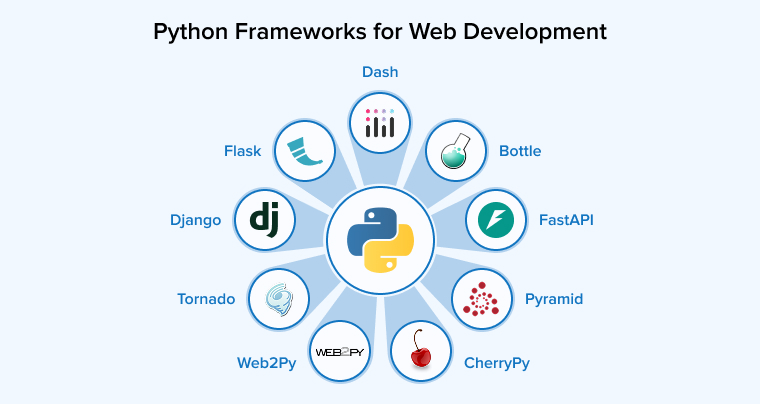
There are multiple Python frameworks available today for software development. We’re here to discuss the top nine Python frameworks that are robust, up-to-date, and widely used in the software development landscape.
Django
Django is a high-level, open-source, full-stack Python web framework. It’s a rapid development framework based on the Model-View-Template (MVT) architectural pattern, originally developed by Adrian Holovaty and Simon Willison. Django includes a powerful object relational mapper (ORM) that allows developers to map objects to database tables using the object-oriented paradigm. This ORM makes it easy to manipulate data in database tables without writing raw SQL. The DRY (Don’t Repeat Yourself) principle makes Django a unique framework, gaining huge prominence among developers.
Key Features of Django
1. SEO Optimised
It’s easy for search engines to understand page content because Python source code is written in natural, human-like English. Django’s URL routing system lets you generate descriptive, SEO-optimised URLs, and the sitemaps framework simplifies the creation and management of XML sitemaps to help search engines crawl and index pages more effectively. It even provides libraries to optimise the meta description of web pages.
2. Versatile
Django enables the development of various application types- e-commerce apps, content management systems (CMS), news websites, and more, serving multiple domains. It integrates with various technologies, third-party libraries, and components to meet unique project demands and adapt to evolving requirements.
3. High Scalability
Django is designed to be highly scalable. You can “plug and unplug” components and extend the application using plugins in a production environment owing to its component-based architecture.
4. Huge Community Support
The Django web framework benefits significantly from a large, active community that contributes to its ongoing development, improvement, and maintenance. This collaborative effort produces a robust and well-supported framework, offering numerous advantages like an array of reusable packages, well-maintained documentation, online courses and tutorials, etc., for application development.
5. Secure
Django includes built-in security features to protect against common web vulnerabilities like cross-site scripting (XSS), cross-site request forgery (CSRF), clickjacking, and SQL injection. The extensible authentication and authorisation system enables user management, secure password hashing, and control over access to specific resources using security decorators like @login_required and @permission_required.
Flask
Flask is a lightweight, free, and open-source web microframework licensed under the Berkeley Software Distribution (BSD). It follows the WSGI (Web Server Gateway Interface) standard by leveraging the Werkzeug WSGI toolkit for handling requests and responses and uses the Jinja2 templating engine to render dynamic HTML pages.
Key Features of Flask
1. Extensibility
Flask supports a rich ecosystem of third-party extensions, which can be installed using pip to integrate additional features into Flask applications. Choose and integrate only the extensions necessary for your project, such as Flask-SQLAlchemy for database integration, Flask-WTF for form validation, Flask-RESTful for REST API creation, etc., and customize as per your needs.
2. Unicode Compatibility
Flask’s Unicode foundation makes it easier to implement features for internationalization (I18n) and localization (L10n).
3. Built-in Development Server with Debugger
Flask includes a built-in development server that contains a debugger with a web-based interface to help in the development and testing of Flask applications. The debugger provides comprehensive traceback information, making it easier to identify the source of errors and fix them.
4. WSGI Compliant
Flask is WSGI-compliant; it interoperates with any WSGI-compatible web servers, such as uWSGI, Gunicorn, or Apache. Choose the server that best fits your application’s deployment needs.
Pyramid
Pyramid is a general-purpose, small, open-source, relatively new, and progressively growing Python web framework developed and maintained as part of the Pylons Project. It equally works for both small and large-scale applications.
Key Features of Pyramid
1. Routing
Pyramid uses two URL mapping mechanisms: URL dispatch and traversal. URL dispatch is a simple method that maps URL patterns to specific views or functions, whereas traversal uses a resource tree structure to map URLs to code.
2. Security
Pyramid offers pluggable built-in authentication and authorization policies, like AuthTktAuthenticationPolicy, and uses ACLs (access control lists) associated with resources to control access.
3. View Configuration
Views contain the application’s business logic, handle incoming requests, and generate responses to clients using Python objects called View callables. The Pyramid framework uses decorators or configuration files to configure views.
4. Extensibility
Pyramid prioritizes extensibility by providing mechanisms that allow you to extend and customize applications without modifying core framework code easily. This focus on extensibility enables the creation of highly adaptable and pluggable web applications.
Bottle
Bottle is a popular Python micro web framework contained within a single file, with only one dependency: the Python Standard Library. Thus, it allows you to work closely with hardware. As it’s primarily used for API development, Bottle is often referred to as a Python API framework. It’s often compared with the Flask framework, as both come in the microframework category, but Bottle is just around a web server, while Flask is quite comprehensive.
Key Features of the Bottle
1. Built-in Web Server
Bottle includes a built-in HTTP development server that helps developers develop and test applications locally. While it’s generally not used for production environments, it can be integrated with WSGI-capable HTTP servers like fapws3, Gunicorn, etc., for production use.
2. Built-in Template Engine
A built-in, fast, and Pythonic template engine that facilitates the creation of dynamic HTML by separating presentation from Python code. It supports external templates such as Cheetah, Mako, and Jinja2.
3. URL Routing
Bottle provides a simple way to connect URLs to specific Python functions and handlers, supporting both static and dynamic routes. You can use decorators like @route() to define URL routes and specify HTTP methods such as GET and POST for those routes.
4. Extensibility
Bottle supports a plugin architecture that allows installation and integration of plugins into an application to facilitate adding features and connecting with third-party services. This allows applications to adapt to different requirements. Database plugins are the most common -plugins to support interaction with databases such as MySQL, MongoDB, and SQLite.
5. Simplicity and Minimalism
Bottle is a lightweight framework distributed as a single-file module that depends only on the Python Standard Library, making it easy to install and use. Developers do not need to manage additional dependencies and can focus on writing code.
Dash
Dash is an open-source Python microframework developed by Plotly and launched in 2017. It is designed for the development of analytic web applications without in-depth knowledge of web development. Dash is built on three core technologies: Flask, React.js, and Plotly.js.
Key Features of Dash
1. Python-Based Framework
You can build an entire application using only Python, without relying on front-end technologies like JavaScript. This lets data scientists build high-quality data visualization applications easily using Python and its libraries.
2. Interactive Data Visualization
Plotly.js is a sophisticated graphing library that helps you build complex, diverse, and interactive charts like pie charts and heatmaps. You can hover over points for tooltips, zoom in, and click data points to initiate actions on these charts, enabling dynamic insights.
3. Reactive Callbacks
Reactive callbacks enable the dynamic updating of components in response to user input or to changes in the properties of other components. Thus, they eliminate manual event handling and make the application responsive.
4. Component-Based Architecture
Dash applications are built from various types of components, each with properties that define their appearance and behavior. You can create custom components using React and integrate them into your application. These components can be reused across different parts of an app or in multiple projects.
5. Easy Deployment and Scalability
Dash applications can be deployed on any server that supports Python, including cloud platforms like Heroku, AWS, Microsoft Azure, and Google Cloud. You can run Dash apps locally during development and deploy them to production with minimal changes. Because Dash apps are web-based, they support multiple users simultaneously and scale based on server resources. This makes Dash suitable for both small personal projects and large enterprise applications.
Web2Py
Web2Py is a free, open-source, cross-platform full-stack web development Python framework initially created as a teaching tool. It’s an MVC architecture-based independent framework with its own web-based IDE containing a code editor, linter, debugger, and one-click deployment tool. Web2Py provides all the necessary tools for rapid application development, reducing the need for third-party dependencies.
Key Features of Web2Py
1. Batteries Included Philosophy
Web2Py includes built-in packages that support various features like a database abstraction layer (DAL), a multi-threaded web server, a web-based admin interface, error logging and ticketing, a web-based management interface, and many more. Thus, you can build custom solutions without much reliance on third-party tools and services.
2. Inspired by Popular Frameworks
Web2Py is heavily determined by popular full-stack frameworks such as Ruby on Rails (RoR) and Django. All three frameworks follow the MVC pattern, focus on rapid application development (RAD), favor the convention over configuration principle, etc.
3. Secure
Web2Py’s built-in features address security and vulnerability issues such as cross-site request forgery, cross-site scripting, information leakage, and malicious file execution. For example, its error logging and ticketing system hides source code from users despite errors.
4. Database Compatibility
Web2py allows developers to communicate with a wide range of relational and NoSQL databases, including Oracle, SQLite, MSSQL, MongoDB, PostgreSQL, Google App Engine, Sybase, Informix, and Ingres.
5. Backward Compatibility
Web2Py is a backward-compatible framework: applications built for older versions run on newer versions without rewriting the complete codebase. This compatibility simplifies application scaling and maintenance.
Tornado
Tornado is an open-source, asynchronous, non-blocking networking library and web framework. It was created at FriendFeed and later acquired by Facebook. Tornado is widely used as a web server framework for handling large numbers of simultaneous connections—commonly cited as addressing the “10K connections” use case (managing above 10000 simultaneous connections).
Key Features of Tornado
1. WebSocket Support
Tornado allows real-time, bidirectional, and persistent communication between clients and servers by providing built-in support for WebSockets. Thus, applications like live data feeds and chat systems can operate smoothly.
2. Request Handlers
Request handlers are classes that contain specifications for how an application must respond to different types of incoming HTTP requests. Tornado implements this request-handler pattern to manage HTTP requests and responses.
3. Built-in Authentication and Authorization
Tornado provides built-in support for integrating applications with third-party authentication and authorization schemes such as JWT and OAuth. Users do not need to write custom code to add user authentication.
4. Non-blocking Network I/O
Tornado applications can manage thousands of simultaneous connections without waiting for tasks to complete. This increases the application’s performance and optimizes resource utilization.
5. Scalability
Due to its capacity to manage numerous connections concurrently within a single-thread event loop, Tornado is suitable for building scalable web applications.
FastAPI
FastAPI is a modern web framework built on top of Starlette and Pydantic for developing high-performance backend APIs that follow the OpenAPI standards. It uses standard Python-type hints as annotations to aid developers during API development.
Key Features of FastAPI
1. Automatic API Documentation
FastAPI automatically creates live-updating API documentation as you define routes and models. It uses the open-source tools Swagger UI and Redoc for this.
2. Dependency Injection
You can define reusable dependencies for database connections, shared functionality across routes, authentication systems, and more, specifying their scope to enable effective state management and resource optimization.
3. Tooling and Ecosystem
FastAPI, while primarily focused on building web APIs, does not include a built-in CLI. However, it is designed to be extensible and integrates with external libraries like Typer to create management commands and powerful command-line interfaces for tasks like running database migrations. Libraries like FastAPI Cache can be used to add caching support to API endpoints, improving performance.
4. Async/await Support
You can use Python’s modern async/await syntax to handle simultaneous requests and reduce the overall response time, since FastAPI is built on a lightweight ASGI framework, Starlette.
5. Data Validation
Pydantic is a Python data validation library used by FastAPI that allows you to define data models with Python classes and type hints. This model automatically validates incoming requests and serializes responses to decrease the possibility of errors.
CherryPy
CherryPy is a traditional, minimalistic, open-source, object-oriented Python web framework for rapid application development (RAD). It is distributed under the BSD license and runs on all Python-supported operating systems.
Key Features of CherryPy
1. Minimalistic and Lightweight
CherryPy is known for its “Pythonic” design philosophy that focuses on providing only the essentials of web development, prioritising simplicity. It eliminates unnecessary overhead, allowing developers fine-grained control over their application’s architecture, and reduces boilerplate code.
2. Built-in Web Server
CherryPy does not require Apache or Nginx to run applications. It has a built-in production-ready, HTTP/1.1-compliant, multithreaded WSGI web server for deployment.
3. Object-oriented Approach
In CherryPy, you can organize your web application using classes and methods. Each method can handle a specific URL, keeping the code structured, reusable, and easier to manage for larger applications.
4. Flexible Configuration System
CherryPy lets you configure settings using files, inline code, or command-line options. This flexibility helps you adjust application behavior for various environments without modifying the main program logic, keeping development and deployment simpler.
5. Extensible and Pluggable
CherryPy provides plugins and tools that allow features such as caching, session handling, and authentication. These can be enabled or disabled as needed, giving developers the flexibility to extend functionality without modifying core code.
Factors to Consider When Choosing a Python Framework
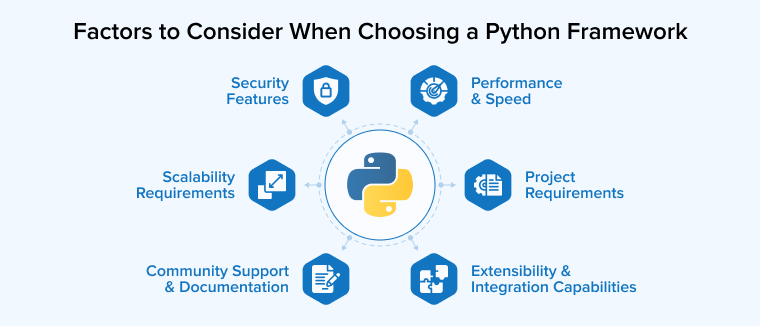
It can be overwhelming to select a particular framework out of so many available. To help you out, we’re discussing some common factors you must consider during selection:
- Project Requirements: The project type determines the framework choice. Django works well for complex, data-driven applications, while Flask or FastAPI are better suited for lightweight APIs or microservices.
- Scalability Requirements: Scalability is crucial when choosing a framework. Ensure it supports horizontal or vertical scaling so your application can handle heavy traffic smoothly across multiple servers without performance issues.
- Community Support and Documentation: Community support and documentation play a vital role in framework selection. Established frameworks such as Django, PyTorch, and TensorFlow offer strong communities, tutorials, and guides. Clear documentation with examples and resources helps developers resolve issues faster and ensures smoother project development, saving time and effort.
- Security Features: Security features are critical when choosing a Python framework. A good framework should protect against common threats like SQL injection, XSS, and CSRF. Built-in security tools reduce risk and save development time.
- Performance and Speed: Performance and speed matter when selecting a Python framework because they shape how fast users get responses. Some frameworks handle many requests at the same time using asynchronous processing. Others work synchronously and may slow down under heavy load. Also consider framework overhead, built-in optimisations, caching support, and how well it fits your application design and deployment setup.
- Extensibility and Integration Capabilities: Extensibility and integration are important when choosing a Python framework. The framework should work well with existing tools, databases, and third-party services. Built-in plugins and strong library support reduce extra coding work. Easy integration saves time, supports future growth, and allows the application to adapt as new features or systems are added.
Final Thoughts
Choosing the right Python framework is essential for building successful applications. Because every project has unique requirements, the framework you select should align with your goals, scalability needs, and customisation preferences. With Python offering a wide variety of frameworks, you can find one that fits perfectly, ensuring efficiency, maintainability, and long-term success for your application.
FAQs
The default framework for Python testing is unittest, which comes built into the Python standard library.
Python consists of several frameworks of different types for different purposes. There is no one framework used for Python.

Niket Shah oversees technology projects at TatvaSoft, blending hands-on expertise with a passion for crafting innovative solutions. He thrives on turning complex challenges into impactful results.



Comments
Leave a message...