

Selecting the ideal programming language for backend development can shape the success of a project. Two popular choices frequently discussed are Ruby and Python. Both are high-level, object-oriented languages known for their simplicity, flexibility, and strong communities. However, each offers distinct strengths, making it important to understand the differences between these two languages before making a decision.
Ruby is widely appreciated for its elegant syntax, while Python stands out as a versatile language used not only in web development but also in fields like data science, machine learning, and artificial intelligence. When starting a new project or scaling existing systems, working with a reliable Python development company can help you leverage the language’s full potential and build robust, future-ready solutions. Similarly, experienced Ruby developers can help you deliver fast, functional web applications.
This blog will break down the key differences between Ruby and Python, exploring their strengths, limitations, and best-fit scenarios.
Overview of Ruby
Ruby is a high-level, open-source, purely object-oriented, general-purpose, and dynamic programming language, also categorized as a scripting language. It was developed by Yukihiro “Matz” Matsumoto in the C programming language, taking inspiration from Perl and Smalltalk languages. Ruby also inherits the Perl philosophy, which emphasizes having multiple ways to accomplish the same task, promoting expressiveness and flexibility in coding style.
Advantages of Ruby
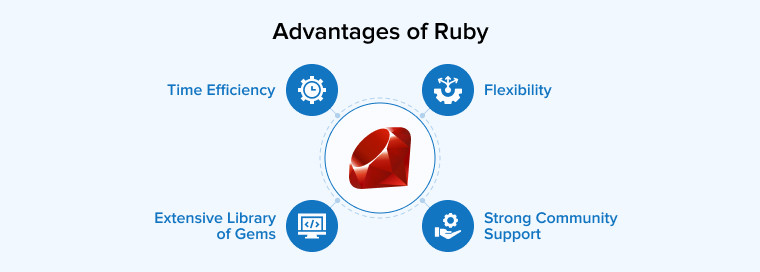
Let’s take a look at the five top benefits of the Ruby programming language:
Time Efficiency
Ruby’s concise syntax and expressive standard library allow developers to write less code to accomplish tasks that would require more code in other languages. In this way, the development and debugging time is decreased, increasing the efficiency of development teams. The built-in features, like blocks, extensive packages, and the “convention over configuration” principle, especially in its Rails framework, speed up the development, making it a well-known time-efficient language.
Extensive Library of Gems
Libraries in Ruby are known as “gems” that can be installed using the Rubygems package manager. There are around 170,000 libraries, forming extensive libraries that support a wide range of development needs by providing pre-built solutions, preventing developers from having to implement common functionality from scratch, and thereby simplifying the development process. These “gems” are thoroughly tested and peer-reviewed, increasing the security and reliability of the code.
Flexibility
Ruby is a dynamic and strongly typed language that lets developers write flexible, adaptable code while maintaining robustness and predictability even when types change at runtime. Developers can modify or remove existing features and even add new features according to their needs. However, altering Ruby’s core behavior requires caution: such changes can make code harder to read and debug, especially in larger teams.
Strong Community Support
The Ruby community has over 1 million registered users, contributing to a wide collection of gems, comprehensive documentation, tutorials, and online support through rubygems.org and conferences like RubyConf. This active ecosystem keeps the language compatible with new technologies and security standards, ensuring its efficiency and versatility.
Disadvantages of Ruby
Some of the limitations of Ruby are as follows:
Performance
Ruby is an interpreted language; therefore, its execution speed is generally slower than that of compiled languages like C++ and Java. Its complete object-oriented nature consumes high memory, increasing costs and potentially degrading performance as the application scales.
Complex Syntax
Ruby allows many ways to write the same code, which can produce inconsistent styles and confusing structure. Its flexible syntax and extensive metaprogramming can obscure program flow, making debugging harder, slowing developer tools, and increasing the likelihood of unexpected runtime errors. This complexity can also make function calls harder to trace and debug, especially when functions invoke themselves or other functions in recursive or algorithmic patterns.
Concurrency
MRI (Matz’s Ruby Interpreter) uses a Global Interpreter Lock (GIL), which blocks multiple Ruby threads from running in parallel. This limits true concurrency, making Ruby less efficient for CPU-heavy, multi-threaded tasks. Developers must adopt alternative implementations or use complex workarounds, increasing development effort and architectural complexity.
Overview of Python
Python is a popular server-side, general-purpose programming language that dominates arenas such as data science, artificial intelligence, web development, and scientific computing. It was introduced by Guido van Rossum in 1991 as a successor to the ABC language. Its readability and simplicity make it a go-to programming language for both freshers and experienced programmers. The diversity of libraries and the community support they offer prevent developers from getting stuck at any point during the development process.
Advantages of Python
Let’s discuss some of the key benefits that make Python the most desired programming language:
Simplicity & Readability
Python is known for its clear, English-like syntax, making it easy to learn and read. This simplicity speeds coding, reduces errors, and helps developers maintain and update code efficiently, improving productivity for both beginners and experienced programmers.
Vast Libraries Support
Python offers a vast standard library and over 200,000 third-party packages, providing ready-made tools for countless tasks. These packages are available through the Python Package Index (PyPI), which serves as a central resource for Python developers to access and share libraries. This extensive ecosystem lets developers build applications faster, reduce coding effort, and avoid reinventing solutions, while its package manager simplifies adding and managing external libraries when needed.
Python Community
Python has a large, active community that offers constant support through forums, tutorials, and events. This collaborative network helps solve problems quickly, promotes language improvements, fosters the development of new libraries, and ensures Python’s growth, making it easier for developers to learn, innovate, and advance their careers.
Rapid Development
Python supports rapid development through its object-oriented design, which promotes reusable code, and its interactive REPL for quick testing. Its dynamic scripting nature lets developers combine components efficiently, speeding development cycles, reducing repetitive coding, and helping businesses deliver applications and features to market faster.
Disadvantages of Python
It’s important to consider the following limitations of the Python language to make an informed decision about its selection, ensuring you choose the right language based on your project’s specific needs and limitations:
Memory Consumption
Python requires relatively large memory per object even for simple data types because it stores much information with every value, owing to its dynamic and interpreted nature. Excessive memory consumption can slow down program execution. If a Python program consumes too much memory, it can exhaust available system resources, potentially leading to “out of memory” errors, program crashes, or even system instability.
Dynamically Typed
Python does not require explicit type declarations, as type checking is performed during runtime. Therefore, errors will surface only during execution, making debugging and maintenance difficult. The dynamic type checking and resolution increase the performance overhead and make scaling difficult.
No Multithreading
The threading module in Python allows multithreading to run concurrent tasks. However, you cannot achieve true multithreading in Python due to the Global Interpreter Lock (GIL), which permits only one thread to execute Python bytecode at a time, even on multicore processors.
An In-Depth Comparison – Ruby vs Python
It’s time to delve into the contrast between Ruby and Python by comparing them on the following eleven parameters:
1. Ruby vs Python: Syntax
- Ruby: Ruby’s syntax is elegant and expressive. Like Perl, Ruby provides multiple ways to implement the same idea, giving developers flexibility. This makes the syntax more human-friendly, readable like natural language, and intuitive and concise. Use of blocks enables more functionality with fewer lines of code. Features like metaprogramming reduce boilerplate code as program code modifies and regenerates other code during execution.
# Ruby Syntax

puts "Hello, World!"               # Print
name = "TatvaSoft"                    # Variable
if name == "TatvaSoft"
  puts "Hi, TatvaSoft"
end
- Python: Python’s syntax focuses on readability and clarity. It does not use curly braces or semicolons like Java or C++; instead, it uses indentation and whitespace to structure code. This makes code cleaner and more consistent, increasing readability and predictability, especially for newcomers. It also reduces the likelihood of errors and facilitates easier maintenance.
# Python examples

print("Hello, World!")            # Print
name = "TatvaSoft"                   # Variable
if name == "TatvaSoft":
    print("Hi, TatvaSoft")
2. Ruby vs Python: Performance
- Ruby: Ruby is slower than languages like Java and Python. Its interpreted nature introduces performance bottlenecks. Ruby’s garbage collector can pause program execution, which may reduce application responsiveness. The use of the RoR framework can mitigate some performance issues.
- Python: Though Python is an interpreted language, it is generally faster than Ruby. The use of optimized libraries like NumPy, Pandas, or SciPy increases the performance of Python applications. Python’s performance is especially notable in domains such as data science, machine learning, and web development, where its extensive ecosystem and efficient libraries provide significant advantages.
3. Ruby vs Python: Web Framework
- Ruby: Ruby on Rails (RoR) is the most prominent framework for the Ruby language. Its convention-over-configuration approach reduces development time by allowing developers to focus on application logic rather than on project configuration. However, RoR’s opinionated nature may limit the flexibility of developers.
- Python: Python has a wide range of frameworks, from full-stack to asynchronous. Django and Flask are two of the most widely used Python frameworks for web development. Django is a high-level, versatile framework promoting rapid growth with its extensive built-in features. Flask, on the other hand, is a popular microframework that offers a minimalist approach for developing small to medium-sized applications.
4. Ruby vs Python: Flexibility
- Ruby: Ruby, inspired by Perl, adopts its philosophy of using multiple approaches to accomplish a specific task. This flexibility creates a range of methods and strategies used by different coders, resulting in ambiguity and unnecessary complexity.
- Python: Python, unlike Ruby, focuses on a single way to perform a task, favoring simplicity over complexity and flexibility. While this can be seen as less flexible in terms of coding style, it promotes consistency and clarity.
5. Ruby vs Python: Testing
- Ruby: Ruby’s standard library includes the Test::Unit framework with diverse tools for defining and running tests. The Ruby ecosystem also includes third-party frameworks such as RSpec, a behavior-driven development (BDD) framework for writing descriptive, readable tests; Capybara, for integration and acceptance testing; MiniTest, for assertion-based and spec-style tests; and FactoryBot, a library for generating test fixtures.
- Python: Python includes a built-in unit testing module, unittest, which provides foundational testing capabilities without requiring external libraries. pytest minimizes boilerplate and offers a rich plugin ecosystem for enhanced testing features. Nose2 further extends Python’s testing capabilities by offering automatic test discovery and a flexible plugin system.
6. Ruby vs Python: Reusable Code
- Ruby: Ruby offers a vast collection of reusable code packages known as Gems. With nearly 150,000 available, gems make it easy to add functionality to projects. However, finding the right gem can be time-consuming because the platform lacks advanced filtering options, often requiring developers to manually compare and evaluate different libraries before choosing the best fit.
- Python: Python provides reusable code via modules, accessible through the Python Package Index (PyPI), which hosts over 150,000 packages. PyPI simplifies the search process by offering filtering options like development status, making it easier to find well-maintained and reliable libraries. This organized structure helps developers quickly locate suitable modules without spending extra time manually comparing different options.
7. Ruby vs Python: Community
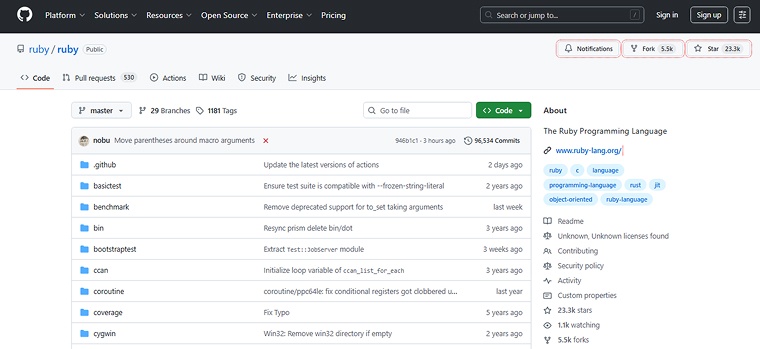
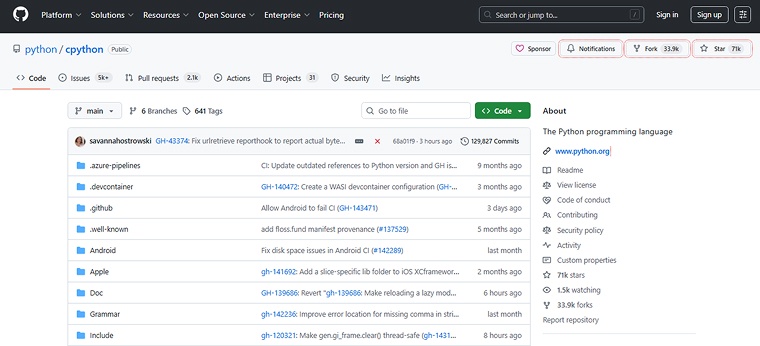
- Ruby: Ruby has a growing community of active developers, particularly around the ROR framework. Ruby developers benefit from resources like RubyGems for libraries, the Rails Guides for framework documentation, and active community forums and events centered on Ruby and Rails.

- Python: Python has been popular for over a decade; its community is larger and more diverse due to widespread adoption across various domains. This larger community translates to a vast ecosystem of libraries, frameworks, tools, tutorials, forums, and online resources, making it easier for developers to find solutions and support for a broader range of applications.
8. Ruby vs Python: Ease of Use
- Ruby: Ruby is admired for its elegant and human-friendly syntax, which allows developers to write code that feels natural and intuitive. It encourages multiple ways to solve a problem, offering flexibility and creative freedom. This approach speeds development but can sometimes make debugging tricky, because unconventional solutions may introduce hidden errors that are harder to track.
- Python: Python emphasizes simplicity and readability, making it beginner-friendly and easy to learn. Its clean structure and adherence to the PEP 8 style guide help maintain consistency across projects. Python may seem less stylish than Ruby, but its simplicity makes it easier to understand and maintain, especially in large or unfamiliar projects. Code readability is a major advantage of Python, making it popular for both web development and learning purposes.
9. Ruby vs Python: Machine Learning
- Ruby: Ruby has limited support for machine learning and artificial intelligence compared to Python. Although Ruby offers some libraries and shows potential, its ecosystem is still growing. Developers often find fewer tools, frameworks, and community resources, so Ruby is less commonly used for building advanced AI and machine learning projects.
- Python: Python dominates machine learning and AI development due to its vast libraries, such as TensorFlow, Keras, and Scikit-Learn. It’s simple syntax and its rich ecosystem. These features make creating, testing, and deploying AI models easier. Strong community support and years of adoption make Python the preferred language for most machine learning applications.
10. Ruby vs Python: Code Differences
- Ruby: Ruby offers highly flexible, expressive syntax and multiple ways to achieve the same result. It supports optional parentheses, keyword-free method calls, and operator overloading. While this flexibility encourages creativity, it can lead to inconsistent styles and be harder to read unless teams follow strict conventions and guidelines.
- Python: Python emphasizes simplicity and readability, using clear and consistent syntax similar to natural language. It enforces indentation to structure code, reducing visual clutter and confusion. This consistency helps developers understand, review, and maintain code more easily, making Python especially beginner-friendly and suitable for large projects with many contributors.
11. Ruby vs Python: Multithreading
- Ruby: Ruby supports multithreading using Thread.new, allowing concurrent tasks within a program. Errors raised in threads usually don’t stop the whole application by default, so unhandled exceptions in threads should be monitored or handled explicitly. Tools like Mutex help manage shared resources safely. Developers can also use thread pools and gems like parallel or concurrent-ruby to simplify and speed up multithreaded application development.
- Python: Python enables multithreading through its threading module, but the Global Interpreter Lock (GIL) limits true parallel execution of threads. While the GIL helps ensure memory safety by preventing concurrent execution of Python bytecode, it can slow CPU-bound tasks. Despite this limitation, Python threads are effective for I/O-bound operations such as file handling and network communication and remain useful for those workloads.
Ruby vs Python: When to Choose What?
Choosing between Ruby and Python depends on your project goals, requirements, and preferences.
When to Choose Ruby?
- When you need to build full-stack web applications or RESTful APIs quickly, the RoR framework and its rich libraries enable rapid development, making it ideal for startups, MVPs, and small to medium-scale business projects.
- When you want clean, elegant, and easily maintainable code, Rails’s emphasis on developer happiness, concise syntax, and strong metaprogramming abilities makes it perfect for teams that value flexibility and productivity.
- Rapid prototyping and fast iteration are essential: its supportive community, extensive RubyGems ecosystem, and simple syntax help developers validate concepts quickly and embed ready-made solutions to speed up the development process.
When to Choose Python?
- When your project involves data science, machine learning, or artificial intelligence. Python’s powerful libraries like TensorFlow, NumPy, and Pandas make it ideal for handling complex data analysis and for building intelligent models efficiently.
- When you need to develop scalable and high-performing web applications or APIs, frameworks like Django and Flask enable rapid development, cross-platform compatibility, and seamless integration with microservice architectures.
- When automation, scripting, or rapid prototyping tasks are involved. Python’s vast standard library and supportive community make it perfect for creating tools and educational or research-based applications.
Ruby vs Python: Comparison Table
Let’s go through a summarised comparison between Ruby and Python:
| Parameters | Ruby | Python |
|---|---|---|
| Created By | Yukihiro “Matz” Matsumoto in 1995 | Guido van Rossum in 1991 |
| Fundamental philosophy | Developer happiness | Readability and Simplicity |
| Change in built-in features | High flexibility in modifying built-in classes | No direct modification allowed |
| Scalability | Scales well with monolithic architectures, but can be challenging to maintain as the codebase grows | Supports both monolithic and microservices architectures, making it scalable and easy to maintain. |
| IDE Support | Average (RubyMine, Visual Studio Code, Sublime Text) | Excellent (IDLE, PyCharm, Jupyter Notebook/Jupyter Lab, VS Code, Spyder) |
| Objects and primitive Data Types Support | Everything is an object. No difference between objects and primitive types | Includes both objects and primitive data types, as Python is not a “pure” object-oriented language |
| Platform use cases | Mainly web applications, then system administration, data processing, prototyping, and testing tools | Web apps, desktop apps, scientific computing, AI/ML solutions, data analysis, game development, etc. |
| Adoption by popular companies | Twitter, Shopify, Zendesk, Airbnb, Apple, | Google, Facebook, Yahoo, YouTube, Instagram |
| Types of Inheritance | Only single inheritance | Single, multiple, multilevel, hierarchical, hybrid |
| Anonymous functions | Blocks, Procs, and Lambdas | Primarily supports lambda functions |
| if-else syntax | if-elsif-else | if-elif-else |
Final Thoughts
The Ruby vs. Python debate has no absolute winner; both languages offer powerful features and strong ecosystems. Ruby excels in web development, especially with Ruby on Rails, enabling rapid prototyping and expressive, elegant code. Python stands out for its simplicity, readability, and vast libraries, making it ideal for data science, machine learning, automation, and cross-domain applications. Your choice should depend on project needs, team expertise, and development goals, ensuring efficient and successful software development.
FAQs
There’s no specific answer to this question. Both languages have their distinct advantages, the choice of which depends on your project requirements.
Python is heavily used by tech giants like Google, Netflix, Spotify, Amazon, Facebook, JPMorgan, and many more.

Niket Shah oversees technology projects at TatvaSoft, blending hands-on expertise with a passion for crafting innovative solutions. He thrives on turning complex challenges into impactful results.



Comments
Leave a message...