

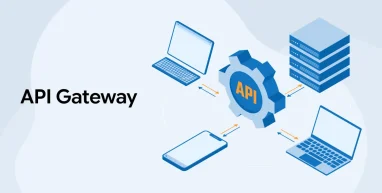
Modern applications depend on various services working together behind the scenes to share data. APIs, or application programming interfaces, allow quick and safe data sharing by defining how software systems communicate with each other. As apps scale, the number of APIs increases, and direct communication becomes harder to manage, increasing the need for an API Gateway. An API Gateway acts as a single front door for all incoming requests, allowing clients to send requests to a single gateway instead of calling many services directly. The API gateway decides where each request should go.
Clients do not need to understand how backend services are built. They interact only with the API gateway, which makes apps easier to maintain and update as services can change or scale without breaking client connections. For any growing product, especially one developed by a web development company, an API Gateway technology helps keep systems organized, secure, and scalable. It turns complexity into clarity and enables smoother communication across platforms.
In this blog, we’ll discuss API Gateway, its working, pros, cons, and implementation challenges to take care of.
How Does API Gateway Technology Work?
We know that an API Gateway serves as a central bridge between clients and backend services. Clients send every request to the gateway. This separation keeps the system clean and easy to manage.
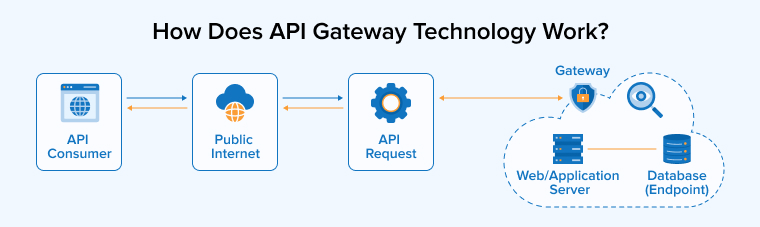
- The process starts when a client makes an API call, which is first received by the API Gateway.
- It checks if the API request is valid by verifying using API keys, tokens, or certificates. It also checks permissions to ensure the client can access the requested data. If the request breaks any rule, it is blocked immediately.
- After validation, the gateway determines the destination for the incoming request. This process is called request routing.
- The API gateway uses details like the URL, headers, or HTTP method to find the correct backend service. In some cases, it sends the request to multiple services at once. This reduces the number of API calls the client must make.
- The gateway can also change how data is sent. It can convert protocols or adjust request formats to align with backend requirements. This allows different systems to work together smoothly. If multiple clients request the same data, the gateway may return a cached response, improving speed and reducing server load.
- When backend services respond, the gateway collects all responses. It may combine them into one result and then send a single response back to the client with a clear status code.
- Behind the scenes, the API gateway technology operates in two layers. The control layer manages rules, security settings, and traffic limits. The data layer handles live requests and responses. The API gateway forms also record logs and metrics. This helps teams monitor performance and detect issues early.
Overall, an API Gateway simplifies communication, improves security, and boosts performance in modern distributed systems.
What Are the Benefits of Using an API Gateway?
Some of the advantages of API Gateway are as follows:
- Increased Security: An API Gateway adds a strong security layer between users and services. It provides access control, limits traffic, and blocks harmful requests. This helps protect sensitive data and prevents attacks from overwhelming backend systems.
- Flexible: An API Gateway creates a flexible connection between clients and services. It hides internal systems, supports different formats, and routes requests smoothly. This allows backend changes easier without affecting users.
- Improved Scalability: An API Gateway spreads traffic across services to avoid overload. It scales automatically with demand, keeps APIs stable, and allows teams to focus on building features instead of managing infrastructure.
- API Analytics: An API Gateway gives clear visibility into how APIs perform and how users interact with them. It tracks traffic, highlights issues, improves security, and helps teams make better decisions to enhance reliability and efficiency.
- Decreased Complexity: An API Gateway connects services built with different protocols and formats. It converts data, manages access, and limits traffic. This removes extra work from services and keeps complex systems simpler and easier to maintain.
What Are the Features of API Gateway?
The following are the five significant features of API Gateway:
- Caching: API Gateway caching stores frequently requested responses for quick reuse. This lowers backend load and speeds up applications. Smart cache rules ensure fresh data when needed, while still delivering fast and reliable performance.
- Rate Limiting: An API Gateway controls which clients can send requests, providing effective traffic management. It slows or blocks excessive traffic, protects backend systems, and ensures every user gets fair and stable access to API resources.
- Protocol Translation: An API Gateway translates requests between different communication protocols. This allows clients and services using different technologies to work together smoothly without changing their internal systems.
- Circuit Breaking: An API Gateway uses circuit breakers to stop traffic to failing services. This prevents system overload and allows healthy parts to keep working during partial outages.
- API Versioning: An API Gateway handles multiple versions at once. It routes requests correctly, lets clients use older or newer versions, and supports smooth updates without breaking existing integrations.
Best Practices for Implementing API Gateway
API Gateway benefits in different ways if implemented using the best practices given below:
1. Implement User Authentication and Authorization
An API Gateway secures backend access by verifying users and appropriate services before allowing requests. It uses tokens, certificates, and defined roles to implement access control. Different methods protect user access and service communication. This approach reduces security risks, supports compliance, and ensures sensitive data is accessed only by trusted and approved entities.
2. Maintaining Documentation
Maintaining clear documentation is essential when implementing an API Gateway. Documents should explain endpoints, versions, security rules, and API usage limits. They must stay updated as APIs change. Simple examples and clear error messages help teams integrate faster, reduce confusion, and ensure consistent use across applications and services.
3. Implementing Version Control
Implementing version control in an API Gateway helps manage changes without breaking existing clients. Each API version should be clearly labelled, and the gateway should route requests to the correct version. Old versions remain available while new updates are released. This ensures stability, backward compatibility, and smooth transitions. Proper versioning reduces errors, improves developer experience, and allows APIs to evolve safely over time.
4. Performance Optimization
A key best practice for API Gateway performance is optimizing response speed and reducing delays. Use caching, request compression, and smart routing to serve data quickly. Implement load balancing to spread traffic across multiple backend services. Integrate CDNs for global delivery, enforce rate limits to prevent abuse, and use service discovery for fast request routing. Monitor metrics and keep the gateway updated to ensure consistent and efficient performance.
5. Limit Request
Limiting requests in an API Gateway protects against abuse and system overload. Use rate limits, throttling, and quotas to control traffic per user, IP, or application. Set burst and rate thresholds to manage spikes. This ensures critical applications remain responsive, prevent crashes, and maintain stable performance, keeping APIs reliable and secure for all users.
6. Implement Monitoring and Analytics
Implementing monitoring and analytics in an API Gateway helps track performance and detect issues early. Collect metrics like API calls, latency, cache hits, and errors. Use tools like Prometheus or ELK for real-time logging, alerts, and analysis. Integrate these insights with security monitoring to ensure APIs run smoothly, identify anomalies, and resolve problems before they affect users.
Challenges of Using an API Gateway
API Gateways may create issues when not designed or managed carefully:
High Latency
An API Gateway may add a slight delay because it operates between clients and services. However, this impact stays low when caching, smart routing, rate control, and load balancing are used. These API traffic management techniques reduce traffic pressure, protect systems, and keep responses fast and reliable for users.
Single Point of Failure
An API Gateway can affect the whole system if it fails. Since all API traffic passes through it, outages or attacks can spread quickly. This risk is reduced by using multiple gateway instances, placing them in different zones, and distributing traffic across entry points. Proper scaling and redundancy help maintain availability and system stability.
Dependency Management
Maintaining an API Gateway can be challenging as services often change. Updates require planning and coordination across teams. Switching gateway vendors later can be costly. Self-hosted gateways offer control but demand more time, effort, and resources from development teams.
Performance Bottlenecks
API Gateways can slow systems when request traffic increases. Since all incoming API calls pass through one layer, a poor setup can cause delays or outages. Proper scaling, load balancing, and tuning are needed to handle heavy traffic and keep performance stable.
Vendor Lock-in
Vendor lock-in happens when an API Gateway ties your system to a single provider. Moving later, it becomes harder due to pricing models, unique features, and platform limits that do not transfer easily.
Final Thoughts
An API Gateway plays a key role in modern application design. It brings structure and control to systems that rely on many APIs and services. By acting as a single access point, it simplifies how clients connect with backend services. This reduces complexity and improves consistency across applications. Looking ahead, API Gateways will continue to evolve, and cloud-native and serverless gateways will become more common. For any organization building scalable and secure applications, an API Gateway is no longer optional. It is a foundational part of a reliable and future-ready microservices architecture.
FAQs
An API Gateway is a central layer that receives client requests and directs them securely to the appropriate backend services.
An API Gateway improves security, manages traffic, and boosts performance. It simplifies system design, supports scaling, and helps teams maintain reliable api managements as applications grow.

Itesh Sharma is core member of Sales Department at TatvaSoft. He has got more than 6 years of experience in handling the task related to Customer Management and Project Management. Apart from his profession he also has keen interest in sharing the insight on different methodologies of software development.



Comments
Leave a message...