

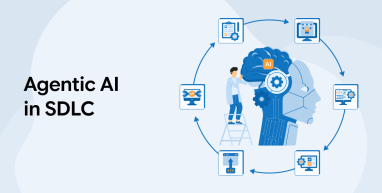
Agentic AI is reshaping how modern teams plan, build, and maintain software by bringing a new level of intelligence and autonomy to the development lifecycle. For any software development company striving to keep pace with rising product demands and tighter delivery timelines, Agentic AI introduces a powerful shift in how work gets done. It can analyze problems in real time, recommend improvements, test code, identify issues, and even adapt its approach as requirements evolve.
As traditional development methods struggle to handle growing complexity, Agentic AI emerges as a game-changer. This technology is not just another trend; it represents the next stage of AI evolution, where tools become intelligent agents capable of leading parts of the software development lifecycle.
In this blog, we explore how Agentic AI is transforming software development and why its real-time capabilities are redefining the future of software engineering teams.
What is Agentic AI?
Agentic AI is an advanced form of artificial intelligence designed to operate with a high degree of independence. It is based on Generative AI (Gen AI) that requires minimal human intervention to perform tasks in complex environments. It often utilizes Large Language Models (LLMs) that make autonomous decisions and act proactively, learning from experience and adapting to dynamic conditions, unlike traditional AI models that depend on human oversight at every step.
Rather than relying on strict rules or constant human direction, these AI systems observe their environment, analyze information, and decide how to act to achieve specific goals. What distinguishes Agentic AI is its ability to integrate reasoning, learning, and action into a continuous cycle. It can generate ideas, choose tasks, solve problems, and adjust its plans as situations evolve. Over time, it becomes more effective by learning from feedback and improving its decision-making processes.
What Are the Benefits of Agentic AI?
Agentic AI is enhancing business productivity on a scale that traditional AI systems cannot match. Let’s explore how Agentic AI solutions are transforming business processes:
Informed and Real-Time Decision-Making
Agentic AI enables real-time decision-making by continuously analyzing large streams of data and detecting critical signals as they emerge. It integrates information from multiple systems, highlights what truly matters, and predicts potential outcomes. This capability helps businesses respond quickly, make smarter actions, and maintain a competitive edge in rapidly changing environments.
Flexible and Precise
Agentic AI combines the adaptability of Large Language Models (LLMs) with the accuracy of traditional programming, creating a system that is both flexible and precise. It can understand natural language, respond to changing conditions, and generate responses suited to complex situations, while still relying on strict rules for tasks requiring reliability and control.
Different types of agents, such as deployment agents, monitoring agents, and others, handle specialized roles, ranging from simple automated actions to memory-driven reasoning and continuous learning. When many such agents work in coordination, the AI system can manage a wide range of tasks smoothly, efficiently, and with consistent accuracy.
Deep Personalization at Scale
Agentic AI delivers deep personalization by understanding each customer’s history, preferences, and intentions in real time. By making decisions in a human-like manner, it creates interactions that feel natural and relevant to every individual. This allows businesses to offer personalized support, recommendations, and services at scale. As a result, customers receive smoother, more meaningful experiences that enhance satisfaction and foster long-term loyalty.
Intelligent Code Generation
Agentic AI enables intelligent code generation by converting natural language instructions into functional, reliable code. It can design workflows, write modules, and run tests without constant developer involvement. By handling repetitive or time-consuming tasks, it reduces errors and accelerates development cycles. This allows engineers to focus on higher-level problem-solving while the AI produces clean, consistent, and ready-to-use code.
Automated Software Testing
Agentic AI streamlines software testing by automatically creating and executing tests at various levels, from small units to full system checks. It can interpret requirements, map user flows, and generate detailed test scenarios with ease. These agents execute tests independently, detect issues quickly, and navigate interfaces like real users. This reduces manual effort, improves accuracy, and speeds up the entire testing process.
How Agentic AI Works?
Before understanding how Agentic AI works, let us first explore the fundamental concepts that form its core:
- Planning: This involves breaking down a large objective into smaller, achievable actions. The agent identifies each step needed to reach the final goal, ensuring the task is organized and manageable.
- Reasoning: This enables the agent to understand the situation, select the appropriate approach, and decide on the next action. It uses intelligence to interpret information and select the most effective course.
- Tool Use: Tools allow the agent to interact with external systems such as CRMs, databases, or coding platforms. Through APIs or interfaces, it performs tasks that require system access or specialized functions.
- Memory: Memory allows the agent to retain previous steps, results, and important details. This supports continuity in long tasks and facilitates learning from past experiences to improve future decisions.
- Reflection: Reflection enables the agent to review the outcomes of its actions, compare them with intended goals, and make adjustments as necessary. This process is key to improvement and self-correction.
How AI agents solve problems in a four-step cycle:
- Perceive: In the perception stage, the AI agent gathers information from various sources, such as user input, APIs, databases, or sensor feeds. It filters this data to identify what is relevant to the task. This step helps the agent recognize the current situation and define the objectives before taking any action.
- Reason: Reasoning allows the agentic system to analyze the gathered information and determine the best plan to follow. Leveraging LLM capabilities, it interprets context, predicts possible outcomes, and chooses the tools or systems required for each step. This stage ensures the agent can develop a logical, adaptive strategy even when faced with new or ambiguous information.
- Act: During the action phase, the agent executes the steps defined in its plan. It may update databases, run code, trigger workflows, or interact with external software through APIs. Every action is monitored and logged for safety and compliance. Some systems incorporate human approval to review high-impact tasks before execution.
- Learn: Learning occurs after the agent completes an action and evaluates the result. It verifies whether the outcome aligns with the goal and adjusts its strategy as needed. Using feedback, reinforcement learning, or past experiences, the agent continuously improves its performance and becomes more effective in handling repeated or complex tasks.
Use Cases of Agentic AI in Software Development
Take a look at how agentic AI benefits the software development process:
Automated Code Generation
Agentic AI helps developers work faster by converting plain-language instructions into usable code and automatically improving existing codebases. It reduces repetitive tasks, identifies inefficiencies, and suggests cleaner structures, allowing developers to focus on design and problem-solving while maintaining human oversight for critical decisions.
CI/CD Pipeline Optimization
Agentic AI can enhance CI/CD pipelines by monitoring every stage in real time, detecting failures early, and automatically adjusting builds or deployments. It helps keep releases stable and fast while still enabling software teams to apply human checks for critical approvals and corrective actions.
Code Review
Agentic AI strengthens code reviews by scanning submissions for risks, security gaps, and quality issues while providing developers with clear suggestions. It reduces manual effort and maintains consistent standards, provided teams fine-tune alerts and preserve human judgment for complex or high-impact decisions.
Security and Compliance
Agentic AI improves security by continuously monitoring code for vulnerabilities and alerting teams about policy or compliance gaps. It helps prevent attacks early through real-time checks and ensures that software adheres to required industry standards.
Benefits of AI Agents in Software Development
The key advantages of autonomous AI agents in the software development life cycle include:
- Scalability: As demand increases, AI agents seamlessly scale their efforts, handling rising workloads without disruption or performance degradation.
- Adaptability: Agentic AI adjusts to changing requirements by intelligently automating tasks and enhancing workflows through quick decision-making, reduced errors, and faster responses to changing project demands.
- Speed and Efficiency: Agentic AI accelerates time-consuming tasks, eliminates workflow bottlenecks, and maintains system stability by automating deployment and monitoring, resulting in faster delivery and reduced operational effort.
- Quick debugging: AI agents expedite debugging by detecting hidden errors early, preventing issues from affecting software and saving valuable time.
Where to Begin with Agentic AI in Software Development?
It requires a proper strategy to use Agentic AI in Software development. The strategy includes the following steps given below:
- Define Use Cases: Each AI agent must influence a clear metric and be assigned to a defined workflow, ensuring its actions directly improve measurable development outcomes.
- Set Agent Orchestration and Automation Boundaries: In this step, multiple AI agents collaborate, each handling specific tasks like analyzing code, creating tests, or monitoring pipelines, while ensuring humans receive relevant insights without disrupting the overall workflow.
- Embed Human in the Loop Checkpoints for High-risk Decisions: Decisions are classified by risk level, allowing AI to handle routine or medium-risk tasks while developers oversee high-risk areas like security or compliance. This approach ensures safety and accountability, and allows developers to focus more on creative, value-driven work.
- Establish Observability and Feedback Loops: To maximize benefits, track and measure AI performance across workflows. Monitoring metrics such as time saved, reduction in production defects, and improved infrastructure efficiency helps quantify ROI, refine agent actions, and clearly demonstrate value to stakeholders, enabling informed decisions and continuous improvement.
- Scale Across Teams with Role Evolution: After pilot agents prove effective, expand their use across teams and projects while redefining roles. Developers oversee AI outputs, QA engineers handle critical edge cases, and product managers leverage AI for backlog predictions, ensuring broader adoption and more strategic, efficient workflows.
Real-World Examples of Agentic AI
Agentic AI is being used by different departments as per their task suitability. Let us discuss some of them:
Agentic AI in IT & Software Development
Agentic AI in IT and software development can perform tasks independently. In IT service management, it can handle complex tickets, verify access, update permissions, and notify users. In software development, it can plan features, write and test code, fix errors, and prepare changes for human review, acting like an autonomous junior engineer.
Corporate Automation with AI Agents
In corporate software development, AI agents now manage tasks beyond coding, including documentation, test creation, automated testing, performance monitoring, and deployments. This full-cycle automation eliminates delays, supports smoother workflows, and boosts collaboration. Enterprises benefit through faster releases, reduced repetitive work, and improved team efficiency and morale.
Agentic AI in Sales and Marketing
Agentic AI can run campaigns and manage supply chains autonomously. It identifies target audiences, creates personalized content, deploys campaigns, and optimizes performance in real time. Similarly, it monitors inventory, predicts demand, places orders, and negotiates prices automatically, improving efficiency, reducing manual work, and maximizing results across marketing and operational activities.
Agentic AI in Customer Service
Agentic AI can handle customer support tickets completely on its own. It reads and categorizes issues, plans the necessary steps, retrieves customer and product information, and takes action. For example, it can verify warranties, provide troubleshooting instructions, generate return labels, update records, and notify relevant teams, resolving the issue efficiently without human involvement.
What to Consider While Adopting AI Agents?
AI agents can bring significant change to the way business processes operate. To make the most of it, do give a thought to the following aspects:
Increase Productivity
Integrating agentic AI into a DevSecOps platform allows developers to focus on building valuable features while reducing unnecessary AI complexity. The platform’s dashboards and reports track performance, helping teams measure results and ensure their workflows remain efficient and effective.
Prioritize Security and Compliance
With AI generating production-ready code, a strong DevSecOps platform is vital to ensure security and compliance. In regulated industries, solutions must follow strict data privacy rules and support offline or air-gapped operation. This safeguards sensitive information while enabling safe, scalable software development.
Data Quality
Accurate and reliable data is crucial for making smart decisions. Low-quality data can cause errors, misunderstandings, and poor outcomes, reducing the effectiveness of analysis and reasoning.
Skills Gap
When adopting AI agents, organizations must consider the skill gap among software professionals. Development teams need training to effectively design, implement, and manage these systems, ensuring successful integration and maximizing AI benefits.
AI Agents vs AI Assistants: Key Differences
You may get confused between AI agents and AI assistants, as they resemble each other in some aspects. However, there are significant differences between them, which you’ll get to understand from the given comparison table:
| Parameters | AI Agents | AI Assistants |
|---|---|---|
| Purpose | Independently manages tasks to achieve defined objectives. | Helps users complete specific tasks when prompted. |
| Interaction style | Acts proactively based on an understanding of goals and environment. | Reacts to direct instructions from the user. |
| Autonomy | Operates independently, making decisions and taking actions. | Requires constant user guidance; limited decision-making. |
| Task Complexity | Manages complex, multi-step workflows that may change over time. | Handles simple, repetitive, or clearly defined tasks. |
| Collaboration | Functions like an autonomous team member coordinating processes. | Acts as a helper or support tool |
| Error Handling | Detects issues and attempts corrections autonomously | Requests clarification or reports errors to the user |
| Learning | Continuously adapts and improves through feedback and experience. | Learns minor preferences but mostly follows fixed patterns. |
| Memory | Maintains context across tasks and learns from history. | Limited; often forgets past interactions. |
| Real-World Examples | Autonomous customer service bots, logistics managers, and trading AI | Siri, Google Assistant, Alexa |
Final Thoughts
Agentic AI is reshaping the software development lifecycle, marking the beginning of a new era where developers work alongside autonomous digital partners. As these systems grow more capable, they will handle larger portions of coding, testing, and deployment work, allowing teams to focus on strategy, creativity, and long-term innovation. The real promise of agentic AI lies in making software development more accessible, efficient, and resilient. Yet success with these tools requires thoughtful adoption. Organizations must establish strong oversight, clear accountability, and continuous training to manage emerging risks around security, transparency, and skill gaps.
Ultimately, agentic AI is not just an enhancement to the SDLC; it is becoming a core force that will shape how software is built and delivered in the years ahead.
FAQs
Agentic AI reshapes the SDLC by using autonomous agents that plan, act, and adjust with minimal human input. These agents handle tasks such as coding, testing, debugging, and deployment, boosting speed, accuracy, and overall development efficiency in a more adaptive workflow.
Agentic AI is built to plan, decide, and complete tasks independently, while Generative AI mainly creates content from learned patterns. Agentic AI often relies on generative models but goes further by taking action and completing multi-step workflows with minimal human guidance.
Yes, Tesla’s autonomous Full Self-Driving (FSD) technology is one of the leading examples of agentic AI.

Itesh Sharma is core member of Sales Department at TatvaSoft. He has got more than 6 years of experience in handling the task related to Customer Management and Project Management. Apart from his profession he also has keen interest in sharing the insight on different methodologies of software development.



Comments
Leave a message...