


Artificial intelligence is no longer a futuristic concept reserved for movies or research labs. It has become a practical technology that businesses, governments, and individuals rely on every day. From recommendation systems and virtual assistants to medical diagnostics and fraud detection, AI is transforming the development of modern digital solutions. Behind all these intelligent systems lies a critical foundation: programming languages.
Choosing the right language can make development faster, more efficient, and easier to maintain. Programming languages selected by an AI software development service provider play a crucial role in transforming ideas into functional models and scalable products.
In this blog, we will explore the most popular programming languages used in artificial intelligence, explain why they matter, and guide you in selecting an appropriate one.
Understanding Programming Languages for AI
AI programming languages are designed to help developers build systems that can think, learn, and make decisions using data. These languages support tasks like pattern detection, prediction, and automation. They come with powerful libraries and tools that simplify complex operations such as data processing, mathematical calculations, and model training. This makes AI development faster and more reliable.
Each programming language serves different purposes based on project needs. Some are better for machine learning, while others excel in data analysis or performance-heavy tasks. By using the right language, developers can create intelligent applications that adapt, improve, and solve real-world problems efficiently.
Best Programming Languages for AI
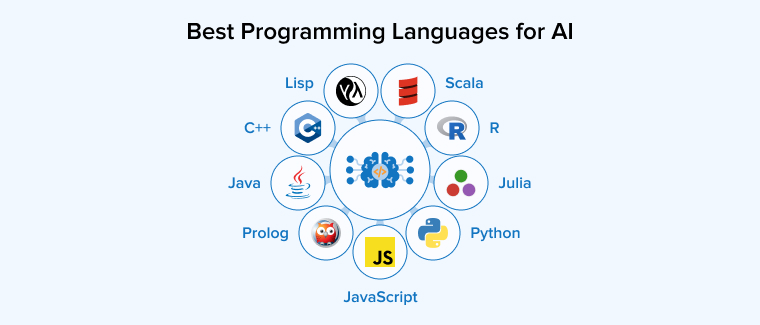
Let us begin with understanding the top nine programming languages used for AI, with their features and methods of usage:
Python
Python stands as the most preferred language for AI because it balances ease of use with strong technical capabilities. Its simple syntax helps beginners learn faster while allowing experts to build complex models. Python supports AI development through powerful libraries like TensorFlow, PyTorch, and Scikit-learn, which simplify machine learning and deep learning tasks.
Tools such as Pandas, NLTK, and SpaCy support data handling and natural language processing. A large global community continuously improves resources, making Python reliable, flexible, and efficient for modern AI projects.
Key Features of Python
- Rich AI Libraries: Python provides many ready-made tools for machine learning, deep learning, and natural language processing. Developers use these libraries to build AI models faster without creating algorithms or utilities from scratch.
- Fast Prototyping: Python allows quick testing of ideas. Developers can experiment, modify code, and validate AI models rapidly, which speeds up development cycles.
- Cross-Platform Support: Python runs smoothly on Windows, macOS, and Linux. This flexibility allows teams to develop and deploy AI applications across different environments without major changes.
- Strong Community Support: Python has a large global community that actively shares tutorials, solutions, and improvements. This support makes learning easier and troubleshooting faster for AI developers.
- High Integration Flexibility: Python connects easily with other languages, cloud platforms, and big data tools. This makes it suitable for building scalable and performance-driven AI systems.
How is Python Used in AI?
- Python helps developers build, train, and test machine learning models easily, supporting the full workflow from data preparation to model evaluation and deployment in real-world AI systems.
- Python is widely used to create NLP solutions such as chatbots, text classification, sentiment analysis, and document processing through powerful libraries designed specifically for language-based AI tasks.
- Python plays a key role in developing generative AI applications, enabling easy integration with large language models for tasks like content generation, conversational agents, and intelligent assistants.
- Python allows fast AI experimentation and research, helping teams quickly prototype ideas, test algorithms, and refine models before moving them into production systems.
R
R plays a strong role in AI projects that depend on statistics, data exploration, and visualization. Data scientists use R to analyze large datasets, build predictive models, and uncover meaningful patterns. Its rich package ecosystem supports statistical modeling, machine learning, and the creation of high-quality charts.
R works well in research, education, finance, and scientific fields where accuracy matters more than speed. Tools like ggplot2 and caret help evaluate models clearly. Although teams rarely use R for large production systems, it excels in experimentation, hypothesis testing, and early-stage AI development driven by data insights.
Key Features of R
- Vector and Matrix Operations: R handles vectors and matrices efficiently. This allows developers to process large datasets and perform mathematical operations essential for many machine learning algorithms.
- Powerful Data Visualization: R offers advanced visualization tools that create clear and detailed graphs. These visuals help teams understand patterns, trends, and model behavior more effectively.
- Extensive Package Ecosystem: R provides a wide range of packages for machine learning and domain-specific analysis. Developers can easily apply existing tools instead of building algorithms from scratch.
- Beginner-Friendly Learning Curve: R uses simple syntax and strong documentation. This helps new learners and researchers start working with data and AI models quickly.
How R is Used in AI?
- R supports AI workflows by transforming model outputs into clear reports and dashboards, helping teams explain AI findings through visual summaries and performance metrics for informed decision-making.
- Researchers rely on R to experiment with AI and machine learning methods, validate models, and publish results, especially in environments that demand transparent methods and reproducible outcomes.
- Developers use R to build predictive AI models using regression, classification, and clustering techniques, making it useful for forecasting, pattern detection, and data-driven decision-making tasks.
- R is well-suited for AI projects that focus on data analysis rather than speed, enabling teams to process large datasets, uncover insights, and support AI-driven strategies in finance, healthcare, and research.
Julia
Julia is built for fast and accurate numerical computing. It allows developers to write clear, readable code while achieving high execution speed. This makes Julia particularly useful for machine learning tasks involving intensive mathematical calculations and large datasets. Unlike some languages that require rewriting code for better performance, Julia supports both development and deployment within a single environment. It is commonly used in areas such as scientific research, robotics, and data modelling.
Although its ecosystem is still growing, Julia offers powerful tools for AI development. Overall, it is a strong option for professionals who want simplicity without sacrificing performance.
Key Features of Julia
- Exceptional Speed: Julia delivers performance close to that of C++ through efficient native code execution. Its high speed makes it ideal for AI tasks that involve large datasets or computationally intensive operations, such as deep learning.
- Readable and Concise Syntax: Julia uses clear, expressive syntax similar to Python. This allows developers to write maintainable code quickly, reducing complexity while keeping programs easy to understand.
- Built for Scientific Computing: Julia is designed specifically for numerical and scientific computing. It supports advanced mathematical operations, making it suitable for AI algorithms that rely on matrix computations and numerical analysis.
- Just-In-Time (JIT) Compilation: Julia compiles code into machine code at runtime. This JIT approach improves performance, allowing AI programs to run faster without sacrificing high-level readability.
- Parallel and Distributed Computing: Julia natively supports parallel execution and distributed computing. This allows AI workloads to scale across multiple processors or machines, improving performance for large-scale applications.
How is Julia Used in AI?
- Julia supports scientific machine learning by combining AI models with physics-based simulations, helping researchers to solve complex scientific problems with speed and numerical accuracy.
- Engineers use Julia for AI tasks that demand extreme speed, such as climate simulations, fluid dynamics modeling, and other compute-heavy scientific and engineering applications.
- Pharmaceutical researchers use Julia to accelerate AI-powered simulations for drug discovery, molecular modeling, and biological data analysis, reducing experimentation time.
- Data scientists prototype AI models in Julia for complex mathematical workflows, then transfer validated results into production systems, benefiting from Julia’s strong numerical and analytical capabilities.
Java
Java is stable, scalable, and runs smoothly across different platforms. Its ability to execute the same program on multiple systems makes it useful for large organizations with complex infrastructures. Java is often chosen for AI solutions in fields like finance, telecommunications, and government, where security and reliability are paramount.
The language supports many AI and machine learning tools that help developers build systems for data analysis, prediction, and automation. Since many existing business applications are already written in Java, adding AI features is easier. Overall, Java is a practical option for enterprise-level AI projects that demand long-term maintenance and dependable performance.
Key Features of Java
- Platform Independence: Java runs on any system with a Java Virtual Machine (JVM), allowing AI applications to work seamlessly across different operating systems without requiring code modifications.
- Robust Ecosystem: Java offers a wide range of libraries and frameworks, like Deeplearning4j and MLlib, which simplify AI development and support machine learning, data analysis, and neural networks.
- Scalability: Java efficiently handles large datasets and complex computations, making it ideal for building AI systems that need to scale and process high volumes of data.
- Multi-Threading Support: Java supports parallel processing, enabling AI tasks like model training and large-scale data handling to run concurrently, improving performance and reducing execution time.
- Memory Management: Automatic Java garbage collection manages memory allocation and deallocation efficiently, ensuring AI applications handle large datasets reliably without memory issues.
How is Java Used in AI?
- Java is used to build large-scale AI systems for businesses, enabling the deployment of machine learning models within existing enterprise codebases without major rewrites or disruptions.
- Developers use Java to create AI workflows that handle massive datasets efficiently, leveraging frameworks like Hadoop and Spark for real-time data processing and analytics.
- Java libraries such as Deeplearning4j allow developers to design, train, and integrate machine learning models directly into Java applications for various business solutions.
- Java supports building secure, scalable server-side AI systems, including fraud detection platforms, recommendation engines, and conversational AI, ensuring reliability under heavy data loads.
- Java helps implement distributed AI applications that can process large datasets across multiple nodes, making it suitable for predictive analytics and real-time decision-making in enterprise environments.
C++
C++ plays an important role in artificial intelligence because it emphasizes speed, efficiency, and close control of system resources. It allows developers to manage memory directly, which helps AI programs run faster and use hardware more effectively. This makes C++ suitable for applications that must respond instantly, such as robotics, autonomous systems, and real-time simulations.
Many powerful AI tools and libraries are built using C++ because it can handle complex calculations with high performance. The language also works well across different platforms, making it flexible for large projects. Overall, C++ is a reliable choice when performance, precision, and hardware interaction are critical for AI development.
Key Features of C++
- High Performance: C++ executes AI programs very quickly due to its close-to-hardware nature, making it ideal for computation-heavy tasks like deep learning and real-time data processing.
- Object-Oriented Programming: C++ supports object-oriented design, allowing developers to organize code into reusable classes and structures, which simplifies building and maintaining large AI applications.
- Templates and Generic Code: C++ supports templates, letting developers write generic code that works with multiple data types, increasing flexibility and reusability in AI projects.
- Multithreading Support: C++ enables multiple threads to run simultaneously, allowing AI programs to perform parallel processing for faster computations and improved performance.
- Extensive Libraries and Frameworks: C++ offers a wide range of libraries like TensorFlow, OpenCV, and Caffe, which simplify AI development and support tasks like machine learning, computer vision, and deep learning.
How is C++ Used in AI?
- C++ is used to build AI systems that need rapid calculations and low latency, such as autonomous vehicles or algorithmic trading, where split-second decisions and fast data processing are critical.
- Developers use C++ to control robots, drones, and other AI-driven hardware, taking advantage of its ability to manage memory, hardware resources, and real-time parallel processing efficiently.
- C++ powers the high-performance backends of AI frameworks like TensorFlow and PyTorch, providing optimized computation for deep learning models and handling matrix operations on CPUs and GPUs.
- C++ enables parallel execution and fine-tuned control over memory and system resources, making it ideal for computationally intensive AI tasks, including neural network training and large-scale data processing.
JavaScript
JavaScript plays an important role in AI when applications run on the web. Developers use it to add intelligent features directly into websites and web apps. It works both in the browser and on the server through Node.js, which supports full-stack development. Libraries like TensorFlow.js and Brain.js allow basic machine learning within web environments.
JavaScript helps build chatbots, virtual assistants, and real-time interfaces. Its large community and fast development cycles make it useful for interactive AI experiences. However, teams avoid it for heavy data training or large-scale AI workloads.
Key Features of JavaScript
- Vast Developer Community & Ecosystem: JavaScript is one of the most widely used programming languages, resulting in a large talent pool of developers already familiar with it. This fosters a growing ecosystem of AI-specific libraries and resources.
- Seamless Web Integration & Data Visualization: AI applications built with JavaScript integrate naturally with web technologies. Libraries like D3.js and Chart.js make it easy to create interactive and dynamic data visualizations, which are crucial for interpreting AI outputs.
- Hardware Acceleration: Modern JavaScript environments can leverage hardware acceleration (e.g., WebGL in browsers) to perform computational tasks required by AI and machine learning, thereby improving performance.
- Asynchronous Operations: JavaScript’s asynchronous and event-driven nature (using promises, callbacks, etc.) is well-suited for handling real-time data processing and I/O operations efficiently, which is common in AI applications.
- Accessibility and Easy Deployment: AI features can be easily deployed and made accessible across virtually any device with a web browser, without complex setups or installations.
How is JavaScript Used in AI?
- JavaScript runs AI models directly inside web browsers, enabling instant responses for features like image analysis, speech recognition, and gesture-based interactions without server dependency.
- By shifting computation to the client, JavaScript reduces server load, cuts infrastructure costs, and removes delays caused by frequent network requests.
- JavaScript keeps data processing on user devices, protecting sensitive information and minimizing the need to send personal data to external servers.
- Developers use JavaScript to build responsive AI features such as virtual backgrounds, face filters, and live webcam controls that react immediately to user input.
- JavaScript frameworks help create AI-powered interfaces for web and mobile apps using a shared codebase, ensuring consistent intelligent experiences across platforms.
Lisp
Lisp, one of the oldest programming languages, continues to serve niche applications in symbolic reasoning and rule-based systems. Its flexibility, along with support for recursion and dynamic typing, allows developers to prototype logic-driven AI architectures quickly.
In modern contexts, Lisp is used in academic research, theorem provers, and expert systems that require symbolic AI rather than statistical learning. While it lacks mainstream adoption, Lisp remains relevant in domains such as cognitive modeling and knowledge engineering.
Key Features of Lisp
- Symbolic Processing: Lisp excels at handling symbolic data, enabling developers to model reasoning, rules, and language-based intelligence more effectively.
- Dynamic Typing: Lisp lets developers to use variables without defining their data types in advance, which speeds up prototyping and supports quick changes during AI development.
- Recursion Support: Lisp makes it easy for developers to write recursive logic, which helps implement AI tasks such as searching for solutions, matching patterns, and solving complex problems.
- Automatic Memory Management: Lisp automatically manages memory cleanup, reducing the risk of errors and ensuring the stability and reliability of large AI applications.
- Extensibility: Lisp enables developers to design custom syntax through macros, allowing them to build specialized languages and tailored tools for AI solutions.
How is Lisp Used in AI?
- Lisp helps AI systems reason using symbols and rules instead of only numbers, which suits logic-based decision-making.
- Developers use Lisp to build expert systems that solve domain-specific problems through structured knowledge.
- Lisp supports research projects in which AI models need to adapt, modify their behavior, or evolve over time.
- Engineers apply Lisp in areas like language understanding, automated reasoning, and game strategy development.
Prolog
Prolog is a logic-based programming language widely used in artificial intelligence for handling rules, facts, and relationships. Developers use it to build systems that reason logically rather than follow fixed procedural steps. Prolog fits well in expert systems, language understanding tools, and intelligent databases.
Programmers define knowledge as rules, and the Prolog engine derives answers automatically through queries. This approach reduces the need for manual control flow and keeps programs concise. Its strong pattern matching and built-in backtracking mechanisms help solve complex problems efficiently. Tools like SWI-Prolog and ProbLog extend their use to modern AI research, including reasoning with uncertainty and symbolic logic.
Key Features of Prolog
- Built-in Backtracking: Prolog automatically explores alternative solution paths when one approach fails, helping programs reach valid answers without manual correction.
- Declarative Logic Style: Developers describe facts and rules, and Prolog determines the execution flow, which simplifies complex AI logic design.
- Pattern Matching and Unification: Prolog intelligently matches and connects data structures, making it easier to search, filter, and relate information.
- Knowledge Base Handling: Prolog stores facts and rules in a queryable knowledge base, enabling dynamic reasoning and decision-making.
- Expert System Support: The language is well-suited for expert systems by modeling human-like reasoning through structured rules and logical relationships.
- Natural Language Capabilities: Prolog supports language-related tasks by analyzing patterns in text and generating structured responses.
How is Prolog Used in AI?
- Prolog helps create AI systems that mimic human decision-making. Developers encode knowledge as rules, and the program applies logical reasoning to solve problems.
- Prolog uses its inference engine to explore solutions and draw conclusions automatically. By following rules and relationships, it can simulate human reasoning and solve problems without programmers specifying every step.
- Prolog’s rule-based logic makes AI decisions transparent. Users can trace how conclusions are reached, which helps in creating AI systems that provide clear explanations for their outputs.
- Prolog stores facts and rules in a structured knowledge base. Programs query this database dynamically, enabling reasoning, decision-making, and complex problem-solving across various AI applications.
- Prolog can analyze and generate language by understanding grammar and sentence structures. It supports building virtual assistants, chatbots, and other systems that require AI to process and interpret human language effectively.
Scala
Scala runs on the JVM and seamlessly blends functional and object-oriented programming. Developers use it to build fast, scalable AI systems that process large data sets. Its strong compatibility with Java allows easy use of existing libraries. Scala also works well with tools like Apache Spark, making it effective for machine learning, data streaming, and distributed AI applications.
Key Features of Scala
- High Performance and Concurrency: Scala supports parallel execution and asynchronous tasks, improving performance in demanding environments.
- Java Interoperability: Scala runs on the JVM and works smoothly with Java codebases. Developers can reuse existing Java libraries while benefiting from Scala’s concise syntax, which simplifies building enterprise-level AI systems.
- Native Support for Apache Spark: Scala powers Apache Spark, helping teams to build scalable machine learning pipelines and AI systems that process data across clusters without losing speed or reliability.
- Functional and Object-Oriented Design: Scala blends functional and object-oriented styles, allowing developers to write clean, structured, and maintainable code. This balance helps manage complex AI algorithms while keeping the logic readable and easier to debug over time.
- Big Data Processing: Scala handles large datasets efficiently and works well with distributed systems. Developers use it to process, analyze, and transform massive data without losing performance or stability.
How is Scala Used in AI?
- Scala supports AI solutions that process massive datasets across distributed environments. Teams use it to build systems that scale smoothly while maintaining high performance in enterprise-grade AI applications.
- Developers use Scala to power real-time analytics platforms. Its concurrency and streaming capabilities help AI systems analyze live data for tasks like fraud detection and risk monitoring.
- Scala helps teams create end-to-end machine learning pipelines. It supports data ingestion, feature engineering, and model deployment in production environments where stability and speed matter.
- Scala enables the reliable deployment of AI models at scale. Its strong typing, JVM support, and performance optimization help teams run AI applications safely in long-term production systems.
How to Choose the Best Programming Language for AI Development?
Choosing the right AI programming language starts with understanding available technologies and then matching their strengths and limits with your project goals, technical needs, and long-term scalability requirements.
Understand Your Project Requirements
Start by defining your AI project goals and use cases. Decide whether you require quick experimentation, high performance, or large-scale deployment. Your choice of programming language should be guided by the problem type, such as data analysis or robotics.
Libraries and Frameworks
Evaluate the AI libraries each language provides before choosing one. Strong frameworks simplify tasks like machine learning and natural language processing, helping developers build reliable and adaptable AI systems faster.
Community Support
Choose a programming language with an active and supportive community. Strong communities offer helpful guides, clear documentation, and quick solutions to problems, making AI development smoother and reducing time spent troubleshooting.
Integration with Existing Systems
Confirm that your chosen programming language works smoothly with current platforms, tools, and infrastructure. Compatibility with existing systems reduces integration issues and ensures your AI solution fits easily into enterprise environments.
Performance Requirements
Decide whether your AI system needs instant responses or heavy data processing. For high-speed, parallel execution, and memory efficiency, choose languages like Scala or C++, which are well-suited to handling large workloads.
Final Thoughts
Choosing the right programming language plays a major role in the success of any AI project. Each language supports different AI needs, from quick experimentation to high-performance systems. Python works well for beginners, while languages like C++, Java, Scala, and Julia suit specialized or large-scale applications. No single language fits every use case, and many AI solutions combine multiple tools. As AI adoption grows across industries, developers must stay flexible and continue learning. Understanding language strengths helps teams build efficient, scalable, and future-ready AI solutions. Making informed choices ensures better performance, smoother development, and long-term value in an evolving AI landscape.
FAQs
Python leads AI development because it is easy to learn and rich in tools, while Julia handles heavy computations, and C++ supports fast, low-level AI systems.
Python suits most AI projects because developers write and test ideas quickly with rich libraries. C++ offers higher speed and control, so teams choose it for performance-critical systems.
Yes, you can combine several languages in one AI project. Developers often build models in Python and use C++ or Java to improve speed, performance, and system integration.
Python works best for beginners in AI. It uses simple syntax and offers many ready-made libraries. New learners can test ideas quickly and understand concepts without struggling with complex code.

Niket Shah oversees technology projects at TatvaSoft, blending hands-on expertise with a passion for crafting innovative solutions. He thrives on turning complex challenges into impactful results.



Comments
Leave a message...