


Artificial Intelligence (AI) and Machine Learning (ML) are often used interchangeably, yet they represent different scopes in the technology world. AI is the broad, foundational concept of creating systems that simulate human intelligence and cognitive functions such as reasoning and problem-solving. Machine learning is a subset of AI that enables systems to learn patterns from data and improve their performance over time without being explicitly programmed. These systems solve problems, make decisions, and mimic human thinking. This difference matters more than it seems.
Businesses now rely on these technologies to stay competitive. Healthcare uses them to detect diseases early, finance uses them to manage risk, and retail uses them to personalize experiences. Behind many of these solutions is an experienced AI software development company that knows when to use AI, ML, or both.
This blog explores how AI and ML connect as well as why they are not interchangeable. You will learn their roles, strengths, and differentiating factors. You will be able to understand the technology that drives the future.
What is Artificial Intelligence (AI)?
AI describes systems that create intelligent machines capable of performing tasks like normal human beings. These tasks include problem-solving, pattern recognition, understanding natural language, and decision-making. The goal of AI is not merely to program machines to perform tasks but to enable them to do so with an adaptability and autonomy resembling human cognition.
In a business context, AI can optimise workflows, enhance customer experiences, provide valuable insights, and drive revenue growth by automating various tasks.
What are the Benefits of AI?
High adoption rates of AI are a result of the following advantages it offers:
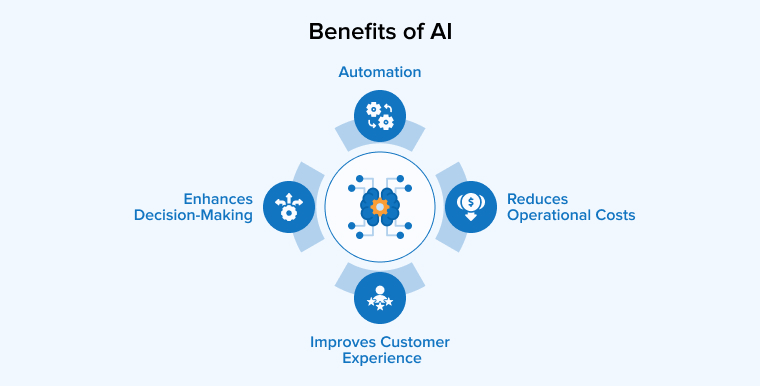
Enhances Decision-Making
Artificial Intelligence improves decision-making by rapidly analyzing large volumes of data. It finds patterns that humans often miss. AI also supports doctors, recruiters, and risk teams with accurate insights. It reduces bias and errors. By working in real time, AI helps organizations act faster, plan better, and stay competitive in changing environments.
Automation
AI-driven automation goes beyond basic machines and repetitive scripts. It helps organizations handle complex tasks faster and with greater accuracy. AI reviews documents, processes claims, and detects errors in real time. Professionals still guide the outcomes with their expertise. By removing routine work, AI allows people to focus on strategy, creativity, and customer needs. This shift improves productivity, service quality, and long-term business efficiency.
Improves Customer Experience
AI helps businesses deliver faster and more personalized customer experiences. Smart chatbots answer questions at any time while keeping conversations natural. AI studies customer behavior to suggest relevant products and services. This makes interactions feel more helpful and engaging. Support teams face less pressure and work more efficiently. As a result, customers stay satisfied, businesses respond quicker, and long-term loyalty grows through consistent and personalized communication.
Reduces Operational Costs
AI helps businesses control costs while improving efficiency. It automates repetitive tasks that once required large teams, reducing labor expenses and speeding up daily operations. Employees spend less time on routine work and more time on high-value tasks. AI also improves planning and quality control, which lowers waste and errors. Together, these benefits allow organizations to achieve more while using fewer resources.
What is Machine Learning (ML)?
Machine learning is a subset of artificial intelligence that allows systems to learn from data. Instead of following fixed rules, ML models analyze examples and improve through experience. Data plays a central role in this process, as the system detects patterns, trends, and relationships hidden within large datasets. Over time, it becomes more accurate when handling new information.
Different learning approaches support different goals. Some models learn from labeled data, while others explore data without guidance. Certain methods learn through feedback and rewards. Advanced techniques use layered networks to understand complex patterns. ML supports many real-world solutions. It powers image recognition, speech systems, fraud detection, and product recommendations. It also helps businesses forecast outcomes and automate decisions. By learning continuously, machine learning enables technology to adapt, scale, and perform tasks that once required human judgment, all with minimal manual instruction.
Benefits of Machine Learning
Some of the pros of machine learning are as follows:
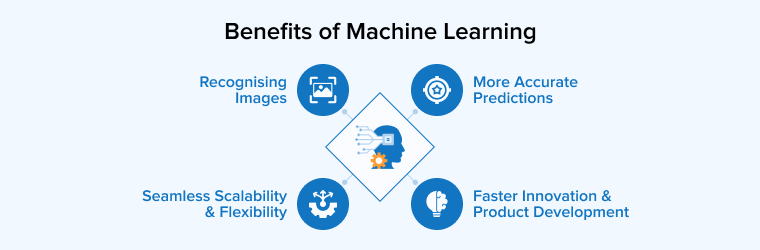
More Accurate Predictions
Machine learning helps organizations predict future outcomes with greater confidence by analyzing past and current data to detect meaningful patterns. Businesses use these insights to plan inventory, manage supply chains, and reduce risks. As new data becomes available, ML models improve, enabling companies to act early, avoid disruptions, and respond quickly to changing market conditions.
Seamless Scalability and Flexibility
Machine learning helps growing businesses scale without losing efficiency. It adapts easily to larger data volumes and more complex workloads. Cloud-based ML systems support many functions, from automated support to deep data analysis. Teams gain faster insights and improved accuracy across operations. ML also reduces manual work and controls costs. This flexibility allows organizations to stay agile as demands change. By adopting machine learning, businesses strengthen performance, prepare for future growth, and remain competitive in data-driven markets.
Recognising Images
Machine learning allows systems to understand and analyze images with high accuracy. These models learn to detect objects, shapes, and patterns from visual data. They can identify faces and distinguish one person from another. This capability supports security monitoring, photo organization, and product analysis. By automatically classifying images, ML reduces manual effort and enables faster, more reliable visual insights across many industries.
Faster Innovation and Product Development
Machine learning helps companies design better products faster. The system creates many design options and checks them in virtual tests. It analyzes factors such as cost, strength, and efficiency. It also adjusts features based on customer choices. In medicine, ML supports drug discovery. It reviews large research data. It predicts how new compounds may work and flags possible risks early.
What are the Differences Between AI and Machine Learning?
If you constantly find yourself trapped in the complicated terms of machine learning, artificial intelligence, deep learning, neural networks, and similar terms, don’t worry. The following six factors will provide you with complete clarity regarding how AI differs from machine learning:
1. AI vs. Machine Learning: Objectives
- Artificial Intelligence (AI): The objective of artificial intelligence is to build systems that act like humans. AI focuses on reasoning, understanding, and decision-making. It aims to solve complex problems independently. The system can analyze situations, respond to questions, and adapt to new conditions. AI targets broad intelligence rather than limited tasks.
- Machine Learning (ML): The objective of machine learning is to improve accuracy through data. ML systems learn patterns from examples. They focus on prediction and classification. The goal is not to emulate human-like thinking. Instead, ML reduces errors over time. It supports specific tasks by refining models using continuous data input.
2. AI vs. Machine Learning: Decision-making
- Artificial Intelligence (AI): Artificial intelligence makes decisions by using logic, rules, and reasoning methods. The system follows predefined knowledge to choose actions and evaluates situations using structured steps. AI can plan, solve problems, and respond to changing conditions. Advanced AI aims to act independently in uncertain environments by considering goals, constraints, and long-term effects. However, its decisions depend on how well humans design the rules. AI works best when facts and relationships are clearly defined.
- Machine Learning (ML): Machine learning makes decisions by studying data patterns rather than relying on fixed rules. It learns from examples and improves with experience. ML models predict outcomes using probabilities, focusing on specific tasks for which they were trained. They adjust their behavior when new data appears. ML works well in complex situations where rules are unclear. However, it lacks true understanding and depends heavily on data quality.
3. AI vs. Machine Learning: Flexibility and Adaptability
- Artificial Intelligence (AI): Artificial intelligence shows high flexibility and adaptability. It can handle many tasks within a single system. AI uses memory, reasoning, and context to adjust its actions. It responds to new situations without complete retraining. The system learns from feedback and experience. Advanced AI can transfer knowledge across domains. This allows it to operate in unfamiliar and changing environments.
- Machine Learning (ML): ML shows limited flexibility and adaptability. Each model focuses on a specific task and learns patterns only from its training data. When conditions change, performance may drop. ML systems usually need retraining to handle new problems, as they cannot easily transfer knowledge between domains. Their adaptability depends strongly on data quality and relevance.
4. AI vs. Machine Learning: Learning Process
- Artificial Intelligence (AI): AI learns through many approaches. It can adopt rule-based systems, use logic, apply machine learning, or utilize stored knowledge. Some AI systems reason without relying on large datasets, solving problems by evaluating facts and relationships. AI can also learn from experience and feedback. It may combine symbolic reasoning with learning methods. This broad learning process allows AI to handle complex tasks and make structured decisions.
- Machine Learning (ML): ML primarily learns from data by studying examples to find hidden patterns. The system improves through repeated training. ML uses methods like supervised, unsupervised, and reinforcement learning. Each model focuses on one task. More data improves accuracy. ML does not rely on predefined rules; it depends on statistical techniques and continuous updates to refine predictions and outcomes.
5. AI vs. Machine Learning: Technologies
- Artificial Intelligence (AI): AI uses many different technologies. It includes expert systems, robotics, language processing, and reasoning models. Some AI systems are simple and rule-driven, while others employ advanced neural networks. AI tools help machines to understand information and act independently. These technologies support decision-making and interaction. AI systems can work in varied environments. They often combine several techniques to simulate intelligent behavior.
- Machine Learning (ML): It relies mainly on data-driven technologies and uses algorithms that learn from examples. Common tools include classifiers, decision trees, and neural networks. Deep learning is an advanced ML method that processes large datasets through layered models. ML technologies focus on improving task performance by helping systems recognize patterns and make predictions.
6. AI vs. Machine Learning: Real-World Applications
- Artificial Intelligence (AI): AI is used across many industries.
- Develop chatbots and virtual assistants for daily interactions.
- AI helps doctors by assisting with disease diagnosis and treatment planning.
- It controls robots in factories and guides autonomous vehicles.
- Businesses use AI for decision support and risk analysis.
- AI improves customer service through smart agents.
- It enhances gaming with intelligent characters.
- Cities apply AI to manage traffic and energy systems.
AI systems handle tasks independently. They focus on reasoning, automation, and human-like interaction in complex environments.
- Machine Learning (ML): ML is applied mainly to data-focused problems. It helps systems learn patterns from large datasets.
- Companies use ML for recommendation systems in shopping and streaming platforms.
- Banks apply ML to detect fraud and unusual activity.
- ML supports image and speech recognition tools. It improves medical imaging analysis.
- Manufacturers use ML for predictive maintenance.
- Marketing teams apply ML for customer segmentation.
- ML also powers sentiment analysis on social media.
These applications rely on accurate data. ML focuses on predictions, classification, and continuous improvement.
AI vs. Machine Learning: Key Differences
Understand the AI vs ML difference quickly by taking a quick look at the comparison table:
| Parameters | Artificial Intelligence | Machine Learning |
|---|---|---|
| Definition | AIs are machine-based systems that mimic human intelligence and perform tasks that require the capabilities of a human brain. | A branch of artificial intelligence that allows machines to learn from data without the need for explicit programming. |
| Aim | Develop intelligent systems possessing human cognitive functions to make informed decisions like a human being. | Develop machine learning models that can learn from the huge dataset and previous experiences to identify patterns and predict results. |
| Scope | AI has a vast and expanding scope encompassing machine learning, robotics, deep learning, natural language processing (NLP), computer vision, expert systems, fuzzy logic, etc. | It is a subset of AI that depends on data to learn and improve its decision-making capabilities. It analyzes data, recognizes patterns, and does predictive analytics. |
| Approach | Computer systems use reasoning, logic, rules, decision trees, ML, expert systems, and knowledge-based frameworks to function like a human brain. | ML uses machine learning algorithms and statistical models to analyze data and figure out patterns to learn and improve. |
| Types | Narrow, General, and Super AI based on capabilities, and Reactive Machines, Limited Memory AI, Theory of Mind, and Self-Aware AI based on functionality. | Supervised learning, unsupervised learning, and reinforcement learning. |
| Data Dependency | AI depends on data, but not in every case. It can even generate its own data. | ML is completely data-driven. It uses labeled and unlabeled data to learn and make predictions. |
| Output | Can perform complex reasoning, decision-making, and planning. | Produces predictions, classifications, or pattern recognition. |
| Data Type | AI systems use both structured and unstructured data. | Machine learning models depend mainly on structured or semistructured data. |
| Human input | AI systems often need manual programming, explicit rule creation, and the integration of expert knowledge to build effective decision logic. | ML reduces human intervention by allowing systems to automatically learn and improve from data inputs. |
| Examples | Virtual assistants like Alexa, autonomous vehicles, chatbots, humanoid robots, etc. | Spam filters in email, recommendation engines, fraud detection models, navigation apps, etc. |
How AI Software Development Service Uses Both AI and ML
Let us understand how software professionals can utilize the full potential of AI and machine learning in software development:
Automated Code Generation and Optimization
Artificial intelligence has changed the way developers build software. It can also generate code, suggest improvements, and handle repetitive tasks quickly. Developers now spend less time writing routine lines and more time solving complex problems.
AI tools can study existing programs and recommend faster, cleaner solutions. They also predict the next line of code and create basic functions from simple instructions. This support reduces errors and saves effort. As a result, teams build products faster and deliver more reliable and efficient software systems.
Predictive Analytics
Machine learning plays a key role in shaping modern software projects. Companies review large amounts of user information and market data before writing code. They look for patterns that show future demands and possible risks. These findings guide planning and help teams set clear goals.
Developers use predictions to refine features and improve system speed. They spot weak points early and fix them before launch. This method cuts costs and avoids delays. It also improves security and user satisfaction. By relying on data instead of guesswork, teams build reliable products that match customer needs and adapt quickly to change.
Better Decision Making
Artificial intelligence and machine learning help software development companies make smarter choices. They study large volumes of data and uncover patterns that people may miss. Teams use these findings to guide plans with evidence instead of assumptions. Some workers worry that automation will replace them. However, these systems usually handle repetitive duties and save time. Employees then concentrate on strategy, design, and problem-solving. This shift improves efficiency and work quality. Organizations also gain more precise results in software projects.
Image and Video Processing
Artificial intelligence and machine learning have changed how computers handle visual content. Modern systems study large collections of images and videos and learn patterns on their own. They recognize faces, objects, and scenes with high precision. They also follow movement across video frames and detect unusual activity.
Additionally, these tools sharpen blurry photos, improve lighting, and raise image quality. In healthcare, they help doctors spot hidden problems in scans. At the same time, the media creates highlights and short summaries automatically. Businesses rely on these abilities to gain insights, improve services, and respond quickly to real-time events.
Eases Testing and QA Process
Machine learning improves software testing and quality checks. It scans code, reviews test cases, and spots hidden defects quickly. Automated tools catch errors that manual testing may overlook. They also recommend practical fixes and highlight weak areas. This process saves time while reducing repetitive work for teams.
Developers run tests more often and receive faster feedback. Early detection prevents small bugs from turning into serious failures. As a result, products become more stable and dependable. By using intelligent testing systems, companies deliver stronger software and create a smoother experience for users.
Future Trends in AI
AI continues to evolve as researchers push systems toward deeper reasoning and wider real-world use. The following future trends will shape how industries innovate, automate decisions, and create smarter everyday experiences.
Conversational AI
Conversational AI powers tools that talk with people through text or voice. Chatbots answer questions on websites, and virtual assistants handle spoken requests. As a result, these systems study language patterns to understand meaning and emotion and respond based on user intent and past interactions. Many companies use them to provide fast support at any time. People use voice commands to set reminders, schedule meetings, or buy products. Each interaction helps the system learn and improve. Over time, responses become more accurate and natural. This technology makes digital communication quicker, smoother, and more personal.
Generative AI
Generative AI has become an important creative partner for many industries. It uses learned patterns to produce new and original content. Teams apply it in marketing, design, and communication to work faster and explore fresh ideas. These systems write articles, create images, produce speech, and even build videos from short prompts. Businesses use them to improve productivity and reduce routine effort. The technology also supports personalized content for different audiences. As more companies invest in this field, new tools continue to appear. Generative AI now plays a strong role in shaping modern digital work.
Multimodal AI
Multimodal AI is emerging as a major trend in 2026. It works with text, images, audio, and video at the same time. This approach allows systems to connect different types of information and produce richer results. A user can share a photo, ask a question, or type a request, and the model responds with meaningful output. Businesses apply this technology to study financial records, customer behavior, and marketing data together. It reveals hidden links across datasets. Companies use these insights to improve decisions, personalize services, and streamline daily operations.
Future Trends in Machine Learning
Machine learning continues to advance as new methods and smarter models drive faster, more accurate, and more adaptive solutions across industries. The future advancements in ML include:
Quantum Machine Learning
Quantum machine learning combines quantum computing with advanced learning methods to solve difficult problems at high speed. Quantum systems process certain calculations far more quickly than traditional machines. Companies explore this power to improve research and analysis. In healthcare, teams study medical images and test new drug ideas more efficiently. In finance, firms review massive datasets to manage risk and price complex assets. This approach also strengthens pattern detection and optimization tasks.
Automated Machine Learning
AutoML makes machine learning easier for businesses and individuals. It automates data cleaning, feature selection, model choice, and tuning. Users can build and deploy models without great technical skills. This approach reduces the need for large expert teams and saves time. Companies apply AutoML in finance, retail, agriculture, and cybersecurity. They use it to detect fraud, manage inventory, monitor threats, and improve marketing results. AutoML supports specialists by handling routine steps. As access grows, more organizations adopt machine learning to drive innovation and practical growth.
Reinforcement Learning
Reinforcement learning trains systems through trial and error. An agent interacts with its environment and receives rewards or penalties for its actions. It adjusts its strategy to gain better outcomes over time. This method works well in fast-changing and complex settings. Companies use it in robotics, finance, and healthcare. It guides robots in movement, supports trading decisions, and improves treatment planning. Developers also refine models with human feedback to shape better responses. Reinforcement learning enables machines to make smart decisions in real-world situations.
Key Takeaways
AI and machine learning are closely connected but serve different purposes. AI focuses on building systems that act intelligently across many tasks. Machine learning supports this goal by learning patterns from data. Together, they power smarter and more flexible technologies. As demand for AI talent rises, businesses must choose the right approach wisely. Understanding these differences helps teams plan better solutions. It also prevents overinvestment in complex systems when simpler models work. With strong processes like CI and CD, teams can develop reliable AI faster. Knowing when to use AI or ML creates practical value and long-term success.

Niket Shah oversees technology projects at TatvaSoft, blending hands-on expertise with a passion for crafting innovative solutions. He thrives on turning complex challenges into impactful results.



Comments
Leave a message...