


Artificial intelligence is evolving rapidly, and modern AI frameworks now play a key role in simplifying the development of intelligent systems. These frameworks allow developers to create, train, and deploy machine learning and deep learning models without writing complex code from scratch. Instead of spending months designing algorithms from theory, teams can rely on tested libraries, ready-made functions, and structured workflows.
Choosing the right framework shapes how scalable and efficient an AI solution becomes, whether the goal is prediction, automation, or generative applications. For businesses, frameworks also provide a strong foundation for integrating AI into real products and services. Organizations offering AI software development services often depend on these frameworks to deliver consistent, high-quality solutions across platforms.
In this blog, we will explore several AI frameworks and their features that help developers and companies build smarter, faster, and more reliable AI applications.
What is an AI Framework?
An AI framework is a software platform that helps developers build artificial intelligence systems efficiently. It provides ready-to-use tools, libraries, and components for tasks such as data handling, model training, testing, and deployment. By offering a standardized development environment, AI frameworks allow teams to work consistently across different projects and platforms.
Developers can focus on designing intelligent models instead of writing complex logic from scratch. These frameworks reduce development time, lower costs, and improve collaboration. Supported by active communities, AI frameworks also offer tutorials and prebuilt models that help teams create scalable and reliable AI applications faster.
Benefits of Using AI Frameworks
The use of AI frameworks is rapidly climbing new heights due to the following reasons:
- Cost-Effective: AI frameworks save money by providing ready-made code, letting developers build applications faster without rewriting basic components.
- Time-Saving: Pre-built tools and libraries enable developers skip repetitive setup, significantly speeding up development and deployment.
- Standardized Development Flow: Frameworks offer structured tools that help developers focus on core problems and deliver AI projects efficiently.
- Innovation Facilitation: Developers use frameworks to explore creative solutions, expanding AI applications across healthcare, finance, and customer service.
Popular AI Frameworks and Libraries
So, let’s begin with understanding the top seven AI development frameworks and libraries to develop advanced AI-powered applications:
TensorFlow
TensorFlow is an open-source artificial intelligence framework created by the Google Brain team. It supports both machine learning and deep learning tasks across many domains. Developers use TensorFlow to build, train, and deploy models for applications like image recognition, language translation, and data prediction.
Its high-level APIs and visualization tools help users understand and refine models easily. TensorFlow runs efficiently on CPUs, GPUs, and mobile devices, making it suitable for scalable production systems. Strong documentation, frequent updates, and an active community make it reliable for beginners and professionals working on complex AI projects.
Key Features of TensorFlow
- Multi-language Support: TensorFlow primarily targets Python users, but it also supports C++, Java, and JavaScript, enabling developers from diverse programming backgrounds to easily build and deploy AI models.
- Graph-based Computation: TensorFlow uses a data flow graph, where each operation acts as a node, allowing the system to run calculations efficiently across CPUs and GPUs.
- Extensive Ecosystem: TensorFlow provides core APIs for building models, TensorFlow Lite for edge devices; JavaScript support for browsers, TFX for production pipelines, and TensorFlow Hub for reusable pretrained models.
- Community Support: Backed by Google, TensorFlow enjoys widespread use in both research and industry, supported by a strong global community that actively shares tutorials, tools, and clear documentation.
- Automatic Differentiation: TensorFlow automatically computes gradients for model parameters, helping developers train models faster by applying optimization methods like gradient descent without manually coding backpropagation logic.
PyTorch

PyTorch is an open-source deep learning framework created by Meta AI and released in 2016. It is built to support flexible and interactive model development through its dynamic computation graph. Developers can easily modify models during training, which makes experimentation faster and debugging simpler.
PyTorch is widely used in research and development fields such as computer vision, natural language processing, and reinforcement learning. It supports parallel processing across CPUs and GPUs and runs smoothly on major cloud platforms. Strong community support, tutorials, and pre-trained models further help users learn and innovate efficiently.
Key Features of PyTorch
- Pythonic Nature: PyTorch integrates seamlessly with Python, letting developers write clear and natural code. It closely follows Python’s style, which helps programmers build, test, and understand models more easily.
- Flexible Integration: PyTorch connects easily with Python and popular scientific libraries, enabling developers to reuse familiar tools and skills while building and experimenting with deep learning models efficiently.
- ONNX Compatibility: PyTorch works smoothly with ONNX, allowing developers to export, share, and reuse trained models across different platforms and frameworks without extra effort.
- Support for GPU Acceleration: PyTorch leverages GPU acceleration to speed up deep learning tasks, helping researchers and developers train complex models faster while efficiently handling heavy computations on modern hardware.
- Huge Ecosystem: PyTorch offers a rich set of specialized libraries that help developers quickly build vision, language, and audio models without having to create every deep learning component from scratch.
Keras
Keras offers a user-friendly way to build deep learning models without requiring extensive technical effort. Developers define networks using clean Python code and reusable layers, which speeds up learning and experimentation. Keras operates on top of powerful engines like TensorFlow, giving access to strong computation while hiding complexity. Users quickly test ideas, adjust architectures, and move projects toward deployment.
The library supports tasks such as image analysis, language processing, and forecasting. A large community shares tutorials and examples, making problem-solving easier. Keras is suitable for both beginners and professionals who want clarity, flexibility, and rapid model development in modern AI workflows.
Key Features of Keras
- Streamlined API: Keras provides a simple and clean interface that helps developers build, test, and adjust models quickly. Its readable structure and helpful feedback make debugging easier and accelerate experimentation during development.
- Extensibility: Keras lets developers design custom layers, loss functions, and models with flexible APIs, helping researchers experiment freely and build specialized neural networks for unique problem requirements.
- Supports Multiple Backends: Keras allows developers to choose from different backend engines, making it easy to adapt projects to specific performance needs or platform preferences without rewriting model code.
- Scalability: Keras uses its backend engines to run models efficiently across CPUs, GPUs, and TPUs, ensuring fast execution and easy scaling.
- Built-in Training and Evaluation: Keras simplifies model training and evaluation with ready-made functions that support different data formats, letting developers focus on building models instead of handling training logic.
Microsoft Cognitive Toolkit (CNTK)
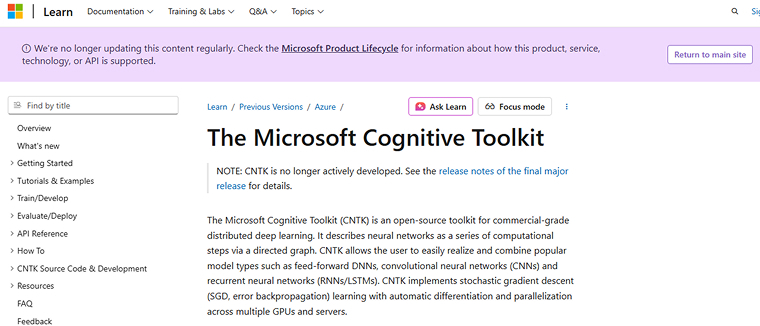
Microsoft Cognitive Toolkit, also known as CNTK, is a powerful AI framework specifically focused on deep learning, created by Microsoft. It represents neural networks as directed graphs and trains them with efficient automatic differentiation. Developers can build models in Python, C++, C#, or Java, and scale training from CPUs to multiple GPUs and servers.
CNTK delivers strong speed and reliability for large, enterprise workloads and complex networks. Teams value its integration with Microsoft platforms, though beginners may face a steeper learning curve in research and production environments worldwide.
Key Features of Microsoft Cognitive Toolkit (CNTK)
- Flexible Network Definition: The toolkit lets developers build complex neural networks by combining basic components and provides both high-level and low-level APIs in multiple programming languages.
- Scalable: CNTK delivers high performance and scales efficiently across several GPUs and servers, making it ideal for large datasets and complex AI models.
- Built-in Components: CNTK includes built-in components that efficiently process multi-dimensional dense or sparse data using Python, C++, or BrainScript.
- Versatile: CNTK provides highly optimized built-in components for creating deep neural networks, including CNNs for images, RNNs, LSTMs, GRUs for sequences, and feed-forward networks for general machine learning tasks.
- Efficient Resource Utilization: CNTK enables precise parallel training across multiple GPUs or machines using 1-bit SGD, improving speed and efficiency for large-scale deep learning applications.
Apache MXNet
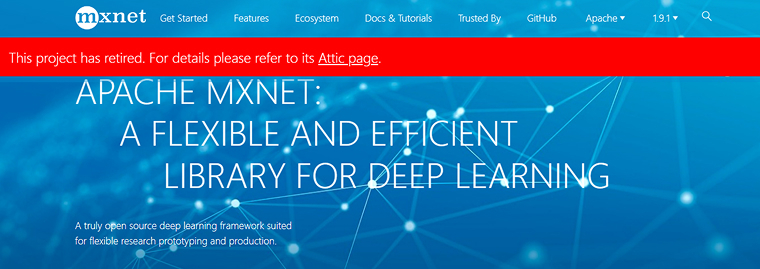
Apache MXNet serves as an open-source framework for creating and running deep learning applications efficiently. This AI framework allows developers to design networks using both symbolic graphs and imperative commands, which gives control and clarity. It scales smoothly across CPUs, GPUs, and clusters, supporting fast distributed training. MXNet offers ready-to-use tools and models for vision and language tasks.
Its APIs in Python, R, Scala, and other languages help teams build research prototypes and reliable production systems with consistent performance and simple deployment workflows for modern applications.
Key Features of Apache MXNet
- Scalable: MXNet allows developers to train deep learning models efficiently across multiple GPUs and machines, handling large datasets and supporting both research and production environments seamlessly.
- Gluon API: MXNet offers Gluon, a high-level API that simplifies building and training neural networks. Developers can use pre-built layers, models, and components to start projects quickly and efficiently.
- Language Bindings: MXNet supports multiple languages, such as Python, R, C++, and Java, allowing developers to train models in one language and deploy them smoothly in another.
- Dynamic Dependency Scheduling: MXNet uses a dynamic scheduler that automatically runs operations in parallel, improving performance and maximizing the use of available resources.
- Flexible: MXNet lets developers choose between symbolic and imperative programming, supporting programming languages like Python, R, and Julia. This flexibility enables both high-performance static graphs and dynamic, easy-to-debug computation graphs.
Scikit-learn
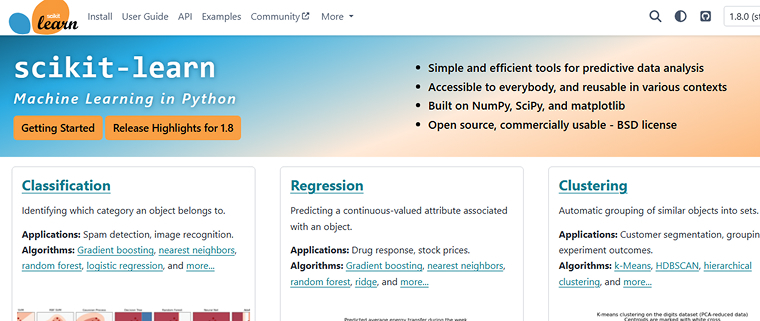
Scikit-learn provides a practical and reliable environment for building traditional machine learning models in Python. Users can handle data preparation, feature scaling, model training, and evaluation within one consistent toolkit. The library supports methods such as regression, classification, clustering, and dimensionality reduction, all with clear syntax. Developers can compare algorithms by changing minimal code, which speeds up testing and learning.
Scikit-learn works best with structured, small to medium-sized datasets and avoids heavy deep learning tasks. Its strong documentation, stable implementations, and integration with NumPy and SciPy make it valuable for students, researchers, and professionals developing predictive models efficiently and with confidence.
Key Features of Scikit-learn
- Simple and Efficient Tools: Scikit-learn offers simple, efficient tools for data analysis and mining. Its consistent syntax allows developers to easily learn, switch between, and apply different machine learning algorithms.
- Wide Range of Algorithms: This library provides a variety of machine learning methods, including classification, regression, clustering, and dimensionality reduction, allowing users to select the best model for their needs.
- Built on Python Ecosystem: Scikit-learn integrates with NumPy, SciPy, and matplotlib, enabling easy use alongside other Python scientific libraries and ensuring efficient data processing and analysis.
- Consistent API: The framework provides a simple, consistent API, letting users change models quickly without rewriting significant portions of code.
- Strong Community and Documentation: A strong community and detailed guides support users, making it easier to solve issues and follow recommended practices.
Caffe
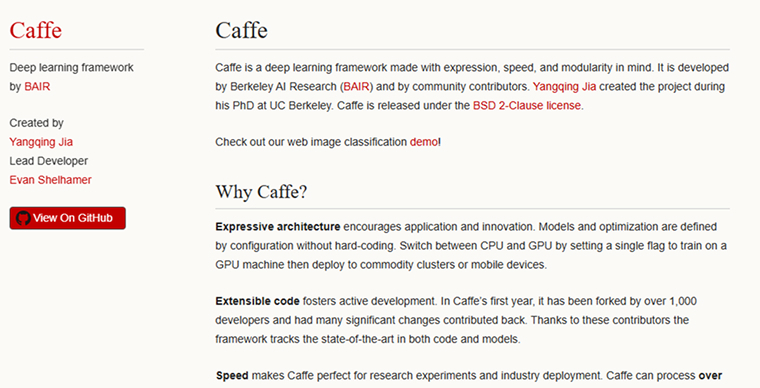
Caffe is an open-source deep learning framework mainly designed for computer vision tasks. It focuses on high speed, efficiency, and a modular design, making it suitable for both research and real-world deployment. Caffe allows users to define neural network models through configuration files rather than extensive coding.
The framework supports both CPU and GPU computation and is compatible with programming languages like C++, Python, and MATLAB. It is especially effective for convolutional neural networks used in image classification and object detection. However, Caffe is less suitable for recurrent neural networks and requires more manual setup.
Key Features of Caffe
- Modularity: Caffe features a modular design that allows developers to build deep learning networks with ease. This structure saves time, reduces coding effort, and makes Caffe beginner-friendly and popular in the AI community.
- Visualization Tools: Caffe provides visualization tools to monitor networks and training. Graphs show architecture, while logs track loss and accuracy, helping users debug and optimize models effectively.
- Pre-trained Models: Caffe provides many pre-trained models in its Model Zoo, letting users apply existing architectures and weights like AlexNet, VGGNet, and GoogleNet for transfer learning.
- Community Support and Documentation: Caffe’s detailed guides and active community provide support for troubleshooting, improving performance, and expanding features, with the BVLC GitHub repository hosting code and discussions.
- High Speed: Caffe processes images extremely fast, handling millions daily on a single GPU. Its single code base ensures smooth CPU-GPU portability and efficient model deployment.
How to Choose the Right AI Framework?
Before finalizing any AI framework, get answers to the following questions:
What are Your Project Requirements?
When choosing an AI framework, consider your project’s needs and goals. Complex deep learning projects require flexible frameworks like TensorFlow, while simpler tasks benefit from Scikit-learn’s ease and speed.
Is the Framework Scalable and Flexible?
Ensure the framework is both flexible and scalable. A good framework adapts to different data types, supports various algorithms, allows customization, and grows with project complexity, making it suitable for both prototypes and large-scale AI applications.
Is the Framework Easy to Learn?
Beginner-friendly frameworks like PyTorch are easier to pick up, while powerful tools like TensorFlow take more time to master. Strong documentation, tutorials, and community support help developers learn faster and overcome challenges, ensuring the framework matches both skill level and project needs.
Does the Framework Perform Well?
Evaluate your performance needs carefully. Consider training speed, inference time, and resource usage. Some frameworks suit fast experimentation, while others excel in large-scale or distributed workloads. Reviewing benchmarks and real applications helps ensure the framework meets efficiency and scalability expectations.
Final Thoughts
AI frameworks play a key role in building modern intelligent applications. Choosing the right AI framework helps teams meet project goals, manage resources, and deliver reliable results. These tools support many programming languages and solve real problems in areas like vision, language, and analytics. As AI continues to evolve with trends like edge computing and ethical design, frameworks will become more powerful and accessible. Exploring and learning these platforms encourages innovation and smarter solutions. By staying informed and selecting AI frameworks wisely, developers can create efficient, scalable, and future-ready AI projects with greater confidence.

Niket Shah oversees technology projects at TatvaSoft, blending hands-on expertise with a passion for crafting innovative solutions. He thrives on turning complex challenges into impactful results.



Comments
Leave a message...