

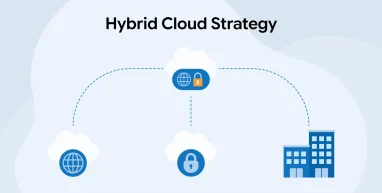
Cloud adoption has transformed how organizations build and run technology. Yet, many businesses still rely on on-premises systems for security, compliance, or performance needs. This reality makes infrastructure decisions more complex than a simple cloud move. Hybrid cloud architecture solves this challenge by combining on-premises systems with public and private cloud environments. It allows organizations to choose the best platform for each workload.
Modern enterprises need systems that adapt quickly to change. Hybrid cloud enables seamless integration across environments and improves workload portability. It also supports data sovereignty and performance requirements across regions. Many organizations work with a trusted Software Development Company to design architectures that align with business goals.
Many organizations work with a trusted Cloud and DevOps service provider to design architectures that align with business goals. This blog explores the hybrid cloud strategy in detail. It explains why it matters today and how organizations can use it effectively.
What is Hybrid Cloud?
A hybrid cloud combines on-premises systems with public and private cloud platforms to create a flexible computing environment. Organizations run sensitive workloads locally while using cloud services for scalability and innovation. This approach supports gradual cloud adoption and reduces migration risk. Hybrid cloud also improves cost control by scaling resources based on demand. Centralized management tools help teams enforce security, governance, and compliance across all environments.
Many industries adopt this model to balance regulatory needs with performance goals. By connecting legacy systems, cloud platforms, and edge locations, hybrid cloud enables smooth operations and better data access. It allows businesses to adapt their infrastructure as requirements change without sacrificing control, reliability, or efficiency.
What Are the Benefits of Hybrid Cloud?
The following are the advantages of hybrid cloud:
- Improved Security: A hybrid cloud keeps critical data in a private setup while using public cloud security expertise. Large providers deliver constant updates and monitoring, improving protection while maintaining control where required.
- Improved ROI: Using a public cloud alongside on-site systems lets organizations scale resources on demand while avoiding new hardware purchases and reducing overall data center costs.
- Regulatory Compliance: Hybrid cloud helps organizations keep sensitive data on-site while using public cloud tools to meet strict compliance rules and strengthen security for regulated workloads.
- Disaster Recovery and Risk Reduction: Hybrid cloud lowers risk by spreading workloads across on-premises and cloud systems, improving disaster recovery, protecting data availability, and supporting business continuity during unexpected failures.
- Multicloud Options: Multicloud and hybrid models give organizations freedom to pick cost-effective clouds, move containerized workloads easily, scale resources on demand, and adjust quickly to changing business needs.
Components of Hybrid Cloud
The components of a hybrid cloud can be categorized into three major categories:
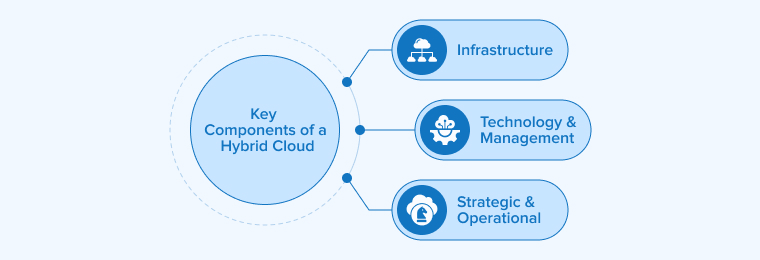
1. Infrastructure Components
- Public Cloud: It represents one part of a hybrid cloud architecture. It provides scalable, flexible resources for dynamic workloads and applications. Businesses use it to access advanced services from major cloud providers. This approach reduces infrastructure costs while improving system accessibility and overall performance.
- Private Cloud/On-Premises: Private cloud running on on-premises infrastructure allows organizations to manage their own servers, storage, and networks. It is commonly used for sensitive data and critical applications, offering stronger security, dedicated resources, and better compliance control.
- Network Connectivity: Network connectivity links private infrastructure with public cloud services. It uses fast, protected pathways to move data. The connection supports workload shifts and maintains reliable performance. Teams manage traffic centrally for consistent and secure operations.
2. Technology & Management Components
- Hybrid Management Platform: It provides a single dashboard to oversee and control resources across multiple cloud environments. It helps organizations monitor performance, automate tasks, and manage workloads efficiently across private, public, and on-premises infrastructure.
- Containerization & Orchestration: They are core components of a hybrid cloud. Containers package applications with their needs so teams run them anywhere. Orchestration tools coordinate containers across clouds, automate scaling and updates, reduce manual effort, and keep services reliable and efficient.
- Automation: Automation coordinates hybrid cloud tasks, enabling faster releases, reliable scaling, and consistent operations.
3. Strategic & Operational Components
- Workload Placement Strategy: Teams place workloads strategically by balancing regulatory requirements, speed demands, and operational costs.
- Security & Compliance: This component protects hybrid cloud systems through centralized identities, strong encryption, and consistent security rules.
- Data Strategy: A hybrid cloud data strategy controls placement, movement, security, and access across environments. It reduces latency, respects data gravity, and supports consistent operations.
- Disaster Recovery (DR): Hybrid disaster recovery uses cloud backups to restore on-prem systems fast and reduces downtime during failures.
How Does Hybrid Cloud Work?
In a hybrid cloud setup, the private cloud often handles sensitive or mission-critical data, while the public cloud provides extra computing power for less sensitive tasks. Businesses connect these environments through secure links such as VPNs, dedicated connections, or APIs, ensuring data moves safely between systems. Hybrid cloud relies on technologies like virtualization and containerization to make applications portable and independent of the underlying infrastructure, while orchestration tools like Kubernetes automate resource management and workload deployment across environments.
IT teams can monitor and manage hybrid systems using unified platforms, which provide visibility into performance, resource allocation, and security. Automation and software-defined networking help optimize workloads, reduce manual effort, and maintain high availability. Developers design applications as small, modular services so they can run on any environment without modification, simplifying updates and scaling.
Additionally, hybrid cloud integrates security measures, including identity management, encryption, and compliance monitoring, to protect sensitive information. Edge computing can extend hybrid capabilities by processing data closer to users, improving speed and reducing latency.
Overall, hybrid cloud offers organizations the freedom to balance cost, performance, and security while modernizing IT operations and maintaining control over critical systems. It enables dynamic resource allocation, seamless interoperability, and improved operational agility.
Challenges in Hybrid Cloud Strategy
The following are the disadvantages of hybrid cloud:
Management Complexity
Hybrid cloud management requires teams to handle different tools, labels, and controls daily. Staff must build strong skills across on-prem systems and multiple cloud platforms. Gaps in visibility can slow monitoring, data transfers, and consistent policy enforcement. Teams rely on automation and careful oversight to maintain stability and security everywhere.
Integration
Organizations often struggle to link on-premises systems with public cloud platforms smoothly. API changes across environments frequently disrupt integrations and complicate release management processes. Hybrid setups also make data synchronization across locations difficult and time-consuming. Poor integration reduces data accuracy, consistency, and availability for analytics and decisions.
Strong data governance defines clear roles, policies, and standards for unified data handling. Data orchestration tools help coordinate movement, improve reliability, and increase overall usability. Multiple providers and networks add compatibility issues, latency risks, and operational overhead. Teams must align applications and services carefully to maintain stable hybrid cloud operations.
High Cost
Running on-premises facilities forces companies to pay for buildings, energy, upkeep, and skilled staff. Using several cloud providers alongside local systems makes true technology cost visibility harder. Hybrid usage patterns and complex billing often create unpredictable spending without careful oversight. Pay-as-you-go pricing can inflate bills through idle resources, data transfers, and inefficient workloads.
Automated cost controls and clear governance help organizations manage providers, licenses, and infrastructure expenses.
Data Transport
Teams consider where most data already lives because nearby applications run cheaper and faster. Shifting large datasets between private sites and clouds consumes time and often adds transfer costs.
Lack of Visibility
Hybrid cloud teams often struggle to see all resources clearly. Different platforms hide performance, security, and policy gaps. Centralized monitoring brings systems into one clear view. Unified logs and metrics expose issues early. AI-powered observability adds real-time insight.
With a clear hybrid cloud strategy and shared controls, teams improve governance, troubleshoot faster, and maintain reliable operations across on-premises and cloud environments.
Security and Compliance Challenges
Hybrid cloud environments increase security and compliance challenges for businesses. Data moving between on-premises and cloud systems can face leaks, unauthorized access, or regulatory violations. Misconfigurations and weak authentication make systems to ransomware, insider threats, and other attacks. Companies must adopt a unified security strategy with identity management, encryption, access controls, and automated configuration checks. Zero-trust models and continuous auditing help maintain consistent protections.
Following these practices ensures sensitive data stays secure, regulatory requirements are met, and hybrid cloud operations remain reliable and compliant.
Steps for Building a Successful Hybrid Cloud Strategy
Every business must plan a hybrid cloud carefully, following the procedure given below:
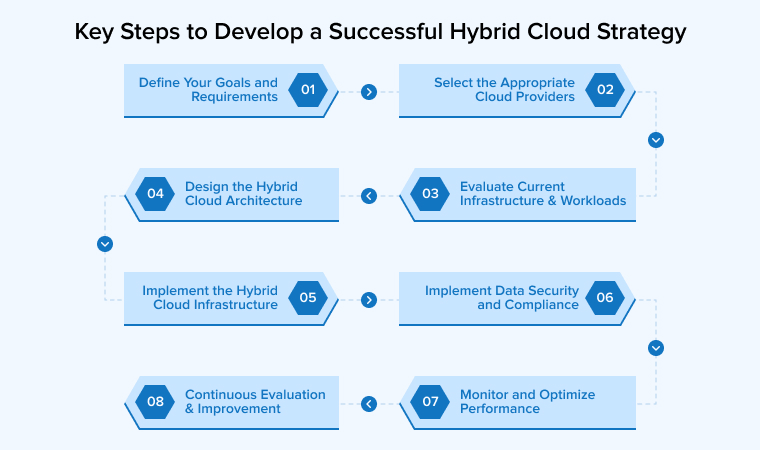
1. Define Your Goals and Requirements
Building a successful hybrid cloud strategy starts with understanding your organization’s goals and technology needs. Begin by analyzing existing systems, applications, and workforce skills to identify challenges and opportunities for cloud adoption. Define clear objectives, such as reducing costs, improving performance, enhancing data security, and supporting scalability.
Determine which workloads should stay on-premises and which can move to public or private clouds. Set measurable KPIs to track success, including ROI, resource utilization, and application performance. Engage stakeholders from IT, compliance, and business units to align priorities. Conduct a cost-benefit analysis to ensure the hybrid approach delivers value, supports growth, and enables smooth digital transformation with minimal disruption.
2. Select the Appropriate Cloud Providers
Selecting the appropriate cloud providers is a key step in building a strong and reliable cloud strategy. Organizations should begin by clearly identifying the cloud services they require, such as infrastructure, platforms, or software delivered online. Each provider offers different strengths, so teams must actively compare service ranges, performance levels, security standards, and compliance support. Cost structures also matter, and decision makers should understand pricing models to avoid unexpected expenses.
Providers must support smooth integration with existing on-premises systems to ensure data and applications move easily across environments. Reviewing service level agreements helps confirm uptime, support quality, and accountability. Global availability also plays an important role for businesses operating across regions.
By carefully analyzing these factors, organizations can choose providers that match both technical needs and business goals. The right providers enable scalability, flexibility, and long-term growth, while reducing risk and complexity in a hybrid cloud environment.
3. Evaluate Your Current Infrastructure and Workloads
Assessing current infrastructure and workloads lays the foundation for a successful cloud strategy. Organizations must first examine their existing data centers by reviewing servers, storage, networks, and data assets to understand capacity, performance limits, costs, and security needs. This review helps reveal which systems still deliver value and which ones create operational strain.
Teams should then analyze each workload to see how it behaves, how much it scales, and how sensitive its data is. Some workloads run best on local systems due to latency or compliance needs, while others perform better in the cloud because they demand flexibility and rapid growth. Decision makers must actively compare these needs with cloud capabilities to choose the right placement.
By clearly understanding infrastructure health and workload behavior, organizations can reduce risk, avoid wasted investment, and design a hybrid cloud model that supports efficiency, innovation, and long-term business goals.
4. Design the Hybrid Cloud Architecture
Designing a hybrid cloud architecture defines how private and public environments work together as one system. The architecture should clearly map how data moves between locations while maintaining security, low latency, and reliability. Network design plays a central role, using secure connections such as VPNs or dedicated links to enable smooth communication across environments.
Identity and access management must be unified so users can access resources safely with minimal privileges. Storage and workload placement should follow business priorities, ensuring sensitive data stays protected while scalable workloads leverage the public cloud. Security controls, monitoring, and compliance mechanisms need to be embedded from the start rather than added later.
A well-planned hybrid design also focuses on flexibility, allowing workloads to shift as demand changes. By aligning technology choices with operational goals, organizations create a resilient, efficient, and future-ready hybrid cloud foundation.
5. Implement the Hybrid Cloud Infrastructure
After finalizing the hybrid cloud architecture, implementation begins with carefully migrating workloads. Choose the migration method that fits each workload, such as lift-and-shift for simple applications or refactoring for cloud-native benefits like containerization and serverless computing. Next, deploy management tools to monitor performance, optimize resources, and secure the environment.
Use orchestration tools to automate processes and maintain consistency. Monitoring and analytics platforms provide insights into usage, performance, and potential issues. Integrating these tools improves visibility, control, and efficiency across the hybrid cloud.
A well-planned implementation ensures workloads run smoothly, resources are optimized, and operations remain secure and reliable throughout the hybrid infrastructure.
6. Implement Data Security and Compliance
Hybrid cloud security requires a comprehensive approach that protects data across all environments. Organizations should implement encryption for data in transit and at rest, along with strict identity and access management to control who can reach sensitive information. Zero-trust frameworks and continuous monitoring help detect and respond to threats quickly. Security measures must also align with industry-specific regulations, such as GDPR or HIPAA, to avoid legal and financial risks. Regular audits, compliance checks, and automated threat detection ensure the environment remains secure. By combining these strategies, businesses can maintain strong security, regulatory compliance, and operational confidence in their hybrid cloud infrastructure.
7. Monitor and Optimize Performance
To maintain a strong hybrid cloud environment, actively monitor and optimize performance after deployment. Use monitoring tools that provide clear visibility into both cloud and on-premises workloads, tracking key metrics such as CPU, memory, network traffic, and security events.
Establish clear incident response protocols to address issues like downtime or security threats quickly and minimize business disruption. Regularly review workloads, resource allocation, and application performance to identify inefficiencies and make adjustments. Automate routine tasks where possible to reduce manual effort.
Continuous monitoring, coupled with performance optimization, ensures that resources are used efficiently, systems remain healthy, and the hybrid cloud environment supports growth and operational excellence.
8. Continuous Evaluation and Improvement
Continuous evaluation and improvement play a key role in building a successful hybrid cloud strategy. Organizations should regularly review system performance, security controls, and overall costs to ensure the environment operates efficiently. Analyzing data from monitoring tools and gathering feedback from users and IT teams helps identify gaps and improvement areas.
Teams must adjust resource usage, strengthen security practices, and control expenses based on these insights. Keeping track of new cloud technologies, services, and industry best practices allows the strategy to evolve with changing business needs. A continuous improvement approach encourages innovation, supports better decision-making, and ensures the hybrid cloud remains reliable, secure, and aligned with long-term organizational goals.
Hybrid Cloud Use Cases
Let’s discuss some of the prominent use cases of the hybrid cloud:
- Support Cloud Migration Efforts: A hybrid cloud supports organizations during a gradual migration from on-premises systems to a public cloud. It allows teams to move applications and data in phases while maintaining stability. This approach reduces risk, avoids major disruptions, and provides flexibility during long-term cloud migration.
- Disaster Recovery: A hybrid cloud helps businesses stay operational during failures by combining on-premises and cloud resources for disaster recovery. It allows organizations to reduce downtime, plan for vulnerabilities, and ensure continuous service, keeping users supported and systems running smoothly.
- Support Legacy Systems: A hybrid cloud strategy allows companies to modernize their systems without discarding older systems. It lets on-premises legacy applications and new cloud-based apps work together, sharing data efficiently. This approach ensures smooth transitions while maintaining existing infrastructure.
- Application Modernization and DevOps: Hybrid cloud enables companies to gradually move to cloud-native technologies like containers and microservices, letting them test new applications in the cloud while keeping core systems on-premises.
- Local Data Processing: Hybrid clouds help manage large amounts of data efficiently. You can process big data on-premises when size or speed matters. Afterward, back up the results to a public cloud for storage and redundancy. This approach ensures data safety while leveraging both local and cloud resources effectively.
Final Thoughts
A well-planned hybrid cloud strategy lets organizations use both on-premises and cloud resources effectively. It improves flexibility, strengthens data security, and helps control costs. By selecting the right tools, partners, and management practices, businesses can address integration, compliance, and cybersecurity challenges. Hybrid cloud also supports innovation by enabling faster deployment and scalable workloads.
Organizations that embrace this approach can achieve long-term growth, maintain operational resilience, and adapt to changing business needs. Overall, a hybrid cloud strategy provides a balanced, secure, and flexible foundation for modern digital operations.
FAQs
A hybrid cloud combines on-premises systems with public and private cloud platforms to create a flexible computing environment.
The major components of a hybrid cloud strategy include public cloud, private cloud infrastructure, network connectivity, automation, hybrid management platform, containerization & orchestration, security & compliance, disaster recovery plan, etc.

Shruj Dabhi is an enthusiastic technology expert. He leverages his technical expertise in managing microservices and cloud projects at TatvaSoft. He is also very passionate about writing helpful articles on the same topics.



Comments
Leave a message...