

In the age of AI, machine learning empowers algorithms and machines to mimic human behaviour and improve their performance. Programs are no longer written to perform specific tasks; instead, they learn from historical data and patterns to behave appropriately.
Java, being one of the most popular and widely used programming languages, provides various libraries that Java development companies use to build, train, and deploy ML solutions. Expert Java developers are essential to understand fundamental approaches and pick the most suitable option for your project.
In this guide, we will explore the best Java machine learning libraries, detailing their features and helping you choose the right tools to enhance your project’s results.
Why Choose Java for Machine Learning?
Java offers a myriad of advantages for machine learning, especially when working with large-scale, enterprise-level apps.
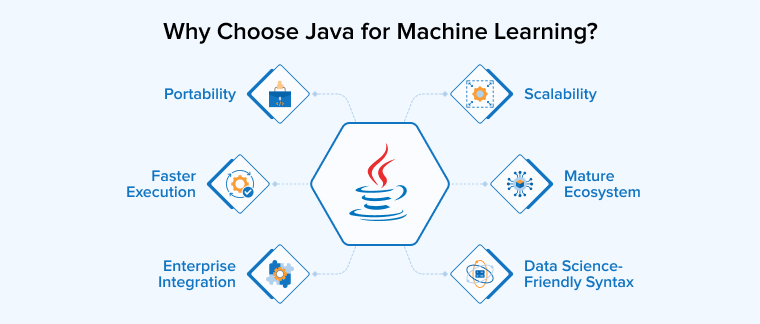
Data Science-Friendly Syntax
The Java programming language has a simple and easy-to-understand syntax. Its data types come predefined with the language. Setting a standard coding grammar across the organisation ensures that the developed codebase is uniform and up to company standards. In this case, Java helps by ensuring that its own standards are maintained.
Java provides different data science techniques, including statistical analysis, data visualization, data analysis, and data processing, to assist developers and organizations in implementing ML algorithms for real-world business applications.
Faster Execution
Java is faster than the popular machine learning language Python. Python is an interpreted and dynamically typed language, whereas Java is a compiled and statically typed language. Python performs type checks during runtime, while Java executes them during compilation. This saves development time and delivers enhanced performance.
Portability
Java Runtime Environment ensures that Java apps can run on any platform or device, maintaining consistency across development, testing, and production environments.
Scalability
Java helps developers to build scalable machine learning systems using frameworks such as Hibernate, Spring, and other offerings from its rich and mature ecosystem.
Enterprise Integration
Java is widely used for building enterprise systems, including the addition of advanced machine learning functionalities to existing apps. This approach helps avoid the complexities associated with integrating different programming languages. Many legacy systems and large-scale apps are designed with Java, making it easier to integrate AI capabilities into those enterprise apps using Java alone.
Mature Ecosystem
Since Java is one of the traditional programming languages, it has a rich and mature ecosystem. It offers a comprehensive set of Java frameworks, libraries, and tools for developing machine learning-based applications. Moreover, the language provides robust security features for handling sensitive information within ML applications.
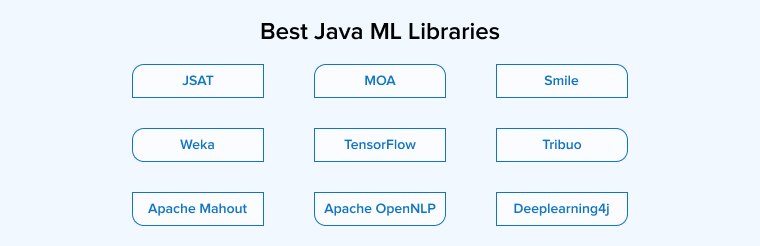
Best 9 Java ML Libraries for Your Projects
Numerous Java machine learning libraries are available in the market, each catering to a specific type of project requirement and developer preferences. Let us explore the most popular and widely used libraries.
Deeplearning4j
Eclipse designed this library to meet machine learning-related requirements by providing several ML algorithms and neural network architectures. DL4J helps you build and train Java-based ML models. It offers seamless integration with Apache Spark and Hadoop and is easily interoperable with Python.
This machine learning framework is versatile enough to meet diverse needs, ranging from image recognition to fraud detection. DL4J supports a distributed computing infrastructure and offers a comprehensive set of deep learning functionalities, such as time series analysis, computer vision, and natural language processing.
Key Features of DL4J
- Distributed Computing: DL4J uses Hadoop and Spark for distributed training and inference, efficiently scaling across multiple CPUs and GPUs. This enables handling large datasets without compromising performance.
- Support for Various Neural Network Architectures: DL4J supports multiple neural network architectures like LSTM, RNN, CNN, and DBNs, providing flexibility for different AI apps.
- Keras Compatibility: DL4J supports Keras, allowing users to leverage both Keras’s simplicity and DL4J’s backend to build models.
- ND4J: DL4J employs ND4J, a robust Java library for linear algebra, to perform matrix operations, facilitating effective computation across CPUs and GPUs.
- Integration with Hadoop and Spark: DL4J integrates with Hadoop and Apache Spark to enable distributed deep learning in big data environments.
Weka (Waikato Environment for Knowledge Analysis)
Weka is a machine learning library for data mining and analysis. It is an open-source tool that offers an intuitive GUI, enabling users to start ML development, even without extensive coding experience.
Weka users do not need to write complex code, as it enables them to perform various operations like regression, classification, clustering, and data preprocessing through its visual environment. Such ease of use makes Weka an ideal option for Java beginners.
For direct integration of ML capabilities into Java apps, Weka offers robust APIs designed for users with advanced knowledge of the library. This machine learning library supports various algorithms, including neural networks, support vector machines, and decision trees. Its comprehensive documentation and simplicity make it suitable for educational settings and academic research.
Key Features of Weka
- Algorithm Diversity: Weka supports numerous machine learning algorithms for operations like data preprocessing, association rule mining, regression, clustering, and classification.
- Integration with Java for Extensibility: When implemented with Java, Weka provides custom algorithms that enable Java developers to extend its functionalities. It offers APIs for easy integration with Java-based ML projects.
- Comprehensive Preprocessing and Visualisation Tools: Weka provides built-in tools for visualisation, transformation, and data cleaning to optimise the dataset before training ML models. It helps users summarise statistics, create scatter plots, and generate histograms.
- User-Friendly Interface: Weka’s GUIs encourage users to experiment with ML algorithms without writing a single line of code.
- Preprocessing Tools: Weka has tools for every data preprocessing task, including attribute selection, missing value imputation, and normalization.
Apache Mahout
Built on Java and Scala, Apache Mahout is an open-source library for developing scalable machine learning algorithms. It offers various ready-to-use implementations for a diverse range of machine learning tasks, including classification, clustering and filtering. It also supports multiple data formats for analysis.
Mahout leverages Apache Hadoop to process multiple parallel tasks. This integration is also useful in processing and analyzing large volumes of data. Mahout provides businesses with capabilities to quickly build scalable ML models through recommendation algorithms like collaborative filtering. So, they no longer need to create complex machine learning models from scratch.
Key Features of Apache Mahout
- Scalability: This library scales automatically as your dataset grows, ensuring efficient data processing.
- Rich Algorithm Library: Name any machine learning task, like collaborative filtering, classification, or clustering, and Apache Mahout will provide an algorithm for it.
- Integration with Big Data Technologies: Through seamless integration with Apache Spark and Hadoop, Mahout allows distributed processing.
- Flexible API: Developers can easily apply the machine learning solutions using the library’s user-friendly APIs.
- Community Support: As an open-source library, Mahout benefits from a vibrant community that actively contributes to its advancement and offers technical support to fellow developers.
Smile (Statistical Machine Intelligence and Learning Engine)
Smile provides a comprehensive set of machine learning algorithms and data structures for both unsupervised and supervised learning. Popular for its speed, Smile is ideal for building high-performance ML applications.
Smile can easily provide machine learning algorithms for dimensionality reduction, clustering, regression and classification, along with advanced techniques for time series analysis and NLP. On top of that, it supports integration with statistical methods, making it suitable for tools for data exploration and analysis.
Everything a developer needs to create a machine learning pipeline is available in Smile’s toolkit, including features for visualization, feature selection, and data preprocessing. Its intuitive APIs and extensive documentation make it easy, even for beginners, to work on complex machine learning workflows in Java.
Key Features of Smile
- Algorithmic Diversity: Smile comes with a wide range of algorithms for different machine learning tasks such as dimensionality reduction, clustering, regression, and classification.
- Graphical User Interface (GUI): Helps to interact with the library and build models without writing code.
- Multi-threading Support: The ML library supports parallel and distributed computing, enabling the execution of large-scale ML operations efficiently.
- Extensibility: Smile allows you to easily extend the library’s functionality or easily integrate with other Java apps.
- Statistical Analysis: The Smile ML library provides robust statistical tools for regression analysis, distribution fitting, and hypothesis testing.
Tribuo
Tribuo is a Java-based library developed by Oracle Labs to simplify and clarify the machine learning process. It supports strong type safety and native integration with the JVM. Many libraries built upon C++ or Python can not entirely help in building, training, and deploying ML models, but Tribuo can accomplish all these tasks while being entirely Java-based.
Therefore, Tribuo is one of the most practical and production-ready solutions that isn’t dependent on any external tool or libraries. It also offers algorithms for various machine learning operations like clustering, classification, and regression.
Key features of Tribuo
- Supervised Learning Algorithms: Provides a comprehensive set of battle-tested classifiers and regressors with consistent APIs to simplify the training, evaluation, and prediction processes.
- Unifying Data Model: Utilizes a type-safe data representation that supports categorical and numerical types, separates features from labels, and ensures data ingestion, feature engineering and serialization remain consistent across tasks.
- Built-in Evaluation and Metrics: Offers task-specific metrics, standard evaluation tools, calibrated probability evaluation, and model comparison utilities.
- Feature Processing and Transformations: Includes a composable and flexible feature pipeline used during both training and inference. This pipeline can also be persisted with the models.
- Model Persistence and Interoperability: The library enables developers to save and load ML models to and from disk. It also offers runtime-friendly prediction APIs that support seamless integration with Java systems and are ideal for production deployment.
TensorFlow
TensorFlow is a popular framework used by AI software development companies for creating machine learning and deep learning models. Initially built for deep learning experiments by the Google Brain team, it was known as DistBelief, which gradually evolved into a full-fledged machine learning library, i.e., TensorFlow for internal use. Later, the library’s success compelled the team to make it public.
Computations are represented in TensorFlow through a data flow graph, enabling developers to define the data as edges and operations as nodes. This makes it easy to visualize and optimize complex processes. For numerical computations, the library provides multi-dimensional arrays called Tensors. TensorFlow’s high scalability and flexibility enable it to help with diverse requirements ranging from small projects to large applications.
Key Features of TensorFlow
- Dataflow Graphs: The development team uses them to determine how data moves through a series of processing nodes. It helps visualise and understand complex ML pipelines. Moreover, they offer a high level of abstraction necessary to handle the intricacies of neural network architectures.
- Execution Platforms: The TensorFlow library is quite versatile. It can be easily integrated with Android and iOS apps, deployed on cloud clusters, used directly on GPUs and CPUs, and run on local machines.
- Automatic Differentiation (Autograd): To simplify the backpropagation process when training ML models, TensorFlow automatically calculates the gradients of all the trainable variables in the model.
- Multi-language Support: Although TensorFlow was originally created for Python, it also offers APIs to support other programming languages, including Java, JavaScript, and C++.
- Parallel Neural Network Training: With TensorFlow, it becomes possible to train multiple neural networks and GPUs, helping create efficient, large-scale systems.
JSAT ( Java Statistical Analysis Tool)
JSAT is a Java-based ML library that helps build small to medium-sized ML solutions. The code is self-contained and has zero external dependencies. It offers one of the largest collections of algorithms of any framework. JSAT is faster, free, and open-source.
The JSAT library is especially useful for statistical modelling projects, making it an ideal option for data scientists and researchers. It is lightweight and well-suited for quick experiments in academic environments. JSAT also provides flexibility to customize algorithms to meet project-specific statistical learning requirements.
Key Features of JSAT
- Data Ingestion and Preprocessing: Supports reading and streaming data from SQL databases, ARFF, JSON, and CSV formats. On top of that, the library offers built-in handling for feature scaling, encoding categorical variables, standardisation, normalisation, outlier detection, and missing value imputation.
- Feature Engineering and Selection: Provides embedded methods, automated selection techniques, and feature construction tools.
- Algorithmic Support: Offers both supervised learning algorithms and unsupervised learning algorithms.
- Model Evaluation and Validation: Provides confusion matrix utilities, evaluation metrics for regression and classification, time-series-aware validation, K-fold and stratified K-fold cross-validation, and train/test split.
- Hyperparameter Tuning and Model Selection: Allows automated pipeline search, random search, grid search, and more through distributed and parallel search capabilities.
MOA
Designed for online learning and extracting information from large datasets, MOA is an open-source Java platform. It consists of numerous machine learning algorithms that can even provide the capability to continuously process data in real-time. Developers leverage this library to build highly scalable and efficient machine learning models that can easily adjust to the changes as they occur.
Key Features of MOA
- Stream Data Processing: MOA is not created to store data but to process it in real-time. It efficiently manages continuous and fast-moving data streams, making it ideal for apps with limited storage capacity where data arrives quickly.
- Incremental Learning: This library supports incremental learning, allowing models to grow continuously as new data becomes available. This approach eliminates the need to retrain models from scratch and enables quick adaptation to new data.
- Concept Drift Detection: Concept drift occurs when the statistical properties of data change over time. MOA has specialized tools for detecting these drifts, helping models adjust dynamically and maintain predictive accuracy.
- Integration and Extensibility: MOA supports easy integration with other ML libraries, such as Weka. Users are also allowed to extend its functionalities by adding their own components and algorithms.
- Visualization and Evaluation Tools: MOA has built-in tools for performance metrics, model predictions, and visualizing data streams. Users can leverage them to monitor how an ML model evolves and analyze its effectiveness on streaming data tasks.
Apache OpenNLP
As the name suggests, the Apache OpenNLP library provides NLP capabilities to Java apps. It provides an extensive set of tools to process and assess human language, which helps developers create apps with the capability to understand, interpret, and generate natural language.
For most common natural language processing tasks, like language detection, sentence splitting, named entity recognition, part-of-speech tagging, and tokenization, OpenNLP provides ready-made algorithms and models.
Within the Java environment, using Apache OpenNLP is straightforward. Developers can design sophisticated NLP apps like text classifiers, sentiment analysis tools, or chatbots by simply integrating the library into their project.
If you are working on models that need to be trained on domain-specific data, then this library supports it by providing various customization options. It remains critical for tasks that demand specialized knowledge or high accuracy.
Key Features of Apache OpenNLP
- Tokenisation: Enhances accuracy when working with multilingual or messy input by supporting language-specific rules. The library uses rule and model-based tokenisers that separate the input text into words and punctuation.
- Sentence Detection: Utilises neural models or maximum entropy to detect statistical sentence boundaries. It effectively manages punctuation variations and abbreviations to create reliable sentence segmentation for downstream tasks.
- Part‑of‑Speech (POS) Tagging: Machine-learning models were utilized to train POS taggers that assign grammatical tags to tokens, enabling syntactic analysis and feature extraction within NLP pipelines.
- Named Entity Recognition (NER): Machine-learned sequence models are used in entity chunking models to locate and classify names. It also supports custom entity types for re-training with annotated data.
- Training & Evaluation Tools: Developers use the built-in APIs to train, analyze, persist, and refine ML models for their specific language and domain.
Important Considerations When Choosing a Library
Every Java project has different requirements, and every team has specific preferences. Picking a suitable machine learning library seems a challenging undertaking, but it can be streamlined by considering key factors such as:
Ease of Use
The library you are choosing must be easy to use, especially for beginners. This can be determined by checking if it needs you to learn complex concepts, has a user-friendly interface, provides necessary tutorials, etc.
Community Support and Documentation
Having clear and comprehensive documentation means having a guiding light on a dark road. Libraries that explain their features, provide guides to use them, examples, and tutorials can certainly streamline machine learning development. Meanwhile, an active and vibrant community can help you get through specific project problems or give access to valuable resources, enabling you to deliver effective outcomes.
Performance
If a library can’t help you deliver results quickly, then it will be more of a hurdle than a help. In the realm of AI/ML, trends arise and fade quickly. Businesses expect developers to quickly deliver ML solutions that help them capitalise on these opportunities. That won’t be happening if your library isn’t fast enough. More importantly, a fast library allows you to work with large datasets without wasting much of your time and effort.
Flexibility
A rigid library might be able to fulfill today’s business needs, but maybe not tomorrow’s. Such libraries are not helpful in the case of unique or specific ML requirements. A flexible machine learning library enables you to experiment with different approaches, algorithms and methods to help businesses explore various ML capabilities and innovate.
Specific Project Requirements
Getting clarity on specific project requirements is a must before you go shopping for the machine learning library. Budget is one of the most influential factors in deciding on the library. There are many open-source options available, which are also highly trusted and widely used around the world. Determine the ML type, language type, data types, and APIs required to fulfil the project objectives.
Conclusion
Choosing an appropriate Java machine learning library mostly depends on the kind of problem you are trying to solve or your project requirements. Java is a suitable language for machine learning because of its speed, portability, and robust offerings. That helps develop complex and enterprise-level smart systems.
Java has a rich ecosystem consisting of libraries like Weka, Deeplearning4j, and MOA, helping developers effectively tackle tasks ranging from deep learning and real-time data processing to NLP and big data analytics. Whether you are performing image classification, sentiment analysis, or complex data mining, Java provides a library for every unique requirement, ensuring impactful outcomes for your ML projects.
FAQs
Python is a widely preferred choice for machine learning applications because it is easy to use, has many helpful libraries, and strong community support. Java can handle large systems, but Python makes building and testing AI solutions faster and simpler.
Machine learning relies on several useful libraries that help with different tasks. These include TensorFlow and PyTorch for building and training neural networks; Scikit-Learn for performing machine learning tasks, Keras to build deep learning models, Pandas to analyze and manipulate data, NumPy for numerical computing, and Matplotlib and Seaborn for data visualization.
Well, it depends on your project requirements. You can use Deeplearning4j to build deep learning models, Smile to perform machine learning tasks, Tribuo to develop production-ready ML APIs, Stanford CoreNLP, or Apache OpenNLP for NLP tasks, and TensorFlow Java or ONNX Runtime Java (or model servers like Triton/TorchServe) to run state-of-the-art models trained in Python.

Rakshit Toke is a Java technology innovator and has been managing various Java teams for several years to deliver high-quality software products at TatvaSoft. His profound intelligence and comprehensive technological expertise empower the company to provide innovative solutions and stand out in the marketplace.



Comments
Leave a message...