


The innovation of the DevOps principle has marked a cultural shift in the workings of the technology industry. It focuses on automation and collaboration between development and deployment teams to get faster and more reliable results. Decisions are now taken based on well-prepared data provided by different teams, and every responsibility has become a shared responsibility, fostering a healthy working environment. Companies providing DevOps cloud services are working enthusiastically on ingraining DevOps in every aspect of an organization’s operations.
For better utilization of DevOps services, it’s important to keep a check on the ongoing DevOps practices. Keeping this in mind, we’re here with the DevOps Maturity Model blog. It’ll give a report card of your company’s DevOps culture implementation. Explore the factors, stages, benefits, tools, best practices, and challenges of implementing a DevOps Maturity model.
What is the DevOps Maturity Model?
Implementing DevOps practices is not a one-time solution. The DevOps journey requires proper assessment at regular intervals to determine its current position. The DevOps maturity model is a well-designed framework that organizations use to assess the extent and depth of adoption of DevOps principles and practices. They can check their performance across DevOps metrics, such as integrating CI/CD pipelines, automation, and collaboration between teams, etc. Teams can find out where they are lacking and what the future strategy must be to achieve the required sophistication.
Achieving DevOps maturity is a gradual process where teams get closer to their business goals while continuously refining their workflows and adapting to the changes. The DevOps maturity model provides a common space for higher management officials to make smart decisions regarding alignment of team skills, tools, and processes with DevOps goals.
Key Factors of the DevOps Maturity Model
The DevOps maturity score of an organization is the sum of scores across all the individual areas. The following factors form the base of the DevOps maturity framework:
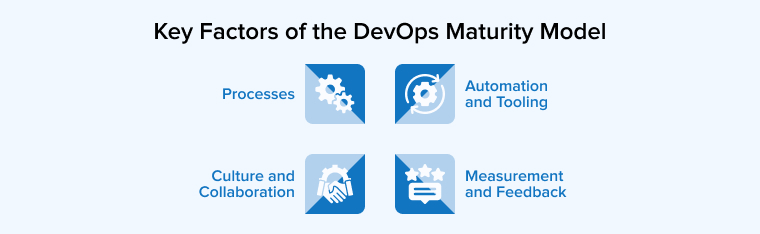
Culture and Collaboration
The DevOps philosophy works on the collaboration between development and operations teams to maximize the output in less time. Hence, properly assess how both teams work in your organization. Are they working in isolation? How and when do they collaborate? What are the communication channels they use for effective coordination? Is there a proper feedback loop to improve the effectiveness of working? How do teams deal with failures and learn from them? Mutual understanding, trust, shared responsibility, and accountability make a mature DevOps culture.
Automation and Tooling
DevOps aims to speed up the processes and deliver faster results. Hence, DevOps automation cannot be overlooked. Check the extent of automation across CI/CD pipelines, performing repetitive work, monitoring and testing processes, and infrastructure provisioning. Observe and record how automation plays a crucial role in reducing errors, increasing employee productivity, and facilitating faster deployments.
Processes
In DevOps, well-defined processes help teams manage work smoothly from planning to deployment. Evaluate how activities such as coding, testing, releasing, and handling incidents are organized. These steps follow clear guidelines and align with business goals. Regular reviews of past releases and development stages allow teams to learn from their experiences, identify gaps, and improve future workflows.
Measurement and Feedback
It’s important to track key metrics such as recovery rates, deployment frequency, and failure rate, etc. Ensure that data from these metrics is being recorded properly. Also, you must take into account user feedback to improve software functionality and continuous delivery.
What Are the Stages of DevOps Maturity?
The DevOps maturity model consists of five progressive stages that let you evaluate where you currently stand, and how to transition to further levels:
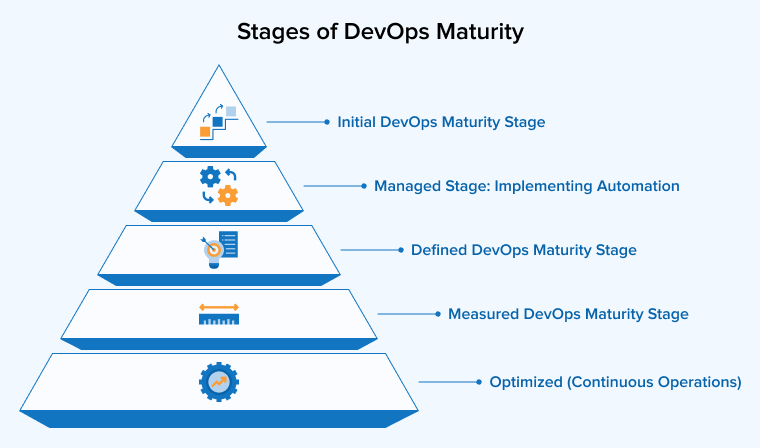
1. Initial DevOps Maturity Stage
This stage indicates an organization’s start of its DevOps journey. They often face many challenges due to isolated working teams and manual processes. Teams tend to work independently, which slows communication, creates inefficiencies, and increases the risk of errors. Releases are mostly manual, testing is slow, and infrastructure is managed individually, making deployments time-consuming and prone to failures.
Without automation, monitoring, or continuous integration, bugs take longer to detect, fix, and recover. Waterfall-style workflows and long feedback cycles further delay delivery, making it difficult to respond to market changes or customer needs.
To move forward, organizations need to build a collaborative culture in which teams share responsibilities, communicate regularly, and align goals. Implementing version control, automating builds and tests, and standardizing infrastructure using tools like configuration management or infrastructure-as-code can significantly reduce errors and improve productivity. By addressing these foundational issues, organizations can start moving toward more efficient, resilient, and faster software delivery, laying the groundwork for advanced DevOps practices.
2. Managed Stage: Implementing Automation
Now teams start realizing the importance of DevOps practices and taking meaningful steps in the DevOps direction. Teams communicate more openly than before, and the most basic DevOps principle, i.e., automation, begins in development and operations tasks. They started tracking key performance metrics to understand the workings of their delivery processes. However, deployments are still partly manual and often require supervision, which can slow down releases.
Software updates are usually delivered in large batches instead of smaller, frequent releases, making it harder to quickly fix problems or respond to user feedback. Automated testing exists in certain projects, but it is not applied consistently across the entire organization. Security and compliance checks are also often handled separately and later in the development process, which can introduce delays or risks.
To progress further, organizations need to expand automation across testing and deployments, encourage stronger collaboration among development, operations, and security teams, and move toward smaller and more regular releases.
3. Defined DevOps Maturity Stage
At this stage of DevOps maturity, organizations have connected their development and operations teams and created consistent processes across projects. Now, the workflows are not fragmented, and teams collaborate regularly to plan releases, fix issues, and maintain systems. Automation becomes a major part of daily work, helping automate repetitive manual tasks and making development faster and more reliable.
Practices like continuous integration and continuous deployment are commonly used, allowing teams to release updates more frequently in smaller pieces instead of releasing in batches. Because changes are smaller, it becomes easier to detect problems early and fix them quickly, reducing downtime and risk. Security is also integrated earlier in the development pipeline, with security teams participating in planning, design, and architecture discussions.
Automated testing, monitoring, database updates, and deployments to non-production environments ensure consistency and repeatability. Developers can also use self-service cloud resources to speed up development and testing. Although releases may still feel like large events and sometimes include multiple features together, teams take the help of documentation and release notes to keep everyone informed.
4. Measured DevOps Maturity Stage
Teams have now assimilated DevOps practices quite deeply into their working culture. They have gained an in-depth understanding of the business objectives and how their working strategy will help reach the best results. Therefore, it’s time to measure how effectively they’re moving in their adopted DevOps approach and what else needs to be done to improve further. Teams track important performance indicators and Agile metrics to understand the working of their development and deployment processes.
Continuous deployment to production environments is fully automated, allowing updates to be delivered quickly and reliably. Instead of relying on assumptions, teams use collected data to identify delays, inefficiencies, and areas that require improvement. Collaboration across departments becomes stronger as everyone focuses on delivering the best possible experience for end users.
Real-time monitoring, analytics, and AI are also introduced to improve system performance and reliability. These tools help detect potential problems early and even predict failures that can occur. This stage requires skilled engineers, proper data management, and strong security practices to fully benefit from data-driven DevOps improvements.
5. Optimized (Continuous Operations)
Organizations at this final stage are at the peak of DevOps maturity. DevOps practices are now fully embedded in the organization’s culture and daily operations. Dependency on automation has increased significantly, allowing code changes to move through the entire pipeline and reach production without any manual intervention. Due to the integration of security and compliance into the DevOps pipeline, i.e., DevSecOps, unsafe code never gets deployed.
It’s not a big task to release updates more than once or twice a day, as risks are low and users face minimal downtime. Every business unit, including developers, operations, and security experts work independently and as a cross-functional team, strengthening collaboration. Real-time data and feedback help teams quickly evaluate performance and make informed decisions to improve their systems.
New ideas get easily converted into functional software, encouraging innovation and experimentation. Even though this stage represents the highest level of DevOps maturity, organizations must continue refining their processes and using feedback to maintain efficiency and prevent stagnation as they grow.
What Are the Benefits of Achieving DevOps Maturity?
Adopting DevOps practices has a positive impact not only on different teams working in the organization but on the entire business in the following ways:
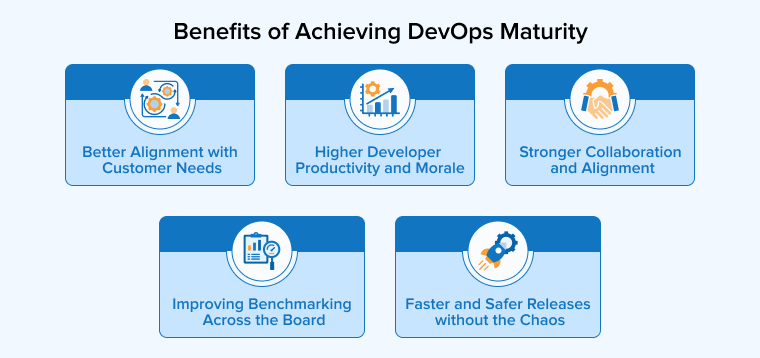
Faster and Safer Releases without the Chaos
DevOps maturity increases the speed of software delivery and updates using automated testing, integration, and deployment pipelines. Strong collaboration between development and operations teams also improves feedback and coordination. As a result, new features reach users faster, downtime is reduced, and overall service quality improves.
Better Alignment with Customer Needs
As the level of DevOps maturity advances, the deployment speed of updates and services increases. Constant collaboration between development and operations teams helps implement user feedback and respond to their needs quickly. This continuous testing flow of improvements allows businesses to introduce new features regularly, provide better value to users, and stay competitive in a fast-moving market.
Improving Benchmarking Across the Board
The DevOps maturity model establishes consistent practices across different teams and departments operating within an organization. Hence, it becomes easy for companies to accurately measure their progress and identify the improvement areas.
Stronger Collaboration and Alignment
DevOps provides a healthy work environment where developers, operations, and security professionals communicate and coordinate to perform shared responsibilities. Security and testing are addressed earlier in development, which helps detect issues sooner. This collaborative approach reduces delays, improves problem-solving, and supports smoother and more reliable software releases.
Higher Developer Productivity and Morale
DevOps methodology automates most of the repetitive and routine tasks that do not require manual intervention. The workflows become streamlined, and tasks get clearly defined. Therefore, developers can use their skills and energy on tasks requiring human attention, resulting in less burnout, job satisfaction, and software quality.
What Are the Tools for DevOps Maturity Assessment?
To get a holistic view of your organization’s DevOps maturity, you must include the following tools in your maturity assessment process:
DORA Metrics
DORA stands for DevOps Research and Assessment. It’s a team that conducted various surveys and came out with the following four metrics, known as DORA metrics, to assess the DevOps maturity level of any organization:
- Deployment Frequency (DF): DF lets you know the frequency at which the error-free code is released into the production environment. Teams can know their efficiency level and success rate in deploying quality code.
- Lead Time for Changes (LTTF): It gives the time taken between the first code commit to production in the software delivery pipeline. The lower the value, the faster the speed of the code delivery process.
- Change Failure Rate (CFR): CFR denotes the stability of code that reaches production. Teams can understand from the CFR percentage if speedy delivery is leading to deployment failures.
- Mean Time to Recovery (MTTR): MTTR gives the time taken for a service to recover from a failure or downtime. It shows the resilience and recovery strategies followed by your organization to prevent major breakouts.
Capability Maturity Model Integration (CMMI)
Capability Maturity Model Integration(CMMI) is a framework that provides a structured and organized approach to organizations for their process management and improvement. This framework is an improved version of the earlier Capability Maturity Model (CMM). It combines practices from areas such as software development, systems engineering, and workforce management.
The main goal of CMMI is to help organizations deliver better products and services, meet customer expectations, increase market growth, and build a strong reputation in the industry. There are different maturity levels in this model that show how well an organization’s processes are managed and improved over time. As organizations progress through these levels, their processes become more refined and efficient, which reduces risks and improves quality.
xMatters Incident Management Analytics
xMatters Incident Management Analytics helps organizations understand and improve how they handle system incidents using data and performance metrics. It collects and analyzes information such as Mean Time to Repair (MTTR), alert volumes, and team response times to assess the efficiency of incident management. The platform also supports DevOps measurement by tracking well-known indicators like DORA metrics.
The detailed reports allow teams to see what happened during an incident, who responded, and how long it took to detect and resolve the problem. This information helps organizations identify delays, communication gaps, or inefficient processes in their workflows. By integrating with monitoring tools and CI/CD systems, the platform provides a broader view of system health and operational performance. These insights can help teams improve their response strategies, increase automation, and move slowly toward a more efficient and mature DevOps environment.
Self-Assessment Surveys
A DevOps self-assessment tool helps organizations assess the effectiveness of DevOps practices adopted by their organization and identify the improvements to be made. It usually works as a questionnaire that focuses on every aspect, such as team collaboration, automation, monitoring, infrastructure management, and security practices. While attempting these questions, teams will be compelled to think deeply about their strengths and what are the gaps prevent them from achieving their goals.
The results often classify organizations into maturity levels, ranging from basic manual processes to highly automated and optimized environments. These assessments also provide recommendations on how to enhance workflows, adopt better tools, and strengthen cooperation between development and operations.
Common Mistakes that Stall DevOps Maturity
You must not run DevOps implementation blindly. It has to be done in a proper way to avoid future repercussions. Take a look at some of the common DevOps challenges teams face or ignore during implementation.
- Not Enough Automation: It happens many times that only automating deployment pipelines is prioritized, whereas ensuring compliance and infrastructure setup is ignored. One part is automated, while others remain manual. This affects the deployment speed, and mistakes increase.
- Ignoring Security Practices: Many times, security comes at the end of development, thinking it will not affect speed. As a result, problems found later get harder to fix and may lead to data breaches, delays, and trust erosion.
- Tool Accumulation: Some teams use too many different tools to manage infrastructure, deployment, monitoring, and security. This creates confusion, repeated work, and dependency issues.
Best Practices for Implementing DevOps Maturity Model
Consider the following best practices to get the best out of the implementation of the DevOps Maturity Model:
- Monitoring and Observability: Teams must constantly watch system performance and health using monitoring and observability tools. These insights help in quickly detecting unusual behavior, investigating problems, and resolving issues early to keep services stable.
- Culture of Continuous Improvement: Regularly audit the processes and do not wait for occasional reviews. This helps in continuously refining workflows and feedback systems to prevent small issues from turning into bigger and more costly problems in the future.
- Work On Cross-Functional Collaboration: Ensure that development, operations, and security teams collaborate closely instead of working separately. Open communication and shared tools help everyone stay informed, detect problems earlier, and work more efficiently toward delivering reliable software.
Final Thoughts
DevOps maturity is not limited to large organizations. It is something every industry is running behind to bring quality and efficiency in their processes and outputs. Organizations have to be careful while selecting DevOps maturity models. It must suit their team size, strategic goals, and industry standards. Therefore, take time and deeply research different aspects of various models and go for a result-oriented implementation.
FAQs
A DevOps maturity model is a well-designed framework that organizations use to assess the extent and depth of adoption of DevOps principles and practices.
DORA stands for DevOps Research and Assessment. It includes four key metrics: Deployment Frequency (DF), Lead Time for Changes (LTFC), Change Failure Rate (CFR), and Mean Time to Recovery (MTTR) to assess the DevOps maturity level of any organization.

Shruj Dabhi is an enthusiastic technology expert. He leverages his technical expertise in managing microservices and cloud projects at TatvaSoft. He is also very passionate about writing helpful articles on the same topics.



Comments
Leave a message...