

In an era where speed and reliability define business success, scaling DevOps has become a key priority for every Cloud & DevOps company. DevOps practices connect development and operations teams, enabling faster software delivery without errors. However, as companies grow, simple DevOps practices that worked for small teams often struggle to handle larger projects, more complex systems, and expanding infrastructure. This is where DevOps scaling becomes critical.
Scaling DevOps is not just about adding more servers or hiring more engineers. It requires thoughtful refinement of workflows, automation tools, and collaboration of different teams to maintain speed and reliability. Without proper scaling, organizations may face delays, increased errors, and higher operational costs.
In this article, we will explore DevOps scaling, covering when to scale, the process, common challenges, practical solutions for overcoming them, and best practices to follow. This will help organizations maintain high-quality software delivery while growing rapidly.
What is Scaling in DevOps?
Scalability in DevOps means adjusting tools, processes, and teams to match changing business demands without slowing delivery. It allows enterprises to add or reduce resources, automate workflows, and manage growing systems smoothly. Effective scaling improves collaboration, software release speed, and system reliability. However, scaling DevOps is not only about technology, but it also requires cultural changes, standardized practices, continuous improvement, and better teamwork to handle increased complexity while maintaining performance and quality.
When to Scale DevOps?
If you’re noticing the following situations in your organization, it’s time to consider DevOps scaling:
- Declining Deployment Frequency: If releases slow down as teams grow, your DevOps practices need scaling to preserve delivery speed.
- Increasing Lead Time: Longer gaps between code commit and production release show that pipelines require optimization to handle growing complexity.
- Rising Failure Rates: Frequent deployment failures or rollbacks indicate existing processes cannot safely manage increased system scale and complexity.
- Team Burnout: Regular overtime, constant firefighting, and heavy manual work suggest automation gaps and an urgent need to scale DevOps.
- Cognitive Overload: When teams struggle to manage tools and platforms, rising cognitive load signals that DevOps scaling has become necessary.
- Successful Pilots: Strong DevOps success in one team often means it is time to expand practices across more teams.
How to Scale DevOps?
If you’re planning to scale DevOps in your organization, follow the process below:
1. Assess Your Company’s Current DevOps Culture
Before making changes, teams should carefully review their current DevOps practices. Slow releases, repeated manual tasks, or weak testing often signal scaling problems. Using clear performance indicators like delivery speed and failure rates helps teams find real issues instead of guessing.
Enterprises must decide what they want to improve, such as faster releases, better quality, or higher system stability. If builds take too long, teams should strengthen their CI/CD flow. If testing feels unreliable, automation should come first. Teams should also examine cultural readiness, collaboration habits, and existing tools. Knowing your DevOps maturity level helps plan practical and valuable scaling steps.
2. Structure Your Priorities
Identify what matters most to your company, such as quality, faster releases, or frequent deployments. Scaling DevOps helps improve delivery speed, stability, and feature rollout efficiency.
3. Establish Success Criteria
Define clear metrics to track DevOps scalability goals, such as faster deployments, reduced legacy systems, or shorter timelines from code submission to production releases.
4. Select the Right Tools
Teams must review their DevOps tools across build, test, release, and monitoring stages. The right stack supports growth, security, and speed. Security-focused teams should favor scanning and vulnerability checks, while others may prefer integrated platforms. Regularly evaluate fit, automation, cost, and usability, then replace tools that slow delivery or add complexity.
5. Understand Your Team Culture
DevOps succeeds only when teams follow shared tools and practices. Isolated knowledge and disconnected groups slow progress and weaken results. Leaders should engage teams early, agree on common goals, and define joint performance measures. Training helps people understand new workflows and their value, which improves adoption.
Long-term scalability also relies on skilled engineers who maintain and improve systems. Enterprises may need to reshape team structures so developers, operations, and support roles work closely and share responsibility for outcomes.
6. Iterate Changes
Large, simultaneous changes often create confusion and hidden failures. Teams should introduce improvements step by step to reduce risk and learn from each update. Small, tested changes allow quick validation before moving forward. High-value, low-risk actions should come first, such as testing individual services or using canary releases. This approach supports easier rollbacks and system stability.
Teams should rely on monitoring results and defined success measures to judge progress. Regular feedback and data-driven reviews help refine decisions and guide future DevOps scaling efforts.
7. Automate Processes
Automation strengthens DevOps by removing repetitive tasks that slow teams down. Automated provisioning, testing, deployments, and security checks improve efficiency and reduce errors. Using open-source automation tools, teams can adopt infrastructure as code and CI/CD pipelines to create consistent environments, lower cognitive load, and deliver stable releases faster while maintaining quality.
Pillars of Scaling DevOps
There are three important pillars that you need to be well aware of when planning to scale DevOps:
People
Scaling DevOps starts with aligning people across the organization.
- Teams must collaborate openly, communicate clearly, and be willing to adopt new ways of working.
- Cultural resistance often slows progress, especially in risk-averse environments. Strong leadership helps overcome this by setting a clear vision and encouraging shared ownership across teams.
- DevOps does not replace people; it empowers them to work better by reducing unnecessary effort. Supporting employees through change requires time for learning, honest feedback, and involvement in setting standards.
- Cross-functional teams, broad skill development, and structured communication improve coordination at scale.
A culture focused on continuous learning and trust that helps teams reduce time, improve productivity, and deliver better outcomes consistently.
Process
Scaling DevOps depends heavily on refining how work moves through the delivery process.
- Teams must focus on efficiency, clarity, and smooth execution as systems and responsibilities grow.
- DevOps automation plays a major role by removing repetitive manual processes such as testing, provisioning, and deployments, allowing teams to focus on product improvement.
- Clear and accessible documentation ensures everyone follows the same workflows, reducing confusion, errors, and support overhead.
- Faster decision-making also matters, as fewer approval layers help changes move quickly without unnecessary delays.
- Monitoring and alerting systems enable teams to detect and resolve issues early, improving reliability and reducing downtime. Measurement adds further value by tracking metrics like deployment frequency, lead time, recovery speed, and failure rates, which highlight bottlenecks and improvement areas.
- Strong governance supports quality and compliance without slowing delivery and creates accountability through clear rules and audit trails.
- Integrating security early through DevSecOps helps identify vulnerabilities sooner and prevents costly fixes later.
- Open information sharing encourages learning from both successes and failures, helping teams continuously improve.
Together, these practices reduce waste, speed up delivery, improve quality, and increase return on investment. By treating DevOps as an evolving operating model rather than just a technical solution, organizations build scalable systems that consistently deliver value to both users and the business.
Platforms
As organizations grow, their infrastructure must adapt to support increased scale and complexity.
- Investing in modern DevOps platforms helps teams manage demand changes, control costs, and use resources efficiently.
- Tools such as CI/CD pipelines speed up testing and releases, while version control systems support smooth collaboration.
- Monitoring and alerting tools provide real-time visibility, and configuration management automates server setup and deployments. Streamlining these tools and ensuring strong integration reduces errors and deployment delays.
- However, scaling infrastructure is not only about adopting new technology. Many industries still depend on legacy systems that are costly and difficult to replace. Instead of removing them completely, teams should integrate modern DevOps practices alongside existing systems. For example, organizations can use microservices to deliver new features while legacy platforms continue handling core operations. This balanced approach allows innovation without major disruptions.
- Cloud-native platforms enable auto-scaling, container technologies support flexible deployments, and infrastructure automation ensures consistency at scale.
By choosing platforms that evolve with business needs and work well with existing systems, organizations can modernize safely, maintain reliability, and scale DevOps operations without increasing operational complexity.
Key Strategies for DevOps Scaling
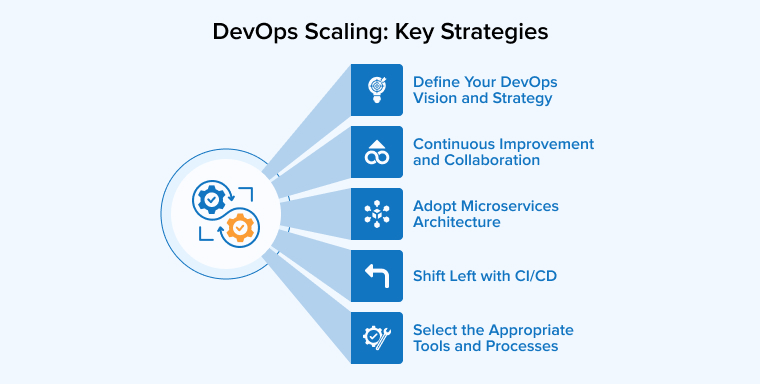
Now we’ll discuss the five DevOps scaling strategies to ensure we scale DevOps effectively:
1. Define Your DevOps Vision and Strategy
To scale DevOps successfully, your organization needs a clear strategy that aligns with business priorities. Leaders should show how embracing automation, collaboration, and CI/CD accelerates delivery, lowers costs, and improves software quality. A practical way to start is by implementing DevOps in a single project and tracking progress using defined performance metrics.
Gradually expanding from that initial effort enables teams to adopt new practices confidently while keeping everyone aligned. This step-by-step approach reduces risks, encourages learning, and ensures that improvements are sustainable as DevOps grows across the organization.
2. Cultivate a DevOps Culture of Continuous Improvement and Collaboration
For DevOps to grow successfully within an organization, the right culture must come first. Teams need to move away from working in isolation and start collaborating more closely. Developers, operations engineers, QA specialists, and security teams should share responsibility for delivering reliable and secure software.
Open communication and regular feedback help teams solve problems faster and improve their processes over time. Organizations that encourage learning from mistakes rather than blaming individuals create a healthier environment. When people collaborate, share knowledge, and continuously improve together, DevOps practices and automation become much easier to scale and sustain.
3. Adopt Microservices Architecture
Microservices allow teams to build and deploy software in small, independent units, giving each team control over its own services. This approach improves scalability because individual services can expand based on demand without impacting the whole system.
Teams gain flexibility to use the best tools for each service, and failures in one component do not bring down others. To manage complexity, organizations use containers, monitoring, and service meshes, which help coordinate, secure, and observe services effectively, making large-scale systems more reliable and easier to maintain.
4. Shift Left with CI/CD
Shifting left means teams test code early while developers write it, not after handoffs to separate teams. Fast, reliable CI/CD pipelines support this approach by building, testing, and releasing code automatically. Strong pipelines reduce risk, avoid delays, and keep software ready to ship.
Practices like Git-based deployments, containers, and incremental releases improve consistency and control. Automation limits manual errors and speeds delivery as teams grow. DevOps automation supports repeatable environments, while monitoring tools provide quick feedback, helping teams detect issues early and maintain quality at scale.
5. Select the Appropriate Tools and Processes
A strong DevOps toolchain requires selecting the right tools for each stage, ensuring faster delivery and higher software quality. Standardizing tools and processes across teams reduces complexity and improves collaboration. Integrated solutions for version control, CI/CD, configuration management, and monitoring create a unified pipeline.
Clear coding standards, security practices, and deployment workflows help teams stay aligned, onboard new members quickly, and maintain productivity while scaling operations efficiently across the organization.
DevOps Scaling Challenges and Their Overcoming Techniques
So, what are the common obstacles in the way of DevOps scaling? Let’s see below:
Deployment Difficulties
Scaling DevOps adds complexity to existing workflows and infrastructure, requiring careful planning, effort, and collaboration. Managing microservices, automated pipelines, and multiple teams introduces challenges like conflicts, monitoring, and rollbacks.
Teams must coordinate changes, maintain independent components, and optimize CI/CD processes to ensure smooth, reliable deployments while minimizing bottlenecks and disruptions as the organization grows.
Tight Budget and Fewer Resources
Scaling DevOps needs careful cost control to avoid waste and budget overruns. Teams should optimize infrastructure, share environments, and track usage continuously. Smart platform choices, automation, and ROI-based investments reduce inefficiencies. Although scaling requires upfront spending, improved workflows and monitoring lower long-term costs and support growth without financial strain.
Security and Compliance Maintenance
Scaling DevOps safely requires embedding security into every stage of delivery. Automated checks, access controls, and policy-driven compliance reduce risks without slowing teams down. Early security testing prevents costly fixes later and protects sensitive data. When teams share responsibility and automate governance, they maintain speed while securing complex and distributed systems.
Increasing Test Coverage
Strong testing prevents defects from reaching production. Teams use unit, integration, and system tests to validate growing codebases. High test coverage keeps declarative infrastructure reliable as it expands. Monitoring test results and service behavior helps teams spot issues early, maintain quality, and scale DevOps processes with confidence.
Final Thoughts
Scaling DevOps is a continuous journey that focuses on people, processes, and smart technology choices. It demands clear goals, strong collaboration, and steady improvements across teams. By reducing manual work, automating workflows, and selecting tools that balance cost and performance, organizations can handle growth without losing speed or quality. A thoughtful DevOps scaling approach also strengthens security, improves reliability, and supports changing business needs. When teams rethink how they build, test, and deliver software, DevOps becomes a long-term advantage rather than a short-term solution.
FAQs
Yes, DevOps scaling is not only for large enterprises. In fact, it’s easier for small companies to implement DevOps scaling due to operational flexibility, limited bureaucracy, agility in decision-making, and lower technical debt, among other factors.
Scaling up or vertical scaling means increasing the existing server’s capacity, while scaling out or horizontal scaling means adding more servers or instances.

Shruj Dabhi is an enthusiastic technology expert. He leverages his technical expertise in managing microservices and cloud projects at TatvaSoft. He is also very passionate about writing helpful articles on the same topics.



Comments
Leave a message...