

Software development has become a core driver of growth for organizations of all sizes, especially as digital solutions continue to transform every industry. Yet, despite improved tools, skilled teams, and refined processes, many projects still struggle to reach completion. A surprising number of products fail to meet expectations, fall behind schedule, or never launch at all. These setbacks not only increase costs but also weaken customer trust and hinder long-term business goals. Any software development company understands that building a successful product requires more than technical expertise; it demands clear planning, continuous communication, and strong decision-making.
Projects collapse for many reasons, including unclear requirements, overlooked risks, or poor coordination between teams. The good news is that most of these issues are preventable when identified early. This blog explores the most common causes of software development failure and highlights practical steps to avoid them.
Why Do Software Development Projects Fail?
Software development projects often fall short of expectations due to a mix of strategic, technical, and human-driven challenges that accumulate over time. Let’s discuss the key reasons contributing to the project failure:
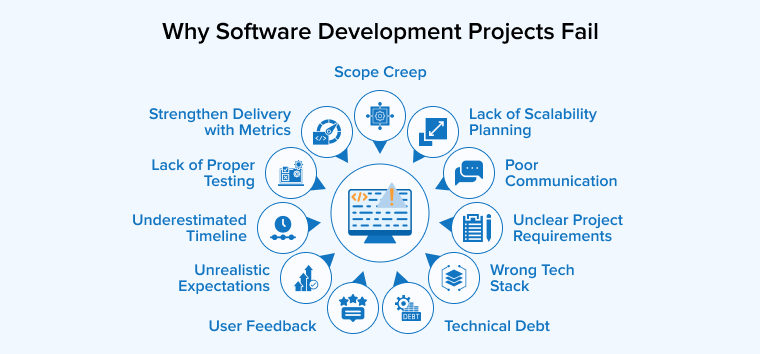
Unclear Project Requirements
Clear and complete requirements are essential for building successful software. When teams receive vague goals or constantly changing instructions, they struggle to understand what the product should do, who will use it, and how it must function. This leads to misunderstandings, delays, and features that do not match business needs.
To avoid this, requirement clarity should be established early in the discovery phase. Engaging stakeholders, developers, and end-users in discussions helps everyone align on the project’s goals. Techniques like user story mapping, wireframes, and mockups make ideas more concrete by showing how users will interact with the product. Detailed documentation, defined use cases, and realistic expectations ensure developers build exactly what the business envisions. With a clear direction from the start, teams can avoid rework and deliver solutions that genuinely solve user problems.
Underestimated Timeline
Poorly planned timelines and unrealistic budgets often push teams into rushed development, resulting in low-quality work and missed objectives. To avoid this, teams must estimate timelines carefully and use past project data to predict effort more accurately. Adding buffer time helps manage unexpected challenges without derailing progress. Visual tools such as architecture diagrams and project management templates also make it easier for stakeholders and developers to understand system design and dependencies, reducing confusion early on.
Techniques like Three-Point Estimation provide balanced predictions by considering optimistic, likely, and pessimistic scenarios. Clear communication with clients is equally important, especially since requirements often change mid-project. Breaking the work into smaller milestones, tracking progress regularly, and setting a shared definition of done ensure everyone stays aligned and prevents unnecessary time or cost overruns.
Technical Debt
Technical debt arises when teams take shortcuts such as quick fixes, outdated libraries, or incomplete documentation, to meet deadlines or reduce costs. While these choices may speed up delivery initially, they gradually slow development, increase maintenance demands, and make future changes more difficult. If ignored, technical debt can lead to severe failures, as seen in the Knight Capital incident, where neglected code caused massive financial losses.
To manage this risk,
- Teams must regularly review their codebase, refactor fragile sections, and replace obsolete dependencies.
- Documenting all known issues helps maintain clarity and makes prioritization easier.
- Allocating dedicated time for cleanup, maintaining strong coding standards, and using automated testing and continuous integration ensure problems are detected early.
- By addressing the debt that directly impacts stability and team productivity, organizations can maintain healthier systems and avoid costly setbacks.
Wrong Tech Stack
Choosing an unsuitable tech stack often leads to performance problems, limited scalability, and security risks. Teams may select tools based on trends instead of aligning them with actual project needs. To avoid this, carefully evaluate requirements, budget, expected load, and long-term goals before selecting any technology. When uncertainty remains, seeking guidance from experienced professionals can prevent costly mistakes.
Staying updated with new tools and industry shifts also helps teams make timely adjustments. Supporting developers with strong project management tools further improves coordination, reduces confusion, and ensures the chosen technologies continue to meet evolving project expectations.
Lack of Scalability Planning
Failing to plan for scalability can severely limit a software product’s long-term performance and stability. As user numbers grow, systems that were not designed to scale may slow down, crash, or struggle to process increasing data. A well-known example is Friendster, which faced massive performance failures because its database, architecture, and caching approach could not keep up with rapid user growth.
Several factors contribute to scalability issues:
- Poorly structured databases often become a major bottleneck because they cannot handle expanding records efficiently.
- Selecting technologies that are not built to scale can also restrict growth, making it harder for applications to support rising traffic.
- Rigid code architecture prevents teams from improving or expanding individual components without affecting the entire system.
- Missing load balancing further intensifies the problem, as traffic concentrated on a single server can cause outages.
- Lack of asynchronous processing also slows down the main application when background tasks are handled inefficiently.
To avoid these issues, teams should begin scalability planning early. This includes performance testing, adopting modular architecture, relying on cloud platforms, monitoring system health, and applying techniques like caching, database optimization, horizontal scaling, and asynchronous task handling. Building with growth in mind ensures a smoother experience as the software expands.
Poor Communication
Strong communication is essential for any software project to succeed. When clients, developers, designers, and managers do not share updates or clarify expectations, the entire process becomes confusing and unorganized. Each team works on different parts of the product, and even a small misunderstanding can create issues for everyone involved.
Regular discussions, clear documentation, and accessible communication channels help prevent this. By meeting often, reviewing progress, and encouraging honest feedback, teams can spot problems early and adjust quickly. Collaboration tools like Jira, Trello, or Slack also support smooth information flow and keep all members aligned. When communication is open and consistent, teams avoid unnecessary rework, reduce delays, and stay focused on delivering a product that functions as intended.
Scope Creep
Scope creep occurs when new ideas, features, or changes are added to a project without proper review, slowly pushing it beyond what was originally planned. Even small additions can pile up and cause delays, higher costs, and extra pressure on the team. This usually happens when the initial requirements are unclear or not documented well, leaving room for confusion and unwanted expectations.
To avoid this, teams should define the scope in detail from the beginning and use a structured process to review and approve any changes. Regular communication, consistent updates, and stakeholder involvement help catch issues early and keep the project aligned with its goals. Clear planning and controlled changes ensure smooth and predictable development.
Strengthen Delivery with Metrics
Tracking the right metrics is essential for rescuing any software project, because relying on assumptions often leads to hidden problems and unexpected delays. Instead of guessing how the project is moving, teams should depend on clear indicators such as sprint velocity, bug patterns, code coverage, deployment frequency, and the number of urgent fixes or rollbacks.
These measurements reveal how efficiently the team is working, where quality gaps exist, and whether the delivery process is improving or slowing down. Sharing these metrics openly with developers, managers, and stakeholders encourages honest conversations based on actual data rather than opinions. This transparency helps teams spot risks early, make smarter decisions, and keep the project on a stable track, reducing the chances of failure.
Unrealistic Expectations
Software development projects, whether large-scale or small-scale, are planned with great expectations as they would ease the working process and improve productivity. A project is not called successful if it’s only technically sound, but also if it fulfills the expectations of clients/product managers/stakeholders/ in terms of good user experience, correct timeframe, budget boundaries, etc. There’s no harm in being proactive and setting high expectations regarding a software development project. However, the problem starts to come to the surface when expectations cross the boundary of existing situations.
It has often been observed that clients or customers are unaware of the software development process. They are not even keen to know what all stages a software has to go through to become eligible for the desired use. As a result, they give a very tight deadline to the development team and demand a product with advanced features and performance. Does this seem feasible to you? It’s definitely not. The end result either exceeds the timeline or does not follow the quality parameters. Ultimately, it doesn’t obey user intent and provides a poor user experience.
So, what can be done to balance the expectations of both clients and end users? The following are some of the preventive measures companies can consider:
- Establish well-defined and achievable targets from the beginning of the project.
- Development teams must inform the concerned stakeholders about the challenges and constraints they’ll face during the development cycle to keep realistic expectations and ensure transparency and trust.
- Communicate the reasons and recovery strategy for the project’s failure.
- Goals and expectations must be discussed at every phase of the SDLC and not only during the planning phase.
- Provide a realistic picture to the stakeholders as to what they can expect from the development team.
Lack of Proper Testing
What if the software, after being developed, does not work as expected? What if your system suddenly comes to a halt, and all the data disappears from the system? The efforts that the team put into development are nearly wasted. It happens due to the less importance given to software testing than to development. Sometimes time crunch forces teams to cut back on testing or not go for rigorous testing.
As a consequence, the product, after being released into the live environment, faces security vulnerabilities and is at risk of being exploited by malicious actors. Service interruptions and security issues downgrade user experience and affect the reputation of the client company very badly. Not only this, but the cost of fixing these issues sometimes goes even higher than development expenses. The more time it takes to detect a bug, the more complex and costly it becomes to fix that bug.
Software development and testing must go hand-in-hand. A set of quality parameters must be identified during the planning phase. Testing must be integrated from the initial stages of development, as done in Agile and DevOps strategies. It decreases the possibility of uncovering security vulnerabilities at later stages and thus reduces costly and time-consuming software fixing. Prepare a comprehensive test plan that uncovers all aspects of the software and go for an automated testing approach using advanced tools and frameworks. Prioritize the areas where testing is essential. With updates and changing requirements, test scripts must also be updated accordingly to ensure relevance.
User Feedback
Software development begins with understanding and analyzing user requirements, what problems they are facing, shortcomings of the existing solutions available in the market, and so on. Thus, users take the center stage during the planning and development process. However, the irony is that the task began with a user focus, but subsequently ignored them in the later stages. Clients and developers ignore what the actual user needs, resulting in dissatisfaction and complaints after the software release.
- Involve end users as active rather than passive partners in the entire software development process.
- Observe users in their actual work environment to see how they perform tasks.
- Use software analytics to monitor user behavior and identify areas where users struggle, informing future updates and iterations.
- Conduct formal reviews where users provide feedback on design mockups and proposed workflows.
- Perform User Acceptance Testing (UAT) where end users verify that the system satisfies the specified requirements and supports their business processes.
Real-Life Examples of Software Failures
We’ll now look at real-world instances where software projects failed owing to one or more of the above reasons.
Pentium FDIV Bug, 1994
A minor technical flaw in the Intel Pentium chip, discovered by Thomas Nicely, caused tiny errors in complex math, projected once every 360 billion operations. Public alarm over the issue forced Intel into a general replacement program costing around $475 million.
Volkswagen’s Software Crisis
Volkswagen’s software arm, Cariad, faced setbacks from complex, non-reusable systems and poor testing, resulting in project delays and employee dissatisfaction. These issues led to a two-year delay in major projects, a $5 billion partnership with Rivian to catch up, and a 25% drop in employee morale.
IBM Watson for Oncology
IBM Watson for Oncology failed due to inaccurate cancer treatment recommendations. The AI was trained on limited, U.S.-centric data and couldn’t adapt to diverse global medical guidelines, leading to significant financial losses and public criticism. As a result, IBM shut down Watson Health in 2023 and started concentrating on cloud infrastructure and general enterprise AI.
Final Thoughts
Software development failure is rarely the result of weak technology; it is most often the outcome of unclear goals, poor communication, and decisions made too late. The encouraging reality is that these issues can be prevented when teams adopt thoughtful planning, transparent dialogue, and a strong focus on user needs. Successful projects grow from a foundation of clear requirements, collaborative teams, and consistent quality practices.

Itesh Sharma is core member of Sales Department at TatvaSoft. He has got more than 6 years of experience in handling the task related to Customer Management and Project Management. Apart from his profession he also has keen interest in sharing the insight on different methodologies of software development.



Comments
Leave a message...