

Java is one of the most popular and widely used programming languages globally., It has a rich ecosystem, consisting of numerous frameworks and libraries for web development. Among them, the Spring Framework stands out because of its varied offerings. Spring MVC and Spring Boot are two key modules that top Java development companies leverage for building robust web apps. These frameworks remain relevant in the modern age of AI by helping developers and businesses alike to meet their project requirements.
This article explores the features and benefits of each option and then discusses their differences based on standard industry parameters. We will also examine their use cases to help you choose the right framework for your upcoming Java development project.
What is Spring MVC?
Spring MVC framework is popular for building scalable web apps. The framework separates modules like Model, View, and Controller to ensure separation of concerns, resulting in enhanced software development and maintenance.
In Spring MVC, developers can build complex apps using plain Java classes. It uses maps to pass the Model object between the View and the Controller. Let us understand the components of a Spring MVC framework.
- Model: An object or a collection of objects consisting of the app data.
- View: Displays information to users in a specified format.
- Controller: The logical part of the app. Using the @Controller annotation marks the class as a controller.
What Are the Features of Spring MVC?
Understanding the features of Spring MVC will help you learn about its capabilities.
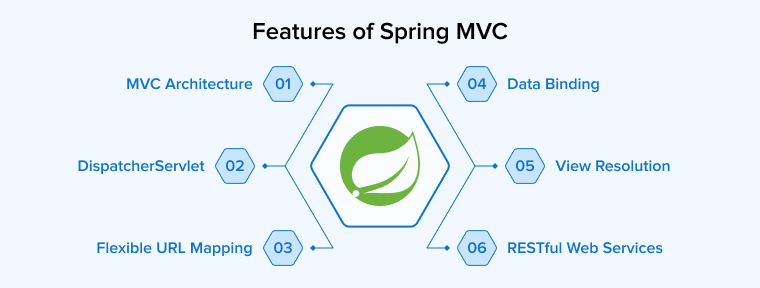
1. MVC Architecture
As the name suggests, the Spring MVC framework follows the MVC architectural pattern. In this approach, the software is separated into three interconnected components, each representing a different aspect.
- Model (Data and business logic)
- View (Presentation layer)
- Controller (Request handling and application flow)
2. DispatcherServlet
DispatcherServlet is one of the critical elements of the Spring MVC framework. It uses URL mappings to intercept incoming HTTP requests and route them to the appropriate controllers.
3. Flexible URL Mapping
In Spring MVC, developers can define URL mappings flexibly, allowing them to route requests to different controllers and apply various techniques.
4. Data Binding
Spring MVC offers powerful data binding capabilities that automatically convert HTTP request parameters to Java objects. This feature streamlines form handling and validation.
5. View Resolution
By offering support for various types of view technologies like FreeMaker, Thymeleaf, and JavaServer Pages (JSP), Spring MVC gives developers the flexibility to choose the view technology that best fits their needs or preferences.
6. RESTful Web Services
Spring MVC is widely used for web app development, but its data binding and request handling capabilities also make it a valuable tool for creating RESTful web services.
What Are the Advantages of Using Spring MVC Architecture?
Here are a few important benefits of using the Spring MVC architecture in Java app development:
Different Roles
Spring MVC separates the Model, View, and Controller, assigning each clear roles and responsibilities to ensure modularity and enhance app maintainability.
Lightweight Framework
You won’t find any unnecessary complexity in the app that adheres to the Spring MVC architecture. It is lightweight in terms of configuration and runtime, leading to quick setup and easy use.
Flexible and Powerful Configuration
Spring MVC offers structural flexibility, supporting both XML and annotation-based configurations to fulfill your unique project requirements.
Rapid Development
With Spring MVC, programming is highly simplified as it offers built-in features for validation, annotations, and form handling. Thanks to these ready-made features, developers don’t have to build a Java application from scratch, allowing them to focus on core tasks and increasing productivity.
Reusable Business Code
Spring MVC architecture follows a modular pattern that encourages code reusability. It decouples the business logic from request handling and presentation. This helps prevent any kind of data duplication and makes it easy to scale or maintain Java applications.
Ease of Testing
Spring MVC provides seamless integration with Java testing frameworks and tools like Mockito and JUnit, which support unit testing to help maintain quality standards and keep the app bug-free.
Flexible Mapping Options
Spring MVC offers various mapping options, providing developers with the flexibility to choose the most appropriate one through annotations. Using the right mapping option gives more control over incoming requests and simplifies web page design.
Dependency Injection
Dependency injection reduces coupling in Spring MVC, which improves adaptability. Therefore, you do not require designing tight dependencies to integrate with services such as database connections
What is Spring Boot?
Spring Boot is an integral part of the Spring ecosystem, designed to reduce boilerplate code and accelerate the development of production-grade applications. It effectively streamlines the development, deployment, and configuration processes for Java apps.
For that purpose, the Java framework offers embedded servers, a set of defaults, and more. If you are working on a project that demands quickly building a powerful and production-ready application while providing the flexibility to customize the configuration as needed, then Spring Boot is an ideal choice.
What Are the Key Features of Spring Boot?
Spring Boot provides numerous features to simplify Java app development, including but not limited to:
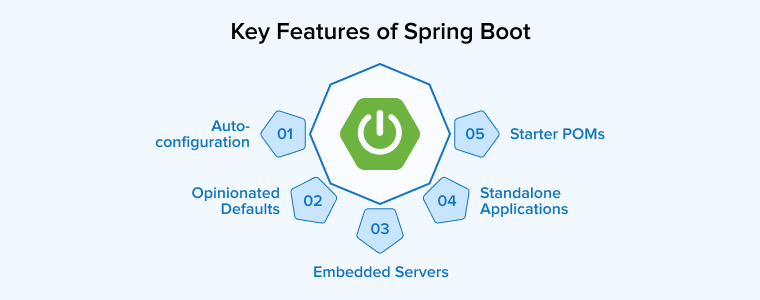
1. Auto-configuration
This allows the app to configure the settings automatically, considering the environment. This reduces the need for manual setup and configuration complexities.
2. Opinionated Defaults
Spring Boot offers default settings and configurations for different aspects of software development. The need for manual configuration reduces dramatically when a framework is opinionated, allowing programmers to quickly get started with Java development.
3. Embedded Servers
The availability of embedded servlet containers such as Undertow, Jetty, and Tomcat in Spring Boot helps avoid manual configuration and server setup.
4. Standalone Applications
With Spring Boot, developers can build apps that run on their own without any external web server. The most important benefit of having the capability to build such a standalone appthat can be launched on almost every platform.
5. Starter POMs
This feature is a set of convenient dependency descriptors that simplify dependency management for Gradle or Maven.
What Are the Advantages of Spring Boot?
Having opinionated defaults and auto-configuration capabilities, Spring Boot packs a lot of features, offering various advantages like:
Spring Boot Starters
To simplify the app development, Spring Boot offers ready-made starter projects. Developers have the flexibility to use these starters to begin a project or add them even in the middle of the development process. Java Mail Sender, Spring Boot Dev Tools, Spring Data JPA, Eureka Server, MySQL Driver, Spring Security, and Spring Web are to name some starter projects available in the framework. Spring Boot also allows you to add third-party libraries that work like a starter project.
Reducing Boilerplate Code
The need to write complex XML configurations, annotations and boilerplate code is reduced when using Spring Boot. It offers easy-to-use APIs that save developers from the manual effort of writing and rewriting boilerplate code.
Additionally, Spring Boot provides a single annotation that eliminates the need for manual configurations, including XML-based configurations. For instance, the @SpringBootApplication annotation is specific to the Spring Boot framework, which is a combination of three annotations, namely, @Configuration, @ComponentScan, and @EnableAutoConfiguration.
Features Suitable for Production
Spring Boot provides standard features like logging, monitoring and analytics to build production-ready applications. Its opinionated settings save developers time and effort. The health actuator endpoint is a feature that allows developers and stakeholders to monitor the status of their applications.
Adaptation Curve
Familiarity with the Java Spring framework makes learning Spring Boot simple. Compared to Spring, business logic needs a little more attention in Spring Boot. Moreover, knowledge of a small set of annotations goes a long way in Spring Boot development.
No XML Configuration Required
Spring leaves the decision between using annotations or XML configurations completely up to developers. Programmers who want to minimise extra effort in the development process are inclined to use annotations over XML configurations.
WAR Files are Not Required
Though Spring Boot supports Web application resource files, using them is not essential, as it mostly relies on Java resources or JAR files. Developers find JAR more useful due to its simple and concise structure. Being lightweight, JAR quickly connects the apps with the required tools.
Spring MVC vs Spring Boot: Key Differences
After understanding the features and benefits of both frameworks, it becomes necessary to compare Spring MVC and Spring Boot against the standard parameters to determine which one is most suitable for your project requirements.
1. Configuration and Setup
By providing greater flexibility and customizability, Spring MVC has become an ideal choice for building large-scale, complex enterprise applications. However, all configurations and setups must be done manually.
Spring Boot offers opinionated settings and default configurations that enable rapid development. Such a framework works best for building small to medium-sized software applications and microservices. Spring Boot enables developers to efficiently write the code that precisely implements the underlying business logic.
2. Dependency Management
Dependency management in Spring MVC is manual. It requires developers to explicitly declare every library and coordinate the compatible versions across dependencies. As a result, the Spring framework, servlet container integrations and security libraries are kept aligned by adding several Gradle or Maven coordinates and handling transitive version conflicts.
Developers are required to check the compatibility across different artifacts to upgrade the version. Meanwhile, adding BOMs or explicit dependency exclusions helps avoid mismatched transitive dependencies.
Spring Boot provides a Bill of Materials and curated starter dependencies to simplify dependency management. These help pin compatible versions across the entire stack. So, instead of adding different kinds of libraries, just use short starters, and Boot will bring up compatible modules and third-party libraries.
Version upgrades are easy with Spring Boot by making a single change in the parent or dependency management entry. This minimizes version conflicts, speeds up the setup processes, and enhances the maintenance of consistent dependency sets.
3. Performance & Monitoring
It allows manual configuration of components, wiring, and deployment descriptors in Java applications. This flexibility helps fine-tune the app for high performance. With the customizability of Spring MVC, developers can explicitly choose the dependency injection scopes, caching strategies, thread pools and servlet containers. When done properly, such manual fine-tuning can reduce memory overhead and improve the startup time.
However, this flexibility also demands more boilerplate code, resulting in longer development cycles. More importantly, any misconfiguration can easily disrupt the runtime performance. Monitoring in Spring MVC heavily relies on integration with external libraries. Therefore, teams are required to add and explicitly configure the logging, health checks, and metrics.
Whereas Spring Boot is an opinionated framework with auto-configuration that impacts both performance and monitoring. It builds on Spring MVC and other Spring projects, bundling a large number of embedded servers and defaults.
This results in a larger memory footprint and longer startup time compared to a minimally configured Spring MVC app. Although Spring Boot increases development speed and reduces configuration errors, its conventions can cause your Java app’s performance to deteriorate.
Spring Boot provides minimal setup and immediate visibility for monitoring through tracing systems, health checks, metrics, and actuator endpoints. The framework offers auto-configuration but also allows you to disable unused configurations, configure caches and thread pools, and trim dependencies.
4. Development Speed
The development speed of Spring MVC is slow at the beginning because developers are required to manually configure files such as web.xml or Java config. Additionally, they must integrate libraries, manage metrics, handle dependency versions, and configure servlet containers as needed.
Performing all this setup work manually results in excessive boilerplate code, increasing the time and effort required to standardize projects across the team. Such an approach serves well for custom projects; it can significantly affect development speed.
On the other side, Spring Boot offers starter dependencies, opinionated auto-configurations, conventions over configurations, and embedded servers that accelerate development. Spring Boot enables you to build a fully functional application with minimal configuration and code. It also offers starters for common as well as production-ready features, which help reduce boilerplate and accelerate development, especially if you are working on microservices or greenfield projects.
5. Security
Spring MVC supports Spring Security to implement authentication, authorization, and other security measures. The configurations of security features, such as defining access rules and setting up the authentication providers, must be done manually.
Spring Boot’s auto-configurations include security configurations for common security concerns. It also provides starters like the Spring Boot Starter Security to implement sensible default security for apps. Java configurations and properties are used to customize the security settings in Spring Boot.
6. Embedded Server
Spring MVC doesn’t include an embedded server. The Java app must be deployed as a WAR file to an external servlet container. This separation needs deployment steps, configurations and server provisioning, but also enables a shared container for different apps and centralized server management.
Embedded servlet containers are available in Spring Boot by default within an executable JAR. It simplifies the CI/CD, development, testing, and microservices deployment by making the application self-contained and runnable with a Java JAR.
If necessary, Spring Boot also allows you to build and deploy a WAR file to an external container. Embedded servers help increase the artifact size, shift the server management to the application, and enhance the portability and startup automation.
7. Scalability
The load balancer in Spring MVC allows for horizontal scaling of the Spring MVC apps by deploying multiple instances. But in Spring MVC, scaling needs manual configuration and handling of resources like caching and connection pools. On the other hand, Spring Boot offers production-ready features and an embedded server, ensuring high scalability for Java applications. It provides externalized configurations, health checks and metrics for easy management and monitoring of large-scale deployments. Additionally, containerizing the Spring Boot application is easy using Docker for deployment in cloud environments.
Spring MVC vs Spring Boot: Tabular Comparison
This section provides a brief look at the differences between Spring MVC and Spring Boot.
| Parameters | Spring MVC | Spring Boot |
|---|---|---|
| Purpose | Enables Java development through Java Enterprise Edition | Simplifies and speeds up the web development process by reducing the code length |
| Project Setup | Complex with numerous configurations | Spring Initializr simplifies the setup |
| Deployment | Deployable on an external server | Runs standalone with an external server |
| Learning curve | High configurations lead to a steeper learning curve | Opinionated defaults and reduced boilerplate make it easy to learn |
| Development time | The need to check whether every dependency is coupled with a suitable version results in slow development | Wrapping all the dependencies together reduces the development time |
| Auto-configuration | Not available | Available for common use cases |
| CLI | Not available | Provides CLI tools to quickly generate boilerplate code and start the project |
| Monitoring | Need manual setup and configuration to monitor and handle the app | Offers built-in monitoring and management endpoints to easily monitor the app’s health and status |
| Server | For testing the Spring project, it’s necessary to explicitly configure the server | Spring Boot provides an embedded server like Tomcat, Jetty, etc. |
| Use cases | Suited for large-scale and complex projects that require extensive configurations and fine-grained control over app components | Ideal for prototyping, rapid development and projects with standard configurations. Widely used in building containerized and microservices apps |
When to Use Spring MVC?
The strengths and limitations of the Spring MVC framework determine its ideal use cases.
When You Need a Clear Separation of Concerns (MVC Pattern)
When working on an app that benefits from separating the concerns of the Model (data), View (UI), and Controller (request handling), the MVC pattern proves to be very useful. It enables the frontend team to work on UI and the backend team to work on backend separately, which helps improve the testability and maintainability of the application.
When You Want Annotation-Driven, Convention-Over-Configuration Development
Annotations like @GetMapping, @RequestMapping, and @Controller from the Spring MVC simplify the request management, accelerate the development and keep the XML/config to a minimum to ensure code readability.
When You Need Robust Request Routing and Flexible URL Mapping
With the help of the robust request mapping features like content negotiation, request params, path variables and method-specific mappings in Spring MVC, developers can build clear, RESTful URL structures and manage complex routing scenarios.
When You Require Easy Integration with the Spring Ecosystem
Integrating Spring MVC with a different Spring project, such as Spring Data, Spring Security or Spring Boot, is easy because all of them have standardized configurations and shared features like transaction management and dependency injection.
When You Build RESTful APIs or Web Applications
Developers can create both server-side rendered applications and REST APIs with the help of a wide range of tools offered by Spring MVC. Therefore, the framework is suitable for building a variety of web solutions.
When to Use Spring Boot?
Let us understand the instances where the Spring Boot implementation might prove to be more beneficial.
When You Want a Rapid Application Setup and Minimal Configuration
Spring Boot comes with starter dependencies and auto-configurations, which help you quickly get started and build a functional app with minimal boilerplate. As a result, the setup time is low, and the development speed is high.
When You Prefer Convention-Over-Configuration and Sensible Defaults
Spring Boot offers default configurations for most of the use cases. However, in case of a unique requirement, it allows easy override for necessary customization.
When You Need Standalone, Production-Ready Applications
Spring Boot allows you to choose between packaging the app as an executable JAR or WAR with an embedded server. This helps simplify the development process and reduces the external server handling.
When You Want Opinionated Starters for Common Functionality
Spring Boot provides a bundle of sensible defaults and dependencies such as Spring Boot Starter Data JPA, and Spring Boot Starter Web to accelerate the development for web, data security and messaging use cases.
When You Need Built-in Production Features
Production-ready features like app configuration management, logging, metrics, and health checks are available in Spring Boot through externalized configuration and actuators to simplify the monitoring and operations.
Conclusion
The Spring ecosystem consists of numerous frameworks, but Spring MVC and Spring Boot stand out due to their extraordinary capabilities. Despite both belonging to the same ecosystem, they were designed to fulfill different project requirements.
Spring MVC lays the foundation for building complex apps by providing flexibility and customizability. Meanwhile, the Boot simplifies the development process with sensible defaults and auto-configurations, helping developers save time and quickly build runnable applications.
The decision of picking the right tool varies according to the project requirements and the development team’s preferences. But understanding the features, benefits, and use cases of these frameworks certainly helps make an informed decision.

Rakshit Toke is a Java technology innovator and has been managing various Java teams for several years to deliver high-quality software products at TatvaSoft. His profound intelligence and comprehensive technological expertise empower the company to provide innovative solutions and stand out in the marketplace.



Comments
Leave a message...