

Web development has moved beyond building websites that display content or respond to basic user actions. It’s high time to explore smarter solutions that can understand what is happening, make decisions, and take meaningful action without requiring constant human input. This is where agentic AI is starting to make a real difference.
Agentic AI in web development brings AI systems into the web development workflow. These systems can analyze user behavior, identify patterns, perform tasks, and adjust their actions based on changing situations. However, this requires proper planning, decision-making, tools, secure data usage, and understanding how different AI agents work together.
This guide explores agentic AI, its role in modern web development, how such web apps differ from traditional ones, their working, benefits, challenges, real-world examples, and future potential.
What is Agentic AI?
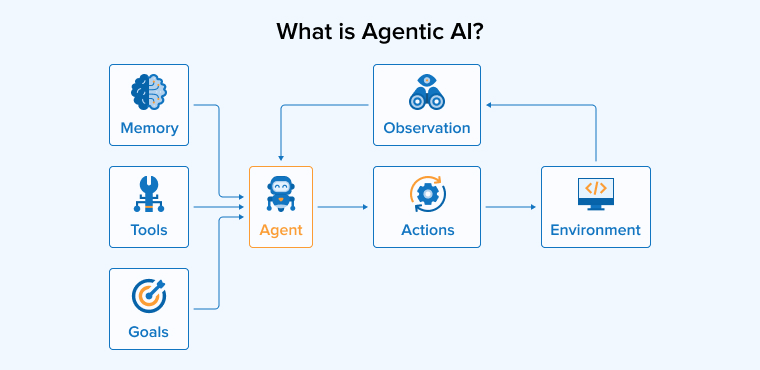
Agentic AI is an AI system made up of AI agents, i.e., machine learning models that are capable of thinking, planning, making decisions, and executing tasks by taking multi-step actions to complete a particular task in real time. It mimics human decision-making capabilities, unlike traditional AI, which needs commands or prompts at every step to perform a given task. Agentic AI adapts itself to changing scenarios by itself and thus performs proactively in dynamic environments.
What is Agentic AI in Web Development?
Agentic AI in web development is the use of independent AI agents by web development companies to analyze project requirements, define project objectives and scope, write code, test and debug it, deploy, and monitor the web application after it goes live with minimal human intervention.
Agentic Web Apps vs Traditional Web Apps: Tabular Comparison
Let’s quickly understand how traditional web applications differ from those made using Agentic AI:
| Parameter | Agentic Web Apps | Traditional Web Apps |
|---|---|---|
| User interaction | Form fills, clicks, manual navigation | Natural language goals and intent |
| Execution model | Synchronous and deterministic | Asynchronous, event-driven, and goal-driven |
| Learning Capability | It learns continuously from its mistakes and feedback | Zero native learning capability |
| Problem Solving | Autonomous reasoning, self-correction, and replanning | Follows fixed, hard-coded logical pathways |
| Primary Database | Relational (SQL) or basic NoSQL | Vector databases for semantic context and retrieval (RAG) |
| Context Awareness | Highly advanced | It’s very limited, as context is a set of hardcoded data |
| API Integration | Dynamically interprets, executes, and orchestrates API calls based on the goal to achieve | Static hardcoded endpoints |
| Decision-making | AI agents make decisions based on the goals to achieve | It’s completely rule-based |
| Lead Handling | Assisted routing | Manual |
How Do Agentic AI Websites Actually Work?
Agentic AI websites combine the functioning of AI models with web development technologies to create websites that can take autonomous actions. They follow the perception, reasoning, and action loop that works continuously according to some predefined conditions and human-defined objectives.
1. Perception Layer
AI agents understand user behaviour and try to find out what the user wants to do. The user may be researching to get some information, comparing different products to purchase the right one, or ready to purchase the desired product. The agents can understand all of these and make correct decisions by observing the data generated from:
- User clicks
- Scroll depth
- Sessioon duration
- User interaction
- APIs
- Navigation behavior
- Databases
- Logs and Analytics
- Web events
2. Reasoning
AI agents try to derive the logic behind every user action and predict what future action the user will take through:
- Predictive models
- Finding out all the possible actions the user can take in response to a particular event
- Interpreting user goals
- Understanding user objectives by dividing them into smaller tasks
- Selecting the most appropriate response based on user goals
3. Action
After understanding what the user wants to do and why they want to do that, it’s time for AI agents to execute actions, which can be:
- Trigger APIs
- Adjust variations in the displayed content
- Modify workflows
- Generate personalized messages
- Suggest changes in the user interface
- Update the components of the user interface
- Communicate with other services or agents
4. Feedback and Learning
AI agents evaluate the actions they took to see whether:
- If the action achieved the user’s goal
- What improvements can be made next time?
- Was there any performance improvement after the action execution?
How is Agentic AI Transforming Web Development?
Let us now understand in detail why web development companies are increasingly adopting Agentic AI in web development:
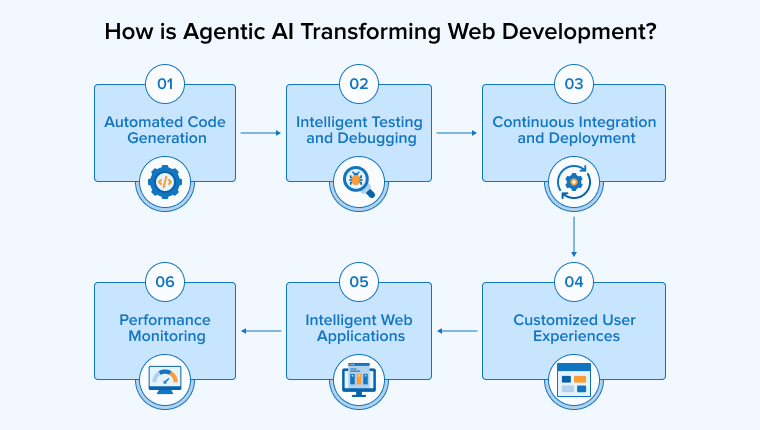
1. Automated Code Generation
Unlike LLMs, which typically generate code snippets in response to prompts, agentic AI can do much more. Agentic AI agents understand your development objectives and help you develop larger parts of an application. They are capable of creating frontend interfaces, backend functions, database structures, API connections, and supporting configuration from a basic description. They can also review existing code, identify problems, improve its structure, and suggest safer or more efficient solutions. This makes them best suited for debugging, testing, and maintaining projects, as well as creating entirely new projects.
When updating older or legacy software, agentic AI reduces the amount of manual work involved by analyzing a legacy codebase and helping migrate its functionality to newer technologies. You can also describe a design or feature in plain language to an AI agent and receive working components that fit into an existing project. In this way, agentic AI makes the development process faster without replacing developers in making important decisions.
2. Smart Testing and Quality Assurance / Intelligent Testing and Debugging
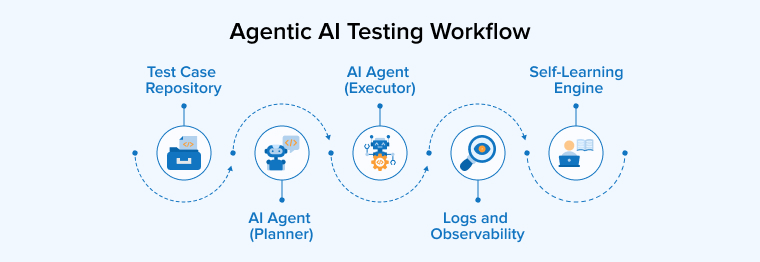
Agentic AI makes web application testing a more intelligent process. It increases the speed and reliability of the process by replacing the huge amount of repetitive tasks and manual testing effort involved in it. AI agents can self-examine an application and try to find possible weaknesses instead of waiting for you to discover them after they actually appear. They automatically create a variety of tests that cover individual functions, complete workflows, performance under heavy traffic, and common security risks.
Whenever a test fails, the agent can investigate the code and surrounding system activity to determine why the problem occurred. It may then recommend a suitable solution or apply one automatically if you’ve authorized it to do so. An AI agent can also monitor applications after they’ve been deployed and recognize unusual behavior that could indicate a failure or performance problem. In more advanced systems, it can respond automatically by applying a safe fix, restarting a service, or returning the application to a stable version.
3. Continuous Integration and Deployment (CI/CD)
AI agents handle various tasks within deployment pipelines, simplifying the process of moving web applications from development to production. They do not require step-by-step instructions; instead, they can infer the expected workflow and generate the necessary pipeline configuration. AI agents can review code changes before they are accepted, identify potential problems, and ensure that the code passes all required checks. They can dynamically manage development branches by creating, merging, and organizing them when new features or updates are introduced.
AI agents consider factors like system activity, expected traffic, and application readiness to schedule releases at the appropriate time. They can integrate vulnerability scanners into the deployment pipeline to trigger automatic alerts or rollbacks when vulnerabilities are detected in the code. They can also restore the application to a previously working version in case of unexpected errors arising during deployment.
4. Customized User Experiences / Hyper-Personalized User Experiences
Agentic AI can make your website feel more responsive by providing visitors with personalized experiences according to their interests, actions, and needs. AI agents do not display the same content to every user visiting the site. They can study how a person interacts with a website and use that information to make useful changes. For example, if you operate an online store, an AI agent could display products, offers, or categories that match a visitor’s previous searches and purchases. It could also dynamically adapt the user interface based on each user’s preferences and behavior, making frequently used features easier to access.
AI agents can provide proactive assistance and relevant guidance to users by anticipating their requirements or by noticing if they appear confused or stuck. They can also manage continuous experiments on different page designs, messages, or features to discover what works best. They can automatically implement changes to the site based on experiment results. As a result, your website can improve over time without requiring developers to manually optimize it after every experiment.
5. Intelligent Web Applications
Agentic AI is not only making the development process faster and smarter but also enabling the creation of entirely different types of web applications that can make decisions, respond to changes, and perform tasks with much less human involvement. These are dynamic applications that can observe what is happening around them and adjust their functioning as scenarios change. For example, a website that detects technical issues can take steps to resolve them automatically. Here, detection and fixing both occur without human intervention.
Websites can also adapt their content according to factors such as the visitor’s device, location, interests, or time of day. AI agents can dynamically manage content by identifying popular topics, organizing information, and helping to create content that matches audience needs. Agentic systems can even examine large amounts of website and business data to provide useful insights. They can identify different groups of visitors, recognize changes in customer behavior, predict future demand, and measure how updates to the website can influence important performance indicators such as engagement and sales. As a result, you can get a clearer understanding of what is happening and what may happen next.
6. Performance Monitoring
Agentic AI can continuously observe how your system behaves in real time. It can analyze the normal traffic patterns, response times, and resource utilization and then recognize any unusual change that may indicate a developing problem. It can investigate different parts of the application to determine where the issue is actually coming from and may discover that a slow database query, inefficient piece of code, or overloaded server is affecting the user experience. An AI agent can then suggest suitable improvements and even make changes automatically if it’s allowed to.
An AI agent can dynamically increase or decrease computing resources as per the variation in traffic levels. Thus, it intelligently manages resource allocation to ensure optimal performance. This is an ongoing process that allows your system to automatically respond to changing conditions without your intervention.
What Are the Challenges and Considerations in Agentic AI Web Development?
Agentic AI development services are highly transformative in nature. They provide multiple benefits, and there is still much to explore in web development. However, Agentic AI integration into web development also comes with its own set of limitations that need to be taken care of:
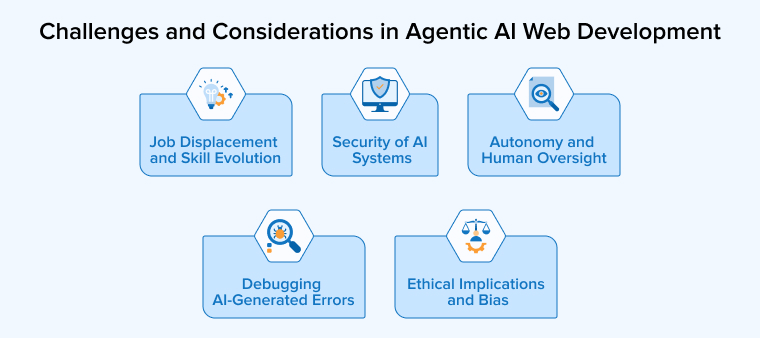
Security of AI Systems
AI agents need to access sensitive information, such as users’ personal details, to provide a personalized experience. This makes them attractive targets for attackers. A weakness in the agent, its connected tools, or its operating environment could expose sensitive information or allow malicious actions. Hence, you must implement strong access controls, compliance with security regulations such as GDPR, secure data storage, regular monitoring, and effective threat detection.
Autonomy and Human Oversight/ Over-Reliance On Autonomous Systems
Agentic AI systems require limited human intervention. This is beneficial, but too much dependence on them may prove costly. An AI agent may process information quickly, but it does not always understand context, human values, or all the possible consequences of a particular decision. In areas like healthcare and finance, the use of Agentic AI web solutions may prove risky if we ignore human insight and judgement. You must always take a balanced approach that combines the efficiency of AI and human judgement.
Ethical Governance and Transparency/ Ethical Implications and Bias
AI agents make decisions based on huge amounts of data, and therefore, if the training data is biased or contains inaccurate information, the results may become more biased and lead to wrong decisions. There must be clear rules that specify what an AI agent is allowed to do, when human approval is required, and how to review actions later. Document transparency rules, audit trails for decisions, and how to counteract AI-generated results.
Debugging AI-Generated Errors
AI agents are good at finding and fixing mistakes, but this may not be enough for larger and more complicated systems. When such systems produce errors, it can be difficult to find out the real cause of the problem. The debugging methods we generally use may not adequately predict or explain this type of system behavior. Hence, it is important to develop debugging approaches specifically designed for errors generated by AI-based systems.
Job Displacement and Skill Evolution
As agentic web systems become more advanced, they’re taking over repetitive and time-consuming tasks traditionally performed by humans. This shift is enabling human developers to move away from routine tasks and focus on productive tasks that require major human judgment. AI-based systems are opening new areas of human roles such as complex problem-solving and AI-agent design.
Real-World Examples of Agentic AI Web Development
Today, agentic AI-based web systems are powering almost every industry, be it finance, technology, healthcare, cybersecurity, and many more. We’ll see some of the most prominent real-life use cases in this section:
Prototype Development
Agentic AI is making full-stack prototyping much easier by handling development tasks from requirement analysis to prototype deployment. You can now describe what you want the application to do, and an AI agent will generate the frontend, backend, database structure, and basic integrations automatically. There’s no need to write each part manually. The agents can also test the prototype, identify errors, and make changes when needed.
Finance and Fraud Detection
Agenti AI systems can monitor transactions, recognize unusual behavior, and signal possible fraud before it causes serious damage. They can also study market conditions and financial data and help you with your investment and portfolio decisions. They even help banks improve their financial strategies by continuously analyzing large amounts of information and providing them with useful insights.
Supply Chain Management
Agentic AI is helping factories and logistics teams manage everyday supply chain challenges more efficiently. It can study demand patterns, suggest better delivery routes, monitor shipments, and support compliance. Thus, it helps your business to prepare the right amount of stock, avoid shortages, improve coordination between different operations, and reduce unnecessary delays.
The Future of Agentic AI in Web Development
Agentic AI represents a major step forward in the development of intelligent technology. Over time, AI agents have gained the ability to understand situations, plan actions, use different tools, and complete several connected tasks with less human guidance. This change could create a major impact on web development and business automation. AI agents may assist with writing code, finding errors, testing applications, deploying updates, and maintaining software after it goes live.
There can even be a system of AI agents working together, with each agent handling a particular responsibility and sharing useful information with other agents. This cooperation can make complex projects faster and easier to manage. You’ll have more time to focus on setting goals, designing systems, and checking important decisions rather than writing every part of the code by yourself. In the future, websites and applications will become more personalised by responding to users and changing conditions in real time.
Final Thoughts
Agentic AI is changing web development by making the development process smart and fast. Developers can now work with AI agents to automate repetitive work, solve problems, and support better decision-making. There’s no need to do everything manually. This does not mean AI will replace developers, but it can give them more time to focus on creativity, strategy, and building better digital experiences.
FAQs
Agentic AI automates web development by planning workflows, writing clean code, fixing bugs, and deploying sites autonomously. It handles multi-step projects, tests features, and adapts to user feedback without significant human intervention.
Agentic AI speeds up web development by automating repetitive coding tasks, fixing bugs in real time, generating responsive UI designs, and testing code autonomously.
Agentic AI cannot fully replace human web developers yet. While it automates basic coding, complex problem-solving, creative design, and deep client communication still require human skills, strategic judgment, and oversight.

Itesh Sharma is core member of Sales Department at TatvaSoft. He has got more than 6 years of experience in handling the task related to Customer Management and Project Management. Apart from his profession he also has keen interest in sharing the insight on different methodologies of software development.



Comments
Leave a message...