


Vue.js is a popular progressive JavaScript framework used to build interactive and scalable web applications. However, the quality of your project ultimately depends on the skills and experience of the developer behind it. As more businesses choose Vue.js for their projects, the demand to hire Vue.js developers has grown steadily. Businesses are competing to find professionals who can write clean code, deliver smooth user experiences, follow development best practices, and develop production-ready applications.
Finding the right Vue.js developer can directly influence how fast your product reaches the market and how well it performs over time. However, choosing the right candidate involves more than checking technical knowledge. Vue.js development companies need to evaluate problem-solving abilities, communication skills, project experience, and how well the developer fits your team’s workflow.
This blog covers why hiring Vue.js developers makes sense for modern projects, the necessary skills to look for, a well-planned hiring process, the cost factors, and how to choose a trusted partner for Vue.js development.
Why Hire Vue.js Developers?
There are several reasons why hiring experienced Vue.js developers is a smart investment for modern web projects. Some of the key reasons include:
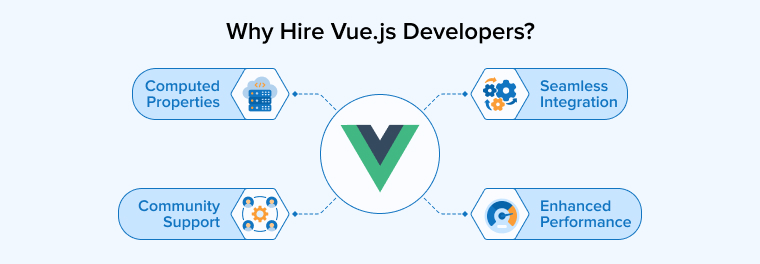
Seamless Integration
Vue.js is known for being easy to integrate with existing projects, libraries, and tech stacks. A skilled Vue.js developer can introduce Vue into a legacy application or pair it with backend frameworks such as Laravel, Django, or Node.js without disrupting the existing codebase. This flexibility allows businesses to modernise their applications gradually instead of performing a complete rewrite. This approach protects previous investments and minimizes project risks.
Enhanced Performance
Performance is one of Vue.js’s biggest advantages, and experienced developers know how to use it effectively. Vue’s virtual DOM, reactivity system, and lightweight core deliver fast page loads and responsive interfaces, especially when combined with techniques such as lazy loading, code splitting, and efficient state management. A skilled developer applies these practices from the start of a project to avoid performance issues that often appear later in production.
Community Support
Vue.js has a large and active community of developers, contributors, and companies backing the framework. This gives experienced Vue.js developers easy access to detailed documentation, third-party libraries, and active forums that help solve complex problems quickly. For businesses, this means faster development cycles, smoother project execution, and the confidence that the framework has long-term support.
Computed Properties
Computed properties are one of Vue.js’s most useful features for building clean and efficient applications. They allow developers to define reactive values that update automatically when their dependencies change, while caching results to avoid unnecessary recalculations. An experienced Vue.js developer uses computed properties to keep components organised, reduce code duplication, and improve runtime performance, especially in larger applications with complex data flows.
What Are the Essential Skills to Look For in a Vue.js Developer?
You cannot miss out on any of the below-given proficiencies while hiring a skilled Vue.js developer for your project’s long-term success.
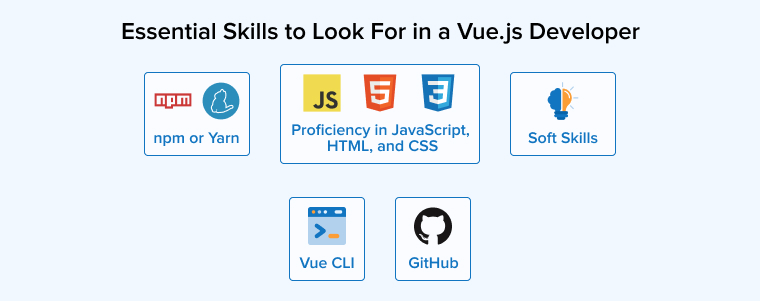
Proficiency in JavaScript, HTML, and CSS
Strong foundations in JavaScript, HTML, and CSS are non-negotiable for any Vue.js developer, as the framework itself is built on these three core technologies. A capable developer should be comfortable working with modern JavaScript features such as arrow functions, async/await, ES6 modules, and destructuring, along with a solid grasp of semantic HTML and responsive CSS practices. This foundation directly affects code quality, maintainability, and how well the developer adapts to project-specific requirements.
GitHub
GitHub experience reflects how well a Vue.js developer collaborates within a team and manages real-world projects. Look for candidates who actively contribute to open-source repositories, maintain personal projects, or have a clear commit history that shows clean code practices and meaningful pull requests. Keep in mind that their GitHub activity often reveals more about their problem-solving skills and coding habits than their resume can.
Vue CLI
Vue CLI is the official tool for scaffolding, configuring, and managing Vue.js projects, and it plays a central role in everyday development. A strong Vue.js developer should know how to set up a project, manage plugins, configure build settings, and use the CLI to streamline the development process. If a developer has hands-on experience with Vue CLI, it is a clear sign that he can set up and deploy projects to production environments without unnecessary delays.
npm or Yarn
Package management is a core part of working with Vue.js, and developers should be comfortable using npm or Yarn to install and manage project dependencies. Beyond basic installation, a capable developer must understand version control for packages, dependency resolution, and how to troubleshoot conflicts when libraries do not work well together. This expertise directly reduces project risk and helps the team avoid build issues during development and deployment.
Soft Skills
Technical proficiency alone does not make a great Vue.js developer. Strong communication, problem-solving skills, and the ability to work well within a team are equally important, especially in projects involving multiple stakeholders. A developer who can clearly explain technical decisions, take feedback constructively, and adapt to changing requirements adds far more value to a project than one who works in isolation.
Steps to Hire Vue.js Developers
A structured hiring process helps you identify the Vue.js developer who best fits your project’s technical and business needs. The six-step hiring strategy given below covers every single aspect that must be considered while hiring a skilled Vue.js developer:
Step 1: Define Project Scope and Technical Requirements
Before searching for a Vue.js developer, take time to understand exactly what your project requires. Start by outlining your business objectives, the features you want to build, and the results you expect from the application. You also need to identify the type of application you want to build, whether it is a single-page app, a full-stack web app, or a progressive web app.
Decide whether you need support only for frontend development or someone who can also handle API integration and work with the backend team. The target tech stack should also be clear, whether you plan to use the Vue.js version, the Composition API, or extend the project with Nuxt.js. A well-defined scope also helps you decide whether the project needs a single developer, a dedicated team, or a senior developer who can lead the architecture and mentor junior developers. When your requirements are clearly documented, writing an accurate job description becomes much easier.
Step 2: Write a Targeted Job Description
A well-written job description is essential for attracting skilled Vue.js developers who match your project requirements. You need to clearly explain what the role involves, the technologies the developer will work with, and the outcomes you expect. Mention the key technical skills required, such as Vue.js, JavaScript, HTML, CSS, Git, and REST APIs. If experience with any additional Vue tools or libraries such as Vue Router, Pinia, or Vuex is important for your project, include those details as well.
Describe the qualities other than the technical skillset needed, for example, teamwork, problem-solving, and effective communication. It is also helpful to provide information about your company, work environment, employment type, recruitment process, salary range, and employee benefits. Document the engagement model in the same place so role expectations stay clear from the start, and the model can be full-time, project-based, or part of a dedicated team.
Step 3: Shortlist Based on Real Engineering Work
It’s time to identify developers who have the right experience. Instead of relying only on resumes, review each candidate’s GitHub activity, their contributions to open-source Vue projects, and the production work they have delivered in environments similar to yours. This can provide valuable insights into their coding style, consistency, and technical expertise. Give preference to developers who have worked on applications similar to your project of comparable scale and complexity because previous experience with high-traffic SPAs, real-time dashboards, or e-commerce platforms usually translates into faster delivery and fewer architectural mistakes.
Step 4: Conduct Hands-on Technical Assessments
After creating a shortlist, the next step is to evaluate each candidate’s technical abilities. Technical assessment is where most hiring decisions are made or unmade. A structured interview helps you understand how well they know Vue.js and related technologies by discussing important concepts, development practices, and real-world problem-solving approaches.
Move beyond standard Vue.js questions and run hands-on tasks that reflect your actual project needs, such as building a component with the Composition API or optimising a performance-heavy interface or wiring state management with Pinia. Reviewing how candidates approach the task is often more important than simply checking whether they reach the correct solution. You should also review the candidate’s past projects or portfolio to evaluate their coding standards, architectural thinking, and how they solve complex challenges.
Step 5: Evaluate Engineering Collaboration and Working Style
No matter how technically sound a candidate is, it is equally important to determine whether they can work effectively within your team’s environment. For engineering teams, cultural fit is less about personality and more about how a developer collaborates inside a technical workflow. During interviews, assess how they communicate, collaborate with others, and approach code reviews and technical discussions in group settings.
A developer has to regularly interact with designers, QA engineers, product managers, and other stakeholders, so they should be comfortable sharing ideas, giving constructive feedback, and working toward common goals. You need to pay attention to how they explain technical concepts, participate in code reviews, document their work, and respond to suggestions from teammates. Remember that a developer who can defend their technical decisions with clear reasoning and still accept better ideas adds far more value to the project than one who only meets the technical checklist.
Step 6: Finalize the Engagement Terms
The final step focuses on terms that protect both the project and the working relationship. Document deliverables and milestones, along with the clauses for intellectual property and code ownership. Include scaling terms in case the project grows beyond the determined scope, and add exit and replacement options that keep your engineering plan flexible if priorities shift.
How Much Does It Cost to Hire Vue.js Developers?
The cost of hiring Vue.js developers depends on multiple factors, of which the most important ones are given below:
Vue.js Developer Rates by Experience Level
Experience level is one of the strongest cost drivers because it directly reflects the type of work the developer can take on independently. The general hourly ranges below are based on current Vue.js developer rates across global markets.
- Junior Vue.js Developer (0–2 years): $15 to $35 per hour. Best for component-level work and smaller tasks under supervision.
- Mid-level Vue.js Developer (2–4 years): $25 to $50 per hour. Can handle most features independently with proficiency in the Composition API and state management.
- Senior Vue.js Developer (4+ years): $30 to $100 per hour. Strong in performance optimization along with architecture decisions and TypeScript-heavy projects.
- Lead or Architect (5+ years): $40 to $120 per hour. Suited for enterprise-scale apps that involve SSR, complex state management, and design system ownership.
Onshore vs. Offshore Hourly Rates
Geographic location plays a major role in shaping hourly rates because of local market dynamics and the overall cost of living. Companies often blend onshore and offshore talent to balance cost with collaboration.
- Onshore (United States and Canada): $60 to $150 per hour
- Onshore (Western Europe): $45 to $120 per hour
- Nearshore (Latin America for US-based companies): $35 to $90 per hour
- Offshore (Eastern Europe): $30 to $70 per hour
- Offshore (India and South Asia): $20 to $50 per hour
Cost Based on Engagement Model
The engagement model you choose has a direct impact on the total project cost and the level of flexibility you get during development.
- Full-time In-house Hiring: Total cost typically ranges from $80,000 to $160,000 per year per developer when you take base salary, including benefits, taxes, and overhead into consideration. It works well for long-term product development where the same team continues to scale the application over time.
- Dedicated Team or Staff Augmentation: Costs usually run between $3,000 and $15,000 per month per developer based on region and seniority. You pay only for the development hours, and the engagement scales up or down based on project needs. This model is widely used for medium to long-term projects without the overhead of permanent hires.
- Project-based or Fixed-price Engagement: Budgets typically start from $10,000 for small projects and can go beyond $100,000 for larger applications. The pricing structure is agreed upon at the beginning based on a clearly defined scope, which works well for short-term projects with predictable deliverables.
- Freelance or Contract Hiring: Hourly rates often range between $20 and $120, depending on experience and region. This option is useful for very specific tasks or short engagements where the commitment level is lower than other models.
Other Key Factors That Influence Cost
There are several other variables beyond rates and engagement models that shape the final cost of a Vue.js project.
- Project Complexity: A standard single-page application costs far less than a complex enterprise platform with multiple integrations and advanced state management needs.
- Tech Stack Requirements: Projects that depend on Nuxt.js for SSR or heavy TypeScript usage with GraphQL integrations usually need higher-rate developers.
- Timeline and Urgency: Tight deadlines often involve premium rates because they require fast onboarding and additional working hours from the development team.
- Maintenance and Support: Ongoing post-launch support adds to the overall cost, especially for applications that need regular updates and feature enhancements over time.
- Quality Assurance and Testing: Projects that include automated testing with code reviews and performance audits cost more initially but reduce long-term technical debt.
Why Choose TatvaSoft for Hiring Vue.js Developers?
TatvaSoft is a trusted software development company that has been delivering custom Vue.js solutions for businesses across industries for over a decade. The points below highlight why companies must choose TatvaSoft as a reliable Vue.js development partner.
- Experienced Vue.js Talent: Our team includes Vue.js developers with deep expertise in Vue 3, the Composition API, Pinia, Nuxt.js, and modern frontend tooling. So your project starts with talent that already understands production-level work.
- Proven Industry Experience: With Vue.js solutions delivered across e-commerce, healthcare, fintech, education, and SaaS, our developers bring domain knowledge that complements their technical skill set.
- Flexible Engagement Models: Whether you need a single Vue.js developer for a short project or a dedicated team for long-term product development, we offer engagement models that adapt to your scope and budget.
- Transparent Communication: You stay informed at every stage through regular updates, sprint reviews, and direct access to the developers working on your project, so there are no surprises during delivery.
- Quality Assurance from Day One: From the first sprint, every Vue.js project at TatvaSoft passes through code reviews, automated testing, and performance audits, which keep technical debt low throughout the project lifecycle.
- Long-term Post-launch Support: Beyond launch, we provide ongoing support that covers bug fixes, performance tuning, feature updates, and continuous maintenance to keep your application healthy as it scales.
Conclusion
Hiring the right Vue.js developer plays a key role in the success of any modern web project. The right developer brings not just technical proficiency but also a clear understanding of how to build scalable applications that grow with the business.
A well-planned hiring approach helps you find developers who match your technical needs, team culture, and long-term goals. It sets a strong foundation for building high-performing Vue.js applications.
FAQs
Vue.js is used to build interactive user interfaces, single-page applications, dashboards, e-commerce platforms, and progressive web apps. Its flexibility makes it suitable for both small projects and large enterprise applications.
Communication, problem-solving, collaboration, and adaptability are the most important non-technical skills. A Vue.js developer with strong soft skills works better in code reviews and adapts quickly to changing project priorities.
Vue.js offers a gentle learning curve, lightweight architecture, and strong performance, which makes it easier to develop and maintain than many other frameworks. It is also versatile enough to handle everything from small interactive components to large production-grade applications.
The most common mistakes include focusing only on resumes, skipping practical coding assessments, and ignoring cultural fit. Avoiding these missteps helps you hire a Vue.js developer who delivers both technical proficiency and long-term value to your project.

Parind Shah is responsible for frontend innovations at TatvaSoft. He brings profound domain experience and a strategic mindset to deliver exceptional user experience. He is always looking to gain and expand his skill set.



Comments
Leave a message...