

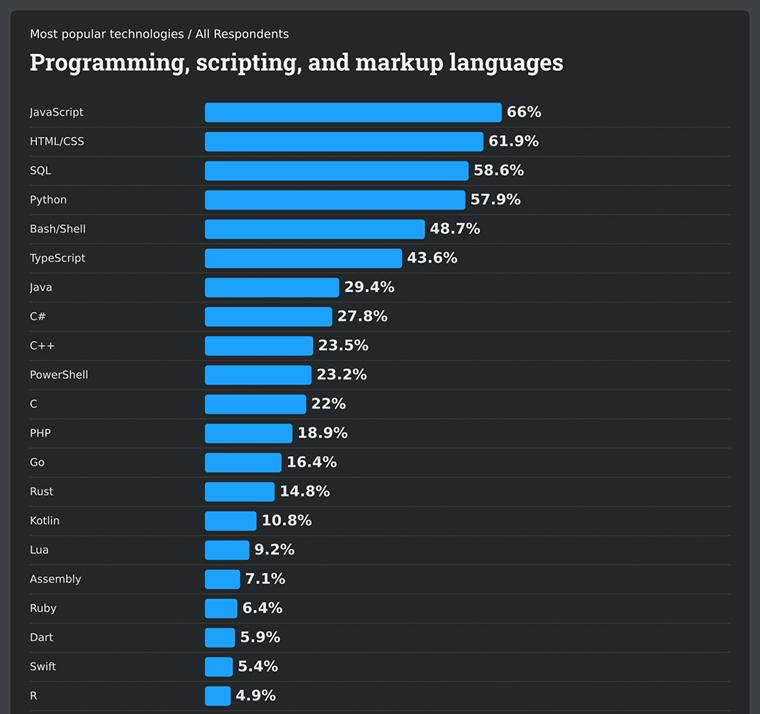
Python has become one of the most preferred programming languages for software development, and its popularity continues to grow across industries. From web platforms to automation tools and enterprise systems, Python supports a wide range of use cases. Its simple and readable syntax makes it easy for beginners to learn while still being powerful enough for experienced developers to build complex applications. Many successful Python development companies rely on its vast ecosystem of libraries and frameworks to develop scalable and stable software systems. As per the Stack Overflow survey in 2025, around 57.9% of developers use the Python programming language.
In this blog, we will explore why Python stands out for software development, its prominent frameworks, development procedure, and real-time applications built using it.
What is Python?
Python is a high-level programming language designed for better code readability and simplicity. Its human-friendly syntax helps both beginners and experts to achieve maximized outcomes by writing fewer lines of code. This makes Python an ideal choice for rapid prototyping and building robust software solutions.
Python is an open-source language used across different domains like web development, data science, automation, and artificial intelligence. As a result, it has a large community and a mature ecosystem providing numerous tools and libraries. Object-oriented programming in Python allows the creation of scalable business solutions.
Why Choose Python for Software Development?
There are many benefits of using Python for both developers and business owners, including easy readability, leading to better code maintainability, and its extensive library offerings mean having a wide range of use cases. But more importantly, this language is a reliable option for projects regarding machine learning, automation, data science, etc.
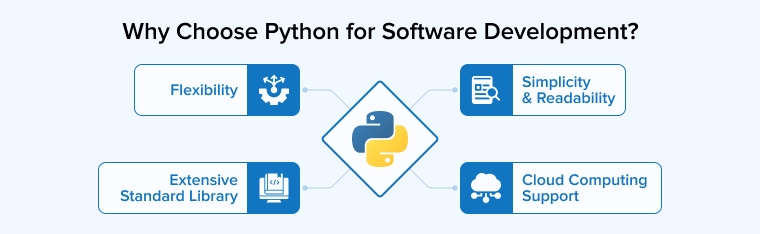
Simplicity and Readability
Python is a widely appreciated language for its clear syntax, which makes coding easier for both beginners and experienced developers. Its structure feels close to natural English language, helping users understand and write code without confusion, lowering the learning curve. With features like dynamic typing and built-in data structures, developers can create applications using fewer lines of code.
This simplicity reduces errors and makes debugging faster, resulting in quicker and more efficient development. Python’s readable style also helps teams collaborate better, since the code is easy to follow without spending too much time getting into it.
Extensive Standard Library
An extensive standard library is one of the greatest strengths of the Python programming language. It comprises a vast array of pre-built modules for different tasks, including file handling, networking, and data processing. Also known as the “batteries-included” approach, this feature helps developers perform complex functions without writing the code from scratch. As a result, development cycles become shorter, and time-to-market is faster.
Additionally, Python is highly extensible, boasting over 200,000 third-party packages. It offers frameworks like Django and FastAPI for web development, or TensorFlow and NumPy for data science, enabling users to build advanced and feature-rich applications quickly. Its rich ecosystem makes Python a suitable choice for rapid prototyping and specialized applications across various domains.
Flexibility
Python is a general-purpose programming language that offers a high level of flexibility. It can be used for a wide range of projects, from web development to complex AI modelling. It is the same language that tech giants like Google use to write core search algorithms and create scalable APIs.
Being highly portable and dynamically typed, Python can easily run on multiple platforms without requiring any modifications. Whether you are using automation to streamline business operations or developing predictive models for healthcare, Python’s flexibility ensures it remains relevant for both traditional software and emerging technologies.
Cloud Computing Support
Developers can use Python to create websites and customized applications that can be deployed directly to the cloud or distributed networks. By offering seamless cloud integration, Python helps businesses scale their operations while maintaining software reliability.
Python’s cloud capabilities provide authenticated users with access to the necessary information anytime and anywhere. Businesses or developers use this language to build easy-to-access and secure infrastructure for their data-driven solutions. Python helps companies stay agile and future-ready by streamlining cloud development.
Which Python Frameworks Are Used for Software Development?
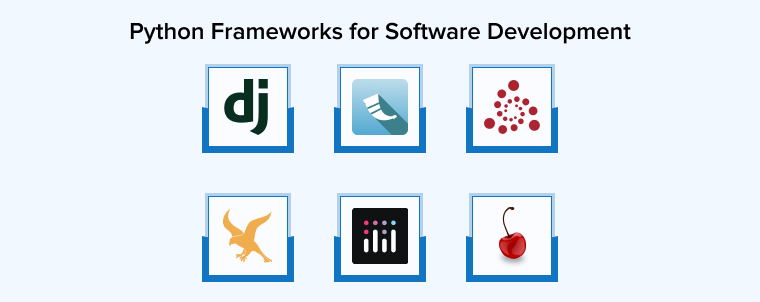
Python offers frameworks for every type of software development. Some of the highly used frameworks are as follows:
Django
Django is an open-source, robust, and full-stack Python framework designed to streamline the development process of complex backend web apps. It follows the Model-Template-Views (MTV) architectural pattern and adheres to the “Don’t Repeat Yourself” (DRY) principle. This approach minimizes redundant coding, making Django one of the most flexible and time-efficient tools for developers.
Popular for its “batteries-included” approach, Django provides pre-built features like admin interfaces, URL routing, and user authentication. The framework also enhances app security by offering protection against common threats like SQL injection. Thanks to its modularity and scalability, Django is an ideal option for everything from small content management systems to high-traffic social networks.
Flask
Flask is a micro-web framework rather than a full-fledged framework because it does not include many built-in tools. Therefore, it is categorised as a micro-framework. On the bright side, Flask provides extensions that help you add functionalities to your application, just as if they were built into Flask itself. Its modular structure and lightweight design make Flask highly adaptable. This flexibility enables the developers to choose and incorporate only the components they need.
Developers can organize their apps as they see fit because Flask is not opinionated and does not enforce a predefined structure. While Flask offers some basic modules and components, it also allows you to create custom ones to fulfill your specific project requirements. As a result, you can create a mobile app whose capabilities can be increased over time while it remains lightweight.
Pyramid
Pyramid is an open-source and flexible Python framework that is used for building solutions ranging from simple prototypes to complex enterprise-level applications. It takes a minimalist approach to help developers start small and gradually scale the app to a huge enterprise-grade app. Some software companies use Pyramid to maintain the robustness and expandability of their core solutions.
Although Pyramid offers all kinds of essential tools from routing to authentication, you have the flexibility to choose only the components you need for the project. Additionally, the framework is platform-independent, supports flexible templating, and offers superior integrated testing tools. This makes it a top choice for experienced developers who need a customizable, WSGI-compliant framework for both simple sites and complex custom solutions.
Falcon
Flacon is a framework for building specialized REST APIs and Python microservices. Designed with reliability and performance in mind, the framework is clean, fast, has a massive codebase, and is very easy to use.
Flacon supports WebSocket, native asyncio, CPython 3.5+, and PyPy 3.5+. It includes features like API modelling, centralized RESTful routing, stable interfaces, backward compatibility, RFCs adherence, ASGI/WSGI helpers, and mocks for testing.
Dash
Dash from Python is suitable for designing interactive data visualization interfaces and developing analytical web apps. It is a go-to option for data scientists who need to create professional dashboards without having a deep understanding or practical experience in web development. Dash functions as a standalone library that is flexible enough to be integrated with large-scale servers such as Nginx.
Dash facilitates simple UI controls like graphs, dropdowns, and sliders to simplify the creation of mobile-friendly and data-driven apps. Companies like Citigroup and Ford utilize Dash for its excellent error handling capabilities and deep access to low-level modules. It also simplifies the development of real-time analytics, allowing users to transform complex data sets into accessible and visual web tools with minimal effort.
CherryPy
CherryPy is one of the earliest and most critical Python frameworks. It adopts an object-oriented approach to web development. CherryPy is mainly used to handle HTTP requests and map them to specific developer logic. Since it’s a backend-only framework, CherryPy isn’t opinionated about the use of specific databases or templating engines, giving users total control over their app’s architecture.
A multi-threaded web server from CherryPy is popular for running high-performance tasks across various operating systems. Streaming giants like Netflix and Hulu leverage this framework to make their production infrastructure flexible and stable. From a simple website to complex services, CherryPy’s extensive API and plugin system make it a reliable and battle-tested choice.
How to Develop Software Using Python: A Step-by-Step Guide
Below is the step-by-step, detailed guide to using Python as the language for your software development project:
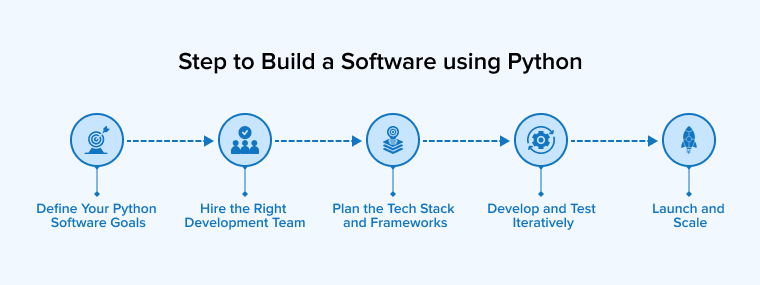
1. Define Your Python Software Goals
You must have clarity on your software project goals and understand why Python is the right fit. If you develop software that cannot solve your business challenges, all your efforts will be useless.
To define the software development goals, start by identifying the problem. Find out what problems your business teams are facing or figure out the customer pain points you want to address with the upcoming software.
Next, define your target audience and their expectations. Also, determine the features you want to add to address or solve these problems. In the end, set measurable outcomes to find out whether the project is successful or not.
2. Hire the Right Development Team
You need a Python development team with the skills and experience required to complete your project. You can either hire an in-house team of developers or engage a reputed custom software development company to build the Python solution for you. Of course, the in-house option gives you total control, but it is costly, whereas the outsourcing software option provides agility and access to global expertise.
Whichever path you choose, be sure to conduct a thorough background check. Evaluate their technical expertise, project experience, project management approach, work culture, and communication style to see if they are the right fit for the project.
3. Plan the Tech Stack and Frameworks
To get started with the software development process, you need to build a tech stack by selecting appropriate tools, frameworks, and libraries based on Python that help achieve your project goals. Python has a vast ecosystem, providing a large array of tools and frameworks specific to fields and software operations. Find out which Python frameworks and databases work best for your project. For example, Django works best for complex backend web apps, whereas Dash works best for data visualization.
4. Develop and Test Iteratively
Python is an easy-to-use language with a rich testing ecosystem. Therefore, it is best to conduct development and testing simultaneously. The development process begins with the configuration of the project environment. Use the virtualenv or venv commands to create a virtual environment, and Poetry or pip to install dependencies. After proper setup, it’s time to perform the actual coding using a modular approach where every block of code deals with separate concerns such as data handling, business logic, UI, etc. Go for combining the core modules to form the frontend interface, backend logic, and other necessary integrations.
As Python is a flexible language, you can develop the software iteratively, expanding its features and functionalities whenever needed. Therefore, proper implementation of version control systems such as Git and GitFlow is necessary to manage updates, hotfixes, and releases.
Python offers a comprehensive set of tools and frameworks to support developers and QAs at various stages of software testing. For testing individual code units, pytest and unittest are most commonly used frameworks. When you need to test the working of components in a combined form, pytest and nose2 can help in integration testing. For higher-level testing, like functional testing, Behave enables BDD while Selenium automates browser-based functional tests.
Continuous testing can be achieved through automation platforms like Jenkins and GitHub Actions, which help run tests as part of the deployment pipeline. Python supports performance and security evaluation through tools such as Locust for load testing and Bandit for identifying potential security vulnerabilities in the code.
5. Launch and Scale
Once the test results suggest that the software is performing as expected, it’s time to launch the app. But that doesn’t mean this is the end of the development cycle. Now, we enter the continuous improvement, maintenance, and support phase. Use appropriate monitoring tools to continuously track the health and performance of your system, whether it is web-based or cloud-based. Gather user feedback from early adopters to refine the app before a full-scale release.
To ensure your software keeps up with new trends and remains stable as it scales, regularly update the software, optimize performance, and provide support for increased user load. In the end, implement software maintenance best practices using security patches, bug fixes, and smooth updates. However, it is important to note that if you want to scale your app in the future, you should plan and design the app architecture in a way that supports future software scalability and doesn’t become a hindrance.
Real-Life Example of Python Software Development
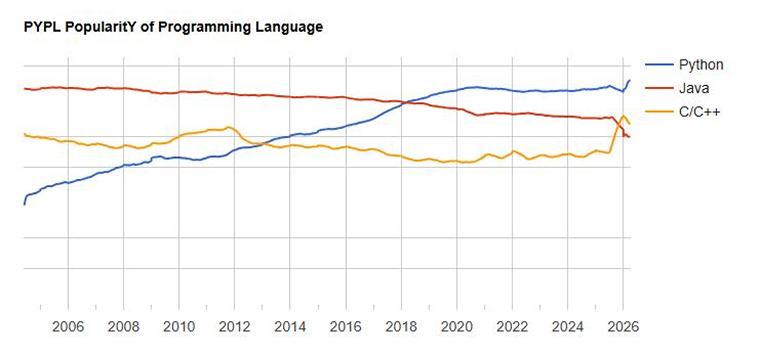
Python is a general-purpose programming language offering robust capabilities. You can find a lot of instances where using Python can prove to be more effective. That is the reason why many tech giants, along with some global enterprises, are empowering their modern software solutions through Python. The recent PYPl report shows Python is the most popular programming language compared to other programming languages.
- YouTube: It uses Python for numerous operations, including web design and video controls.
- Instagram: This popular social media app utilizes Django, a Python-based framework for effective and efficient image sharing across the app, enhancing user experience for millions of people.
- Netflix: This video streaming giant has PyTorch in its toolkit for different machine learning and deep learning tasks. They leverage PyTorch’s dynamic computation structure and adaptability to build and train a sophisticated recommendation system that improves the streaming experience of the users.
- Spotify: Python uses its machine learning capabilities to run Spotify’s backend and process data quickly.
- Facebook: Facebook leverages Python for several reasons, including scripting, prototyping, backend services, APIs, automation, microservices, testing, and QA, etc.
- Uber: The Web platform for Uber uses Flask for real-time ridesharing and logistics services.
- Pinterest: Python’s extensive libraries and ease of use work in favor of Pinterest. The language helps with the backend development, automation and scripting, machine learning, and data processing operations.
Conclusion
Python continues to be a reliable and powerful choice for software development due to its simplicity, flexibility, and strong community support. It allows developers to build everything from small tools to large-scale enterprise applications with ease. Its wide range of frameworks and libraries makes it suitable for web development, automation, data analysis, and AI projects. Businesses of all sizes can benefit from faster development and easier maintenance when using Python. With its ability to adapt to different domains and evolving technologies, Python remains a practical and future-ready language for modern software development needs.
FAQS
Yes, Python is proven to be one of the most popular and flexible choices for software development. It comes with clean and simple syntax while supporting high-level programming and offering a myriad of frameworks, tools, and libraries to build web apps, AI/ML models, games, and data science solutions.
No, Python is not a dying language. On the contrary, despite having one of the richest and most mature ecosystems, it is still evolving. Python is largely used for building AI and data science solutions. So, in the age of AI, Python has a bright future. Although there are a few metrics where other languages have managed to surpass Python, it still holds importance and plays a critical role in delivering robust solutions across various domains.
Software development using Python involves clearly defining goals, hiring skilled developers, planning technologies and frameworks to use, simultaneous development and testing of software, and deployment and future maintenance.
There are multiple software available in the market, such as VSCode, PyCharm, IDLE, etc. However, the selection of the software depends only on your project requirements. For example, Jupyter Notebook is best for data analysis and visualization tasks, whereas IDLE is best for writing basic Python programs.

Niket Shah oversees technology projects at TatvaSoft, blending hands-on expertise with a passion for crafting innovative solutions. He thrives on turning complex challenges into impactful results.



Comments
Leave a message...