

JavaScript and Python are both popular programming languages with rich ecosystems and strong community support. Each brings its own strengths to the table, making the decision both important and sometimes challenging for businesses. The selection of the right language is not just a technical decision but also an important business decision, as it has a huge impact on the product outcomes. Choosing the right language is as much a business decision as it is a technical one. There is no need to focus solely on the most popular language of the year or on which contender has the most downloads on GitHub. Instead, this strategic decision largely depends on your deliverables, business objectives, and your team’s preferences.
JavaScript is the most preferred technology when it comes to the development of dynamic user interfaces and cross-platform applications that can offer a near-native experience. Python is ideal for developing AI/ML solutions, automating tasks, and performing data analysis. For any Python development company, understanding where each language excels can help in building scalable and high-performing applications.
Take a look at the language preference graph of JavaScript vs Python over a period:
This article provides a comprehensive comparison of both languages and discusses their merits against standard parameters. It also explores the features and use cases of each language to help you make an informed decision.
What is JavaScript?
JavaScript is a versatile programming language widely used to develop dynamic web pages and modern web applications. Along with CSS and HTML, it adds useful attributes like graphic widgets and interactive features to enhance user experience.
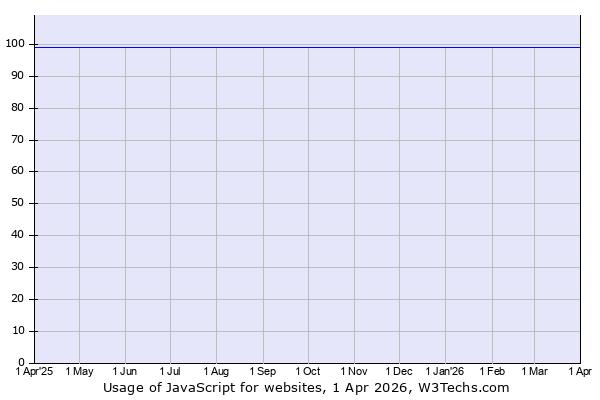
Although it usually runs in web browsers, environments like NodeJS enable it to be a full-stack language that can be used for both front-end and back-end development. This language has a rich ecosystem comprising several frameworks such as Vue.js, AngularJS, and ReactJS, each providing distinct web development capabilities. According to a recent survey, JavaScript is used as a client-side programming language by 98.9% of all websites.
What Are the Key Features of JavaScript?
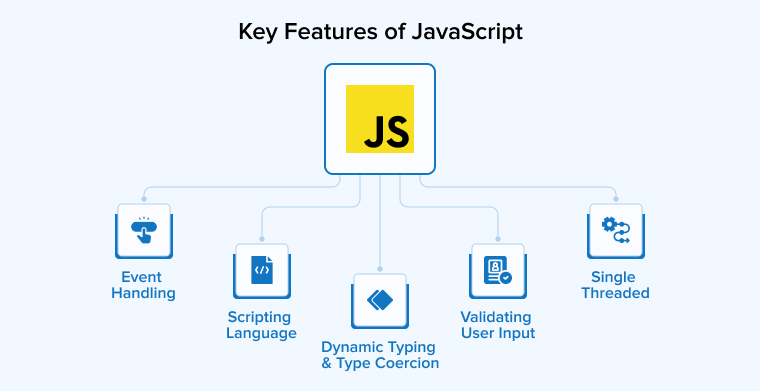
JavaScript is a robust programming language that empowers interactive web experiences, ranging from real-time form validations to complex SPAs across the internet. Event handling, dynamic typing, server-side scripting, JIT compilation, and validating user input are some of the great features of JavaScript that enable the development of faster and more engaging web solutions.
Dynamic Typing and Type Coercion
Variables in JavaScript don’t require a specific type declaration. The language provides enough flexibility to allow them to hold any data type. The data type is determined at runtime and can be easily changed even if the program is running.
Although this helps speed up the software development process, developers need to understand the concept of type coercion in JavaScript, which includes automatic type conversions during active operations. Modern versions of the language offer runtime validation libraries or the use of TypeScript to maintain development speed while adding type safety.
Validating User Input
JavaScript is useful when working with forms. It allows you to validate the user input for errors and save time. It also checks for \fields that are either empty or filled with incorrect information before sending the data to the server.
Single-Threaded
Being a single-threaded programming language, JavaScript can execute only one operation at a time. JavaScript uses an event loop and this execution model to avoid concurrency issues. This language was originally a web browser scripting language. JavaScript was intended to meet the needs of a single user interacting with a single browser window at any given time.
Scripting Language
JavaScript is a lightweight language created to work on the client-side. It is not a general-purpose language and can serve only a certain type of web apps. As a scripting language, it runs directly in the browser.
Event Handling
Events refer to the specific actions performed by the user within a system, such as clicking a button, pressing a key, or loading a page. Event handling is the process of responding to these events on a webpage, such as opening an information box when a button is clicked.
JavaScript facilitates event handling and can even create custom ones. It is useful in making web pages more interactive and dynamic, triggering an action by running a pre-determined code when a specific event occurs.
What is Python?
Python is a robust and high-level programming language. Its simplicity and readability have made the language quite popular, making it easier to write code more logically and clearly. It supports object-oriented programming, which helps organize code around objects instead of actions.
Being a high-level language, Python abstracts away complex aspects of programming, allowing developers to focus on solving problems without worrying about technicalities. Unlike JavaScript, which is used for both frontend and backend development, Python is primarily used in backend development. This general-purpose language also provides excellent capabilities for data science, machine learning, and AI solutions.
What Are the Most Important Features of Python?
Let us discuss some key features of Python that contribute to its widespread adoption in the development of modern technologies:

Integrated Development Environments (IDEs)
Python supports a wide range of IDEs, including PyCharm, VSCode, and Jupyter Notebook, that help developers write code clearly and efficiently. These IDEs offer features for code completion, syntax highlighting, debugging, and project management, improving overall productivity. Python IDEs simplify the development process, making it easy to develop, test, and maintain the code.
Simple and Readable Syntax
Python is a programming language designed to promote code readability. Using this language, developers can express their concepts or create a component with fewer lines of code. Such simplicity makes this language beginner-friendly and enhances productivity for experienced developers.
Python avoids using keywords or braces to define code blocks; instead, it uses indentation to define them, resulting in cleaner and more readable code. Most of the commands and keywords in Python resemble the English language, making it easier to learn and understand.
GUI Programming
Graphical User Interface programming makes your web application user-friendly. It ensures seamless user interaction by making the software more engaging and intuitive. Python supports GUI programming through several libraries, such as JPython, wxPython, and Tkinter. These libraries help UI designers create GUIs quickly and easily.
Interpreted Language
Instead of executing the entire program all at once, an interpreted programming language like Python runs the code line by line. Languages like C++ and Java are not interpreted and require code compilation before execution. In the case of Python, the code is not compiled into machine code beforehand. Instead, an interpreter processes it during runtime. It transforms the code into an .exe file before execution, a trait of an interpreted language. This also simplifies code debugging.
JavaScript vs Python: A Tabular Comparison
Let’s take a quick look at some of the basic differences between JavaScript and Python:
| Parameters | JavaScript | Python |
|---|---|---|
| Objective | High-level, versatile programming language to create interactive web applications | It is a general-purpose language designed to be easy to read and understand. |
| Syntax | Every code block begins with curly braces | Every code block is defined using indentation |
| Learning Curve | Steeper learning curve for complete beginners | Easy to learn, thus a smoother learning curve |
| Encoding format | It uses UTF-16 encoding | ASCII is the default source code |
| Inheritance support | JavaScript supports only one type of inheritance, i.e., single inheritance | Python supports single and multiple inheritances |
| Hash Tables | No support offered for hash tables | Sets and dictionaries allow the use of a hash table in the code |
| Implicit Conversion | JavaScript is a weakly typed language supporting implicit data conversions | There’s no implicit conversion, as Python is a strongly typed language |
| Conditional statements | if, else if, and else are the three conditional statements | If, elif, and else for statements are used |
| Output statement | console.log() is used to print output on the screen | The print() function prints the output on the screen |
| REPL | No built-in REPL support, so dependent on third-party tools | Built-in REPL and browsing-based REPL support |
JavaScript vs Python: A Detailed Comparison
There are some major differences between JavaScript and Python programming languages when compared for factors like syntax, scalability, inheritance, and learning curve. This section explores these differences in detail.
1. Syntax
JavaScript
- The syntax in JavaScript is dynamic and flexible, allowing developers to write the same function in multiple ways. However, it uses semicolons and curly braces, which can cause issues if not used properly.
Python
- Python comes with a readable syntax. It’s so simple that even beginners have no difficulties in writing code. To make coding easier, Python uses indentation instead of braces. For clean and simple coding, Python is the best choice.
2. Speed and Performance
JavaScript
- The JavaScript programming language was designed to work fast on the web. Advanced multithreading capabilities in Node.js make JavaScript faster than Python. As a result, the language is widely used for building apps that require dynamic, real-time user interactions, as well as websites and ERP systems. For example, the Facebook app generates vast amounts of data every second. To ensure users receive the latest updates without delay, the company empowers the platform with JavaScript.
Python
- Python performs well for CPU-intensive operations involving heavy computation or large data processing, such as in machine learning models or other modern software solutions. Since it is easy to use, Python is often chosen for enterprise app development, especially when it involves excessive computations. The Instagram app is also developed in Python, even though it is based more on I/O than CPU-intensive activities. This demonstrates that Python can deliver high performance when properly optimised for the situation.
3. Scalability
JavaScript
- JavaScript is widely preferred for scalable web applications, especially those that require real-time interaction. It is capable of handling multiple users at once due to its multi-threading features and works smoothly across distributed systems. With a Node.js environment, developers can manage multiple connections efficiently, making it a strong choice for chat apps, streaming platforms, and real-time dashboards.
Python
- Python can also scale effectively, but it often needs extra planning and tools to do so. Due to the threading limitations owing to the Global Interpreter Lock (GIL), developers have to rely on multiprocessing, asynchronous programming, and microservices. It performs particularly well in data-heavy applications such as machine learning and analytics, where handling complex computations is more important than real-time responsiveness.
4. Popularity
JavaScript
- JavaScript continues to dominate as one of the most highly used programming languages, especially in web development. Its role in building interactive user interfaces and full-stack applications keeps it highly relevant, making it a reliable choice for modern web-focused projects. JavaScript has consistently ranked at the top in Stack Overflow developer Surveys, showing its strong presence in the industry.
Python
- Python has gained immense popularity in fields such as data science, machine learning, and backend development. As per various indexes, it’s often placed at or near the top due to growing demand for data-driven solutions. Its easy syntax and large number of libraries attract both beginners and professionals, helping it stand out as a preferred language beyond traditional web development.
5. Web Development
JavaScript
- JavaScript is one of the most useful languages in web development. It can be directly run on a browser to create interactive and dynamic web applications. Integration of JavaScript frameworks like Vue, Angular, and React with JavaScript has just extended its scope and capabilities in delivering better web solutions and user experiences. Developers can also write server-side programs in JavaScript using Node.js, making it a full-stack language. JavaScript makes it possible for deep learning, big data, neural networks, concepts, algorithms, and more to run on the frontend.
Python
- Python is a more suitable language for backend development. Python frameworks like Flask and Django streamline the development process for web apps. It is widely used for APIs, automation, and secure systems, making development easier even if performance is slightly lower. Python developers can take the readable syntax and language simplicity to their advantage for prototyping and rapid development.
6. Mobile Development
JavaScript
- The JavaScript programming language supports mobile development through a myriad of frameworks like Ionic and React Native. React Native is one of the most popular and widely used mobile development frameworks around the world. It helps write JavaScript code and then deploy it on both Android and iOS platforms, ensuring flexibility and high performance.
Python
- Python provides frameworks like BeeWare and Kivy for mobile app development. The frameworks from JavaScript are more mature, efficient, and widely used for building native apps compared to Python frameworks.
7. Inheritance
JavaScript
- Initially, JavaScript didn’t have any classes, so it used prototypes. Inheritance in JavaScript is quite complicated because it implements the prototype chain. After the E6 update, JavaScript started mimicking Python by introducing a class feature. However, it still uses prototypes in the backend.
Python
- Python follows a proper class-based inheritance where new classes are created from existing ones. This makes it easier to understand because it closely reflects the real-world relationships. Python also supports multiple forms of inheritance, such as single and multiple inheritance, giving developers a structured and straightforward way to reuse and organise code.
8. Numeric Types
JavaScript
- JavaScript mainly works with two numeric data types, i.e., Number and BigInt. The Number type uses a 64-bit floating-point format, so it represents both integer and decimal numbers, but can lose precision with very large values. BigInt was introduced to fix this issue by allowing safe handling of large integers. Together with TypedArray, JavaScript now handles numeric operations more efficiently than before.
Python
- Python provides a range of numeric data types, including int, float, and complex numbers. Its integers can grow to any size without losing accuracy, which is useful for scientific and financial calculations. Python’s variety of numeric options makes it more flexible when working with different kinds of mathematical data compared to JavaScript.
9. Learning Curve
JavaScript
- JavaScript’s syntax somewhat resembles the English language, but it uses symbols instead of words in most places. This language largely relies on braces and semicolons to separate two different lines of code. More use of symbols in a code makes it hard to read and even harder to master, especially if you don’t have any prior knowledge or experience of how the language works.
Python
- Python has a simple syntax similar to the English language. Most of the logical operations in Python are provided as words from the English language. As a result, learning Python becomes easy. It also offers indentations and colons for easy management of the code layout, making the code more readable.
10. Community and Ecosystem
JavaScript
- JavaScript is a preferred choice for most developers in web development. Obviously, it is going to have a large and active community. JavaScript provides frameworks such as React, Vue, and Angular. For server-side programming, NodeJS is a JS-based runtime environment that helps developers to design interactive web apps.
Python
- Python is still a growing language, but it has already garnered support from a large community. When it comes to the Python ecosystem, the language offers numerous frameworks and libraries for machine learning and data science projects. Django, TensorFlow, NumPy, and Pandas are some of the popular Python libraries used for specific purposes.
11. Modules & Library
JavaScript
- Compared to Python, JavaScript has fewer modules to offer, including JSON, date, and math. So, it completely falls upon the developers to extend the capabilities of JavaScript to fill the gap or meet specialized project requirements. However, after the advent of NodeJS, the JavaScript capabilities have increased exponentially. NodeJS enabled it to offer basic modules for networking, file processing, and more features.
Python
- Python is popularly called a battery-included programming language. It offers a large number of modules for everything, including file management, web services, scientific computing, data analysis, regular expressions, and machine learning. This language provides a module for every service and any specialized task. For more advanced requirements, it allows you to access various third-party libraries hosted on the Python Package Index through its package management system called pip.
When to Choose JavaScript
- Interactive Web Development: JavaScript is a highly beneficial language when it comes to modern web development. It supports frontend, and with the help of NodeJS, it can work on the backend as well. JavaScript seems like a fine choice for creating dynamic websites and interactive user interfaces that deliver a seamless user experience.
- High-Performance Real-Time Applications: Thanks to its event-driven, non-blocking architecture, JavaScript is capable of building high-speed apps that need real-time user interactions. Therefore, any application that requires real-time tools, including multiplayer games, live streaming services, and online chat apps, can be easily created with JavaScript.
- Cross-Platform and Mobile Development: JavaScript is a highly flexible programming language. Developers use it to create cross-platform applications from a single ecosystem. It even offers a framework like React Native to create cross-platform mobile apps that provide better results than native technologies.
- Serverless and Infrastructure Integration: JavaScript is a suitable option for writing serverless functions on platforms such as AWS Lambda and Google Cloud Functions. It offers a flexible and powerful framework for integrating various services into a robust and modern application architecture.
When to Choose Python
- AI/ML and Data Science: Python is a programming language offering robust libraries like PyTorch and TensorFlow, which help it dominate the field of data science and artificial intelligence. For the projects demanding advanced scientific computing, predictive modelling, and big data analytics, developers prefer to use Python.
- Automation and Scripting: Python helps automate workflows, repetitive tasks, and data scraping. It offers a level of efficiency highly valued in general system administration, DevOps, and cybersecurity.
- Scalable Backend Development: Python speeds up the development process thanks to its clean and readable syntax. Frameworks like Flask and Django make it easy for developers to understand complex server-side logic, as well as to create and maintain applications.
- Image Processing and Computer Vision: If you are working with image recognition technology, computer vision, and complex image data, then Python may prove to be highly effective. The language also has specialized use cases such as managing IoT systems, creating chatbots, and monitoring the stock market.
Conclusion
JavaScript is a fine choice for creating interactive user interfaces and robust mobile applications. Meanwhile, Python specializes in building fast data processing and machine learning applications. Both languages have strong community support and are widely used across the world. The features, strengths and weaknesses of the programming language obviously matter, but what influences the decision to choose one the most are your project goals and the development team’s preferences or previous experience.
FAQs
Though Python is a highly flexible programming language, it can’t replace JavaScript. Every modern web browser comes with a built-in JavaScript engine because the language is mainly used on the frontend, allowing developers to directly execute the code natively on the user’s device. Since Python lacks client-side programming capabilities, it can’t replace JavaScript.
There cannot be a specific answer to this question, as both JavaScript and Python are widely used languages for different purposes. The choice between them completely depends on your project requirements and business objectives.
AI is definitely better at Python due to the large number of libraries available for AI, ML, and data science.
No, JavaScript is not a dying language. It is one of the most popular dynamic web development languages used globally.
ChatGPT is developed using multiple technologies nd Python contributes a significant part of its development process.

Niket Shah oversees technology projects at TatvaSoft, blending hands-on expertise with a passion for crafting innovative solutions. He thrives on turning complex challenges into impactful results.



Comments
Leave a message...