

The selection of a programming language is one of the initial and most important steps in any software development project. The decision affects how fast the product can be developed, how well it performs, and how easy it will be to maintain and scale in the future. Among modern programming languages, Python and Rust are often compared because they represent two very different approaches.
Python is known for its simplicity, flexibility, and wide range of libraries, making it popular among beginners and experienced programmers. Many businesses hire a Python development company to quickly build and deploy advanced solutions. On the other hand, Rust focuses on performance, memory safety, and reliability, making it ideal for systems programming and performance-critical applications.
This blog explores the key differences between Python and Rust by comparing them across some critical parameters. You’ll even learn their important features, real-life use cases, and scenarios to select the appropriate one.
What is Python?
Python is a high-level, interpreted, general-purpose programming language created by Guido van Rossum in 1991. The language quickly became popular for its simplicity and readability. It uses an intuitive syntax that replaces traditional curly brackets with indentations. Python is an open-source and interpreted language that supports various paradigms, including object-oriented programming. It is also compatible with multiple platforms like Windows, Linux, and macOS.
An extensive set of libraries, such as TensorFlow and NumPy, makes Python a preferred option for machine learning, data science, and web development. The language also allows for rapid prototyping and efficient app development through its dynamic typing features. Python has also garnered support from a large and vibrant community.
What Are the Key Features of Python?
The Python programming language is popular and widely used because of its robust features like code reusability, dynamic typing, flexibility, and simple syntax.
- English-like Syntax: Python feels easy to understand and write because its syntax is close to the plain English language. It allows developers to learn faster and build applications by writing just a few lines of code.
- Dynamically Typed: Python uses an interpreter to determine variable types at runtime based on the assigned values, so developers no longer need to specify types manually. This allows them to focus more on the functionality.
- Versatility: Python is a flexible programming language that supports various paradigms, such as functional, object-oriented, and procedural programming. This allows Python developers to create a wide range of solutions.
- Code Reusability: Python has an extensive ecosystem offering several libraries with pre-built components. On top of that, the language has a modular architecture and supports object-oriented programming. All of these help promote code reusability, reducing the development time.
What Are the Use Cases of Python?
Python is a general-purpose programming language used for a variety of development purposes. Some of the important use cases include:
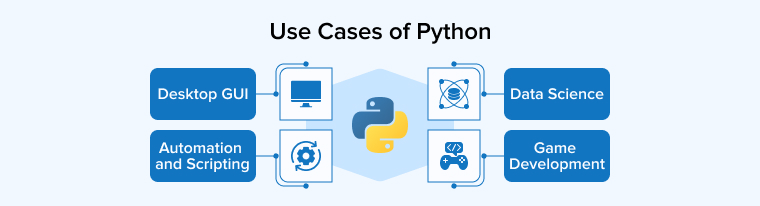
Game Development
One of the most important use cases of Python is building indie games. It offers a library called PyGame, which specifically helps with game development. Although Python is often used in creating systems that empower photorealistic 3D games, the games themselves are not coded in Python because the language is slower and has relatively high memory usage, making it less ideal for game coding.
Data Science
Python offers libraries like Matplotlib, Pandas, and NumPy, making it the go-to programming language for analysts and data scientists. These libraries are designed to help developers to build mobile applications with machine learning, data processing, analysis, and visualisation operations. If you are working with a large dataset or running sophisticated data processing operations, then Python is the right fit.
Automation and Scripting
Writing Python scripts enables you to automate various repetitive tasks. You can write these scripts or create additional modules and embed them into existing software to automate specific tasks.
For automation, most developers prefer Python. It offers a different type of test automation tools that help you understand existing code and reduce the need for manual testing. Python libraries like Selenium, smtplib, Beautiful Soup, and more help developers in automating processes like data scraping, sending HTTP requests, etc.
Desktop GUI
Desktop GUI programming is another important use case of Python. The language provides the capability to design a full functional graphical user interface. Python frameworks adopt a modular programming approach with a comprehensive syntax to create responsive and high-performing GUIs. Kivy, wxWidgets, PyQt, Python GTK+, and Tkinter are popular GUI development tools in Python. The language is also used to empower standard apps like BitTorrent and Dropbox.
What is Rust?
Rust is a modern, multi-paradigm systems programming language launched in 2010 by Graydon Hoare at Mozilla Research. Designed for speed and memory safety, Rust offers low-level control similar to C++ while maintaining high-level productivity.
It is also a statically and strongly typed language that ensures software reliability. Rust’s robust design principles and user-friendly compiler help prevent unexpected code behavior.
Rust uses its ownership model for memory management rather than relying on a garbage collector, which helps prevent common errors and improves reliability, especially in embedded and large-scale applications.
What Are the Main Features of Rust?
Features like memory safety, thread safety, automatic type inference, and zero-cost abstraction make Rust a robust and reliable programming language. Companies ranging from startups to large enterprises trust Rust to align their software with core business values and consistently deliver seamless brand experiences.
- Zero-Cost Abstraction: Rust allows developers to make use of abstractions without hampering the program’s performance. These abstractions make code easier to manage and read, while still delivering the same performance as low-level implementations, with no extra runtime cost.
- Automatic Type Inference: In Rust, the data type of an expression is determined automatically. As a result, developers don’t need to provide explicit type declarations, which reduces errors and accelerates the programming process.
- Memory Safety: The type system and ownership model from Rust help solve memory issues. This enables the programs to examine the memory checks during compilation rather than at runtime. This allows variables to own their memory and borrow it from other variables. With this feature, a garbage collector is unnecessary, as Rust ensures programs remain bug-free during compilation.
- Thread Safety: Rust prevents data races through its ownership system, which also ensures data safety. This feature avoids the need for additional synchronization by supporting interior mutability. It allows safe sharing of data across threads, as well as modification of data and references. Consequently, you don’t need a synchronization mechanism in most cases.
What Are the Use Cases of Rust?
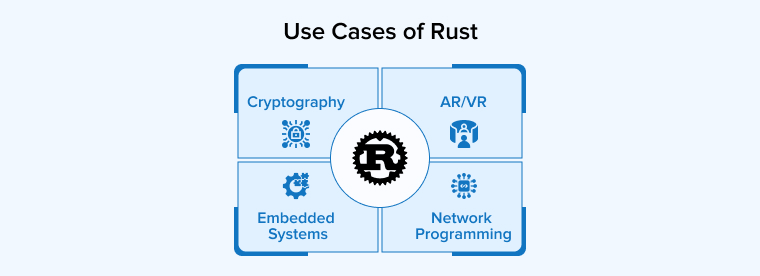
Rust is an emerging programming language finding applications in some of the high-performance requirement applications, such as:
Embedded Systems
Rust is an ideal option for embedded systems because of its control and memory safety features. It enables developers to create low-level hardware drivers and operating systems for such systems, which are widely used in automotive, aerospace, and medical device applications.
Network Programming
Network programming has played a vital role in the global growth of Internet usage. Developers trust Rust for network development because it delivers high-speed performance and impenetrable security. Rust excels in various network programming tasks, including HTTP development, asynchronous networking, and more.
AR/VR
AR/VR is another emerging technology where Rust proves to be highly useful. Its memory safety and low-level control features make the language an ideal option for building real-time apps that need low latency and high performance. Additionally, Rust’s concurrency features enable applications to effectively manage multiple threads, a basic requirement for any AR/VR app.
Cryptography
With booming trends like Web3 technology and NFTs, cryptography provides the means to secure sensitive user data in the field of blockchain. Rust’s data control and memory safety features are valuable for protecting this data. Meanwhile, the RustCrypto library offers numerous ready-to-run cryptographic algorithms that you can easily implement in your application.
Python vs Rust: A Comparison at a Glance
Here is a brief overview of the comparison between Rust and Python.
| Parameters | Python | Rust |
|---|---|---|
| Ease of Use and Learning Curve | Simple syntax and a wide range of libraries make it easy to learn and use, respectively. | Difficult to learn if you do not have any prior programming experience because syntax strictly follows the rules of safety and performance. |
| Error Handling | Since it offers exceptions, error handling is flexible. | Provides result and Option types for explicit error handling. |
| Memory Management | Has a garbage collector for automatic memory management. | Memory management is manual, but its ownership model ensures it remains safe. |
| Speed and Performance | As an interpreted language, Python has a slow execution speed for CPU-bound tasks. Although the garbage collector may cause delays, it works for I/O bound tasks and rapid development. | Rust is a compiled language, providing high performance. No garbage collector, making it ideal for CPU-bound and time-sensitive systems. |
| Security | Python can not match the level of security offered by Rust. | Rust is a highly secure programming language, offering a safe-by-default mode to ensure the program’s high security. It also comes with guidelines for developers to maintain security. |
| Scalability | Scaling Python apps is difficult, but can be made possible using hardware-focused vertical or horizontal options. | Rust provides a highly scalable architecture. |
| Concurrency | Python has a GIL, which restricts multi-threading, leading to very limited concurrency support. | Supports concurrency and parallelism, enabling safe concurrent execution with a GIL. |
| Ecosystem | It has a vast and rich ecosystem offering libraries and tools for data science, machine learning, automation and web development domains. | Rust’s ecosystem is still growing. It offers tools and libraries for systems programming, networking and performance. |
| Community Support | Python boasts a large, diverse and active community. | Rust has garnered a small but very passionate community. |
What is the Difference Between Rust and Python?
Let us now compare Python and Rust across the following nine major parameters and understand the differences between them:
1. Syntax and Readability
Python
Python is popular and widely used because of its easy-to-read syntax, which is similar to the English language. This makes it easy for beginners to master Python and quickly build applications. Moreover, the readability encourages code clarity. Python also offers a huge number of frameworks and libraries, allowing developers to undertake various types of projects ranging from web development to scientific computing.
Rust
On the contrary, Rust promotes performance and safety with a syntax that strictly adheres to these principles. Although Rust code might look complex, it guarantees correctness, making the language ideal for performance-critical apps and systems programming.
Developers can efficiently manage memory safety and minimize programming errors by following the compiler-enforced rules and leveraging Rust’s unique ownership system, resulting in enhanced software reliability.
2. Memory Management
Python
- Python handles memory automatically with a garbage collector, which frees developers from managing memory manually. It regularly removes unused objects, making coding easier and faster. However, this convenience can sometimes reduce performance and increase memory usage, especially in applications that need precise control or consistent speed, such as real-time systems.
Rust
- Rust manages memory using a specialized ownership system that is checked during compilation. This means errors like invalid memory access or data races are prevented before the program even runs. It does not need a garbage collector, which helps improve speed and reliability. This approach also allows safe multithreading while maintaining strong control over memory usage.
3. Speed and Performance
Python
- Python focuses more on simplicity than on speed. It runs through an interpreter and uses a garbage collector, which adds extra overhead during execution. This makes it slower compared to compiled languages like Rust. While Python is easy to write and understand, its higher abstractions and runtime memory management can reduce performance in tasks that require high speed.
Rust
- Rust is built for speed and efficiency. It compiles directly into machine code, so there’s no extra layer like an interpreter slowing things down. Its memory management works at compile time, preventing errors while maintaining high performance. With low-level control and zero-cost abstractions, Rust delivers fast execution, making it ideal for systems and performance-critical applications.
4. Error Handling
Python
- Python uses exceptions to deal with errors that occur while the program is running. Developers can catch and manage these exceptions, but Python does not provide any suggestions for fixing them. Because errors appear at runtime, finding the root cause often requires extra effort, especially in larger programs with multiple possible failure points.
Rust
- Rust deals with errors in a structured and proactive way. It separates errors into recoverable and unrecoverable types, forcing developers to think about how to resolve unrecoverable errors because Rust panics when such issues arise. Many issues are caught early, even before running the program. This approach improves reliability and safety, and often gives clear guidance that helps developers quickly understand and fix problems. In case of a recoverable error, the user must either resolve the issue or provide the correct input.
5. Ecosystem and Libraries
Python
- Python has a rich ecosystem with a large array of frameworks and libraries tailored to different domains such as scientific computing, machine learning, web development, and data analysis. It is beneficial for tasks like research, rapid prototyping, and developing production-grade apps. Its libraries, including Django, Pandas, TensorFlow, and NumPy, help developers create a wide variety of robust solutions.
Rust
- Rust is still a growing programming language, hence its ecosystem is not as strong as Python, especially for advanced tasks involving data analysis, and AI/ML. But it offers libraries for specialized cases like Serde for data serialization, Rocket for web development, and Tokio for asynchronous I/O, etc. The Rust community actively works towards building high-performance and reliable applications.
6. Popularity
Python
- Python is one of the most widely used programming languages in the world. It is popular across many fields, including web development, data analysis, machine learning, and automation. Its simple syntax makes it accessible to beginners, while its powerful libraries support advanced work. Because of this flexibility, Python has built a large and diverse global community.
Rust
- Rust is growing steadily in popularity, especially among developers focused on system programming work and high-performance applications. Its strong safety features and modern design attract a dedicated community. Although it is not as widely adopted as Python, interest in Rust continues to rise as more developers explore its reliability and efficiency.
7. Scalability
Python
- Python has the capability to scale, but it often depends on improving the underlying infrastructure rather than the language itself. Developers may need to use techniques like distributing workloads, i.e., horizontal scaling, or adding more servers, i.e., vertical scaling.
Rust
- Rust is well-suited for building scalable systems because it delivers high performance with efficient memory use. Its strong support for concurrency allows programs to handle many tasks at once without slowing down. Since it runs close to the hardware, applications can scale with fewer resources, making it a solid choice for large, performance-focused systems.
8. Community and Support
Python
- Python boasts a large and active community providing detailed documentation, tutorials, and support on online forums. This makes it easier for beginners to learn, get started, and find technical help when facing issues with their projects. The Python community also provides support across multiple channels, special forums, and other community platforms. Many Python-based frameworks and libraries have their own dedicated online space where fellow users can either share their knowledge and experience or seek help.
Rust
- Rust has significantly less community support than Python. However, Rust developers are very passionate and provide comprehensive documentation. The Rust community has established support channels like Stack Overflow, a Discord server, and the Rust Users Forum to promote learning and collaboration. The community provides strong support and resources crafted to meet unique project characteristics like performance and safety.
9. Extensibility
Python
- Python’s vast ecosystem of numerous frameworks, tools, libraries, and modules provides exceptional extensibility. This enables developers to write a Python script that can automate daily activities or even create a complex web app with minimal code. Python has several use cases across many industries, thanks to its mature ecosystem that allows extending functionality without writing from scratch, which greatly speeds up development.
Rust
- Even though Rust has witnessed rapid growth, its ecosystem is still developing and remains smaller than Python’s. Developers can use community-built crates to add features, and new tools are introduced regularly, but the available options are still limited. As a result, it has yet to reach Python’s level of extensibility.
Which One Should You Choose?
Since both Python and Rust are equipped with different sets of features, they are useful for a different scope of projects, which are as discussed below:
Choose Python for:
- Rapid Development and Prototyping: Python is the ideal choice when working under deadlines or when a faster time-to-market is a priority. Its simple syntax and modern features allow developers to build, test, and deploy applications quickly.
- Data Science and Artificial Intelligence: If the project deals with Data Science, AI, or ML, choose Python as it offers strong libraries such as TensorFlow, Keras, and Scikit-learn, and various tools to help developers build models, analyze data, and perform complex computations easily.
- Web Development and Automation: This language is suitable for creating web applications and managing automation or scripting tasks. Its ease of maintenance and accessibility make Python perfect for building manageable web services and high-performance web scraping.
- Beginner-Friendly Onboarding: Python is the best choice if your team is already familiar with the language or you’re about to begin a new software development project. Its simplicity helps new developers learn the language easily, and teams can get started with their projects without any hassle.
Choose Rust for:
- High-Performance and Resource Efficiency: Choose Rust when building performance-critical applications, such as game engines, operating systems, or embedded systems. It offers high speed and low-level hardware control, making it ideal for resource-constrained environments.
- Memory Safety and Security: Developers prefer Rust for security-critical applications where memory safety is a primary concern. Its advanced management capabilities ensure that applications remain error-free and secure without sacrificing processing speed.
- Scalability and Concurrency: Use Rust to create scalable backend services that need to handle a high volume of user demands. It offers robust solutions for multi-threaded applications, allowing efficient concurrency at the core of the software.
- Long-Term Maintainability: If you need code that guarantees long-term stability, Rust is the language for you. It ensures existing code remains compatible with the latest updates and simplifies complex maintenance operations, ensuring high performance over time.
Conclusion
Python is a general-purpose programming language. This means it serves various objectives, and it comes with simple syntax, which makes it easy to learn and use. On the contrary, Rust is a relatively new language with a more complex syntax, but its code is more specific and less abstract than Python’s.
Rust has a smaller community and ecosystem compared to Python’s, which is much larger. Both languages differ significantly in terms of features and objectives. Hence, they are both used for different types of projects. There is no way any one of them can replace another. This article aims to clarify their respective capabilities and use cases, helping you make an informed decision about which language to choose for your upcoming project.
FAQS
Rust is a robust programming language, and it can be used alongside Python for specialized projects, but it can’t entirely replace Python. Both have distinct capabilities, leading to excellence in different domains. Therefore, it is not possible for Rust to replace Python.
Python is generally better for AI because it has extensive libraries and community support, making model development easier. Rust, while faster and more memory-efficient, is less mature for AI and is mainly useful when performance and safety are critical in deploying AI applications.
Yes, Rust is a very good option for developing large-scale and high-performance web applications owing to its ownership model providing effective memory management and high concurrency.
Yes, Rust is considered more secure than Python due to its strict compile-time checks, ownership system, and memory safety features, which prevent common issues like null pointer errors, buffer overflows, and data races. Python, while simple and easy to use, relies on runtime checks and does not enforce memory safety.
Yes, Rust can be used for graphics programming as it has libraries like wgpu, gfx-rs, glium, and Bevy that support 2D and 3D graphics, game development, and GPU programming.

Niket Shah oversees technology projects at TatvaSoft, blending hands-on expertise with a passion for crafting innovative solutions. He thrives on turning complex challenges into impactful results.



Comments
Leave a message...