


Single-page applications have gained traction because they can offer dynamic content without requiring the user to reload the entire page, enhancing the user experience. There are different types of SPAs, and similarly, a lot of libraries, tools, and frameworks are available in the market to help you build different SPAs. Developers create SPAs in many ways. They choose from numerous libraries, tools, and frameworks that support different features, structures, and development needs for building them.
Consult with a top web application development company to determine which framework is the right fit for your project. To help you with that, this article discusses the top single-page application frameworks, their features, pros and cons, along with a brief comparison and a list of their use cases to help you pick a suitable option.
What Are SPAs?
Single Page Applications or SPAs, as they are popularly known, are websites or web pages where users can rewrite the existing page data instead of reloading the entire page data from the web server to interact with it.
Single-page applications are basically HTML pages that load once in the browser. It then updates content dynamically according to user interactions, changing only the required data on the screen. It does not reload the whole page each time users interact.
In a traditional method, when the user interacts with the website, such as clicking a link or submitting the form to fetch some data from the server, the whole page reloads to serve the user with the requested data. Single Page Applications use the JavaScript programming language along with its libraries and frameworks for data rendering and offer navigation on the front-end.
How to Select a SPA Framework?
To build a single-page application, you need the right tech stack. Make sure your choices are not influenced by the trends and what your competitors are using, but purely focused on your project and business requirements.
After that, you can list out potential options and compare them against your clearly defined requirements to determine which will be more beneficial in achieving your goals. Here, we provide a few questions that can help you choose a suitable single-page application framework for your project.
- Determine the number of users whose requirements you are expecting to manage or fulfil through this SPA.
- Do you want to build an SPA with a flexible architecture, where you can add a new feature even after product launch?
- Are you planning to develop a large-scale application like Gmail or an app with a smaller user base like Trello?
- Will your website need live content updates, such as the number of active COVID cases or live stock prices?
- Would you prefer a slow or a quick loading time for your single-page application? For faster loading times and better performance, pick modern frameworks like AngularJS.
- What kind of security protocols do you need to implement in your SPA?
- How much JavaScript programming will your SPA require?
- Do you need to optimize your SPAs for search engines?
- Are you looking for a complete solution that offers enhanced testing and server configurations? Choose EmberJS for robustness and a batteries-included approach.
- What is the nature of the solution you are planning to build? In case of lightweight solutions like a simple UI design or client-side rendering, picking BackboneJS or Vue might prove to be more effective.
- Do you need your SPAs to be scalable? Normally, SPAs do not have much scalability, but if your project demands it, then use ReactJS for maximum scalability.
List of Top Single-Page Application Frameworks
In this section, we will discuss some of the most popular single-page application frameworks, their features, pros, and cons to help compare options against your requirements and make an informed decision.
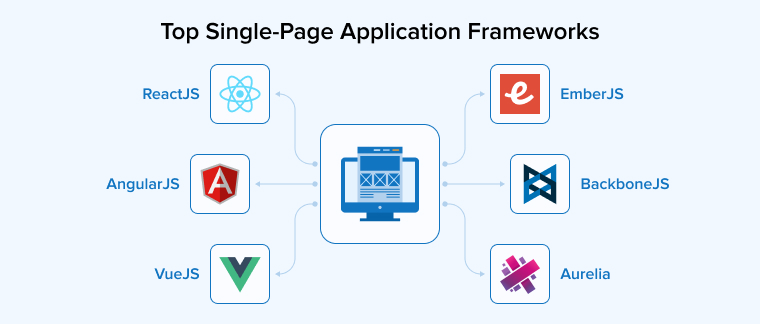
1. ReactJS
Meta created an open-source framework named React.js because it is based on JavaScript. It helps design SPAs and highly engaging user interfaces for web apps. The framework supports a component-based single-page application architecture, allowing React developers to break down the user interface into reusable UI components for better management and creation of enterprise-grade UIs.
React is popular for its performance, simplicity, and efficiency. Its virtual DOM minimizes actual DOM manipulation during updates, optimizing the app’s performance. Blending this capability with its declarative approach to UI building makes it easier to understand the app’s logic.
Moreover, it has a vibrant ecosystem of libraries that further extends React’s capabilities, such as Redux for state management and React Router for smooth navigation. The flexibility and scalability of React make it ideal for projects of varying sizes.
Key Features:
- Component-Based Architecture: This enables the React developers to create tailored and reusable web components, leading to increased efficiency and code reusability.
- Unidirectional Data Flow: This feature helps ensure that the state of the application remains well-maintained and uncompromised.
Pros:
- Improved Productivity: React supports a modular architecture, encouraging developers to build reusable code and UI components. So developers don’t have to design the application from scratch every time, enhancing individual productivity.
- Rich Ecosystem: ReactJS offers numerous libraries and frameworks, including React Router and Redux, to build a variety of single-page applications.
Cons:
- Steep Learning Curve: React is not quite beginner-friendly. Many developers need more time and effort to master React because of its challenging concepts, like state management and JSX.
- Increased Overhead: As the size of the app grows, React requires multiple libraries, leading to increased boilerplate code, which also makes the app quite heavy.
2. AngularJS

Angular is a popular framework for building SPAs and complex enterprise applications. Google developed the initial version of AngularJS, which was known for its simplicity, DOM rendering, and data binding features.
The modern Angular is a comprehensive, feature-rich front-end framework that utilizes TypeScript to ensure enhanced code quality. With a modular architecture, it promotes code organization and reusability.
Two-way data binding is a key feature of the Angular framework. It simplifies the synchronization between the model and the view, allowing developers to build complex single-page applications. Angular is quite rich in terms of tools and features, helping businesses create web applications that deliver excellent performance and a seamless user experience.
Key Features:
- Two-Way Data Binding: It automatically allows for easy synchronization between the model and the view.
- Robust Routing Model: This feature helps Angular developers build a single-page application with multiple views.
Pros:
- Large Community: AngularJS framework is widely popular, supported by Google and a large community of expert web app developers. They offer extensive resources and detailed documentation.
- Simplified Dependency Management: Angular comes with a powerful dependency injection system that simplifies dependency management, enhancing modularity and code reusability.
Cons:
- Steeper Learning Curve: The learning curve of Angular is higher compared to other JavaScript-based frameworks due to its extensive tools and features.
- Performance Overhead: Angular supports two-way data binding, which helps increase developer productivity. But it may lead to performance overhead, especially in large-scale apps.
3. VueJS
Vue.js is a progressive JavaScript framework primarily used for designing user interfaces. Its flexible core library and incremental adoption approach make it versatile for projects of varying sizes and complexities, ranging from small features to large single-page applications. This allows developers to adopt its features as needed.
The reactive binding system in Vue.js ensures efficient updates and reusability. The framework also employs a component-based structure. It comes with a gentler learning curve and clear documentation, maintaining a strong balance between simplicity and functionality.
Key Features:
- Easy to Learn: Vue is easy to learn because it is a simple framework. Beginners can easily master the fundamentals of Vue and get started with web application development.
- Flexibility: VueJS allows developers to use its modules for different parts of the application without rewriting the entire module. It provides numerous integration options as well.
Pros:
- Collaborative Atmosphere: Vue is popular for offering a positive and collaborative atmosphere for developers, allowing them to collaborate and contribute to projects. It also enables them to produce and share various resources.
- User-Friendly: Because of its simplicity, Vue.js is very easy to use, allowing developers to build web applications effortlessly.
Cons:
- Not Used Widely: Despite being a popular framework, VueJS has a low adoption rate. Therefore, the opportunities for Vue developers remain extraordinarily low compared to other JS frameworks, especially with large enterprises.
- Fewer Resources: Vue is still growing. Hence, it doesn’t have a mature ecosystem offering numerous tools, features, tutorials, and other resources. Even its community is small compared to other frameworks like Angular and React.
4. EmberJS
Ember.js helps build enterprise-grade applications and single-page applications. It comes with quite an opinionated development approach and adheres to the convention over configuration principle, leading to a structured and rapid development process. EmberJS provides a cohesive environment and a wide set of built-in features, popularly known as a “batteries-included” approach.
This open-source JavaScript framework also offers web application URL routing, HTML templating, and server-side rendering. It also offers strong developer tooling and conventions that help write clean and maintainable code, ensuring consistency and aiding in rapid application development.
Key Features:
- CLI: This feature allows developers to handle dependencies, execute test cases, write code, and perform other activities included in the development workflow.
- Strong Conventions: They ensure a consistent structure during web app development.
Pros:
- Large and Active Community: EmberJS is supported by a large community of developers that actively contributes to the advancement of the framework by building various plugins and extensions to address different web development challenges.
- Rich Ecosystem: Ember provides a large array of tools, including Ember Data, Ember CLI, and Ember Inspector. It also comes with a comprehensive set of features such as templating, data management, and routing.
Cons:
- Performance Issues: Single-page Apps built using Ember.js tend to be bigger than apps built by other frameworks. This significantly affects app performance, especially when running on mobile devices with limited resources.
- Limited Customization: Developers can’t use this tool to build a tailored web app as it lacks customization options, limiting its flexibility.
5. BackboneJS

Backbone.js is a lightweight and minimalist JavaScript framework. It is often referred to as a library because of its simple design. Developed and launched by Jeremy Ashkenas in 2010. It is mainly used for developing single-page applications and client-side applications.
Backbone.js takes a structured approach to web development by following the Model-View-Presenter (MVP) architectural pattern. It’s offerings a collection of APIs, views, and connections to JSON interfaces, streamlining code organization and facilitating seamless data synchronization.
Backbone is popular for its minimalistic toolset and flexibility. It allows developers to choose and integrate the tools of their choice into their projects, making it suitable where a simple, tailored approach is required.
Key Features:
- Lightweight: BackboneJS comes with a minimal structure and hence is a lightweight framework, which is ideal for small-scale projects.
- Modular Approach: Following the modular approach, BackboneJS makes it easy to build scalable and easily maintainable single-page applications with better code consistency.
Pros:
- Developer-Friendly: BackboneJS enables developers to use the features and tools of their preference during web app development.
- Data Sync: This framework offers built-in data syncing capabilities between the client side and the server side.
Cons:
- More Boilerplate Code: BackboneJS requires more boilerplate code compared to other frameworks, resulting in increased code verbosity and longer development time.
- Manual Code Organization: Backbone.js is highly dependent on JavaScript and manual code organization when it comes to maintaining or scaling the app. This makes the codebase bigger and more complex.
6. Aurelia
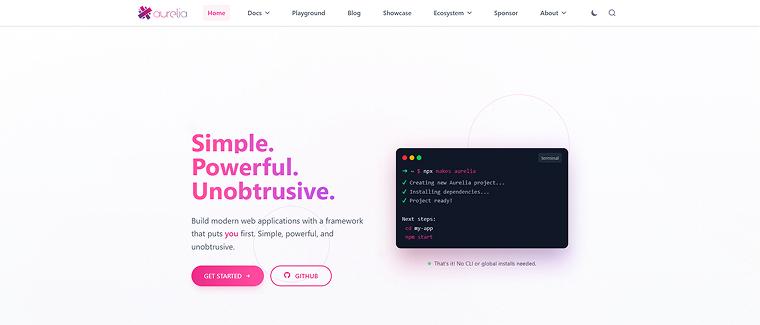
Aurelia is a modern open-source JavaScript framework specifically designed for building SPAs. Rob Eisenberg created this framework and released it in 2015. Aurelia provides numerous features for building powerful, scalable, and easily maintainable applications, especially large and complex projects. Aurelia consists of two-way data binding and dependency injection, which helps developers write organized and maintainable code.
Key Features:
- Supports TypeScript: On top of a lightweight JavaScript framework, this framework also supports TypeScript, which enables developers to leverage a large range of features and tools for writing scalable and easy-to-maintain apps.
- Powerful Router: Developers use this feature to define routes and navigate through various components and views in your app.
Pros:
- Scalability: Because it supports a modular architecture, developers can easily add new features to the existing app or remove outdated or faulty features immediately without disturbing ongoing web activities. Modularity improves app scalability and maintainability.
- Enhanced Performance: Since it is built upon modules, the overall project or app size remains small, which allows for faster loading time and improved app performance.
Cons:
- Low Adoption: Compared to popular frameworks like Angular and React, the adoption rate of Aurelia is very low. One reason can be that it is relatively new.
- Immature Tools: Many users have reported that tools for dependency management and others are not mature enough, like other frameworks. It also offers fewer libraries and plugins.
Single-Page Application Frameworks – A Comparison at Glance
After discussing the popular frameworks, this section gives you a short comparison between these frameworks and where you can use them to help you make an informed decision.
| Framework | Features | Pros | Cons | Where to Use? |
|---|---|---|---|---|
| React | Component-based single-page application architecture and unidirectional data flow | Improved productivity and a rich ecosystem | Steep learning curve and increased overhead | To create interactive user interfaces, complex single-page applications, and mobile apps. |
| Angular | Two-way data binding and a robust routing model | Large community and simplified dependency management | Steeper learning curve and performance overhead | To build dynamic views, complex SPAs, and enterprise applications. |
| Vue | Easy to learn and flexible | Collaborative atmosphere and user-friendly | Low adoption rate and fewer resources | Ideal for small to medium-sized projects, and when progressive adoption is required. |
| Ember | CLI tools and strong conventions | Large, active community and rich ecosystem | Performance issues and limited customization options | Suitable for ambitious web applications that prefer or follow the convention over configuration principle. |
| Backbone | Lightweight and modular approach | Developer-friendly and data syncing capabilities | Need more boilerplate code and manual code organization | Good for lightweight projects that need flexibility. |
| Aurelia | Robust router and TypeScript support | Enhanced performance and scalability | Low adoption rate and immature tools | To large apps that require a modern SPA Framework with modularity |
Conclusion
Selecting a suitable option to build a single-page application can be challenging, especially if you have too many options to choose from. Therefore, in this article, we discussed the most popular SPA frameworks, their key features, strengths, and limitations. It included widely used JavaScript-based frameworks like ReactJS and AngularJS, and relatively new frameworks like Aurelia.

Itesh Sharma is core member of Sales Department at TatvaSoft. He has got more than 6 years of experience in handling the task related to Customer Management and Project Management. Apart from his profession he also has keen interest in sharing the insight on different methodologies of software development.



Comments
Leave a message...