


Modern businesses are under constant pressure to deliver software faster without compromising on quality, security, and reliability. This growing demand has encouraged organizations to adopt DevOps practices that improve collaboration between development and operations teams. As a result, many organizations have started investing in DevOps Cloud Services to simplify infrastructure management and accelerate deployment processes.
It’s important to note that DevOps implementation is not an easy task. Many roadblocks come in the way when organizations initiate the implementation process. It’s also common for teams to start a DevOps implementation without a complete understanding of its various aspects. This results in delays and mid-way obstructions, which proves costly in the long run.
To achieve successful DevOps adoption, organizations must understand these obstacles and learn how to address them effectively. This blog explores the key DevOps challenges businesses commonly face and highlights practical ways to overcome them for smoother workflows and long-term operational success.
What Are the DevOps Adoption Challenges?
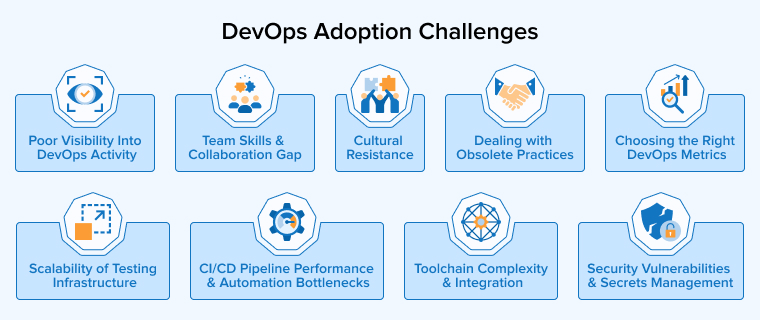
Let us discuss some of the top challenges organizations generally face during their journey of DevOps adoption:
Cultural Resistance
Resistance to change is one of the most common challenges often seen in many organizations starting DevOps adoption. Many teams are used to working separately and may hesitate to adopt new ways of collaboration. Developers might feel uncomfortable learning new tools or sharing responsibilities across roles. Additionally, fear of losing expertise or stepping out of familiar processes can also slow progress. DevOps requires a shift in mindset where teamwork, communication, and shared goals become more important than working in isolated groups.
Solution
Organizations need to encourage teamwork and continuous learning. Multiple teams should work together from the beginning rather than staying separate. Clear communication, regular training, and involving employees in decisions can make the transition smoother. Leaders should focus on shared goals and support collaboration. They should recognize team efforts and promote open discussion to help build trust and a comfortable environment where employees can accept new ways of working.
Dealing with Obsolete Practices
Organizations still dependent on outdated systems and working in isolation face many challenges in adopting DevOps practices. There’s limited communication between development, operations, and testing teams, increasing the communication gap and adding to difficulties such as delays, repeated fixes, and inefficient workflows. Bugs keep moving back and forth between teams, slowing releases and reducing quality. Outdated tools also make it harder to improve DevOps processes, making modernization and smooth collaboration a major challenge.
Solution
Even though DevOps uses automation, teamwork and clear communication remain essential. When development and operations teams collaborate openly, processes become smoother and more efficient. It is also important to catch errors early by using automated testing during software development. By making testing a regular part of the workflow and halting faulty builds immediately, teams can improve quality and reduce problems later.
Team Skills and Collaboration Gap
DevOps depends heavily on teamwork, but many organizations struggle because their teams lack the right mix of skills and fail to collaborate effectively. There’s a high demand for skilled engineers capable of managing complex infrastructure and automating deployment processes. Developers, testers, and operations staff often work separately, which creates communication gaps and slows down progress.
When teams focus only on their own goals, for example, developers pushing changes and operations maintaining stability, it becomes harder to align efforts. This challenge grows even more in distributed or outsourced environments where time zones and cultural differences increase complexity. Some organizations also rush into automation without building strong fundamentals, which leads to unstable systems.
Solution
To successfully adopt DevOps, organizations need to focus on the team, not just tools. They should help team members upskill through regular training, hands-on practice, conducting workshops, and certification programs. They have to start building teams that include members from different roles, encourage shared responsibility, and foster a better understanding of each other’s work. Conducting regular meetings and providing common platforms to keep everyone aligned is necessary to reduce communication gaps.
When teams work toward the same goals instead of separate ones, collaboration improves naturally. Encouraging knowledge sharing and recognizing teamwork can further strengthen this culture. Over time, these efforts help remove barriers between teams and create a more cooperative and efficient working environment.
Toolchain Complexity and Integration
Managing multiple DevOps tools can become challenging when they do not work well together. Teams often use different platforms for tasks like CI/CD, testing, and monitoring, which creates communication gaps and slows down workflows. Poor integration can lead to delays, duplication, and higher costs. Instead of improving efficiency, a disconnected toolchain can make collaboration harder and increase the chances of errors.
Solution
A strong DevOps setup works best when all tools connect smoothly and support each stage from coding to deployment. Teams should choose tools that integrate well, reduce duplication, and are easy to use and maintain. Using cloud-based platforms such as Azure DevOps and shared dashboards can simplify configuration management. Regular reviews help eliminate unnecessary tools, while training ensures everyone can use the system effectively and contribute to continuous improvement.
Security Vulnerabilities and Secrets Management
Using DevOps can improve security by integrating development and operations, but it also introduces new risks if not handled carefully. Faster releases, shared access, use of cloud technologies, and various tools and platforms can create vulnerabilities, especially if security is addressed too late or secrets are poorly managed. Organizations must not focus only on speed, as this can weaken the security posture. Automation enhances the development and deployment efficiency, but it can even open doors to unexpected security threats.
Solution
Organizations must consider security as an equal part of development and operations by implementing the DevSecOps model. Instead of adding security measures at the end, development teams should include them from the beginning by following a “shift-left” approach. This helps detect issues early, reduce risks, and avoid costly fixes later.
Implementing automated testing, vulnerability scanning, and continuous monitoring ensures consistent protection across the pipeline. Teams should also adopt secure coding practices, carefully manage sensitive data, and apply strict access controls. There must be regular audits and training programs to help build awareness and responsibility. Keep in mind that when security is shared by everyone and integrated into every stage of software development, it results in faster, safer, and more reliable software delivery.
Poor Visibility Into DevOps Activity
DevOps deals with many interconnected systems to improve speed and consistency, but this also makes it quite tough for teams to keep an eye on everything happening at each stage. Teams often struggle to identify errors, fix issues, and enhance performance, especially while dealing with complex DevOps environments. It requires a proper DevOps strategy and effort to monitor every step from code changes to testing and deployment. Strong observability helps engineering teams quickly detect issues, understand system behavior, and make better decisions rather than relying on assumptions or incomplete information.
Solution
Teams can prevent or reduce monitoring gaps by using tools that provide complete visibility into their systems and automatically collect useful data. There are options like end-to-end monitoring, logs, and dashboards to track DevOps performance and system health easily. A good observability setup helps detect problems early and supports better decision-making based on real insights. Focusing on key metrics and continuously improving alert systems over time ensures faster responses, smoother scaling, and more reliable and secure legacy applications.
CI/CD Pipeline Performance and Automation Bottlenecks
DevOps aims to accelerate the software delivery process, but inefficient workflows can have the opposite effect. Slow CI/CD pipelines, especially during build, testing, or deployment stages, can delay feedback and interrupt developers’ working speed. Unreliable tests, known as flaky tests, create confusion and waste time as teams get busy identifying false failures.
Overloaded pipelines and complex test setups further add to delays and reduce productivity. Manual steps in testing or deployment also cause errors and slow down the release process. When pipelines are not well-optimized, even small changes take longer to validate, resulting in frustration, reduced efficiency, and slower overall progress in software delivery.
Solution
DevOps teams must prioritize automation and a faster feedback loop to improve their continuous integration and continuous delivery pipelines. Developers must first run tests locally to identify issues in the early stages instead of waiting for the pipeline. There’s a need to reduce unnecessary steps, run tests in parallel, and regularly review and update test cases to increase the speed and reliability. Automation of testing and deployment processes minimizes the probability of human errors and saves time.
The system can be made capable of efficiently handling increased workloads through scalable infrastructure and modern containerization and orchestration solutions. Teams must integrate performance testing and monitoring into the pipeline to help detect slowdowns early, resulting in faster releases and a smoother development experience.
Scalability of Testing Infrastructure
With the increasing complexity and size of applications, the testing infrastructure must also scale to meet the growing demand. Limited availability of testing resources, for example, servers or devices, may hamper the entire software development process and delay feedback. Increased traffic of user requests, a surge in data, and connected devices can disrupt small test setups, resulting in missed issues. When testing infrastructure keeps pace with application growth, it results in high speed and quality.
Solution
DevOps teams must go for flexible solutions such as Selenium-based setups or cloud-based testing platforms to manage the increasing demand for testing, as these automation tools can easily scale with the growing size of applications. These solutions can automatically add the required nodes to adjust to higher loads when required. There is also the choice of parallel testing across multiple devices and production environments to reduce delays, increase the frequency of feedback, and thus maintain a smooth release DevOps lifecycle.
Choosing the Right DevOps Metrics
There are a number of metrics available in DevOps, but not all of them are that useful. Getting overwhelmed by the number of metrics, teams many times focus on numbers that look impressive but do not indicate real issues and improvements. It’s essential for them to select the relevant metrics to understand performance and efficiency bottlenecks and identify the problems causing them.
Measurement and analysis across too few or unclear metrics can create gaps in insights. Organizations need meaningful Key Performance Indicators (KPIs) that truly reflect progress, efficiency, and system health.
Solution
Organizations must stop tracking random numbers and prioritizing visibility metrics. They should start focusing on metrics that depict the speed of value delivered, stability of software releases, and how the system’s resilience is to recover from failures. There are some popular and reliable metrics, such as DORA metrics, that teams must rely on to measure speed and stability. DevOps teams must select KPIs wisely, align with their business objectives, and not chase the metrics just to compare between teams.
Clear dashboards and visualization tools make it easier to understand performance trends and spot problems early. Continuous monitoring must be adopted across the system to help teams stay aware of builds, deployments, and system health. Teams must regularly conduct a review of these metrics to ensure their relevance and support improvement.
Final Thoughts
Achieving DevOps integration and accustoming themselves to its principles and DevOps practices is not something organizations can achieve overnight. It is time-consuming and grows through steady effort, learning, and adaptation. Along the way, it’s obvious for teams to face various top challenges, be it scaling problems or skill gaps, but they are a part of the DevOps processes.
The thing that matters is how development and operations teams respond to these DevOps challenges by improving collaboration, investing in training and development, and addressing problems in a structured manner. Small wins can boost confidence and help organizations turn obstacles into opportunities to fully realize the benefits of DevOps.
FAQs
Organizations, while implementing DevOps practices, generally face common challenges in the form of resistance to the new DevOps culture, skill gaps, confusion in choosing the right tools and their integration complexity, security risks, monitoring and observability, selection of appropriate measuring metrics, etc.
There are some globally accepted DevOps metrics, such as DORA metrics, that include Deployment Frequency(DF), Lead Time for Changes(LTFC), Change Failure Rate(CFR), and Mean Time to Recovery (MTTR).

Shruj Dabhi is an enthusiastic technology expert. He leverages his technical expertise in managing microservices and cloud projects at TatvaSoft. He is also very passionate about writing helpful articles on the same topics.



Comments
Leave a message...