

The demand for specialized software solutions is growing rapidly with the evolving needs of businesses and continuous updates in digital trends. Businesses today often require more than standard software products to meet their unique operational needs. This is where Independent Software Vendors (ISVs) play an important role.
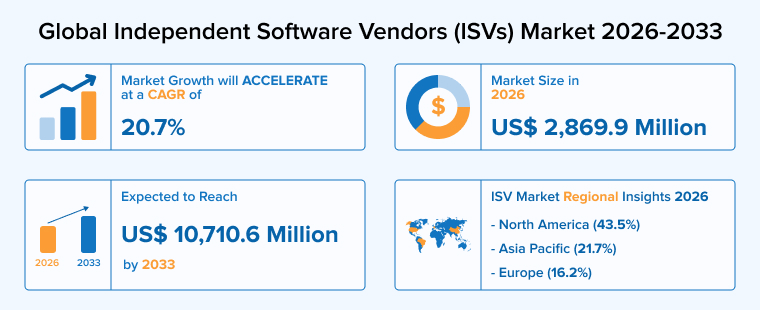
Businesses have started collaborating with offshore software development companies to customize, implement, or enhance software developed by ISVs. ISVs create solutions that can work independently or integrate with existing platforms, allowing businesses to extend functionality without building software from scratch. As a result, the global ISV market size is expected to reach US $10,710.6 million by 2033, growing at a CAGR of 20.7% from 2026 to 2033.
In this guide, we will explore everything you need to know about Independent Software Vendors, including their working, types, selection criteria, and best practices they must implement to deliver the best results.
What is an Independent Software Vendor?
An Independent Software Vendor (ISV) is an organization whose main focus is on developing and selling software products for businesses. These companies design applications that help users perform specific tasks, solve business challenges, or improve daily operations across different industries. You can use the software of an ISV on various devices and platforms, allowing them to cater to a large customer base.
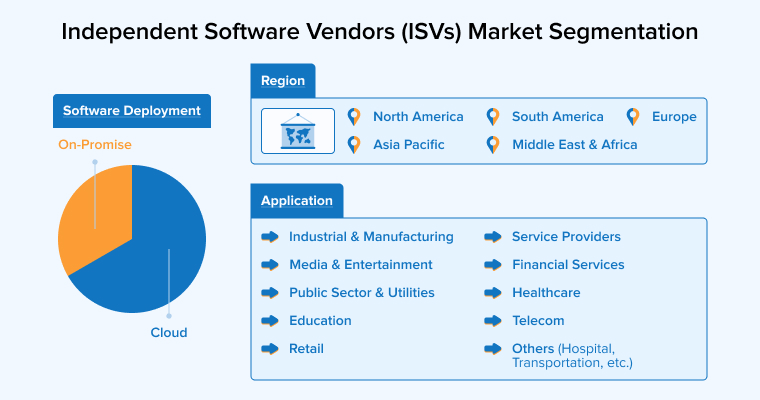
ISVs develop a range of solutions from healthcare, financial services, retail, telecom, media & entertainment, education, to the public sector and utilities. They have a client base across North & South America, Europe, the Asia Pacific region, the Middle East, and Africa. ISVs mainly employ the cloud deployment method to deliver the software.
Instead of transferring ownership, ISVs grant customers the right to use their software through licensing, term agreements, or subscription models. Many also offer cloud-based solutions that make software easier to access and maintain. ISVs’ complete focus is on software development that helps them build deep expertise in particular markets and continuously improve their products through innovation and new technologies.
How Do Independent Software Vendors Differ From Other Types of Software Providers?
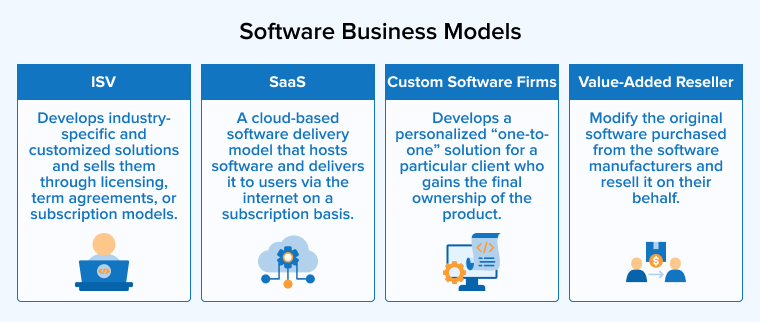
An Independent Software Vendor (ISV) differs from other software providers because software development and sales are its main business activities. ISVs create products that can usually work across different operating systems, devices, and cloud environments, increasing their accessibility across a broad range of users. Unlike hardware manufacturers, who often develop software mainly to support their own equipment, ISVs focus on building independent solutions that address business or operational needs.
ISVs even differ from custom software firms, which develop applications for individual clients who often gain ownership of the final product. In contrast, ISVs keep ownership of the software and provide customers with the right to use it through licenses or subscriptions. Their role also goes beyond reselling, as they are responsible for designing, improving, and maintaining the software products they bring to market.
When it comes to Value-Added Reseller (VAR), they do not develop their own solutions, unlike an Independent Software Vendor (ISV). They build complete business solutions by purchasing software from third-party providers, customising it for the clients, and reselling it through licenses, subscriptions, and managed services on behalf of the software manufacturers.
SaaS and ISV are often used interchangeably, as they are closely related but represent different aspects of software. SaaS (Software as a Service) is a cloud-based software distribution model that provides software to customers via the internet on subscription-based pricing. ISVs build software and use SaaS as a delivery medium. For example, Slack is an ISV that sells its communication software as a SaaS application.
The following table will help you get a brief difference between ISVs, SaaS, custom software firms, and hardware manufacturers:
| Provider Type | Primary Focus | Owns the Software? | Example |
|---|---|---|---|
| ISV | Build & sell software products | Yes | Salesforce, Veeva |
| SaaS Company | Cloud-based software delivery | Yes | Zoom, Slack |
| VAR (Value Added Reseller) | Resell + enhance existing software | No | CDW, Insight |
| Custom Software Firm | Build bespoke apps per client | Usually client | TatvaSoft (partner) |
| Hardware Manufacturer | Build devices; software is secondary | Sometimes | HP, Cisco |
What Does an ISV Do?
An ISV is responsible for performing some of the major functions to provide maximum benefits to the customers:
Software Development
ISVs create software products that help businesses handle specific tasks and challenges. They manage the entire product lifecycle, including planning, development, updates, improvements, and ongoing support.
Licensing and Distribution
ISVs not only develop software but also ensure it reaches customers through multiple deployment options. As businesses use different technology environments, vendors make their products available across cloud platforms, private infrastructure, and secure offline systems. This flexibility helps customers choose the setup that best matches their operational and security requirements.
Maintenance and Support
ISVs help customers get the most value from their software by offering guidance, technical support, and training. They also maintain product reliability through regular updates, security improvements, and ongoing assistance.
Compliance and Security
ISVs place strong emphasis on robust security features and regulatory compliance, such as SOC 2, HIPAA, GDPR, PCI DSS, ISO 27001, etc., to protect customer data and maintain trust. They follow recognized software development practices, perform security audits, and obtain independent certifications when needed.
What Are the Types of Independent Software Vendors?
There are three major types of Independent Software Vendor (ISV) categorized by target market:
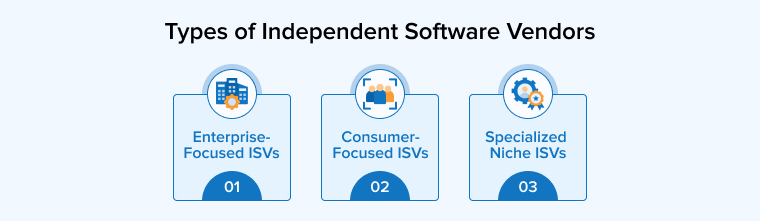
1. Enterprise-Focused ISVs
Enterprise-focused ISVs develop software primarily for organizations that need reliable solutions for managing complex industry-specific challenges. Their products are designed to improve processes, increase efficiency, and support large-scale operations across different industries. These vendors often possess strong knowledge of specific sectors, enabling them to create tools that address unique operational requirements.
Enterprise ISVs focus on helping companies manage essential functions such as customer relationships, resource planning, workforce management, and operational workflows more effectively, instead of serving general consumer needs. Some of the popular Enterprise ISVs are Red Hat, Microsoft Azure, and Salesforce.
2. Consumer-Focused ISVs
Consumer-focused ISVs create software such as mobile apps, digital wallets, gaming platforms, etc., for regular users rather than businesses. These products are designed to be simple, accessible, and convenient for entertainment, communication, productivity, payments, and other daily activities. These vendors typically distribute applications through online marketplaces and app stores to help consumers easily discover and download them.
Success in this market often depends on attracting a large number of users instead of securing a few high-value contracts. To generate revenue, many consumer-focused ISVs rely on subscriptions, premium features, in-app purchases, or advertising. Their software plays a major role in how people interact with technology in their personal lives.
3. Specialized Niche ISVs
Specialized niche ISVs focus on serving particular industries such as healthcare, real estate, finance, etc., by developing software as per their unique requirements. Instead of creating broad solutions for all users, they address specific operational challenges that demand deep domain expertise. Their products are often designed to fit industry workflows, regulations, and security expectations, making them more effective than generic alternatives.
These vendors frequently connect their applications with larger technology platforms to improve functionality and ease of deployment. Thus, Niche ISVs can develop highly targeted solutions that help organizations work more efficiently, maintain compliance, and manage specialized tasks by focusing on a particular domain.
What Are the Benefits of Working with an Independent Software Vendor?
Organizations benefit in multiple ways by collaborating with the appropriate Independent Software Vendor:
Specialized Solutions
Independent Software Vendors are industry experts, so they have a deep understanding of the processes, requirements, and challenges faced by a particular industry. It helps them to develop customized solutions that cater to the organization’s unique needs, perform efficiently, and simplify their daily business processes and workflows.
Time and Cost Efficiency
ISVs make use of pre-built software components or platforms without developing the software from scratch. Their solutions are pre-configured and can be deployed immediately, reducing the time-to-market of companies. ISVs distribute development tasks to multiple clients, which spreads the development expenses, and an optimized pricing structure is formed. The offering of features through cloud-based platforms and through a subscription model results in significantly reduced costs incurred by businesses.
Innovation and Agility
ISVs align their software products with evolving technology and trends by following the agile methodology so that the solutions always remain up to date. As a result, businesses do not need to worry about significantly updating the existing solutions to respond to the changing market demands and remain competitive.
Integration Capabilities
It is a necessary requirement of businesses that their newly introduced systems must integrate smoothly with the existing systems, so there’s no need to introduce major changes in the ongoing processes. ISVs help in this by providing pre-built API connectors that allow rapid deployment and automated data synchronization, enhancing productivity and no need to rely on third-party services.
Scalability and Flexibility
ISVs create solutions that are capable of scaling alongside a business without requiring major system changes. They design software that can handle increasing workloads and changing requirements efficiently. They provide flexible deployment options and adaptable resources, which help organizations expand operations smoothly without compromising performance to support long-term growth and evolving business demands.
How to Choose the Right Independent Software Vendor?
The selection of the right independent software vendor will determine the success or failure of your business idea to a large extent. Therefore, it’s highly important to follow a well-recognized methodology to choose the best suitable one:
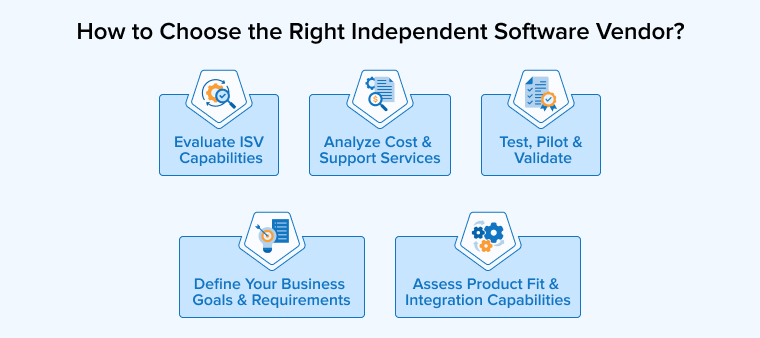
Define Your Business Goals and Requirements
Before choosing an ISV solution, it is important to clearly understand your own business needs and the problems you want to solve. This may include replacing manual work, improving operations, or supporting new business goals. You should also consider industry requirements, essential features, and any compliance rules. A clear view of your workflows helps you compare software options more effectively. Keep in mind that the best choice is one that not only solves current challenges but can also support future growth and long-term plans.
Evaluate ISV Capabilities
It is important to check whether the vendor has experience in your industry and can show their success story of implementations. Look for customer reviews and case studies to help reveal how reliable and effective their solutions are in practice. You should also assess technical aspects like integration capability, security standards, and support systems. Compliance with data protection laws and clarity on intellectual property ownership are also essential. A vendor with strong domain knowledge usually delivers smoother implementation and requires less customization.
Assess Product Fit & Integration Capabilities
When evaluating an ISV, consider how compatible its software is with your existing technology environment. A solution that connects smoothly with current business systems can reduce implementation challenges and improve efficiency. It is also important to assess whether the software can be adapted to changing business needs and support future expansion to ensure long-term value and minimize the need for major system changes later.
Analyze Cost & Support Services
When selecting an ISV, do not forget to look beyond the initial purchase price and consider the overall long-term value. Costs related to implementation, training, maintenance, and future upgrades can significantly affect the total investment. Reliable customer support, clear Service Level Agreements (SLAs), and timely issue resolution are also essential factors. In addition, evaluate the vendor’s roadmap for future product improvements to ensure that the software remains relevant and effective over time.
Test, Pilot & Validate
Selecting software from an Independent Software Vendor should involve more than reviewing presentations and promises. Verify thoroughly that the solution performs effectively with their own data, systems, and daily operations. Ask for a limited trial with actual users to help reveal usability issues, performance concerns, and workflow compatibility. The results of this testing phase provide evidence of business value so that you can assess costs, expected returns, support quality, and long-term suitability before committing to a full deployment.
Independent Software Vendor Best Practices
It will help ISVs to deliver expected software solutions to the clients by following the best practices given below:
Understand Customer Needs Properly
For an Independent Software Vendor, success depends on understanding customers and responding to their real challenges.
- Communicating regularly with users helps to uncover their expectations, frustrations, and priorities.
- ISVs can make better development decisions by studying customer behavior and product usage.
- Flexible development practices allow quick improvements based on feedback and market changes.
- Strong integrations, dependable support services, and clear documentation also play an important role in improving user satisfaction and maintaining long-term customer relationships.
Align Software Development with Enterprise Business Architecture Principles
It’s important to ensure that the software aligns with enterprise business architecture to deliver long-term value to customers.
- The focus should be on understanding how businesses operate and designing solutions that support their core functions and workflows.
- Software should be structured around real business activities so that users can work more efficiently and communicate using familiar terms.
- Easy integration with existing enterprise systems allows organizations to connect new applications without major disruptions.
- A flexible and modular design helps businesses expand, modify, or replace features as their needs evolve.
- Adopting modern development practices, including automated testing and deployment, enables faster delivery of updates while maintaining reliability.
- Embed security throughout the development process rather than being added later. Strong access controls, continuous monitoring, and compliance-focused practices help organizations protect sensitive information and meet regulatory requirements.
Build Strategic Partnerships and Alliances
Successful partnerships are built on shared objectives, strong collaboration, and a commitment to creating value for customers.
- Choosing partners whose products, services, and markets complement the organization’s own goals can lead to more effective business opportunities.
- A clear explanation of how both solutions work together to solve customer challenges helps strengthen the relationship and improve market acceptance.
- Integrations should be easy to implement and supported by clear documentation and dependable assistance.
- Expanding through established marketplaces and partner networks can increase visibility and open access to new customer segments.
- Partners should receive proper training, resources, and guidance so they can confidently represent the solution. Once a partnership is established, ongoing evaluation is essential.
- Regular communication and performance reviews ensure both organizations remain aligned and continue growing together over time.
Final Thoughts
As organizations are increasingly pursuing digital transformation, Independent Software Vendors are becoming valuable partners in delivering innovative and flexible technology solutions. Before opting for ISV services, it’s essential to have a conceptual clarity on their operation pattern and how they can benefit your business. Smarter technology investments will give desired results and profits if done with a thoughtful strategy.
FAQs
An ISV is a software company that develops and sells software, whereas SaaS is a specific cloud-based, subscription model for delivering software applications online. ISVs use the SaaS model as one of their software delivery mediums.
Independent Software Vendors (ISVs) solutions are commonly used across technology, healthcare, finance, manufacturing, retail, and logistics to optimize operations and drive digital transformation.
Businesses must consider robust security compliance, scalability, integration capabilities, continuous technical support, vendor’s long-term financial stability for continuous innovation, etc., when selecting an ISV.

Itesh Sharma is core member of Sales Department at TatvaSoft. He has got more than 6 years of experience in handling the task related to Customer Management and Project Management. Apart from his profession he also has keen interest in sharing the insight on different methodologies of software development.



Comments
Leave a message...