

Businesses today need software that can adapt to changing customer needs and remain reliable over time. Java continues to play an important role in this space because it can support everything from enterprise applications and backend systems to cloud-based platforms and large-scale business solutions. However, building and maintaining Java applications in-house is not always simple. Finding experienced developers, managing project timelines, controlling costs, and keeping up with new technologies can put considerable pressure on internal teams.
This is where Java development outsourcing can make a practical difference. Java development companies can work with an experienced external team to build new applications, improve existing systems, or modernize older Java solutions instead of handling every development task internally. The global IT services outsourcing market size was valued at USD 797.4 billion in 2025 and is projected to grow from USD 860.0 billion in 2026 to USD 1,498.2 billion by 2033, at a CAGR of 8.3% from 2026 to 2033. The right partner can bring specialized skills, flexible resources, and development experience without requiring a company to expand its permanent workforce.
In this blog, we’ll explore how Java outsourcing works, its key benefits, potential challenges, which types of projects can be outsourced, what businesses should consider when choosing an outsourcing partner, and the difference between in-house and outsourced Java development.
What is Java Outsourcing?
Java remains a widely used programming language for creating modern, scalable software. Its object-oriented approach organizes applications into classes and objects, which makes complex projects easier to structure and maintain. Companies that provide Java development services value the language for its flexibility, broad ecosystem, and ability to support different types of applications. Businesses often choose Java when they need dependable solutions that can grow with their changing requirements.
However, building and maintaining a Java application requires suitable technical knowledge and practical experience. Companies without an experienced in-house team can work with software outsourcing companies to handle specific projects or complete development tasks. Such outsourcing can provide access to skilled Java developers while reducing the effort needed to manage every stage internally.
What Are the Benefits of Java Outsourcing?
Outsourcing Java projects helps companies achieve their project goals by providing the following advantages:
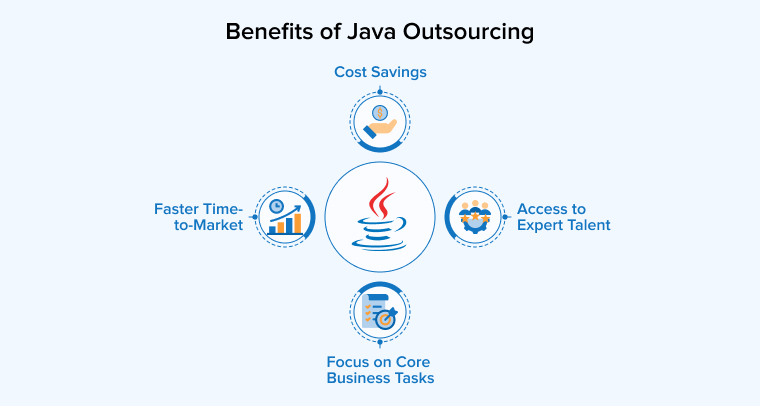
Cost Savings
Java development outsourcing can help businesses control expenses by avoiding the high costs of maintaining a full-time in-house team. Companies don’t have to pay for recruitment, training, infrastructure, software, or employee benefits. They can bring in external specialists when needed. Companies can also expand or reduce teams according to project requirements, which increases the flexibility of budgets while still providing access to experienced Java professionals.
Faster Time-to-Market
Reaching the market quickly is essential to staying competitive. External Java teams usually have experienced developers, organized workflows, and the resources needed to handle different stages of development. They can work alongside in-house teams, manage several tasks at once, and reduce delays caused by limited staff or competing priorities. This faster approach helps businesses respond to market needs, launch useful features quickly, and maintain steady progress without placing extra pressure on in-house teams.
Access to Specialized Talent
Businesses that outsource Java development gain access to skilled professionals from around the world. Java development outsourcing allows companies to access specialized talent without the constraints of geographical limitations, time-zone differences, or local hiring challenges. Companies can quickly find developers with experience in specific Java frameworks, tools, and technologies that match their project needs. This saves time on recruitment, training, and onboarding, enabling projects to begin on schedule. External teams can also contribute fresh ideas and valuable technical expertise, increasing the development capacity of in-house teams.
Focus on Core Business Operations
Outsourcing Java development lets businesses keep their attention on important business goals instead of getting caught up in technical work. While outsourced skilled developers manage coding, testing, and other software tasks, internal teams can concentrate on customers, sales, operations, and growth. This reduces the workload on managers and employees and helps them make strategic decisions, improve services, and explore new opportunities without being overburdened by everyday development responsibilities.
Key Stages of the Java Outsourcing Process
There is a proper framework for outsourcing any kind of development project. Now, we’ll see the detailed process to outsource a Java development project to an external partner.
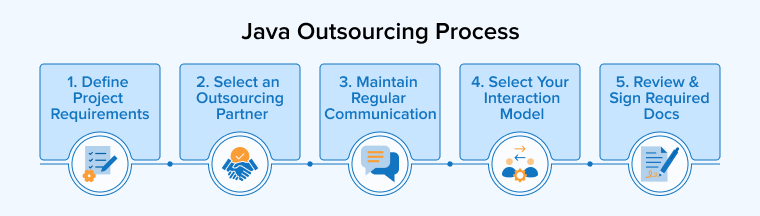
1. Define Project Requirements
First of all, it is important to clearly explain what you expect from the development team. Start by defining the main features, technology requirements, budget, and project deadlines. You should also mention important technical requirements such as security, performance, scalability, compatibility, and reliability. Along with these details, decide how the team will communicate, report progress, handle changes, and conduct testing. Clear requirements help both sides understand their responsibilities and avoid confusion during development. It is also useful to discuss maintenance, documentation, and support after the project is completed.
2. Select an Outsourcing Partner
Selecting the right Java development outsourcing provider requires more than simply looking at their services. It is important to check whether the team has relevant experience and has completed projects similar to yours. Their technical knowledge, certifications, case studies or portfolios, and ability to understand your requirements can give you a better idea of their capabilities.
Good communication is equally important, especially when teams work remotely. You should also consider differences in time zones and working styles, as these can affect collaboration. Finally, reviews, client feedback, and testimonials can help you understand how reliable the company is and what you can expect from the partnership.
3. Maintain Regular Communication
Clear communication helps create a strong working relationship with a Java outsourcing team. Before development begins, explain your project goals, expected features, priorities, and important limitations in a simple and detailed way. This helps the outsourcing partner understand your goals and project expectations. It is important to work with a team that follows your instructions, values your input, and provides regular updates on the project’s progress. Regular discussions and progress updates can help identify problems early and prevent misunderstandings. If any requirement changes during the project, share the information as soon as possible.
4. Choose Your Preferred Interaction Model
Before starting a Java outsourcing project, decide how you want to interact with the Java development provider. The right engagement model can make it easier to manage costs, responsibilities, and project progress. Common choices include fixed-price, time-and-materials, and dedicated team arrangements. A fixed-price model can suit projects with clearly defined requirements, while other models may provide more flexibility when needs can change. Discuss the available choices with them beforehand, as they may not support every option.
5. Discuss and Sign the Necessary Documents
After selecting a Java outsourcing partner, the next step is to put the business agreement in writing. The contract should clearly explain the work to be completed, project deadlines, pricing, payment terms, and each party’s responsibilities. It is also important to protect confidential business information and clearly state who will own the software and other intellectual property created during the project.
Depending on the arrangement, documents such as an NDA, Master Services Agreement, Statement of Work, IP agreement, and SLA may be included. Service expectations, support, response times, and maintenance terms should also be clearly defined. Review the documents carefully before signing to prevent future disagreements.
Which Types of Java Projects Can Be Outsourced?
The three most common types of Java projects that can be outsourced are as follows:
1. Web Application Development Projects
Java is widely used for developing web applications because it can support secure, reliable, and interactive software. Businesses in areas such as finance, education, retail, and online services can use Java-based solutions for different needs. Outsourcing this allows companies to bring in developers who already understand Java and popular technologies such as Spring and Hibernate. This can reduce the time needed for training and help teams begin development sooner. External developers can also provide additional support when in-house teams have limited resources or tight deadlines.
2. Enterprise Backend Systems
Java is a suitable choice for enterprise systems that manage huge operations, transactions, and connections between different applications. These platforms often support areas such as finance, customer processes, and internal workflows, where reliability and easy maintenance are important. Having dedicated Java developers can be useful for such long-term projects because they gradually gain a deeper understanding of the system and business needs. This familiarity can improve their work, reduce repeated explanations, and make it easier to handle ongoing updates and technical changes.
3. Migration and Upgradation Services
Older Java applications may need to be updated as newer versions and technologies become available. However, migrating an existing system can involve technical challenges and may affect regular business activities if not handled carefully. Outsourcing this work to experienced Java developers can provide the required technical knowledge for a smoother transition. They can assess the existing application, plan the upgrade, resolve compatibility issues, and help reduce interruptions in the migration to a newer Java environment.
Challenges of Java Outsourcing and How to Overcome Them
Outsourcing your company’s project to external teams does come with certain challenges that project managers must have an idea of before implementing the outsourcing process. Some of the commonly faced challenges and their solutions are as follows:
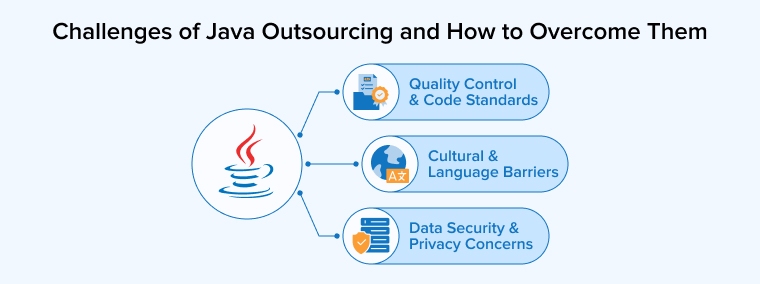
Quality Control and Code Standards
Keeping software quality consistent can be difficult when developers work remotely, especially when team members follow different coding habits. A clear quality process can reduce these problems. Teams should agree on coding standards before development begins and use regular reviews to catch issues early. Automated tools can also identify common errors and style problems. Frequent testing and performance checks help ensure that the final application remains stable, secure, and easy to maintain.
Cultural and Language Barriers
When a development team works from different locations across different time zones, it becomes quite challenging to keep the code consistent. Each developer may have a different way of writing and organizing code, which can create problems during integration and review. Setting common coding rules at the start gives everyone the same direction. Regular code reviews help the team notice mistakes and improve weak areas early. Automated checking tools can support developers by finding formatting issues and common errors. Regular testing and performance monitoring help ensure the application works smoothly.
Data Security and Privacy Concerns
Sharing project work with an outsourced Java development team can create security concerns when the project involves confidential information or valuable business assets. Before working with an outsourcing provider, companies should carefully check how the partner handles and protects data. Access to important systems should be limited to authorized people, and secure methods should be used when transferring information. A clear agreement should also explain confidentiality, data protection, and ownership responsibilities. Regular security checks and controlled access can help keep sensitive business information safe throughout the development process.
Best Practices for Successful Java Outsourcing
There are some core best practices that every company must follow when considering Java development outsourcing to achieve the expected outcomes:
Focus on Strong Communication
Good communication is essential when software teams work across different locations, languages, and time zones. Use collaboration tools such as Slack, Teams, Jira, or GitHub to share updates, assign work, and track progress. Conduct regular video meetings for team members to understand complex topics and build better working relationships.
Document project requirements, decisions, and changes properly to ensure everyone has the same information. Clear communication rules, cultural awareness, and an open environment for feedback can further reduce misunderstandings and help remote teams work together more efficiently.
Plan for Agile Development
Divide the work into smaller stages for teams to deliver useful features regularly and make changes based on feedback. Use automated testing and code checks to detect problems early, and conduct code reviews to maintain good software development practices. Before expanding the team, start with a small pilot project to check work quality, communication, and overall progress. Clear completion requirements and proper API documentation also help ensure that each task meets the expected standard before it is considered finished.
Implement Robust Data Protection
When working with a Java development partner, it is important to make sure they understand GDPR and other European data protection requirements. Check whether they conduct security reviews regularly through audits, secure coding practices, and protected code repositories. The agreement should clearly state where client information is stored, how it is processed, and who can access it.
Strong controls such as role-based permissions and multi-factor authentication can limit unauthorized access. During testing, masking or anonymizing real customer information reduces risk. The partner should also maintain reliable backups and have a clear recovery plan to protect data and keep services running after unexpected problems.
In-House vs Outsourced Java Development
Let us compare in-house vs outsourced Java development on some crucial parameters to understand which one is better than the other:
| Factors | In-house Java Development | Outsourced Java Development |
|---|---|---|
| Cost | Costs are higher due to expenses such as salaries, benefits, tools, staff training, software licenses, equipment, and office space | Costs may differ based on project scope, team size, outsourcing team’s location, and required expertise. |
| Software delivery speed | It depends on the team’s availability, workload, expertise, and problem-solving capabilities. | Maximized by project-ready teams and well-established project delivery processes. |
| Scalability | Growth may be limited when companies need time to hire people or reorganize existing teams. | Teams can scale up or down depending on changing project requirements and workload. |
| Technical Expertise | Limited to the in-house members’ skill set and can be difficult because it relies on existing expertise and requires significant time for hiring and training new employees. | The level of expertise varies by provider, with many teams offering broad knowledge across different technologies and platforms. |
| Communication efficiency | There are well-established processes that enable smooth communication and coordination. | It requires clear communication structures to ensure information flows smoothly between everyone involved. |
| Company control over the project team | The team directly manages daily development work and project-related decisions. | The level of involvement changes based on the chosen project engagement approach. |
Why Choose TatvaSoft as Your Java Outsourcing Partner?
Choosing the right Java outsourcing partner can make a major difference in the success of a software project. TatvaSoft offers access to experienced Java professionals who can support businesses with different development requirements and technical challenges. Its long-standing involvement in Java development provides a strong foundation for handling projects across areas such as application development, cloud solutions, server-side systems, migration, and mobile applications.
The availability of a large team also makes it easier to find developers whose skills match specific project needs. TatvaSoft also focuses on security throughout the development process by using measures such as restricted access, encryption, network protection, secure connections, and updated security systems. These practices help protect important project information and source code.
Final Thoughts
Java outsourcing helps businesses gain access to experienced developers without expanding their internal teams. It can support various needs such as application development, API creation, system upgrades, and ongoing maintenance. The right outsourcing company can also help control expenses and complete projects more efficiently. However, businesses should carefully assess potential providers by reviewing their technical capabilities, previous work, security practices, communication methods, pricing, and delivery record.
FAQs
Yes, outsourcing Java development is generally much cheaper than hiring an in-house team. When you outsource, you skip major expenses like recruitment, employee benefits, office space, and ongoing training.
Outsourcing Java development can be highly secure if you partner with the right agency. Enforce strict non-disclosure agreements, evaluate compliance certificates, and utilize encrypted communication channels to keep your project entirely safe.
Yes, Java outsourcing can be secure and GDPR compliant when the provider follows strong security practices and data protection requirements. Businesses should verify access controls, encryption, secure development procedures, data processing agreements, and compliance responsibilities before sharing information with an outsourcing partner.
With Java development outsourcing, you can add specialized developers, expand teams for larger workloads, or bring in experts for specific tasks without lengthy hiring processes. This flexibility helps manage changing requirements, accelerate development, and support multiple projects efficiently.
Success can be measured by tracking project quality, delivery speed, development costs, and adherence to agreed requirements. We should also monitor system performance, defect rates, communication, and customer satisfaction.

Rakshit Toke is a Java technology innovator and has been managing various Java teams for several years to deliver high-quality software products at TatvaSoft. His profound intelligence and comprehensive technological expertise empower the company to provide innovative solutions and stand out in the marketplace.


Comments
Leave a message...