

The rapid and continuous adoption of digital solutions has made choosing the right technology one of the most important decisions for any software project. The programming language and development platform you select can affect your application performance, scalability, development speed, maintenance, and long-term costs. Among the many technologies available, .NET and Python have emerged as two of the most trusted and widely adopted options for modern application development.
While both technologies are powerful, they serve different purposes and excel in different areas. Python is widely recognized for its simplicity, flexibility, and strong presence in artificial intelligence, machine learning, automation, and data analytics. On the other hand, .NET has high performance, security, and the ability to support complex enterprise-grade applications. Many businesses turn to a reliable .NET development company to leverage these strengths effectively.
Tech companies providing both .NET and Python development services often find themselves comparing these two technologies when planning new software solutions. Hence, understanding the strengths and limitations of both platforms is essential to make the correct choice and achieve the expected results.
This comparison blog covers what .NET and Python are, their key features, usage scenarios, and how they differ from each other in some crucial parameters affecting decision-making.
What is .NET?
.NET is a widely used cross-platform software development platform launched by Microsoft in 2002. Initially, it was a Windows-only platform that later evolved into .NET Core, now known simply as .NET. It helps .NET development companies create a variety of applications, including web, desktop, mobile, and cloud-based solutions. It’s a managed execution environment that runs on the C# programming language, along with supporting other languages like VB.NET and F#.
What Are the Key Features of .NET?
.NET comes with several built-in capabilities that make it one of the best choices for developing enterprise-grade solutions:
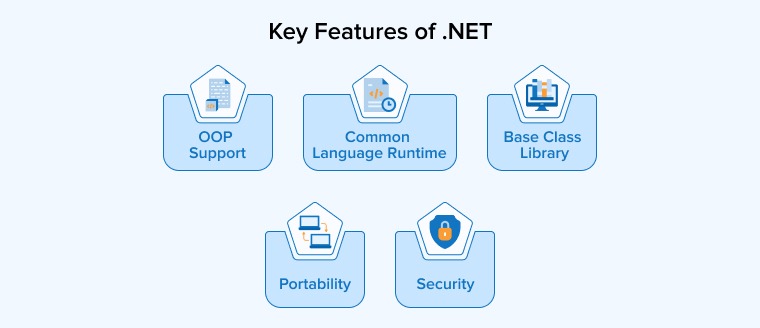
- Common Language Runtime (CLR): CLR is the implementation engine of .NET that deals with program execution, automatic memory management, exception handling, and managing background processes automatically to ensure smooth working of programs built in any language.
- Base Class Library: The BCL is a repository of built-in and pre-tested reusable classes, interfaces, and value types that simplify working with file systems, databases, XML documents, and collections. It thus reduces repetitive coding, code redundancy, and development time.
- Portability: .NET offers the flexibility to work with multiple programming languages within the same development environment due to the Common Language Specification (CLS). This allows your teams to use the languages they prefer while still building applications that function together smoothly.
- OOP Support: .NET is based on object-oriented programming principles, which help you to organize applications into structured and reusable components. As a result, the code becomes easier to manage, update, and scale with the project’s increasing size and complexity.
- Security: .NET provides a strong security system with built-in mechanisms such as role-based security, Code Access Security (CAS), authentication, and authorization to protect applications and sensitive data. It helps to build applications complying with modern security standards.
When to Choose .NET?
You must definitely go for the versatile .NET framework in the following scenarios:
- If your project is about developing an enterprise-grade application that can manage complex workflows, support a large user base, and must strictly comply with regulatory standards and practices.
- If your team is experienced with C# programming and is already working with the Microsoft ecosystem, such as Azure and Windows Server.
- If you want to develop cloud-native solutions that can be easily deployed across cloud platforms such as Microsoft Azure, AWS, and Google Cloud.
What is Python?
Python is a versatile, interpreted, general-purpose, dynamic, and high-level programming language developed by Guido van Rossum in 1991. It is known for its highly simple, plane English like syntax that’s easy to read and understand. It caters to diverse use cases due to the huge ecosystem of open-source libraries and frameworks that simplify the development of complex applications.
What Are the Key Features of Python?
Python’s popularity is experiencing a continuous surge as a result of these features:
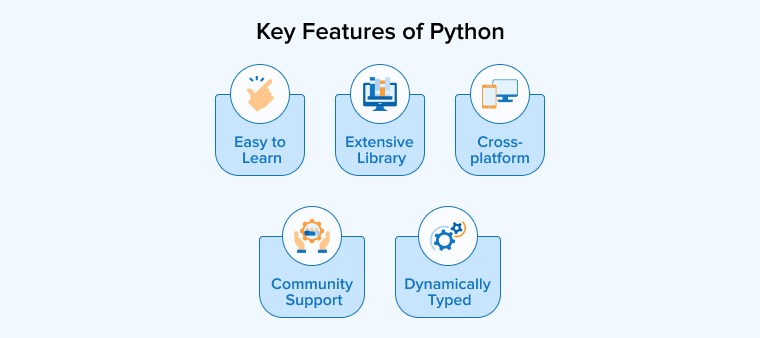
- Easy to learn: Python is a language for beginners owing to its simple and clean English-like syntax. You can write functionality within a few lines of code without getting confused with semicolons or brackets, like C++ and Java.
- Cross-platform: You can develop Python applications for a variety of operating systems, such as Windows, Linux, and macOS, by writing a single piece of code for all, as it’s an interpreted language.
- Extensive library: Python is blessed with a rich ecosystem of both standard and third-party libraries. It helps to avoid writing everything from scratch and use the prebuilt functionality to incorporate the required features into your code, saving your development time.
- Community Support: Python has a vast and growing community of developers and researchers that contributes in the form of documentation, tutorials, tools, libraries, guides, and online support. This provides programmers with continuous access to high-quality resources whenever required.
- Dynamically typed: You do not need to declare the type of a variable while writing the code. Thus, you have the flexibility to assign different values to the same variable whenever required. This is due to the determination of type during runtime by the Python interpreter.
When to Choose Python?
The following are the most appropriate scenarios to consider Python as the development language:
- If your project involves complex AI integrations, data analytics, or high automation, consider using powerful libraries like TensorFlow, PyTorch, Scikit, etc.
- If your company is small-scale or startup-based, requiring quick and cost-effective development.
- If your project involves technologies other than Python, such as JavaScript or C++, Python provides seamless integration through its libraries.
.NET vs Python: Key Differences
Let us now get into the seven major differences between .NET and Python to help you make this challenging decision about which is better.
1. Core Frameworks
- .NET: .NET offers a mature framework ecosystem to support the development of modern business applications. Frameworks such as ASP.NET provide you with the tools needed to build responsive web applications, APIs, and large-scale enterprise solutions efficiently. .NET Core provides cross-platform support, which allows applications to run consistently across different operating systems.
- Python: Python provides a rich collection of frameworks that simplify and speed up application development. Django is widely used for building feature-rich web applications because it includes many built-in capabilities that reduce development effort. Flask follows a lightweight approach and gives you greater flexibility when designing applications owing to its high versatility. This variety allows Python to serve different project requirements, whether it’s simple web solutions or complex enterprise systems.
2. Speed and Performance
- .NET: It is a compiled programming language that helps programs execute efficiently, which is necessary for enterprise platforms, real-time applications, and systems that process huge volumes of data. The performance is high due to features like JIT compilation, caching frequently accessed data, asynchronous execution of requests, and garbage collection that improve memory management and make the application responsive. Strict type checking may take extra time in the beginning, but it provides long-term code stability and maintainability.
- Python: Python’s simple syntax and dynamic typing will help you build and test applications in a short time by writing fewer lines of code. It is especially useful for projects that require frequent changes, shorter time to market, rapid prototyping, or early-stage experimentation. However, because Python is an interpreted language, it may not perform heavy and CPU-intensive operations as efficiently as compiled languages like .NET. Despite this, developers can improve its performance by using optimized tools and libraries such as Cython, NumPy, and C-based modules.
3. Popularity
- .NET: .NET has built a strong and steady presence among businesses and enterprise development teams due to its reliability, performance, and continuous improvements. Its adoption has expanded significantly with the introduction of cross-platform capabilities that help build applications for multiple operating systems using a single framework. Microsoft and an active developer community support .NET, making it a trusted choice for web applications, cloud solutions, and enterprise software.
- Python: Python is the most popular programming language, and its popularity is continuously increasing at a great speed. It attracts beginners, startups, and experienced developers alike because it is easy to learn and applicable across many domains, be it web development, automation, artificial intelligence ot data science. Its large community, extensive learning resources, and rich ecosystem of libraries have contributed to its rising popularity.
4. Security
- .NET: .NET is often preferred by organizations that require strong security from the outset. The framework includes built-in features for handling user authentication, authorization, access control, encryption, and data protection, reducing the need for additional security tools. Its Common Language Runtime (CLR) helps prevent many common coding issues through type safety and memory management that can lead to vulnerabilities. Microsoft releases regular updates to make .NET a dependable option for applications that must meet strict security and compliance requirements.
- Python: Python’s high-level security depends mainly on how you build and maintain your applications. It has many powerful libraries and Python frameworks that support secure coding practices, but it is up to you to carefully manage dependencies and keep packages updated to avoid known vulnerabilities. Python’s large open-source ecosystem helps developers identify security issues quickly. However, your teams must actively monitor and apply fixes to keep Python applications protected.
5. Database Support and Integration
- .NET: .NET uses the built-in ADO.NET data access technology to help you connect, manage, and retrieve data efficiently from a wide range of database systems. The Entity Framework ORM reduces the amount of manual database coding and makes application development more organized. The platform works smoothly with enterprise databases, including SQL Server, Oracle, and MySQL, which helps you build scalable and data-driven solutions.
- Python: Python provides excellent and extensive database connectivity through a rich collection of libraries and frameworks, such as PyMongo, Django ORM, and SQLAlchemy, that support both relational and NoSQL databases. There are multiple tools available that facilitate easy integration with popular databases like MySQL and MongoDB to process large volumes of data in developing large-scale applications.
6. Community & Support
- .NET:.NET is developed by Microsoft, which provides strong support and ensures long-term growth and reliability. As a developer, you benefit from its regular updates, detailed documentation, and development tools that simplify application development and maintenance. It has a well-structured and enterprise-focused ecosystem suitable for developing large-scale infrastructure and high-performance web systems.
- Python: Python has one of the most active, open, and widespread developer communities in the technology industry. There are thousands of contributors continuously creating libraries, frameworks, and learning resources that help developers to solve problems efficiently. Beginners and experienced programmers can easily find guides, tutorials, and community discussions for almost any topic.
7. Cost-effective
- .NET: .NET is a cost-effective solution for large organizations that need to develop complex, powerful, and enterprise-level applications. The framework is open-source, but you need to pay some amount of licensing fees for advanced development tools, cloud integrations, services, and enterprise features. Although these expenses may seem big in the initial stages, they provide the benefits of high performance, improved productivity, and long-term stability and reliability.
- Python: Python is open-source, free to use, and has a huge range of open-source libraries and frameworks, making it both beginner- and budget -friendly option. Its clear and easy-to-read syntax allows developers to build applications faster, which can reduce development time and overall project costs. Businesses often save money by using Python’s ready-made tools instead of purchasing additional software.
.NET vs Python: Tabular Comparison
The following comparison table will provide a quick overview of .NET vs Python by comparing them side by side across the factors that matter most in real projects.
| Factor | .NET | Python |
|---|---|---|
| Best suited for | Large and enterprise-grade systems that need to run reliably for years. | Rapid development, data, and AI projects where the development speed matters. |
| Type | Compiled and statically typed, which catches many errors during compilation. | Interpreted and dynamically typed, which makes code quick to write and change. |
| Performance | High performance, strong for CPU-heavy and real-time workloads. | Python provides slow raw execution speed as it’s an interpreted language. However, it’s fast enough for most web and data tasks. |
| Development speed | Moderate with a more structured approach that suits large teams. | Very fast, due to its simple and readable syntax. |
| Learning curve | Steeper, especially for developers new to the Microsoft stack. | Easy to learn due to simple and concise syntax. |
| Core frameworks | ASP.NET Core, Entity Framework, and .NET MAUI cover web, data, and apps. | Django, Flask, and FastAPI handle everything from full sites to lightweight APIs. |
| Database access | ADO.NET and Entity Framework integrate tightly with major databases. | SQLAlchemy, Django ORM, and PyMongo support both SQL and NoSQL databases. |
| Cross-platform | Runs on Windows, Linux, and macOS through the modern .NET Framework. | Runs on all major operating systems with little or no change. |
| Security | Strong built-in enterprise features backed by regular Microsoft security updates. | Secure when paired with trusted frameworks and good dependency practices. |
| AI and ML | Growing capability through ML.NET and Azure AI services. | Deep learning libraries TensorFlow and PyTorch are used to build and train AI models |
| Community | Backed by Microsoft and has an active open-source community. | One of the largest open-source communities with an extensive library ecosystem |
| Common industries | Finance, healthcare, government, and large enterprises. | Startups, data science, AI, and automation-focused teams. |
Final Thoughts
There is no single solution that fits every business. Both .NET and Python support modern application development with their well-established, reliable, and capable ecosystems. The best decision comes from understanding your project requirements, business objectives, budget, and future growth plans. Choosing the platform that aligns with these factors will help create a more effective and sustainable solution.
FAQs
This cannot be answered in a single sentence. The right choice depends on your project’s requirements, your team’s expertise, and the ecosystem you want to use. .NET is best for enterprise web applications, whereas web applications dealing with data science and AI integration can be best developed using Python.
Python is the most appropriate choice for AI and machine learning projects due to its popular libraries like NumPy and Pandas that help in complex computations, and frameworks like TensorFlow and PyTorch for building advanced AI models.
.NET generally offers better scalability for large enterprise applications due to its high performance, compiled nature, efficient resource management, and robust architecture. Python can scale effectively, but often requires additional optimization for demanding workloads.
Python has widespread use across different industries such as healthcare, finance, scientific computing, research, and entertainment, etc., owing to its machine learning and AI capabilities.
Enterprise-level organizations in the healthcare, manufacturing, IT, ecommerce, and gaming industries use .NET to develop high-performing and scalable applications that can handle heavy user traffic.
Yes, .NET is significantly faster than Python in terms of execution speed as the programs are compiled by the Just-In-Time (JIT) compiler to translate the Common Intermediate Language (CIL) into machine-specific code.
In Python, the initial development costs are quite low due to its free, open-source libraries and rapid prototyping capabilities. However, .NET often requires a higher initial investment for enterprise tooling but reduces long-term maintenance costs for large-scale and complex corporate systems.
Yes, Python and .NET can be used simultaneously in a single project. You can use .NET to build your application with enterprise-grade features, web services, and system integration while using Python for data analysis, machine learning, automation, or AI integration.

Niket Shah oversees technology projects at TatvaSoft, blending hands-on expertise with a passion for crafting innovative solutions. He thrives on turning complex challenges into impactful results.



Comments
Leave a message...