

Software testing methodologies must constantly evolve to keep pace with new technology. Software cannot meet its development goals without undergoing thorough testing. It is true that technological advancements like AI/ML, Big Data, AR/VR, and IoT are highly rewarding but they also bring the risk of large-scale and complex cyberattacks. Therefore, organizations can no longer depend only on traditional testing methods to safeguard their operations. There’s a growing need for defensive strategies that help find out hidden weaknesses before attackers take advantage of them. This is where red teaming and penetration testing become important parts of a modern cybersecurity plan.
Although both methods are designed to improve security using different approaches and deliver different outcomes, understanding these key differences helps software development companies choose the right approach based on their security goals, risk level, and security maturity. Many organizations work with a trusted software testing company to perform these assessments effectively and maintain a strong security posture.
In this blog, we will explore the major differences between red teaming and pentesting, including their benefits, challenges, real-world use cases, and when businesses should use each approach.
What is Red Teaming?
Red teaming is an advanced security testing method widely used in cybersecurity, the military, and AI development to find vulnerabilities before real-world attackers do. In this, security experts imitate the behavior of real cybercriminals to examine how prepared an organization is against cyberattacks. This process not only checks technical flaws, but also evaluates employee awareness, physical security, and the organization’s ability to react during an attack. The group of security experts called the “red team” acts like actual hackers and attempts to achieve specific goals, such as accessing confidential information or disrupting systems, without giving much warning to the people working in that organization.
These exercises are designed to reflect real-world threats, including complex and long-term attack strategies used by skilled hackers. Red teaming is now widely used in cybersecurity to identify weaknesses before real attackers can exploit them. It gives organizations a deeper understanding of their overall security posture and helps improve defense and response capabilities.
What Are the Benefits of Red Teaming?
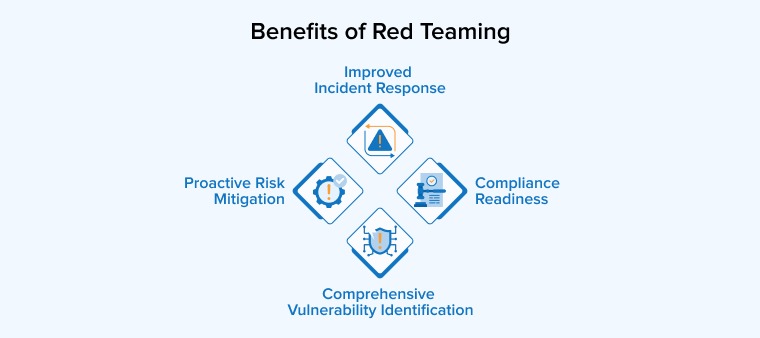
Red teaming improves the offensive security infrastructure of organizations through:
- Comprehensive Vulnerability Identification: Red team exercises assess an organization’s entire security posture by testing systems, employees, and physical controls. This approach helps reveal hidden risks and weaknesses that basic security checks may fail to detect.
- Improved Incident Response: Red teaming helps organizations strengthen their response to cyberattacks by testing how well they can identify, manage, and recover from advanced persistent threats. It also improves preparedness by allowing teams to practice real attack scenarios.
- Proactive Risk Mitigation: Red teaming helps security teams identify potential security gaps, such as weak identity controls and unmonitored endpoints, and develop risk management plans before these vulnerabilities are exposed to attackers.
- Compliance Readiness: Regular security assessments by red teams help comply with the regulatory requirements, such as industry standards and legal obligations. This helps in increasing trust among stakeholders and avoiding the risk of data breaches and fines.
What Are the Challenges of Red Teaming?
Organizations may face the following limitations while considering red teaming:
- Resource Intensive: Red teaming demands skilled cybersecurity professionals, time, and significant resources to implement the red teaming strategy. It’s difficult for organizations with limited budgets and personnel to carry out such testing.
- Ethical Considerations: Red team activities should always adhere to ethical guidelines and be carefully planned to ensure no actual damage occurs. Security teams must perform tests responsibly while protecting the organization, its systems, and its stakeholders.
- Disruption to Operations: Red teaming deals with simulating real-world attack conditions, which may affect the routine operations of an organization. It requires proper planning to minimize or avoid such disruptions.
What Are the Real-World Use Cases of Red Teaming?
Below are some of the use cases of red teaming adopted by real-world organizations to prooftest their security maturity:
- Financial institutions such as banks use red teaming to check how their employees respond to phishing emails that appear to be from legitimate sources.
- Hospital administrations appoint red teams to identify physical security weaknesses in their facilities. The red teams attempt to enter restricted areas and try to access sensitive patient data.
- Retail chains hire red teams to test whether their IT systems are vulnerable to customer data theft and disrupting their daily operations.
When to Choose Red Teaming?
Organizations must consider the red teaming assessment in the following scenarios:
- If they want to assess the entire organization’s social engineering and physical security vulnerabilities.
- If they’ve recently recovered from a cyberattack and want to check whether the causes of that attack are completely removed.
- If they hold intellectual property, need to comply with strict regulations, or deal with sensitive customer data.
What is Penetration Testing?
Penetration testing, or pen test, is a cybersecurity method used to identify weaknesses in computer systems, networks, applications, or other digital environments. Security professionals, often called ethical hackers or penetration testers, use specialized tools and manual techniques to discover flaws that attackers could exploit by simulating a controlled cyberattack. It is commonly performed within a defined scope and under agreed conditions to ensure safety and control.
Penetration testing usually begins with gathering information about the target, followed by scanning and testing for technical vulnerabilities. Once weaknesses are found, testers attempt to exploit them to understand the possible risks and impact on the organization. After the assessment, a detailed report is prepared that explains the discovered issues and suggests ways to fix them. Pen testing can be open-box, closed-box, covert, external, and internal.
What Are the Benefits of Penetration Testing?
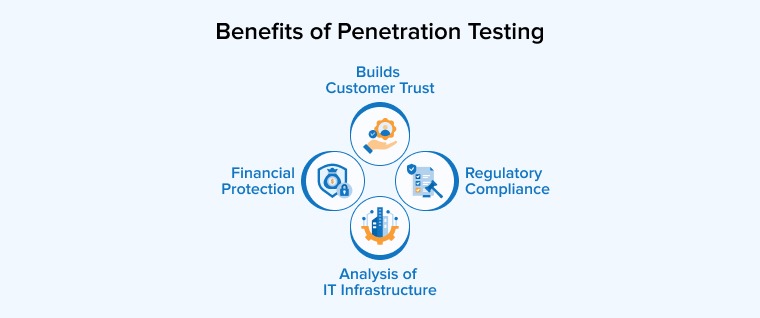
Penetration testing improves the organization’s security controls through:
- Analysis of IT infrastructure: Security teams can use penetration testing to get complete prior knowledge about their security infrastructure to prepare tactics and tools to prevent and mitigate attacks in the future.
- Regulatory Compliance: Pen testing allows organizations to comply with necessary mandates such as PCI DSS, HIPAA, GLBA, and Sarbanes-Oxley, as it provides reliable evidence of risk management.
- Builds Customer Trust: Regular penetration testing helps companies protect sensitive data and avoid security risks. It also shows customers that the business values safety, follows strong standards, and works hard to maintain trust and confidence.
- Financial Protection: Regular penetration testing helps businesses detect security weaknesses before attackers exploit them. This reduces financial losses, protects the company’s reputation, and keeps important systems and customer information safe from cyber threats.
What Are the Challenges of Penetration Testing?
Organizations may face the following limitations while considering penetration testing:
- Business Disruption: It is risky to perform aggressive penetration testing in live production environments, as it may crash systems, corrupt data, or trigger unwanted automated incident responses.
- Blind Spots: It is difficult to hire skilled penetration testers as they are costly and not always available. Companies under heavy workloads may perform rushed assessments, which may bypass security issues and reduce the overall quality of testing results.
- Platform Integrations: Generally, penetration testing produces detailed static PDF reports. These reports are difficult to integrate into modern software development methodologies, which results in increased overhead, ultimately slowing down the software development process.
What Are the Real-World Use Cases of Penetration Testing?
Different organizations go for penetration testing mostly for the following use cases:
- E-commerce platforms hire pen testers to check if their newly launched payment gateway is free from SQL injection and cross-site scripting vulnerabilities.
- Healthcare facilities reassess their compliance with HIPAA regulations after facing security breaches due to old and outdated software.
- Software development companies use penetration tests at various stages of the development lifecycle to effectively implement Agile and DevOps methodologies.
When to Choose Penetration Testing?
Penetration testing proves effective only if it’s carried out when and where it needs to be. Some of the most common scenarios of pen testing are as follows:
- If your company has hosted a new website, application, or service on the web.
- If major upgrades are done in the network and security infrastructure.
- If the company has adopted migration to another cloud infrastructure or if there’s a shift in the work culture, for example, from office-based to remote or hybrid.
Red Teaming vs Penetration Testing: Tabular Comparison
Get a brief idea of how red teaming differentiates itself from penetration testing from the comparison table given below:
| Parameters | Red Teaming | Penetration Testing |
|---|---|---|
| Scope | It holistically assesses the security infrastructure of the entire organization, covering physical security, organizational processes, and human factors. | The scope is predefined and limited to a particular system, application, or network. |
| Goal | Simulates real-world attacks to assess the organization’s ability to stop them and determine its level of resilience. | Find out as many vulnerabilities as possible that attackers can exploit, and ethically exploit them. |
| Approach | Social engineering, deception, and advanced techniques like custom shellcode to create an adversary simulation. | Systematic and exhaustive approach with the help of different automated exploit tools and vulnerability scanners. |
| Test Duration | It can take several weeks or months, depending on the company’s size and the complexity of its systems. | It is of short and predefined duration, generally a few days or a few weeks, as it’s a targeted and controlled exercise. |
| Cost | Expensive owing to its huge scope, long duration, larger teams, and multidisciplinary approach. | It’s cheaper than red teaming due to a predetermined scope and timeline involving a few testers. |
| Testing team composition | Specialized and large team with varied skills, ranging from technical exploitation and physical security to human psychology. | Small teams with network and infrastructure testers skilled in technical security. |
| Recurrence | Depends on the organization, but it is less frequent owing to its broad scope. | It’s recommended to carry out in specific intervals, generally once a year. |
| Maturity level | Designed for mature security programs. | Basic coverage of the systems. |
| Reporting | Comprehensive test report along with recommendations. | Detailed test reports on identified specific vulnerabilities and potential risks. |
Red Teaming vs Penetration Testing: Detailed Comparison
Let us now deeply understand the fundamental differences between red teaming and penetration testing strategies:
1. Scope
- Red Teaming: The scope of red teaming is very broad, which includes networks, applications, employee behavior, and physical security in some cases. There are no predefined boundaries here, and so the entire security culture of the organization comes within its ambit.
- Penetration Testing: This is a narrow and highly defined testing approach that has a smaller and more specific scope. There is only a set of selected applications, systems, or networks on which pen testers conduct exhaustive searches for weaknesses and vulnerabilities with the potential to be exploited by attackers.
2. Objective
- Red Teaming: Red teaming checks the defense and response capabilities of an organization in case of cyberattacks by simulating real-world attack scenarios. Testers try to access sensitive information, access critical and prohibited systems, or hamper business operations by impersonating authorized individuals and remaining unnoticed.
- Penetration Testing: The aim here is to find out and report as many technical weaknesses as possible in specified systems, applications, or networks. Pen testers try to understand the risk level by categorizing the vulnerabilities and the impact they can create on the assessed systems. They even suggest ways to fix weaknesses before attackers can discover and exploit them.
3. Resource Requirements
- Red Teaming: It requires a skilled and larger number of people who have expertise in social engineering tactics, physical security bypass, networking, and other security areas to carry out simulated real-world attacks. Experts are divided into different teams to take care of multiple aspects of cybersecurity to ensure complete coverage of the organization’s security infrastructure.
- Penetration Testing: Pen testing requires a small team or even a well-experienced single tester to use various vulnerability assessment tools and manual testing techniques. As the scope of the testing is limited, the test is performed thoroughly with the given resources. The only thing to note here is that organizations must provide the required access and implement the recommendations of the findings report.
4. Duration and Frequency
- Red Teaming: Red teaming involves simulating real-world attacks without getting noticed, which makes it a time-consuming and deeply engaging exercise. These exercises may continue for weeks or months to test different attack methods and security responses. Organizations carry out red teaming once a year or every few years owing to the huge time and resources involved in it.
- Penetration Testing: It is a short-duration testing method taking a few days to weeks, based on the system size and complexity. The structured and well-defined nature of pen testing targeting specific areas makes it feasible for organizations to carry out at regular intervals, no matter what is their size. However, it’s important to assess the risk profile, compliance requirements, and rate of system change regularly to decide the frequency of penetration tests.
5. Methodology
- Red Teaming: Testing teams employ social engineering, lateral movement, exfiltration, targeted phishing, physical security breaches, network hacking, and custom malware bypass to conduct specific objective-driven simulations of real-world attacks. They change tactics based on responses from defenders trying to breach every possible boundary and generate detailed test reports.
- Penetration Testing: Pen testers use automated vulnerability scanners and exploitation tools to identify technical security weaknesses in specific systems or applications. They employ systematic, controlled, and repeatable methods to detect critical vulnerabilities, exploit them, and report their findings and impact.
6. Collaboration
- Red Teaming: In red teaming, only selected people from senior management are made aware of the exercise, as the goal is to create a realistic attack scenario and assess the defending and responding capabilities of the organization.
- Penetration Testing: Here, the organization’s internal teams and penetration testers work in close collaboration. The testing begins when both sides agree on the testing targets, scope, and access requirements. Internal IT and security team members provide the required system details and support necessary to conduct pen testing by pen testers.
Final Thoughts
Both red teaming and penetration testing are effective testing methods that will help organizations boost their overall security infrastructure. It’s not that you have to go only for one type to build a resilient infrastructure. Comprehensive security is ensured only when both methods are adopted at the right time, at the right place. It’s recommended to start with penetration testing to address fundamental vulnerabilities and then move towards red teaming as the size and complexity of operations advance.
FAQs
Red teaming deals with assessing the security posture of the entire organization, whereas penetration testing assesses technical vulnerabilities in only specific systems, applications, or networks.
No, red teaming is not just a bigger pen test, but a completely different testing strategy with a much broader scope and entirely different goals.
Organizations should shift from penetration testing to red teaming when their security systems are already strong, and no serious weaknesses are found in regular tests. Now, the focus is on evaluating how effectively security teams can identify, respond to, and manage realistic cyberattack scenarios.
Penetration testing and red teaming exercises are usually planned carefully to prevent major system failures. Although small interruptions may occur occasionally, security professionals reduce risks by following strict testing guidelines, choosing suitable environments, and avoiding sensitive systems during critical operations.
Penetration testing mainly focuses on finding technical weaknesses and suggesting fixes, while red teaming examines how attackers could realistically reach important targets and how well security teams respond.

Dipal Patel is a technology expert at TatvaSoft, proficient in backend technologies. His years of experience in software development enable TatvaSoft to effectively meet client needs and create robust software products.



Comments
Leave a message...