

Healthcare is entering a new phase driven by data and intelligent systems. Hospitals no longer rely only on manual processes and traditional tools. They now use machine learning to support faster decisions and improve patient care. Every scan, record, and medical device generates valuable information, and Machine learning helps interpret this growing volume of data in real time. It finds patterns that humans may overlook and turns raw data into useful insights.
The increasing use of AI/ML in healthcare is visible in the global AI in healthcare market, which is projected to reach USD 110.61 billion by 2030 from USD 21.66 billion in 2025 at a high CAGR of 38.6% during the forecast period. Machine learning technologies support clinicians without replacing human judgment. Many organizations now partner with healthcare software development companies to build solutions tailored to their clinical and business needs. These platforms connect data, analytics, and care delivery in one ecosystem.
This blog explores how machine learning shapes modern healthcare. It explains core concepts, real-world machine learning applications, key benefits, trends, and current challenges.
What is Machine Learning in Healthcare?
Machine learning in healthcare uses different algorithms and statistical models to study large amounts of medical data and learn from it without constant human guidance. The datasets are in the form of patient records, lab reports, scans, and device readings. These systems can recognize patterns, predict diseases, and help doctors and other healthcare professionals make better decisions. Supervised and unsupervised learning types are used for tasks such as diagnosing illnesses or grouping patients with similar conditions to provide personalized treatment recommendations.
Hospitals also use these tools to improve daily operations, reduce paperwork, and manage resources efficiently. However, they do not replace healthcare professionals but assist doctors, nurses, and researchers by providing accurate insights and recommendations. As healthcare data continues to grow, machine learning plays a key role in building faster, smarter, and more reliable healthcare systems focused on better patient outcomes.
What Are the Benefits of Machine Learning in the Healthcare Industry?
Machine learning provides the following significant advantages to healthcare organizations in improving treatment outcomes:
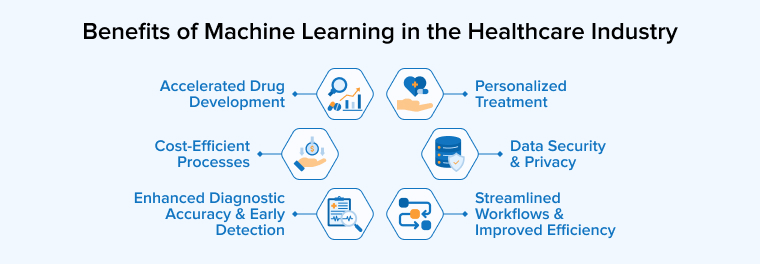
Enhanced Diagnostic Accuracy And Early Detection
Machine learning is transforming how doctors identify diseases by making diagnoses faster and more accurate. These systems study large amounts of patient data, including scans, lab reports, and medical histories. By learning patterns in these clinical data, machine learning can spot early signs of illness that doctors may not easily recognize. In medical imaging, it helps detect small abnormalities in X-rays, MRIs, and CT scans. This supports early diagnosis of conditions such as cancer, skin disorders, and brain diseases.
Early detection allows treatment to begin sooner and improves patient outcomes. Machine learning tools also provide consistent results, reducing human error and bias. As more data becomes available, these systems continue to improve their accuracy. Rather than replacing doctors, machine learning supports clinical decisions and strengthens the overall quality of healthcare delivery.
The following image illustrates how doctors use ML models to accurately diagnose health conditions.
A Boston hospital is now using an MIT machine learning model in its ER to anticipate heart failure by detecting excess fluid in the lungs:https://t.co/ALoynvJejZ
— MIT CSAIL (@MIT_CSAIL) October 1, 2020
(joint work w/@BIDMChealth @PhilipsResearch) #AIinhealthcare #ML pic.twitter.com/cjbTGI95Q1
Cost-Efficient Processes
Machine learning systems help reduce costs for healthcare systems by improving resource utilization and reducing unnecessary expenses. It can predict which patients may need urgent care so that doctors can take early actions and avoid costly hospital stays, reducing the burden on both the patient and the healthcare infrastructure. It also simplifies routine administrative tasks such as billing and scheduling, cutting labor costs and error correction costs.
Hospitals can use these models to manage staff efficiently by forecasting patient numbers. In addition, machine learning models help track medical supplies needs, reducing wastage, overstocking, and last-minute purchases. The faster and more accurate diagnosis will make the treatment simpler and less costly, along with improving patient care and treatment outcomes.
Accelerated Drug Development
Research on new medicines usually takes many years and costs a lot of money. Machine learning transforms this process by working faster and smarter. It analyzes large volumes of biological and chemical data to identify promising drug possibilities early. These systems predict how a compound may behave in the human body before lab testing begins. This reduces the number of failed experiments and saves time.
Machine learning also discovers new uses for existing drugs, helping patients and receive treatments sooner. During clinical trials, it supports better planning and safer patient selection. Researchers can focus exclusively on strong candidates instead of guessing. Overall, machine learning accelerates drug development, lowers research costs, and helps deliver effective treatments to patients more quickly.
Personalized Treatment
Machine learning supports personalized care by turning patient data into useful treatment insights. It analyzes medical records, genetic details, and daily habits to guide clinical decisions. Doctors can tailor therapies to fit each patient instead of relying on generalized protocols. These machine learning models also predict how an individual may respond to a drug, which helps avoid unwanted side effects.
For chronic illnesses, machine learning adjusts care plans as patient conditions change over time. Patients receive doses and treatment schedules customized to their bodies and lifestyles. This approach improves recovery and builds patient trust. When care feels personalized, patients are more likely to adhere to treatment plans. Hence, machine learning moves healthcare away from uniform care toward safer, more effective individual treatment.
Data Security and Privacy
Healthcare systems now store large amounts of digital patient information, which increases security risks. Machine learning protects this healthcare data by continuously monitoring to detect unusual behavior that may indicate hacking or unauthorized access. These tools respond quickly, reducing the chance of data loss. Machine learning also supports safer data sharing by strengthening encryption methods, boosting hospitals’ trust in terms of data movement and storage.
Streamlined Workflows and Improved Efficiency
Machine learning plays an important role in improving the operation of healthcare systems. It addresses hospitals’ daily challenges faster and with less effort. It automatically performs routine tasks, such as appointment booking, billing, and report creation. This reduces paperwork and saves time for medical staff, so doctors and nurses can focus more on treating patients.
Machine learning also organizes patient records clearly, supporting better clinical decisions. It can flag possible errors early, such as incorrect prescriptions. By studying historical data, these systems predict patient flow and help hospitals plan staff schedules. As a result, waiting times drop, workflows improve, and healthcare services become more efficient and patient-centered.
How is Machine Learning Used in Healthcare?
Machine learning caters to various aspects of the medical field. Some of the prominent applications are:
Predictive Analytics
Machine learning plays a strong role in predictive healthcare by helping professionals to act before problems escalate. It studies large amounts of public and clinical data to identify patterns and future risks. Hospitals use these models to predict patient readmissions and prepare early care plans. Doctors can identify high-risk patients and begin treatment sooner.
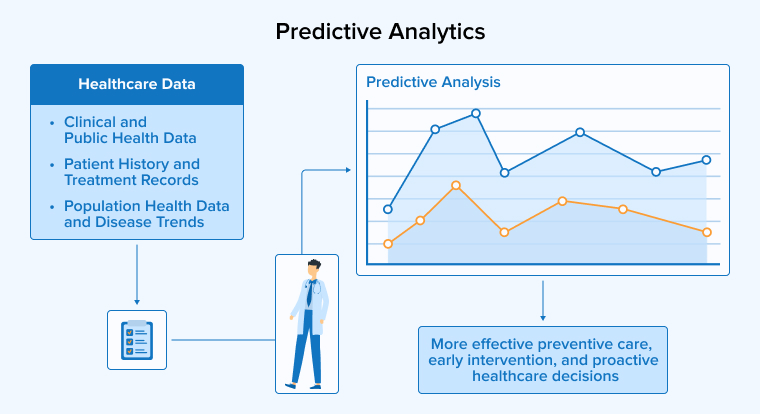
Public health teams also rely on these predictions to track possible disease spread and respond quickly. This supports better control of infectious illnesses. Predictive tools help manage chronic conditions through early intervention. They also improve safety by forecasting equipment issues or clinical complications. By integrating past and current data, machine learning supports smarter decision-making, improves patient outcomes, and promotes a more proactive healthcare system.
Medical Imaging
Machine learning is transforming medical imaging by helping doctors detect diseases more accurately and quickly. Algorithms can analyze X-rays, MRIs, CT scans, and pathology slides to find even small abnormalities that the human eye might miss. This reduces errors and improves early diagnosis of conditions like cancer, fractures, and strokes. Machine learning also helps prioritize urgent cases, allowing radiologists to focus on patients who need immediate attention.
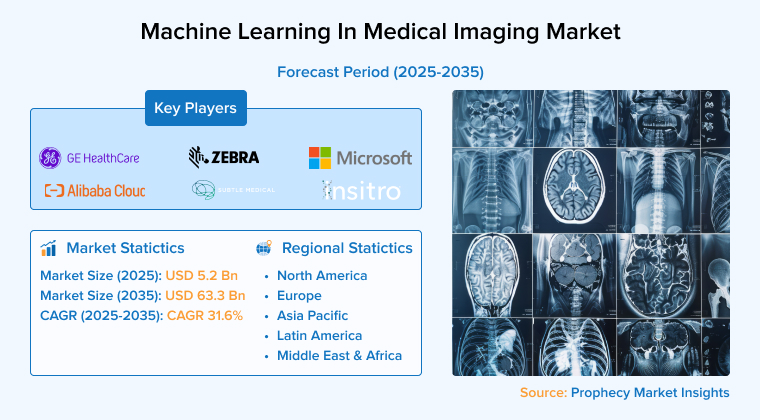
Deep learning models can study large sets of images, recognize complex patterns, and suggest treatment options. These systems improve diagnostic speed, support better decision-making, and reduce the workload for healthcare professionals. By combining automation with human expertise, machine learning enables faster, safer, and more precise healthcare. It continues to expand across specialties, making medical imaging more reliable and efficient for both patients and providers.
Robotic Surgery
Smart surgical systems built and trained using machine learning models use learned patterns from past operations to improve accuracy and control. Robots assist surgeons with precise movements during complex procedures. They help automate tasks like suturing, reducing fatigue, and saving time in the operating room.
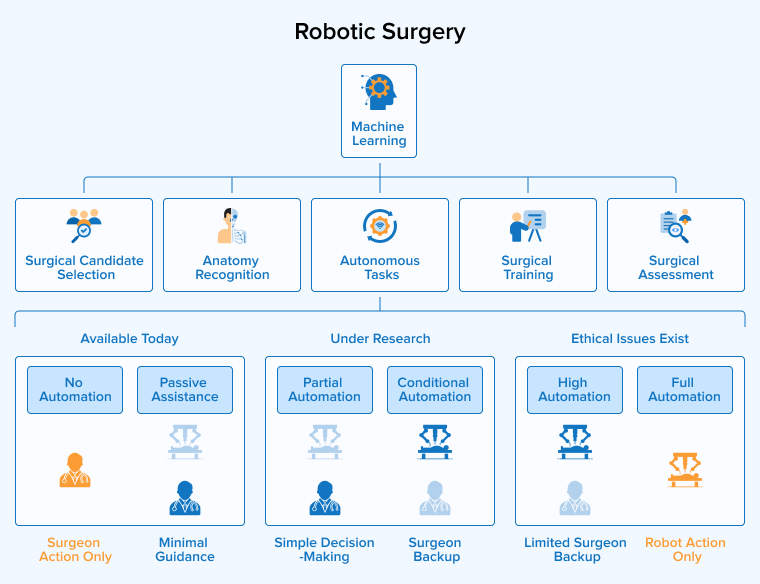
ML models also aid in surgical planning by analyzing patient data and procedure history. This enables surgeons to make better decisions before and during operations. These systems shorten surgery duration and lower the risk of complications. Patients often recover faster and spend fewer days in the hospital. By combining human expertise with intelligent machines, robotic surgery becomes safer, more efficient, and more reliable for both doctors and patients.
Drug Discovery and Development
Machine learning speeds up drug development by rapidly analyzing large sets of chemical data. It helps researchers predict how compounds may work and which ones are most effective. Many companies now use these tools to shorten research timelines and lower costs. Machine learning also finds new uses for existing medicines, which supports faster treatment discovery, bringing affordable and effective drugs to patients sooner.
Clinical Decision Support Systems (CDSS)
With Clinical Decision Support Systems (CDSS) powered by machine learning, doctors can make faster and safer medical decisions. These systems study large amounts of patient data and compare it with medical knowledge to guide care. They suggest possible diagnoses, highlight risks, and recommend suitable treatments. Machine learning algorithms also pull useful details from clinical notes and past records. This gives doctors a clearer view of each patient’s condition.
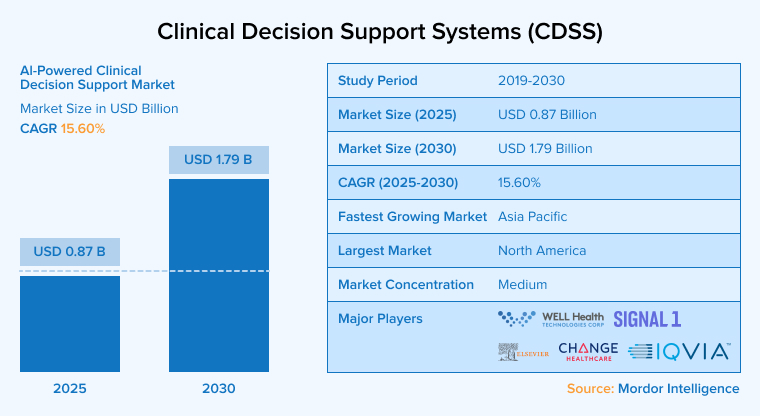
Predictive models enable teams to take early actions and prevent complications. Hospitals use these tools to reduce mistakes and improve the quality of care. When connected to Electronic Health Records (EHR), decision support systems streamline clinical workflows and save time. Overall, machine learning-based decision support improves accuracy, efficiency, and patient outcomes across healthcare settings.
Data Collection
Machine learning improves how healthcare data is gathered by automatically collecting information from devices, medical records, and patient inputs. It quickly organizes and analyzes this data to recognize patterns and provide useful insights in real time, helping doctors and healthcare teams make quick decisions and act accordingly.
Many medical companies use machine learning to extract valuable clinical and genetic details from complex medical records, accelerating cancer research. Handheld ultrasound tools powered by artificial intelligence also allow clinicians to capture and send images easily, even in remote areas. These technologies help staff ask better questions and spot risks earlier. As a result, diagnoses improve, and treatment decisions become faster. Real-time data analysis also supports timely alerts for abnormal health patterns, strengthening overall patient care.
What Are the Challenges of Machine Learning in Healthcare?
Human intervention is important to track machine learning performance for the following reasons:
Data Privacy and Security
Machine learning in healthcare depends on large amounts of patient data, which makes privacy and security a major concern. Medical records contain personal and clinical details that must remain protected at all times. If systems fail, data breaches can harm patients and damage trust in healthcare providers. Strong cybersecurity practices help organizations meet legal requirements such as HIPAA and GDPR. Security teams protect information by encrypting data, limiting access, and storing records in secure environments.
Many technology providers also remove identifiers so models can learn without exposing real identities. Some computer systems train models where the data already exists instead of collecting them at one place, which lowers risk. Regular security checks help detect vulnerabilities early. By combining smart technology with clear governance rules, healthcare organizations can use machine learning safely while respecting patient rights and maintaining compliance.
Integration with Existing Systems
Introducing machine learning into healthcare is difficult when hospitals rely on older systems and complex digital records. Many clinics still use legacy platforms that do not easily connect with modern tools. These systems store data in different formats, which limits smooth data sharing. As a result, care teams may struggle to access complete patient information. Machine learning tools need consistent and connected data to function effectively. Data integration from smart devices having different formats also demands time, budget, and skilled technical support.
A practical approach starts with reviewing the current infrastructure and identifying systems that need upgrades. APIs and middleware can help connect older platforms with newer solutions without disrupting daily workflows. Industry standards like FHIR and HL7 also support better data exchange. With careful planning and expert guidance, healthcare organizations can modernize gradually and enable effective machine learning adoption.
Skill Gap and Training
Healthcare professionals must gain the skills to use the devices and systems implementing machine learning technology. Doctors, nurses, and administrators need to understand how algorithms work and how to interpret their results. Bridging the gap between technology and clinical practice is essential for successful adoption.
Hospitals and clinics should provide training programs, workshops, and resources to help staff learn continuously. Collaboration between technical experts and healthcare teams ensures a better understanding and application. With proper education and guidance, medical professionals can leverage machine learning to improve patient care and make informed decisions.
Algorithm Bias
Machine learning in healthcare depends on large datasets, but biased data can harm patient care. If certain groups are underrepresented, machine learning models may give inaccurate results for those patients, potentially leading to misdiagnoses or unequal treatment.
Bias often comes from human errors during data collection and can be amplified by algorithms. To prevent this, healthcare organizations should use diverse and representative datasets. Techniques like fairness-aware learning and explainable AI help detect and reduce bias, ensuring predictions are accurate and equitable for all patients.
What is the Future of Machine Learning in Healthcare?
Machine learning applications will improve the quality of health care in the following manner:
Remote Patient Monitoring and Telemedicine
Smart systems built using reinforcement and deep learning continuously track data from wearables and medical sensors throughout the day. They detect early warning signs and flag changes in chronic conditions, allowing healthcare professionals to respond faster. Virtual assistants support patients by sending medication reminders and answering basic health questions, reducing pressure on medical staff.
AI-powered chatbots in healthcare also help patients access treatment guidance without visiting clinics. When combined with telemedicine, these technologies support remote checkups and ongoing monitoring. Healthcare teams receive real-time insights and alerts, allowing them to take timely action and improve patient outcomes.
Explainable AI (XAI)
Explainable AI helps make machine learning systems clearer and easier to trust in healthcare.
Explainable AI in healthcare helps medical professionals understand how AI systems make decisions, making results clearer, more transparent, and easier to trust during diagnosis and treatment planning. Doctors need to understand how a model reaches its conclusions before relying on its suggestions. Transparent systems show the key factors behind predictions and treatment advice for safer clinical decisions.
Explainable models play a vital role in fields like radiology and pathology, where accuracy is critical. When clinicians understand AI outputs, they can combine them with their expertise. This teamwork improves diagnoses and strengthens patient care. Clear explanations also increase confidence in using artificial intelligence systems across medical settings.
Impact of Quantum Computing
Quantum computing opens new possibilities for machine learning by offering far greater processing power than traditional systems. It can handle complex calculations that standard computers cannot manage efficiently. In healthcare, this capability supports faster drug research and deeper genetic analysis.
Quantum systems can examine massive genomic datasets and reveal patterns linked to diseases. They can also simulate how molecules interact, which helps researchers design better medicines in less time. Although the technology is still developing, combining quantum computing with machine learning promises major advances.
Public Health Management
Machine learning is transforming public health by helping experts detect risks before diseases spread widely. It studies real-time data from social media, travel patterns, climate, and medical records to spot early warning signs of outbreaks. These systems track how illnesses spread across regions and predict future case surges. Then, health authorities use this information to plan hospital capacity, allocate supplies, and guide policies. This proactive approach improves response speed, saves resources, and protects vulnerable communities more effectively.
Final Thoughts
Machine learning is reshaping healthcare in powerful and practical ways. It helps doctors detect diseases earlier, plan better treatments, and manage hospitals more efficiently. It also supports faster drug discovery and smarter use of medical data. While challenges like data privacy and skill gaps still exist, careful planning can address them. Healthcare providers must adopt these tools responsibly and ethically.
When combined with human expertise, machine learning improves care quality and reduces costs. As technology continues to grow, intelligent systems will play a key role in building safer, faster, and more patient-focused healthcare systems.
FAQs
Machine learning in healthcare helps analyze medical data, predict diseases, support accurate diagnosis, improve treatment plans, and reduce workload, allowing doctors to make faster and better decisions for patients.
Healthcare uses different types of machine learning, mainly supervised, unsupervised, and reinforcement learning, which help in diagnosis, grouping patient data, predicting outcomes, and improving treatment decisions over time.
Machine learning in healthcare is used for early disease detection, medical imaging analysis, personalized treatments, patient risk prediction, drug discovery, and automating administrative tasks to improve efficiency and care quality.
Machine learning lowers healthcare costs by predicting risks early, reducing hospital visits, automating routine tasks, improving resource use, and enabling quicker diagnosis, resulting in less expensive treatments and better efficiency.
Machine learning supports healthcare professionals by organizing patient data, automating routine tasks, providing quick insights, assisting in diagnosis, and helping manage schedules, allowing them to focus on patient care.
Healthcare machine learning models need high-quality data such as patient records, medical images, lab results, treatment histories, and real-time data from devices for accurate analysis and reliable predictions.

Garvit Shukla is a healthcare technology consultant at TatvaSoft. He collaborates with a team of developers to meet client requirements for healthcare software solutions. With a decade of experience in software development, he contributes to TatvaSoft's ability to deliver robust outcomes.



Comments
Leave a message...