

The healthcare industry has changed rapidly in recent years, especially after the global pandemic. Hospitals and medical organizations now depend heavily on technology to improve efficiency and patient care. Digital systems help manage large volumes of health data, reduce costs, and support limited medical staff. It has given a boost to the global healthcare IT market size, which was estimated at USD 866.48 billion in 2025 and is expected to reach USD 2,864.39 billion by 2033, growing at a CAGR of 16.2% from 2026 to 2033.
At the center of this transformation is the Python programming language that powers many modern healthcare solutions. Python supports artificial intelligence, machine learning, natural language processing (NLP), and data analytics, which play a major role in diagnosis, treatment planning, and research. Its ability to handle complex data makes it ideal for real-time medical decision-making.
Python also offers a wide range of libraries and frameworks that speed up development and innovation. Many startups and enterprises rely on healthcare software development companies to use Python for building scalable healthcare systems. In this blog, we’ll discuss how Python benefits the healthcare industry and how to make the most of it.
Python in the Healthcare Sector
Python plays an increasingly important role in modern healthcare and medical research. Every day, healthcare systems generate massive amounts of data, and Python helps manage this volume efficiently. Its simple syntax allows medical professionals, analysts, and researchers to work with data without requiring deep programming knowledge.
Python libraries like Pandas and NumPy help clean and organize patient records, lab results, and clinical reports. Visualization libraries make trends and risks easier to understand and explain. Python also supports machine learning, which helps predict diseases, identify high-risk patients, and improve treatment planning. In medical imaging, Python-based models assist specialists in detecting tumors, fractures, and other abnormalities faster and more accurately.
Researchers rely on Python to study genetic data and support breakthroughs in bioinformatics. Beyond clinical work, Python automates tasks such as scheduling, reporting, and data entry, saving time and reducing errors. By combining ease of use with powerful capabilities, Python continues to strengthen healthcare systems and improve patient outcomes through smarter, data-driven decisions.
Why is Python Beneficial for the Healthcare Industry?
Let’s see the reasons behind Python’s growing usage in the healthcare sector:
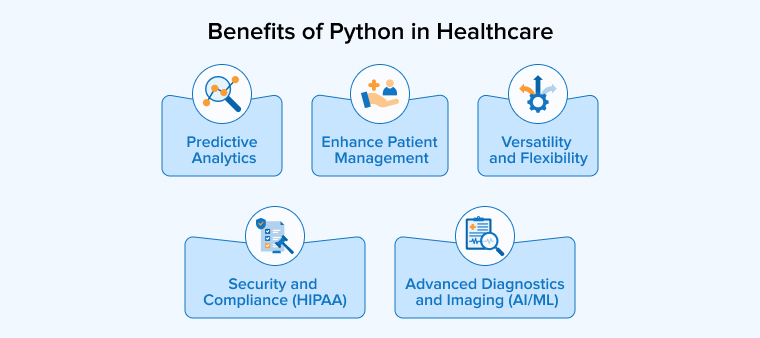
Predictive Analytics
Healthcare teams work hard to forecast disease progression and predict patient response to treatment. Many traditional prediction tools are costly and time-consuming to use at scale. Consequently, professionals increasingly rely on Python-based machine learning libraries that are faster and more affordable.
Using tools like PyTorch and Scikit-learn, experts build deep learning systems that analyze electronic health records to estimate patient survival within a year. These models review diagnoses, medicines, and treatments to support timely care decisions. Python also helps in preventive healthcare by analyzing genetic and clinical data before symptoms worsen. Its ability to manage large datasets supports faster detection, earlier intervention, and improved patient outcomes.
Advanced Diagnostics and Imaging (AI/ML)
Python libraries, like TensorFlow, Keras, and PyTorch, make it easier to build algorithms that can analyze X-rays, MRIs, and CT scans accurately. It’s clear syntax speeds up development, helping researchers and clinicians create tools for early disease detection.
The huge Python community ensures ongoing improvements and access to the latest AI techniques. This allows for better image analysis, detecting abnormalities, and predicting outcomes, ultimately improving patient care and making clinical workflows more efficient.
Security and Compliance (HIPAA)
Healthcare organizations must protect patient data at all times. Python supports this need through frequent updates that quickly address security vulnerabilities. Its libraries help developers to implement strict healthcare rules and safety standards with ease. A large global developer community also reviews code and improves defenses against cyber threats.
Python includes tools for encryption and secure data handling. Its frameworks support safe data exchange and align well with HIPAA requirements. Clear syntax and flexibility allow teams to build secure systems that integrate smoothly with existing healthcare platforms.
Versatility and Flexibility
Healthcare systems need applications that are simple and respond quickly during critical moments. Python meets this demand because it easily adapts to changing medical needs. Developers use it to build web tools, offline software, and data-driven systems for care delivery. Its flexible nature allows for quick updates without complex code changes.
Python also supports artificial intelligence and data analysis, enabling smarter healthcare decisions. Its clear structure and easy integration help reduce errors during emergencies. These qualities make Python a trusted choice for building practical and reliable healthcare apps.
Enhance Patient Management
Hospital administration often struggles to manage patients due to limited medical staff and heavy workloads. Python-based healthcare applications solve this problem by automating routine tasks. These apps allow patients to book or change appointments, request medicine refills, ask common questions, and contact healthcare providers during emergencies. They also let patients upload health updates for regular monitoring. This reduces manual work for staff and helps them focus on more critical tasks.
Python applications are flexible, easy to use, and can grow with the organization’s needs. They also offer strong security features that help protect sensitive patient information. Overall, such systems improve efficiency and quality of patient care.
Top 5 Use Cases of Python in Healthcare
Discover the top five real-world applications of Python in healthcare:
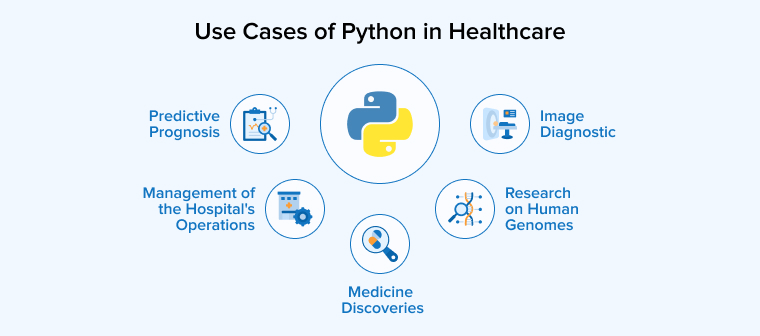
1. Management of the Hospital’s Operations
Hospitals must work efficiently because patient safety depends on timely medical care and proper staff support. In the past, many healthcare organizations relied on manual systems, which often confused staff allocation and scheduling. Python has changed this by supporting data analysis and automation in hospital operations.
Using Python-based data science and machine learning algorithms, hospitals can analyze patient admissions, appointments, and treatment patterns. These insights help managers assign doctors and nurses more effectively across shifts. Python tools also help predict resource needs, such as ICU usage, and prevent overstaffing or shortages. By improving staff planning and resource use, Python applications reduce workload pressure, support smoother hospital operations, and contribute to better patient outcomes.
2. Image Diagnostics
Python plays an important role in modern medical imaging because it is easy to use and supports rapid development. Doctors rely heavily on scans such as MRI, CT, X-ray, and ECG to understand what is happening inside the body. Reading these images manually can be time-consuming and difficult.
When machine learning is applied with Python, systems can study thousands of images at once and identify patterns that humans might overlook. These tools help detect tumors, fractures, heart conditions, and early signs of cancer with high accuracy. Python-based models also combine multiple scans into clear results that reduce confusion. By improving image analysis, this technology lowers diagnostic errors, supports faster decision-making, and helps doctors deliver safer and more effective treatment to patients.
3. Predictive Prognosis
Every patient responds to illness differently, which makes disease prediction very complex for healthcare professionals. Physicians must review large amounts of medical data while dealing with similar symptoms linked to many conditions. Python helps solve this challenge by supporting machine learning and predictive analytics in healthcare.
Python-based models can analyze electronic health records, treatments, medications, and patient history to predict disease progression. These tools help healthcare professionals identify risks early and choose better personalized treatment plans. They also support palliative care by estimating outcomes for patients with severe illnesses. In this way, healthcare teams save time, reduce uncertainty, and prevent serious complications before they develop, leading to more informed and timely medical decisions.
4. Research on Human Genomes
Modern healthcare increasingly relies on mobile and data-driven tools to improve accuracy and research outcomes. Pregnancy apps can now estimate delivery dates using recent menstrual and ultrasound data, offering better precision than manual methods. At the same time, genomic research focuses on studying genes to understand their link to diseases. Python plays a major role in this field by helping researchers analyze complex genetic data.
Using libraries like SciPy, data scientists can process huge datasets generated from genetic studies. Python also supports sequence analysis, variant detection, and automated research workflows. Machine learning tools built with Python help predict the effects of genetic changes. These technologies support cancer research, population studies, and functional genomics, leading to faster discoveries and better clinical decisions.
5. Medicine Discoveries
Python has transformed how new medicines are discovered and developed. In the past, researchers relied on manual testing, matching chemicals to diseases one by one, which was slow and labor-intensive. Now, scientists use Python-based computational tools to analyze vast amounts of chemical and biological data. These tools help identify potential drug candidates faster and more accurately.
Researchers can simulate how compounds interact with diseases before physical testing, reducing trial-and-error in labs. Python also supports bioinformatics and data modeling, making medicine development safer and more efficient. Automating routine calculations and analysis allows scientists to focus on designing effective treatments and accelerating the discovery of new drugs.
Top Python Frameworks & Libraries for Healthcare
Python is a treasure of huge frameworks and libraries catering to different needs. Developers use the following libraries to develop medical applications:
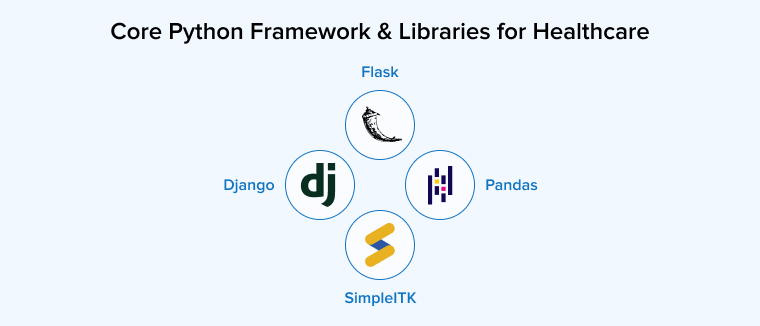
1. Django
Django is a powerful Python framework that helps developers create web applications quickly and efficiently. It allows programmers to build complex systems with less code and a clear structure. Django includes many built-in tools, so developers do not need to install extra packages for common tasks. It supports secure development by protecting applications from threats like cross-site scripting, cross-site request forgery, and SQL injection. This makes it suitable for handling sensitive healthcare data.
Django also scales well, allowing applications to grow as user demand increases. Its ORM feature simplifies database management and data handling. A strong community supports Django with useful libraries and guidance, which helps developers build reliable and secure healthcare applications.
2. Pandas
Pandas is an important Python library that supports healthcare data work by making data easy to manage and analyze. It helps professionals organize large datasets such as patient details, lab reports, and clinical study records. With Pandas, users can load data from files such as CSV or Excel and correct errors like missing or duplicate values. It also enables smooth data transformation, including changing formats and units.
Analysts can filter patient groups, sort records by date, and combine multiple datasets into a single view. Pandas also help summarize information, such as calculating averages or identifying trends. By simplifying complex data tasks, Pandas supports better analysis, improves research accuracy, and facilitates informed decision-making.
3. Flask
Flask is a lightweight Python framework that developers often use to build APIs and early application models. It gives full control over the design and structure of an application. Flask does not include many built-in features, making it simple and easy to customize. Developers can add only the tools they need, which helps keep healthcare applications clean and efficient. Its modular nature supports code reusability and smooth deployment across multiple servers.
Flask is capable of handling heavy traffic when configured properly. It works especially well for healthcare systems that require flexibility and integration with other services. Although it needs more setup time than some frameworks, Flask remains a strong choice for developing scalable and customizable healthcare applications.
4. SimpleITK
SimpleITK is a useful Python library that supports medical image analysis in healthcare and research. It offers a user-friendly interface built on top of the larger ITK (Insight Segmentation and Registration Toolkit), which reduces complexity for users. The library works with 2D, 3D, and 4D images from scans such as CT, MRI, PET, and ultrasound.
SimpleITK allows users to load medical images, improve image quality, and reduce noise through filtering. It also supports segmentation to identify organs or abnormal regions and registration to align images taken at different times. These features assist in tasks like disease tracking, treatment planning, and education. Researchers often use SimpleITK for quick testing and to prepare image data before applying machine learning models.
Final Thoughts
Python has become a strong foundation for modern healthcare innovation. It supports data analysis, automation, and intelligent systems that improve both medical services and patient care. Hospitals and healthcare startups use Python to manage large datasets, build AI models, and create flexible applications with ease. Its wide range of libraries and frameworks helps developers solve complex problems faster and more efficiently.
Although challenges like data privacy and legal regulations still exist, careful policies and responsible development can address them. As technology continues to advance, Python will remain an important tool in shaping smarter, more accessible, and more effective healthcare systems for the future.
FAQs
Python is used in automating hospitals’ routine operations, medical imaging to detect tumors and fractures, discovering and developing medicines, studying human genomes, and predicting disease progression.
Yes, Python is used in the pharmaceutical industry to simulate drug interactions at the molecular level, build predictive models, automate data extraction, and report in clinical trials, etc.
The four types of medical coding are CD-10-CM for diagnoses, ICD-10-PCS for inpatient procedures, CPT for outpatient services, and HCPCS Level II for products/supplies.
A hospital management system built with Python is a program that organizes patient details, schedules appointments, handles billing, and maintains staff records, helping hospitals work faster by managing daily operations more efficiently.
Python frameworks like Django and Flask provide Multi-Factor Authentication (MFA) and Role-Based Access Control (RBAC) and protect against XSS and SQL injection attacks. Its cryptographic libraries allow implementing advanced encryption standards (e.g., AES-256) and have tools automating regulatory compliance like HIPAA.
Python can be used to build healthcare apps like patient management systems, telemedicine platforms, diagnostic tools, health tracking apps, and data analysis systems for better decision-making.

Garvit Shukla is a healthcare technology consultant at TatvaSoft. He collaborates with a team of developers to meet client requirements for healthcare software solutions. With a decade of experience in software development, he contributes to TatvaSoft's ability to deliver robust outcomes.



Comments
Leave a message...