


The healthcare industry is developing as a hub of technological experiments and advancements, especially after the Covid’19 pandemic. Healthcare scientists and technocrats are exploring areas and methods for technology integration to meet the expectations of the rising population for quality care. One such advancement that is being looked forward to is robotic process automation or RPA.
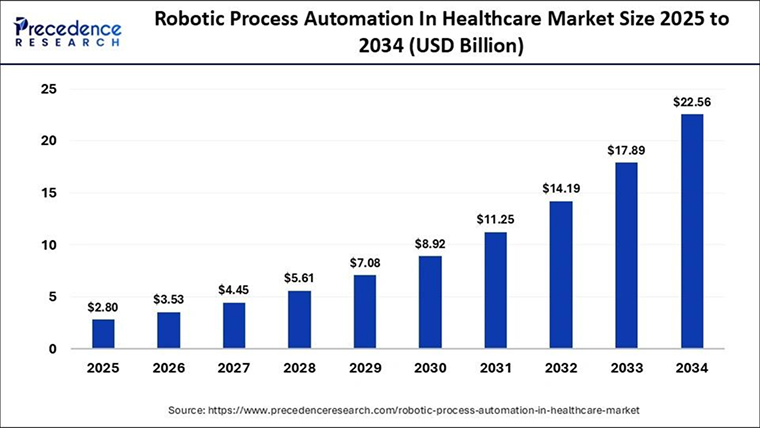
A technology involving robots, also known as bots, is paving the way for healthcare facilities to address the operational burden of healthcare workers. It is not seen as an alternative to human intelligence but as a tool to assist in healthcare delivery tasks. Healthcare organizations are partnering with Healthcare software development companies to get the best quality RPA-driven software that increases the satisfaction of both patients and healthcare staff. This is seen from the fact that the global RPA in the healthcare market is projected to reach $22.56 billion by 2034, growing at a CAGR of 26.1%.
This RPA in healthcare blog provides a complete overview of how RPA benefits the healthcare industry, what the challenges are, use cases, and implementation best practices.
What is RPA (Robotic Process Automation)?
RPA stands for robotic process automation. It is a type of intelligent automation technology that uses software robots, called RPA bots, to perform rule-based tasks across digital systems. These bots log into applications, copy data between fields, fill out forms, extract information from structured and unstructured data sources, and move files between platforms. They replicate exactly what a human user does on a screen, just with a greater speed and without breaks.
RPA software works on top of your existing systems without requiring infrastructure changes or complex API integrations. RPA tools interact with application interfaces the way a person would, making them adaptable across disparate systems. Bots process both structured data and unstructured data using technologies like optical character recognition and natural language processing. The core advantage of robotic process automation is consistency. Bots automate repetitive tasks with the same quality every time, without fatigue or human error.
What is Robotic Process Automation (RPA) in the Healthcare Industry?
Healthcare robotic process automation is the use of RPA software and RPA bots to handle administrative and operational processes in the healthcare industry. This includes patient registration, claims processing, medical billing, appointment scheduling, and electronic health records management.
Healthcare systems produce massive amounts of patient data, medical records, and billing information daily. Much of this data lives in disparate systems that do not communicate well. Bots close these gaps by automating tasks like data entry, transferring patient information between platforms, verifying insurance eligibility, and processing incoming billing documents. It does all of this while maintaining data integrity and regulatory compliance.
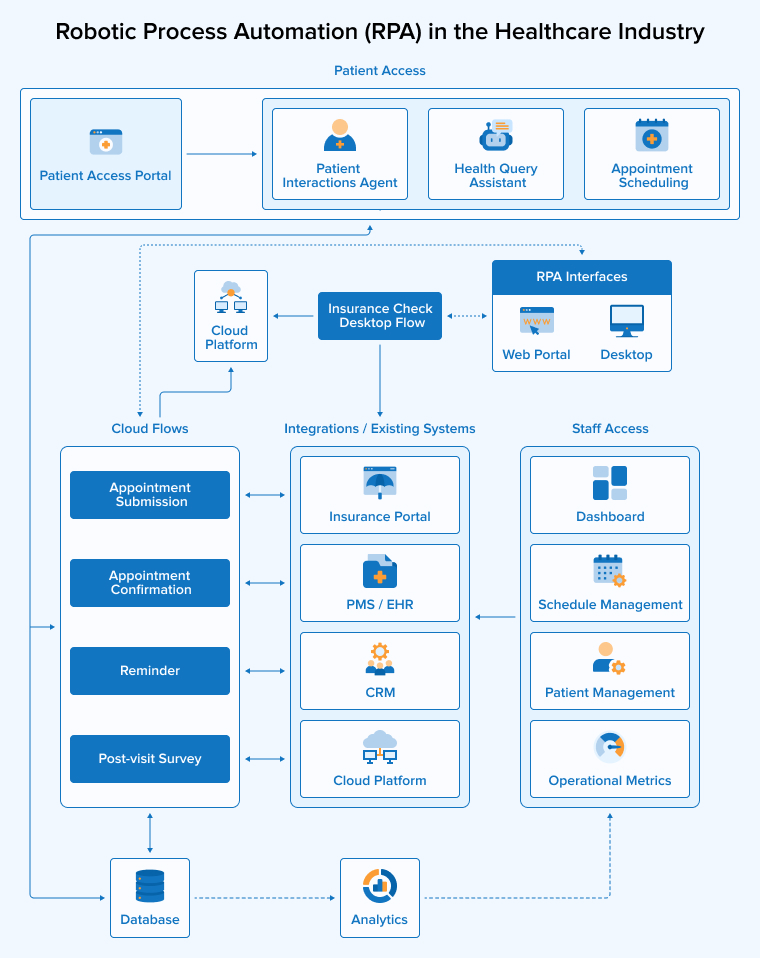
What makes RPA useful, especially in the healthcare sector, is how well it fits into regulated environments. Healthcare providers must follow strict data privacy regulations like HIPAA. RPA solutions follow these protocols every time without exception. By automating administrative data entry and burnout-inducing administrative tasks, healthcare RPA frees up healthcare professionals to spend their time on direct patient care and clinical decisions.
What Are the Benefits of RPA in Healthcare?
Let’s discuss how RPA software and bots aid healthcare organizations in achieving their goal of providing quality patient care:
Cost Saving
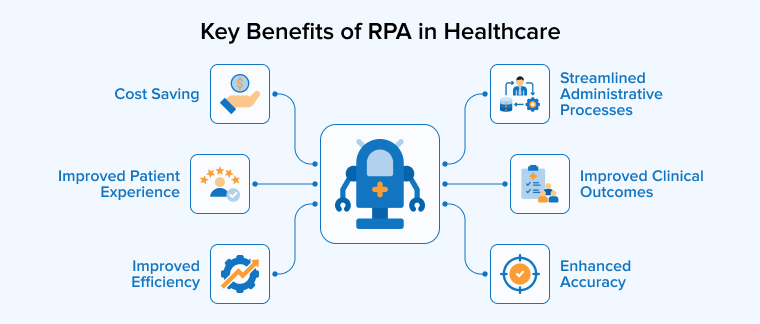
RPA-powered tools are an effective cost-cutting medium for healthcare organizations. The bots automate patient registration, claims management, data entry, audit report generation, billing reconciliation, and many other tedious tasks. As a result, the labour costs of healthcare organizations decrease, which is redirected to processes such as hospital inventory management.
RPA bots, by automating such tasks, allow healthcare professionals to work on providing the required attention and care to their patients to improve health outcomes. This also reduces the need for readmissions and revisits, increasing efficient utilization of hospital resources.
Improved Patient Experience
RPA improves patient experience by decreasing wait times during patient registration, speeding up insurance verification, and keeping appointment scheduling accurate. When bots handle appointment confirmations, patient onboarding, and follow-up messages, patients get timely responses.
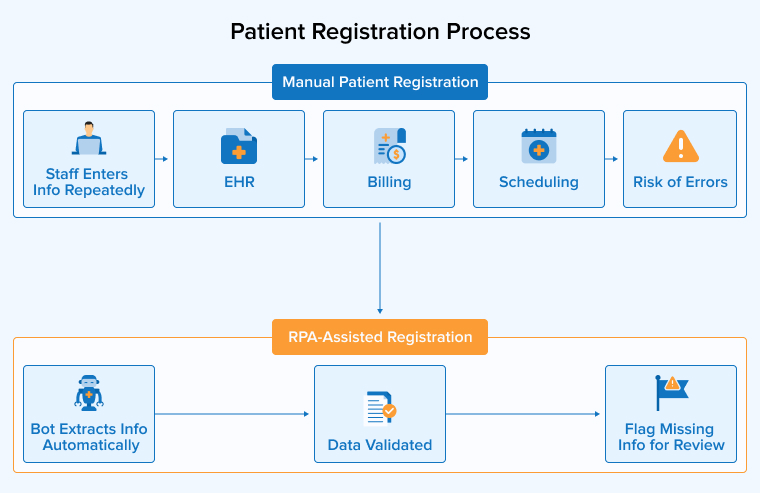
This kind of operational efficiency increases patient satisfaction and provides a smoother interaction with healthcare providers. Patients do not need to visit again and again for the same health issue, increasing convenience and preventing their case from becoming more serious in the future.
Enhanced Accuracy
RPA reduces human error in repetitive processes like data entry, record keeping, and medical billing. Robotic Process Automation bots always follow predefined rules exactly, and eliminate the inconsistencies associated with manual processing, guaranteeing consistency in managing patient data and financial transactions.
RPA software maintains data accuracy across multiple systems by extracting, validating, and transferring patient records and medical data with precision. This accuracy improves compliance with regulations such as HIPAA, strengthens data integrity, and reduces claim denials due to human errors. When healthcare organizations charge patients correctly and keep accurate records, both patient care quality and financial management improve.
Streamlined Administrative Processes
Administrative tasks like processing patient information, handling incoming billing documents, and managing staff schedules are major components of healthcare operations. This increases the burden on healthcare staff, which sometimes compromises the quality of patient care. RPA tools automate these workflows from start to finish and remove the bottlenecks that slow down the delivery of healthcare services.
Bots handle patient registration by collecting form data, checking insurance coverage, and updating electronic health records within seconds. This frees up staff so that they can focus on tasks that actually need human judgment instead of spending hours on repetitive work.
Improved Efficiency
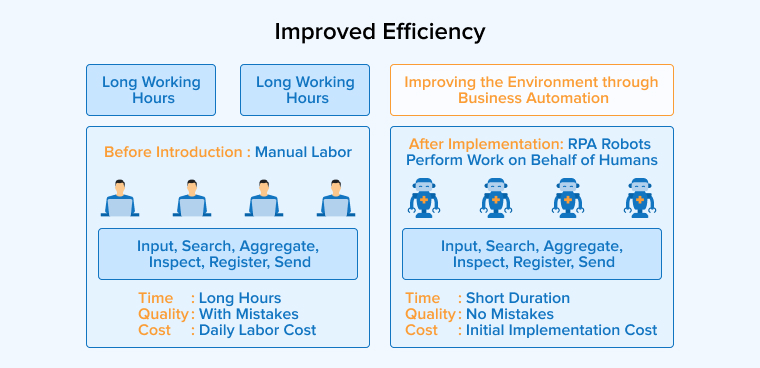
RPA bots run 24/7 without breaks. They process tasks much faster that no manual team can match. Implementing RPA in healthcare operations means faster claims management, appointment scheduling, and processing tasks with fewer delays.
Healthcare organizations that adopt RPA see 50-97% shorter turnaround times for claims processing, quicker patient onboarding, and tighter coordination between departments.
Improved Clinical Outcomes
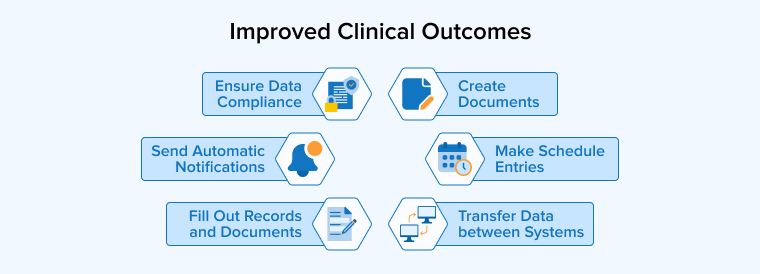
Clinicians who stop spending time on repetitive tasks and administrative data entry can give more attention to direct patient care. Hospitals using RPA report up to 35% faster access to patient records and fewer documentation errors, both of which directly influence treatment quality. Accurate patient records, fast access to medical data, and streamlined workflows all help clinicians make faster, better-informed treatment decisions.
RPA supports remote patient monitoring by automating data collection and transfer between monitoring devices and healthcare systems. When critical patient information reaches the right provider at the right time, RPA bots help enhance patient care and improve patient outcomes across healthcare facilities.
What Are the Use Cases of RPA in Healthcare?
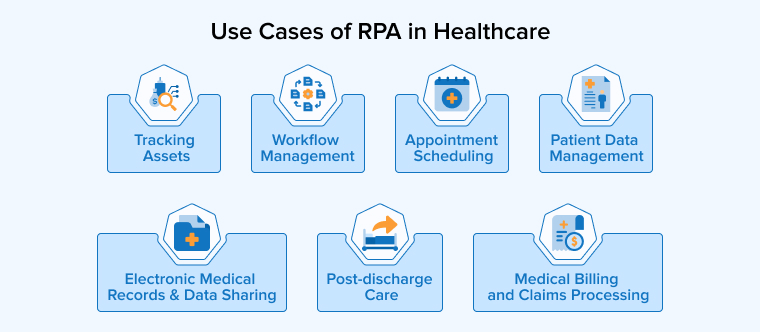
RPA caters to various aspects of the healthcare sector and some of the prominent ones are as follows:
Appointment Scheduling
Appointment scheduling is one of the most common uses of RPA in healthcare. Bots handle the complete scheduling process from checking doctors’ availability, matching patient preferences, to sending appointment confirmations and reminders.
Administrative staff do not need to spend hours checking available slots and calling or messaging patients multiple times to confirm their availability. RPA solutions manage cancellations and automatically reschedule appointments, optimizing doctor availability. RPA integration with healthcare apps for patients and doctors increases their experience.
Medical Billing and Claims Processing
Medical billing and claims processing are tedious tasks that consume more time than almost any other task in healthcare. RPA bots extract data from incoming billing documents, verify treatment claims, flag missing fields, and submit claims to payers. This cuts turnaround time from days to hours and reduces errors.
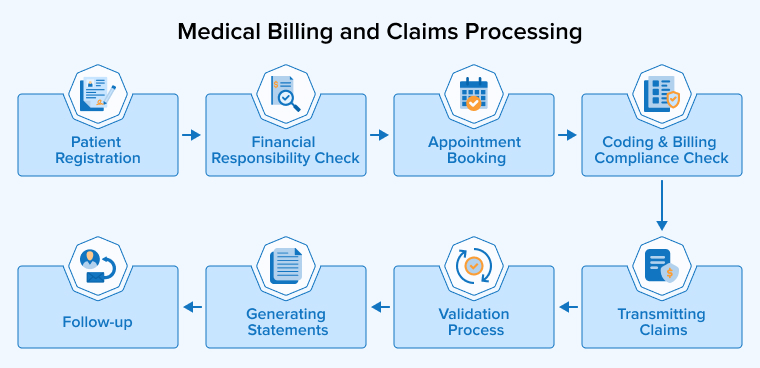
In claims management, RPA software cross-checks patient information with insurance databases, verifies insurance eligibility in real time, and flags problems before submission. This automation reduces claim denials and speeds up health payments. RPA simplifies medical billing by automating the labor-intensive process for healthcare providers processing thousands of claims daily.
Post-discharge Care
Good post-discharge care prevents readmissions and supports patient recovery. RPA bots automate follow-ups by sending medication reminders, scheduling follow-up visits, and sharing discharge instructions with patients.
Healthcare organizations that automate these communications ensure patients get consistent, timely guidance after they leave the facility. RPA solutions alert healthcare providers when a patient misses a follow-up, allowing proactive intervention and increasing patient satisfaction.
Tracking Assets
Healthcare facilities manage large inventories of equipment, pharmaceuticals, and supplies. Bots automate asset tracking by monitoring inventory levels, generating reorder alerts, and updating databases in real time.
This reduces shortages and overstocking while making sure critical equipment is always available. RPA tools connect with current platforms to give a centralized view of asset status across multiple healthcare facilities, supporting smarter procurement decisions.
Patient Data Management
Managing patient data across multiple platforms takes a lot of time and effort. RPA bots automate data management by extracting patient information from different sources, validating records, and syncing data across EHR platforms and other systems. Thus, patient records stay accurate, complete, and updated across every touchpoint.
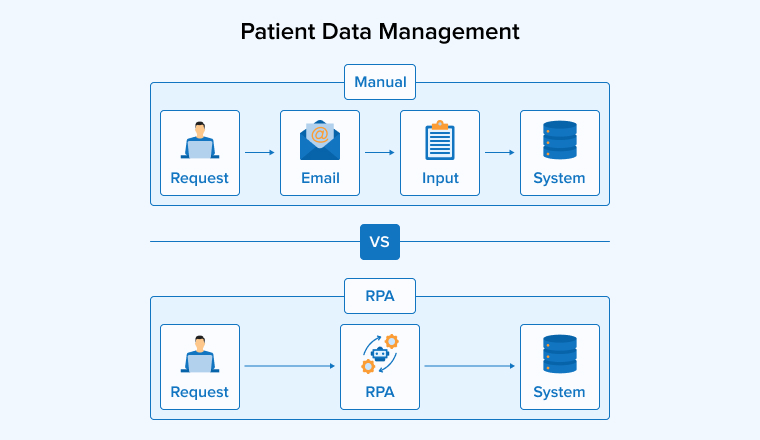
RPA software handles structured and unstructured data, non-standard formats like scanned documents and faxes, using optical character recognition. It automates data collection, cleaning, validation, and organization tasks that help in predicting future health risks and adopting preventive measures accordingly. Organizations investing in healthcare data analytics need clean, well-managed data as a foundation, and RPA facilitates this by automating data collection, cleaning, and organization.
Workflow Management
Healthcare workflows involve multiple exchanges between departments, systems, and people as the patient moves through different stages of care. RPA bots automate workflow management by routing tasks, triggering notifications, and ensuring every step is completed on time and in the right order.
RPA tools keep healthcare workflows smooth by reducing manual delays from referral processing to lab result delivery, driving operational efficiency across healthcare organizations. Its solutions also connect with mHealth apps and other digital health platforms, extending automation beyond a single healthcare facility.
Electronic Medical Records and Data Sharing
Health records are often scattered across different systems, making it difficult to access in one place. Electronic medical records (EMR) serve as a centralized database to access every detail of a particular patient. RPA bots automate updating, transferring, and sharing medical records across healthcare systems and between healthcare providers.
When a patient sees multiple specialists or moves between facilities, RPA ensures accurate transfer of their medical records to the receiving system. RPA software handles structured and unstructured data extraction from different document formats, cutting manual data entry and keeping sensitive data secure and compliant with privacy regulations.
Best Practices for Implementing RPA in Healthcare
If any healthcare organisation is looking forward to implementing RPA to increase the efficiency of their administrative staff and healthcare professionals, the following best practices must be followed:
1. Process Assessment and Selection
RPA implementation must begin with the selection of processes that are potential candidates for automation. Choosing the right processes provides quicker results, reduces effort, and demonstrates the real value of automation in the early stages. Healthcare organizations must look for processes that are repetitive, follow a set pattern, and handle large volumes of tasks. They must assess tasks that are highly prone to delays and manual errors, for example, billing and patient registration.
Processes that are stable, well-documented, and unlikely to change are easier to automate successfully. Identifying areas for automation requires studying workflows, reviewing system data, and discussing with internal staff members.
2. Build a Strong Team
The team responsible for RPA implementation must consist of members with the necessary knowledge and skills. The team members must understand how healthcare organizations operate and have a technical understanding of modern systems and tools. Bringing together IT experts, healthcare staff, and analysts helps create solutions that actually solve real-world challenges.
Effective leadership is also important to set proper goals and track progress accordingly. Good communication within the team helps in solving problems as it comes up, ensuring smooth implementation. Leaders must consider involving end-users in the early stages to improve adoption and highlight key challenges. Team members must be provided with regular training and support to keep them updated with the changing technology and healthcare needs.
3. Start with Pilot Projects
It’s recommended to begin with small-scale RPA implementation instead of directly implementing organization-wide. Starting with a pilot project helps teams to discover and understand the performance of the system in real-time conditions and what all issue arises during and after implementation.
In the pilot phase, teams configure, test, integrate with existing systems, and perform necessary refinements according to the feedback received from different departments and stakeholders. They work on setting well-defined metrics, such as error rates and performance improvements, to measure and monitor the performance of the pilot product and understand adjustments to be made for improvement. Involve members from every department, ranging from operations to compliance, to perform a thorough testing of the pilot project.
4. Technology and Vendor Selection
Long-term success of RPA implementation also depends on technologies and your RPA implementation partners. The RPA platform must be compatible not only with the new systems but also with previously existing healthcare systems such as EHRs. The technology selected should support privacy requirements, comply with modern healthcare standards like HIPAA, smooth data exchange between systems, and be auditable for proper tracking.
Healthcare organizations should also work with experienced partners who have worked on similar projects and possess a good understanding of healthcare requirements and compliance standards. This helps in implementing solutions with expert guidance and continuously improving performance over time.
Challenges of RPA in Healthcare
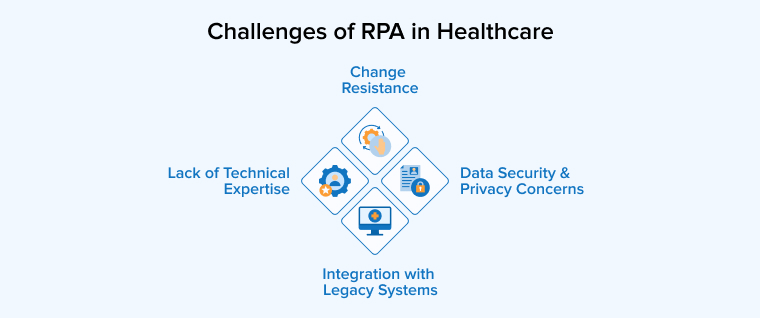
RPA provides multiple advantages to healthcare organizations, but its implementation comes with its own set of challenges that require a strategic approach to overcome. Some of the major challenges in RPA implementation are as follows:
Integration with Legacy Systems
Many healthcare organizations continue to rely on old or legacy systems that do not easily work with modern automation tools. This creates difficulties when trying to implement RPA, as these systems often lack proper integration features such as APIs. As a result, connecting them can take a lot of time and effort, sometimes even requiring custom-built solutions. Although RPA can mimic human actions and interact through user interfaces, these methods may not always be stable or efficient.
Such challenges can delay implementation and increase costs. To make automation successful, organizations need to carefully assess older systems and develop a plan to bridge the gap between outdated systems and newer technologies, ensuring a smooth and reliable data flow.
Data Security and Privacy Concerns
Patient data in healthcare is among the most sensitive data in any sector. Implementing RPA in healthcare demands strict data security protocols to protect patient information and stay compliant with healthcare standards like HIPAA.
Bots access and process large volumes of patient data, medical records, and health data. Any misconfiguration can expose protected health information and trigger HIPAA violations with fines up to $1.5 million per incident. Healthcare organizations need robust access controls, encryption, and audit logging for all automated processes. Regular security assessments keep those protections updated to counter emerging security threats and vulnerabilities.
Lack of Technical Expertise
Running RPA solutions requires specialized skills that many healthcare organizations do not have in-house. Configuring bots, managing updates, and troubleshooting integration issues all require technical knowledge. The knowledge gap slows adoption and limits what healthcare RPAs can actually deliver. Most organizations need 3-6 months to build internal RPA competency.
Partnering with experienced technology providers and investing in training helps close this gap. RPA tools with intuitive interfaces and strong vendor support lower the entry barrier for healthcare facilities that have just started RPA adoption. The upfront investment in training pays back within the first year for most implementations.
Change Resistance
Bringing automation into clinical and administrative workflows often invites pushback from staff. Some may worry about losing their jobs, and others may feel uncomfortable with new technology. This kind of resistance is common when implementing RPA, and healthcare is no exception.
Clear communication makes a difference. The resistance level comes down when people understand that software robots take over routine tasks so that they can focus on meaningful and patient-centric work. Involving staff in the rollout and showing early wins builds trust across the organization.
Final Thoughts
RPA is delivering real, measurable results for healthcare organizations by freeing healthcare workers from routine operations and allowing them to focus on patient care. However, successful implementation needs proper planning and expert teams to tackle the data security, integration, and resistance to adoption challenges.
Robotic process automation (RPA) technology will keep evolving alongside artificial intelligence and machine learning to handle increasingly complex tasks in the healthcare sector in the years ahead. Therefore, healthcare organizations must start building this capability now to put themselves in a stronger position for what comes next.
FAQs
RPA automates repetitive, rule-based tasks such as patient registration, claims processing, medical billing, appointment scheduling, and electronic health records management.
Yes, RPA is a safe and reliable way to handle sensitive patient information. RPA solutions include built-in access controls, encryption, and audit trails to comply with data security standards like HIPAA.
No, RPA is built to handle routine tasks and administrative processes. It frees healthcare staff to focus on clinical decision-making, patient interaction, and work that requires human judgment. RPA bots take over the repetitive parts of the job, not the parts that need a person.
RPA in healthcare will grow alongside artificial intelligence, machine learning, and natural language processing. As these technologies advance, healthcare RPA will move beyond simple rule-based tasks into predictive analytics, intelligent document processing, and adaptive workflow management. The technology is getting smarter, and its healthcare applications will expand with it.
RPA improves patient experience by cutting wait times, automating patient scheduling and onboarding, speeding up insurance verification, and sending timely follow-up messages. When the administrative function runs smoothly, patients receive faster and more accurate service, improving overall patient care outcomes.

Garvit Shukla is a healthcare technology consultant at TatvaSoft. He collaborates with a team of developers to meet client requirements for healthcare software solutions. With a decade of experience in software development, he contributes to TatvaSoft's ability to deliver robust outcomes.



Comments
Leave a message...