

Healthcare is reaching a point where demand for quality services is rising faster than the system can provide. Doctors and healthcare staff spend a large part of their day on unproductive tasks like documentation and scheduling, instead of patient care. At the same time, the healthcare industry is witnessing workforce shortages and burnout, pressuring the entire system.
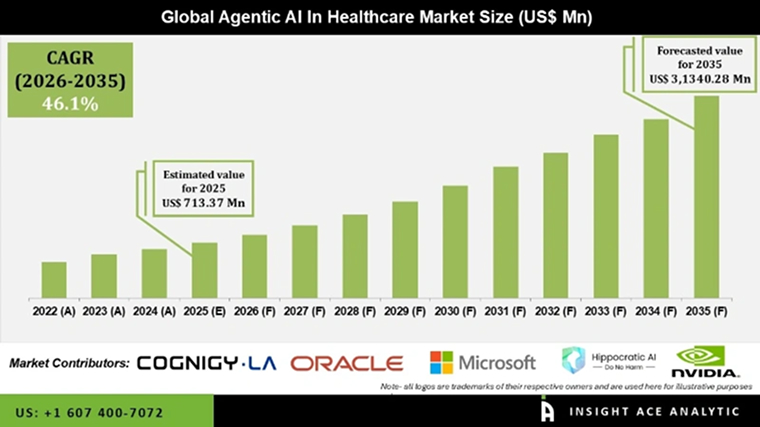
While AI has already been introduced in healthcare, most of the tools handle only isolated tasks and do not integrate completely with existing systems. So there’s one more advancement in the AI domain called Agentic AI to address the drawbacks of traditional AI. As per the report, the global Agentic AI in Healthcare Market Size is valued at USD 713.37 Million in 2025 and is predicted to reach USD 31,340.28 Billion by the year 2035 at an 46.1% CAGR during the forecast period from 2026 to 2035.
Agentic AI can be said to be a self-independent system. It works with minimal human input within defined boundaries. Because of its ability to act independently, healthcare software development companies are looking for ways to introduce Agentic AI from experimentation to practical use in the healthcare industry. Agentic AI can bring such transitions in the working of healthcare organizations that one has never thought of.
This blog covers what agentic AI means in healthcare, how it differs from traditional AI, its benefits, current use cases, and the challenges of adopting it.
What is Agentic AI in Healthcare?
Agentic AI is artificial intelligence that independently understands the goal, plans, reasons, and executes multi-step tasks to achieve a defined goal. Unlike generative AI, it does not require prompts at every step. In healthcare, agentic AI refers to intelligent agents that operate within clinical and operational environments, making clinical decisions, taking actions, and adapting their behavior based on real-time clinical data. These are not chatbots or simple automation tools. These are AI systems that carry out entire workflows on their own, within safe and compliant boundaries.
An agentic AI system in a hospital reads a patient’s medical history, checks the latest lab results, identifies a gap in follow-up care, books the next appointment, and updates the EHR record.
These agentic systems use a modular architecture where each specialized agent owns a specific responsibility and works together as a connected system. For example, one agent collects and verifies patient information during patient intake, so front-desk staff spend less time on data entry. Another agent continuously tracks vitals and flags early warning signs to alert clinicians before a condition worsens. A third agent coordinates care plans across departments, making sure every specialist involved in a patient’s treatment has access to the same updated information.
What Are the Key Benefits of Agentic AI in Healthcare?
Agentic AI delivers practical, measurable advantages across the healthcare domain. The following are the four major benefits of agentic AI in healthcare:
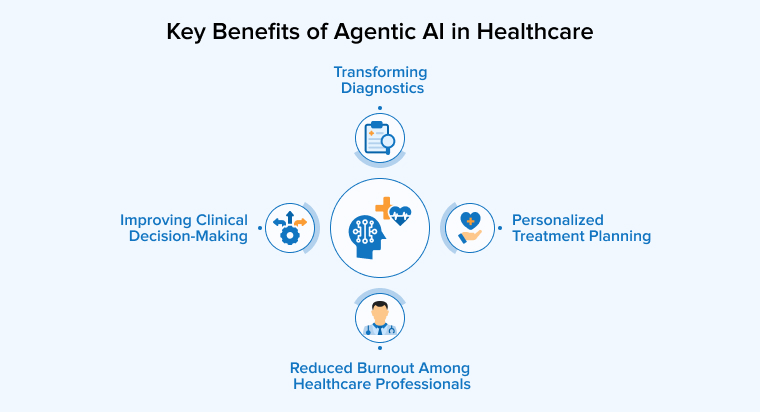
Improving Clinical Decision-Making
AI agents integrate data from multiple clinical systems such as EHRs, imaging, and lab reports, and present actionable insights directly to healthcare professionals during consultations. They consolidate a patient’s medical history, highlight abnormal lab results, and recommend evidence-based treatments in one place. In complex scenarios like oncology, where care teams evaluate dozens of variables to determine the right treatment for cancer patients, AI agents reduce cognitive overload and enable clinicians to reach confident decisions faster.
Agentic AI replaces fragmented chart reviews with comprehensive, real-time data synthesis, so clinical decisions are based on a complete picture rather than limited information gathered manually by clinicians.
Reduced Burnout Among Healthcare Professionals
Administrative tasks like documentation, prior authorizations, and scheduling take healthcare professionals’ time away from direct patient care and increase burnout. Agentic AI takes over these repetitive back-office operations by managing clinical consultations, generating structured notes, updating EHR systems, and handling follow-ups autonomously.
As a result, care providers spend more of their shifts delivering compassionate care rather than managing paperwork, which improves job satisfaction, retention, and the quality of patient care across the organization.
Personalized Treatment Planning
Agentic AI creates personalized treatment plans by analyzing a patient’s medical history alongside current clinical data, genomic markers, and published research. Specialized agents evaluate treatment options, predict response probabilities, and recommend care plans according to individual patient profiles. They do not rely on standardized protocols that miss critical differences in genetics, comorbidities, and medication history.
In clinical settings, agentic AI applications help healthcare providers focus on a more targeted approach to patient care. Agents help identify effective therapy combinations for cancer patients based on genetic markers and prior treatment responses, improving patient outcomes.
Transforming Diagnostics
Agentic AI systems go beyond identifying abnormalities in scans or in pathology reports by recommending next steps, suggesting additional tests when needed, and alerting relevant care teams automatically. In high-pressure environments like emergency departments and ICUs, these intelligent systems provide real-time monitoring and diagnostic support that improves patient experience and reduces adverse events.
When paired with healthcare data analytics, agentic AI also detects population-level patterns across thousands of patient records, identifying healthcare trends that individual clinicians might miss when reviewing charts one at a time.
How Agentic AI Differs from Traditional AI?
Traditional AI and agentic AI solve fundamentally different problems in healthcare. The table below breaks down the core differences between Agentic AI and Traditional AI that matter for healthcare leaders evaluating these technologies.
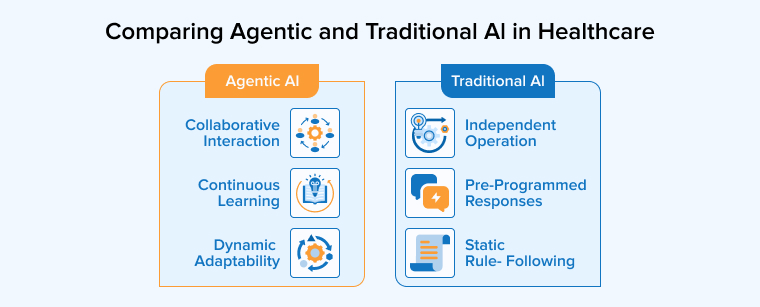
The table below breaks down the core differences between Agentic AI and Traditional AI that matter for healthcare leaders evaluating these technologies.
| Parameter | Traditional AI | Agentic AI |
|---|---|---|
| Autonomy | Requires human initiation for each task and human interpretation of every output. | Sets goals, plans steps, and executes workflows independently within defined safety boundaries. |
| Scope | Limited to a single task, such as image classification, predicting a score, or flagging an error. | End-to-end workflows spanning multiple departments and clinical systems. |
| Adaptability | Static rules and models that do not adjust mid-workflow based on new data. | Continuously learns and adjusts strategy based on real-time patient data and changing conditions. |
| Data Integration | Works within a single system or dataset at a time. | Integrates data across EHRs, labs, imaging, and administrative systems simultaneously. |
| Decision Making | Provides outputs for humans to act on (flags, scores, classifications). | Makes clinical decisions and takes action (schedules, alerts, updates records) with human oversight. |
| Coordination | Operates in isolation with no ability to coordinate with other AI tools or agents. | Interacts with other agents, shares context, and coordinates actions across departments. |
| Healthcare Example | Flags an abnormal lab result and waits for a clinician to review it. | Flags the result, cross-references patient histories, notifies the care team, and schedules a follow-up. |
For healthcare organizations managing complex workflows, fragmented data integration, and growing operational demands, agentic AI represents a structurally different tool rather than an incremental upgrade over traditional AI.
Use Cases of Agentic AI in Healthcare
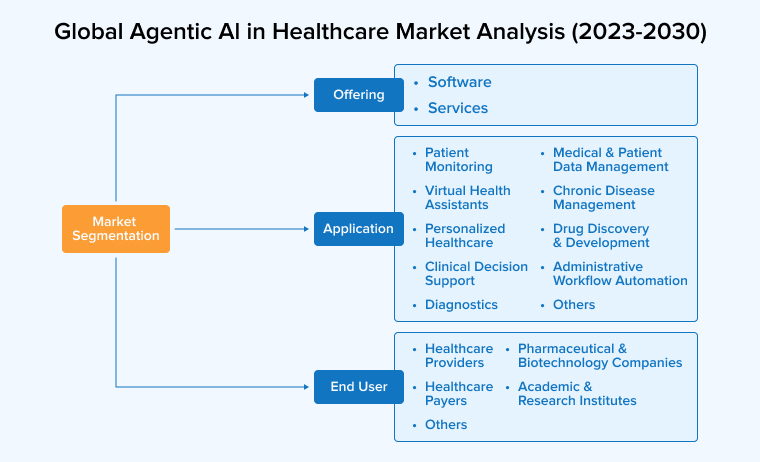
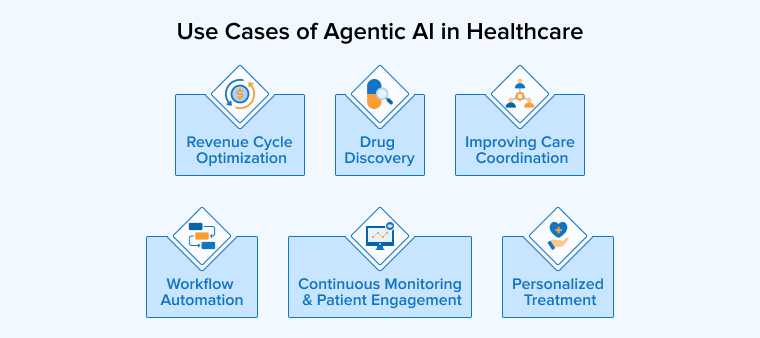
Agentic AI is already showing up in real clinical and operational settings across health care. Here are six areas where AI agents are making a measurable difference:
Improving Care Coordination
Patients requiring special care often visit multiple specialists, see different facilities, and interact with different departments. Keeping everyone on the same page is hard, and gaps in communication lead to delayed treatments, repeated tests, and frustrated patients.
Agentic AI acts as an intelligent layer that connects to all clinical systems. AI agents automatically synchronize records across departments, manage referrals, track patient progress, and flag gaps in patient care before any problem arises. Healthcare teams get access to consistent, up-to-date information without having to manually search for it.
For healthcare organizations that have already invested in enterprise application integration, agentic AI extends that interoperability into clinical decisions and real-time care coordination.
Drug Discovery
Drug discovery takes several years, sometimes over a decade, and costs billions. The life sciences sector has been one of the earliest adopters of agentic AI because of the enormous time and cost savings.
Agentic systems autonomously screen molecular compounds, simulate drug interactions, and predict efficacy and toxicity outcomes. According to BCG, generative AI accelerates early-stage drug discovery and optimization phases by 25% or more. Multi-agent systems in drug development handle everything from protocol generation to patient recruitment for clinical trials, shortening the path from discovery to market.
These intelligent agents are changing how life sciences organizations manage risks, allocate resources, and move promising therapies through complex regulatory pipelines.
Personalized Treatment
Agentic AI enables continuous, adaptive treatment delivery that adjusts based on how a patient actually responds to a therapy. AI agents monitor patient data from wearables, EHRs, and remote monitoring devices in real time. Agents could dynamically update medication dosages, schedule additional tests, or alert healthcare providers when a patient’s condition changes. This level of responsiveness supports personalized experiences that are hard to scale manually across large patient populations.
For health plans and care providers, this translates to better adherence, fewer readmissions, and improved long-term patient outcomes.
Revenue Cycle Optimization
Revenue cycle management involves billing, claims processing, prior authorization, and denial management. It is one of the most labor-intensive functions in healthcare, and errors cost organizations millions every year.
AI agents automate these high-volume processes with minimal human review. They gather missing documentation, verify patient eligibility, submit claims, identify denial risks, and prepare appeals. This level of automation improves operational efficiency, reduces processing times, and strengthens financial performance for healthcare organizations.
According to Gartner’s 2026 predictions, all the surveyed healthcare facilities reported either being using or planning to use agentic AI by 2028. The most common usage that came forward was prior authorization and utilization management. At the same time, 99% of clinicians said they are comfortable with AI helping in prior authorization decisions, as long as proper safeguards and oversight are in place.
Continuous Monitoring and Patient Engagement
Patient engagement does not end when someone leaves the hospital. Agentic AI enables continuous, proactive monitoring through digital tools like connected wearables, remote monitoring platforms, and patient-facing apps.
AI agents track vital signs, symptom trends, and medication adherence around the clock. When an agent detects a concerning change, it initiates follow-ups, alerts the care team, or adjusts the patient’s care plan autonomously. This supports real-time monitoring at scale without adding workload to already stretched staff.
For healthcare leaders focusing on reducing preventable hospitalizations and improving patient experience, agentic workflows offer a way to stay connected with patients between visits. Organizations exploring mHealth app development can integrate these monitoring capabilities directly into their mobile platforms.
Workflow Automation
Workflow automation is often the starting point for many organizations on their agentic AI journey. Processes such as patient intake, appointment scheduling, clinical documentation, and discharge coordination span multiple clinical systems and typically require significant manual effort.
Agents could handle scheduling conflicts, route patients to the right departments, generate pre-visit summaries, and ensure documentation accuracy. All of this happens without constant human oversight, freeing clinical staff to focus on higher-value decision-making and direct care delivery.
Challenges and Considerations for Agentic AI Adoption
Here are the key considerations healthcare organizations need to address before planning agentic AI adoption.
1. Data Privacy and Security
Agentic AI systems require read and write access to sensitive patient data across multiple clinical systems, which creates significant exposure if governance is weak or access controls are poorly configured.
Challenges:
- Autonomous agents access, modify, and move patient data across clinical systems without human intervention at every step, thereby expanding the attack surface for breaches.
- Regulators are yet to fully establish safety standards for autonomous AI behavior in healthcare, leaving compliance requirements partially ambiguous.
Key Considerations:
- Enforce strict HIPAA compliance and implement role-based access controls for every autonomous agent.
- Maintain audit trails for every action taken by agentic AI systems on patient data.
- Establish safety standards and cybersecurity protocols that account for autonomous system behavior, not just human-initiated actions.
2. Interoperability
Many health systems run fragmented IT infrastructures, where clinical systems use different data formats, protocols, and access rules for seamless data integration.
Challenges:
- EHRs, labs, imaging platforms, and administrative systems often lack standardized APIs, creating data silos that block agentic workflows.
- Multi-agent systems compound this problem because multiple specialized agents need to share data and coordinate actions across platforms that were never designed to communicate.
Key Considerations:
- Standardize on FHIR and HL7 protocols to enable data sharing across clinical systems.
- Plan for multi-agent systems where multiple specialized agents need to share data and coordinate actions across different platforms.
- Audit existing IT infrastructure for integration readiness before deploying agentic systems.
3. Human Oversight
Agentic AI systems operate autonomously, but the healthcare industry demands accountability for every clinical decision.
Challenges:
- AI-generated recommendations must go through human review before influencing clinical decisions, but too much oversight eliminates the efficiency gains.
- Defining the boundary between the autonomy of agentic systems and human oversight is the most critical design decision in clinical settings.
Key Considerations:
- Define clear rules for when agentic systems must act independently and when they can hand over decisions to humans.
- Classify workflows by risk level, for example, low-risk tasks like scheduling can run autonomously, while high-risk clinical decisions require a clinician’s approval.
- Build clinical governance structures that evolve as agentic AI matures in clinical settings.
4. Workforce Readiness
Deploying intelligent agents and digital tools alongside existing clinical staff requires meaningful changes to daily workflows and team dynamics.
Challenges:
- Many organizations cite reskilling and upskilling as a major challenge, and clinicians may resist tools they do not understand or trust.
- Without structured change management, AI adoption stalls at the pilot stage and fails to scale across healthcare organizations.
Key Considerations:
- Invest in structured training programs that prepare clinicians to collaborate with AI as part of their daily workflows, enabling clinicians to trust and use these tools effectively.
- Assign change management leads within clinical departments to drive adoption from the inside.
- Healthcare leaders should frame AI agents as digital colleagues that augment expertise rather than replace roles.
5. Governance Gap
According to NVIDIA’s 2026 report, 69% of healthcare organizations use generative AI, but only 22% deploy AI agents, revealing a wide gap between interest and operational readiness.
Challenges:
- Agentic systems demand deeper system integration, stricter governance frameworks, and more comprehensive risk management than generative AI alone.
- Most healthcare systems lack governance structures designed for autonomous AI behavior that create compliance and accountability gaps.
Key Considerations:
- Develop governance frameworks specific to autonomous AI behavior, covering accountability, explainability, and error handling.
- Start with low-risk operational workflows and scale into clinical applications as governance matures.
- Plan for coordinated investment across technology, people, and processes rather than treating governance as an afterthought.
Conclusion
Agentic AI is changing how healthcare services are delivered. From care coordination and drug discovery to revenue cycle optimization, agentic AI systems are improving healthcare delivery and creating real, measurable impact across the healthcare industry.
Technology alone does not solve everything. Healthcare organizations desiring to succeed with agentic AI must take appropriate measures to resolve issues related to data governance, interoperability, workforce upskilling, etc. Healthcare systems that build these foundations now will improve patient outcomes, strengthen operational efficiency, and create more resilient health systems in the long run.
FAQs
Agentic AI improves patient outcomes by analyzing patient data in real time, identifying risks before conditions worsen, and initiating timely interventions without waiting for manual input. It integrates data across clinical systems, so healthcare teams work with complete information, reducing missed diagnoses and supporting personalized care plans.
Yes, most enterprise-grade agentic AI solutions integrate with major EHR platforms like Epic, Cerner, and MEDITECH through FHIR and HL7 protocols. Intelligent agents read from and write to EHR records, access clinical data, trigger agentic workflows, and synchronize patient information across departments.
Agentic AI applications in healthcare include clinical decision support, care coordination, drug discovery, clinical trials management, revenue cycle optimization, patient monitoring, workflow automation, and personalized treatment. These AI systems help healthcare organizations reduce administrative burden, compress drug development timelines, and deliver patient-centered care across health systems.

Garvit Shukla is a healthcare technology consultant at TatvaSoft. He collaborates with a team of developers to meet client requirements for healthcare software solutions. With a decade of experience in software development, he contributes to TatvaSoft's ability to deliver robust outcomes.



Comments
Leave a message...