

The healthcare sector is undergoing a pivotal transformation as AI technologies are increasingly adopted across diagnostics, treatments, patient care, and operational processes. With the global population and medical data growing rapidly, traditional healthcare systems often struggle to meet the increasing demand for quality care. AI offers intelligent solutions to these challenges by automating administrative tasks, analyzing large volumes of data, and assisting doctors in diagnosis and treatment planning.
A healthcare software development company plays an important role in creating AI-powered systems that support hospitals, clinics, and research institutions. These intelligent tools can detect patterns, recommend personalized treatments, and even assist in surgeries, helping medical professionals save time and reduce errors.
In this blog, we’ll explore how artificial intelligence is reshaping the healthcare landscape, the types of AI used in healthcare, the challenges associated with it, and what the future holds.
What is AI in Healthcare?
Artificial Intelligence (AI) in healthcare refers to the use of advanced technologies like machine learning, neural networks, and natural language processing to analyze medical data and assist healthcare professionals in making better decisions. AI enables computers to think, learn, and act in ways that mimic human intelligence, helping doctors diagnose diseases more quickly and accurately. By processing large volumes of patient data, from medical records to diagnostic images, AI tools can identify patterns, predict potential health risks, and recommend personalized treatments.
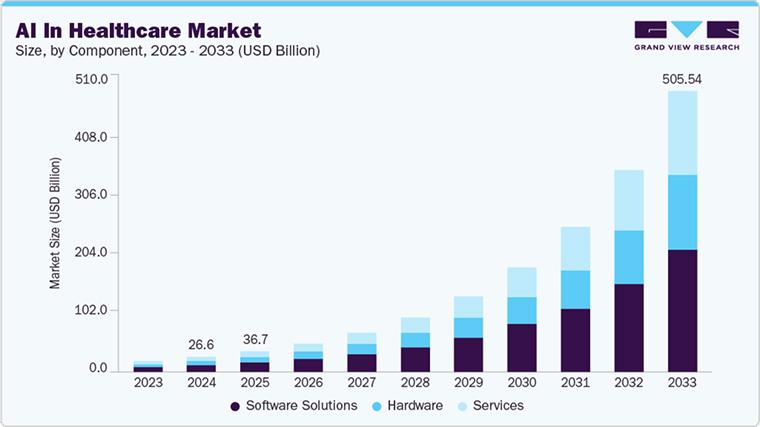
Integrating AI into clinical workflows enhances efficiency and supports better decision-making for healthcare providers. These advancements not only boost patient care but also alleviate the burden of administrative workload and hospital costs. The global AI healthcare market is rapidly growing, driven by the need for precision, automation, and better patient outcomes. The most recent report indicates the global AI in healthcare market size was valued at USD 26.57 billion in 2024 and is projected to reach USD 505.59 billion by 2033, growing at a CAGR of 38.81% from 2025 to 2033.
What Are the Benefits of Artificial Intelligence in Healthcare?
The advantages of AI in healthcare are vast. Some of the significant ones are:
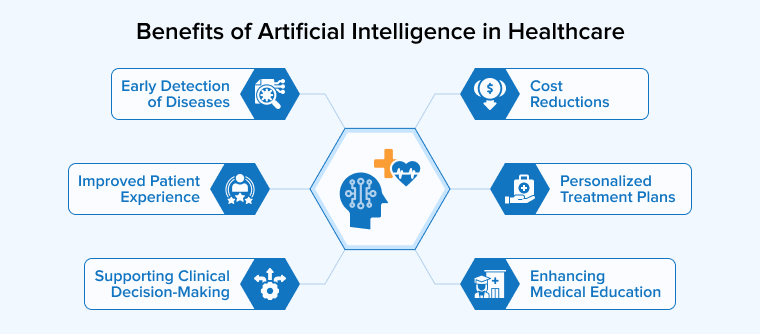
Supporting Clinical Decision-Making
Using AI and machine learning, doctors can analyze real-time clinical data to monitor patients’ health and make timely decisions. These technologies reduce human errors and help clinicians provide more accurate, evidence-based care. By evaluating symptoms and medical histories, AI systems can suggest possible diagnoses or treatments to medical professionals. In fields like cancer care, AI supports doctors in identifying tumor stages and selecting the best therapies for each patient, leading to more precise and effective treatment outcomes.
Early Detection of Diseases
AI helps in early disease detection by analyzing massive volumes of patient and population data. AI-driven predictive models can identify risks for conditions like cancer, heart disease, and liver disorders even before symptoms appear. These models also play a crucial role in population health management by supporting public health interventions, enabling healthcare providers to implement effective disease prevention strategies and improve health outcomes at the community level. By studying past and present health records, AI helps doctors detect patterns, predict future health issues, and plan timely interventions. These technologies support personalized treatment and preventive care, decreasing emergency visits and healthcare costs. Tools like Google’s Verily use predictive analysis to forecast diseases, helping medical professionals take early action and improve patient outcomes.
Improved Patient Experience
AI is greatly improving patient care by enabling continuous support, personalized treatment, and better communication. AI-powered chatbots, such as Babylon from Babylon Health, can collect patient symptoms, suggest possible diagnoses, and even arrange virtual consultations with doctors. Remote monitoring platforms like Biobeat use AI and wearable devices to track patients’ vital signs in real time, helping detect early signs of health issues.
Additionally, AI-driven apps provide health education, reminders, and quick answers to common questions, thereby improving patient engagement. By automating administrative tasks, AI enables healthcare professionals to focus fully on direct patient care and achieve better outcomes.
Personalized Treatment Plans
AI is driving the future of personalized medicine by using data-driven insights to tailor treatments for individual patients. By analyzing vast datasets that include genetic information, lifestyle habits, and medical histories, AI helps doctors design effective therapies that cause minimal side effects. In oncology, cardiology, and chronic disease management, AI predicts response to particular medications and adjusts treatments accordingly. For instance, AI systems can forecast blood sugar fluctuations in diabetes patients or assess genetic markers to recommend safe and effective drugs. This precision medicine approach minimizes the trial-and-error process of prescribing and enhances overall treatment outcomes.
Hospitals like the Mayo Clinic and Stanford Medicine already use AI to predict treatment responses with high accuracy, thereby improving recovery rates and reducing complications. Through continuous learning and real-time monitoring, AI is making healthcare more personalized, predictive, and patient-centered than ever before.
Cost Reductions
AI is helping reduce healthcare costs by improving efficiency, minimizing errors, and promoting preventive care. By automating administrative tasks such as data entry, billing, and scheduling, AI saves time and resources for hospitals and staff. Its predictive algorithms analyze vast amounts of medical data to detect potential diseases early, allowing timely interventions that prevent costly treatments later.
AI tools can also forecast missed appointments, lowering financial losses for healthcare providers. For instance, predictive models like the Missed Visit Prediction Indicator can save billions by identifying patients likely to skip visits. Additionally, AI enhances diagnostic accuracy, preventing unnecessary tests and medical errors that increase expenses. Through telemedicine and remote monitoring, healthcare institutions can serve more patients with fewer resources.
Enhancing Medical Education
AI is transforming medical education by providing interactive, customized, and immersive learning experiences. AI-powered simulation platforms utilize Virtual Reality (VR) and Augmented Reality (AR) to recreate real clinical scenarios, allowing students and professionals to practice diagnoses, surgeries, and treatment planning safely. These tools enhance skill development without posing any risk to patients.
AI-driven adaptive learning systems tailor educational content to individual needs by addressing specific knowledge gaps and improving learning efficiency. Platforms like Touch Surgery use AI and VR to guide learners step by step through complex surgical procedures, providing realistic, hands-on training. By integrating AI into education, medical institutions can improve accessibility, engagement, and proficiency, resulting in better-trained healthcare professionals.
What Are the Types of AI in Healthcare?
In healthcare, different types of AI assist doctors and hospitals in various ways, each serving a unique purpose. Understanding how these AI types function helps explain their specific roles and benefits in the medical field.
Machine Learning in Healthcare
Machine learning (ML) is a key part of artificial intelligence that enables computers to learn from data and make accurate predictions. In healthcare, ML analyzes medical records, images, and genetic data to identify patterns, assist in diagnosis, and support personalized treatments. Supervised, unsupervised, and semi-supervised learning methods allow systems to work with both labeled and raw data.
Neural networks and deep learning, advanced forms of ML, process complex information to deliver faster and more precise results. These technologies help doctors make better decisions, improve patient outcomes, and enhance the overall efficiency of healthcare systems.
Natural Language Processing (NLP)
Natural Language Processing (NLP) is a branch of artificial intelligence that helps computers understand and use human language. In healthcare, NLP is employed to process and analyze large amounts of unstructured data, such as doctors’ notes, medical records, and patient conversations. It can convert spoken language into written text, extract key medical terms, and summarize clinical information.
Techniques like Optical Character Recognition (OCR) digitize handwritten notes, while Named Entity Recognition (NER) identifies important data like diseases or medications. NLP also supports healthcare chatbots, translates medical information, and detects emotions in text. By turning complex language into structured insights, NLP improves documentation accuracy, efficiency, and patient communication in medical settings.
Robotic Process Automation
Robotic Process Automation (RPA) is an AI-powered technology that automates repetitive administrative tasks in healthcare, such as billing, scheduling, and updating patient records. Unlike physical robots, RPA uses computer programs that follow set rules and workflows to complete digital processes quickly and accurately. This technology reduces paperwork, minimizes errors, and saves time, allowing doctors and nurses to focus their time and energy on patient care.
RPA can also work with other AI tools, like image recognition, to analyze medical data efficiently. It is a cost-effective and user-friendly solution that improves hospital operations and overall efficiency.
Rule-based Expert Systems
Rule-based expert systems are early forms of artificial intelligence that use predefined rules created by medical experts to support clinical decision-making. These systems guide doctors in diagnosing diseases, checking drug interactions, and ensuring treatments follow proper procedures. While helpful in handling routine decisions and safety alerts, they have limitations.
Managing large sets of rules can make these systems slow and difficult to update, especially as medical knowledge changes. As a result, rule-based systems are gradually being replaced by data-driven and machine learning models that offer greater flexibility, accuracy, and adaptability in modern healthcare settings.
What Are the Use Cases of AI in Healthcare?
Let’s get into the real-life examples of how AI is benefiting the medical industry with its over-the-top features:
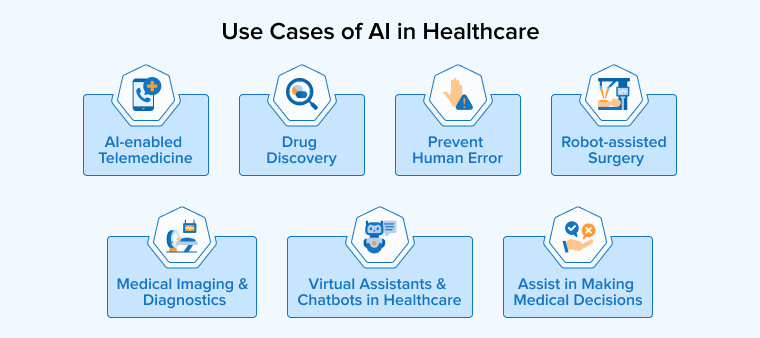
Robot-assisted Surgery
Artificial Intelligence (AI) and robotics are transforming modern surgeries by enhancing precision and efficiency. Hospitals now use AI-assisted robotic systems, such as the da Vinci Surgical System by Intuitive Surgical, for procedures ranging from minimally invasive surgeries to complex operations like open-heart surgery. These systems provide surgeons with a detailed 3D view of the surgical area and eliminate hand tremors, resulting in greater accuracy.
AI also supports preoperative planning by analyzing patient data and medical images, helping doctors create precise surgical strategies. Additionally, machine learning optimizes hospital operations by managing patient queues and scheduling. This technology reduces recovery time, costs, and human error in surgical care. Other advantages include reduced medication use, causing less pain to the patient, less invasiveness, and fewer chances of blood loss, infection, and scarring.
Medical Imaging and Diagnostics
Artificial Intelligence (AI) is revolutionizing medical imaging by analyzing X-rays, CT scans, and MRIs with exceptional speed and accuracy. Deep learning algorithms can identify patterns and detect diseases like cancer, heart conditions, and eye disorders earlier than traditional methods. By automating image analysis, AI reduces human error and ensures more consistent diagnoses. For example, Google Health’s AI has been proven more accurate than radiologists in detecting breast cancer.
AI tools also integrate imaging data with clinical information, helping doctors make faster, data-driven decisions. This technology is transforming diagnostics, improving patient outcomes, and enabling earlier, more effective treatments.
AI-Enabled Telemedicine
AI has transformed telemedicine by increasing the accessibility of healthcare services, especially in remote and underserved areas. During the COVID-19 pandemic, AI-powered telemedicine proved invaluable in connecting patients with doctors without the need to visit hospitals or clinics physically. These systems use advanced technologies such as speech recognition and natural language processing to enable real-time consultations and personalized recommendations for non-critical conditions. AI-driven virtual healthcare and assistants further enhance patient care by scheduling appointments, collecting medical data, and monitoring treatment progress. They also help hospitals in the effective utilization and management of resources.
Additionally, AI-enabled telemedicine applications can track vital signs, analyze patient information, and alert healthcare providers to potential complications, enabling faster and more accurate interventions. By reducing the need for in-person consultations and improving remote patient monitoring, AI-powered telemedicine enhances the quality of care, promotes early treatment, and ensures that professional medical support is available to patients anytime, anywhere.
Drug Discovery
Artificial intelligence is transforming drug discovery by making it swift, more efficient, and less costly. AI systems can analyze large datasets from medical research, clinical trials, and genetic information to identify new drug targets and predict how different compounds will behave in the body. Through molecular simulation, AI reduces the need for physical testing by virtually modeling molecular interactions. It can also predict a drug’s safety, toxicity, and effectiveness before laboratory trials begin.
AI tools like Atomwise use virtual screening to find promising drug candidates in record time. By automating target identification, compound design, and clinical trial optimization, AI accelerates drug and vaccine development, helping bring effective treatments to patients much sooner.
Assist in Making Medical Decisions
Artificial Intelligence (AI) in healthcare helps doctors make faster, evidence-based decisions by analyzing patient data and suggesting the best treatments. AI systems can detect medical conditions from imaging, predict risks like kidney injury, and provide second opinions on diagnoses. Tools like AI co-pilots in medical records save clinicians time by updating documents and recommending treatments.
AI also supports personalized care by combining medical history, genetics, allergies, and lifestyle factors to suggest tailored treatment plans. Platforms like Tempus Edge use machine learning and genomic data to predict patient responses, helping doctors choose the most effective therapies and improve patient outcomes.
Virtual Assistants and Chatbots in Healthcare
AI-powered virtual assistants and chatbots are changing how patients access healthcare. They provide quick answers to medical questions, help schedule appointments, send reminders, and assist with prescription refills. By automating these routine tasks, chatbots allow medical staff to focus on more complex cases. They also offer personalized health advice, pharmacy suggestions, and symptom checking, thereby improving patient care and convenience.
Tools like Healthily, Kore.ai, and Ada deliver real-time support, collect patient data, and streamline administrative tasks such as generating invoices. These AI assistants make healthcare more accessible, efficient, and responsive for both patients and providers.
Prevent Human Error
Manual errors in healthcare can have serious consequences, especially when dealing with sensitive patient data, medications, or treatment plans. AI technologies help reduce these risks by automating documentation, reconciling data, and accurately feeding it into centralized systems.
Tools like Hyperscience, Rossum, and Amygb.ai streamline data extraction, while systems like Cerner’s HealtheIntent, MedEye, and Medaware detect errors in prescriptions or treatment patterns. By analyzing medical records, clinical studies, and genetic information, AI ensures higher accuracy than humans alone. This reduces mistakes, enhances patient safety, and enables medical professionals to focus on critical decision-making instead of repetitive manual tasks.
What Are the Challenges and Considerations of Implementing AI in Healthcare?
We saw how AI is beneficial for the healthcare industry with its most compelling features. However, you must also be aware of the limitations that come with the integration of AI into healthcare systems that must be taken care of:
Data Security and Privacy Concerns
Data security and privacy are major challenges in the use of artificial intelligence in healthcare. AI systems rely heavily on sensitive patient data, which must be carefully stored, processed, and protected. Without proper safeguards, this information becomes vulnerable to cyberattacks, data breaches, or unauthorized use, leading to serious risks like identity theft or biased decision-making.
To prevent such issues, healthcare organizations must adhere to strict standards such as HIPAA in the U.S. and GDPR in the EU. These regulations ensure that patient information is accessed and used responsibly. Protecting data also requires encryption, secure access controls, and regular security audits. Data anonymization is another effective method, removing personally identifiable details from records before they are used for AI training. By maintaining transparency and robust data protection practices, healthcare institutions can build patient trust and safely integrate AI technologies into medical systems.
Ethical and Legal Considerations
The use of AI in healthcare introduces several ethical challenges, including patient consent, data ownership, algorithmic bias, and accountability for AI-driven decisions. Ensuring transparency in how AI systems operate is imperative to maintain trust between patients and healthcare providers. Organizations must establish clear ethical guidelines and governance frameworks to oversee AI implementation.
Regular audits of AI algorithms should be conducted to detect and reduce bias while ensuring fairness in decision-making. Ethical concerns also extend to maintaining patient privacy, protecting jobs, and defining responsibility when errors occur. By following strict ethical standards and complying with legal regulations like HIPAA and GDPR, healthcare institutions can ensure that AI is applied responsibly and equitably.
Bias in AI Algorithms
Bias in AI algorithms is a major concern in healthcare because these systems learn from existing data that may contain inequalities. If not addressed, such biases can lead to unfair or inaccurate medical decisions, especially in diagnosing diseases or suggesting treatments. When AI models are trained on non-representative data, their performance may suffer for underrepresented groups.
For example, some diagnostic systems demonstrate lower accuracy for minority populations due to limited diversity in training datasets. To prevent such disparities, it is essential to use diverse data, regularly evaluate AI models, and ensure fairness and accuracy across all patient groups.
Future of Artificial Intelligence in Healthcare
The future of artificial intelligence in healthcare holds immense potential to transform patient care, research, and clinical efficiency. As technology advances, AI will increasingly support doctors rather than replace them, streamlining diagnosis, treatment planning, and hospital management. Future innovations like remote robotic surgeries, AI-powered chatbots, and virtual doctors will enhance access to healthcare, even in remote areas. Additionally, AI will enable deeper disease prediction through the analysis of genetic and physiological data, allowing for earlier interventions and more precise treatments.
Personalized medicine will become more accessible, with AI-driven systems customizing drug compositions based on each patient’s unique health profile. Beyond clinical care, AI development solutions will help hospitals manage resources efficiently by forecasting patient admissions, supply needs, and workload distribution. However, the widespread adoption of AI in healthcare must address critical challenges such as data privacy, algorithmic bias, and equitable access.
Ethical frameworks and transparency will play a vital role in building trust and ensuring the responsible use of AI technologies. When applied thoughtfully, AI will not only revolutionize healthcare delivery but also make it more predictive, personalized, and inclusive, ushering in a future where medical care is faster, safer, and more human-centered.
Final Thoughts
AI is reenergizing healthcare by enhancing diagnosis, treatment, and patient care, while streamlining hospital operations. It helps doctors make faster, data-driven decisions and allows patients easier access to medical support, even remotely. Although challenges like data privacy and algorithm bias still exist, the advantages of AI in healthcare overshadow the limitations. With continued innovation and ethical implementation, AI will increase the efficiency, accuracy, and accessibility of healthcare services for everyone. The future of modern healthcare lies in the intelligent use of AI to create a healthier, more connected world.
FAQs
AI is enhancing efficiency and improving patient outcomes. It assists doctors in diagnosing diseases, planning treatments, and automating routine administrative work. Through genetic data analysis, AI enables personalized medicine and supports faster drug discovery. Key uses include interpreting medical images for early disease detection, predicting patient risks, managing hospital resources, and enabling remote care. Additionally, AI-powered chatbots help patients with inquiries, scheduling, and follow-ups, making healthcare more accessible and organized.
Artificial Intelligence (AI) is improving disease diagnosis, personalizing patient treatments, and streamlining operations through advanced data analysis and automation. AI tools can accurately interpret medical images, predict health outcomes, accelerate drug discovery, and reduce administrative burdens, ultimately lowering costs, improving patient care, and allowing clinicians more time for direct patient interaction.
Healthcare teams use AI platforms to support diagnosis and care delivery. Tools like Watson Health, DeepMind, PathAI, and Aidoc analyze clinical data and medical images, helping doctors detect conditions earlier and make more precise treatment decisions.
A practical use of AI in healthcare appears in medical imaging analysis. Intelligent systems like Google DeepMind and Aidoc scan X-rays, CT scans, and MRIs to spot early signs of conditions like tumors, strokes, or eye disorders. These tools highlight risky areas for doctors, speed up reviews, reduce diagnostic errors, and help hospitals treat urgent patients sooner.
The following are the types of AI used in the healthcare sector:
1. Machine learning (ML)
2. Natural Language Processing (NLP)
3. Robotic Process Automation (RPA)
4. Rule-based expert systems
5. Conversation AI & Virtual Assistants
6. Deep Learning

Garvit Shukla is a healthcare technology consultant at TatvaSoft. He collaborates with a team of developers to meet client requirements for healthcare software solutions. With a decade of experience in software development, he contributes to TatvaSoft's ability to deliver robust outcomes.



Comments
Leave a message...