

Python has emerged as one of the most popular programming languages, and its growing use across a variety of industries has made it an important part of modern technology. Its simple syntax, flexibility, and ability to handle a wide range of projects, whether it’s small or complex business solutions, are significant factors behind this. People with a non-technical background can learn Python without spending months understanding complicated coding rules.
Python powers web development, artificial intelligence, machine learning, data analysis, automation, and game development. Businesses also use it to process large amounts of information, reduce repetitive tasks, and build software that solves everyday problems. Its wide range of libraries and tools allows developers to create useful applications without writing lengthy code from scratch. A Python development company can help businesses.
In this blog, we’ll take a deep dive into the various use cases of Python and the major companies that are using it to deliver modern-day solutions.
What is Python?
Python is an interpreted, high-level, general-purpose, open-source, object-oriented, versatile, and easy-to-learn programming language. Dutch software programmer named Guido van Rossum introduced it in 1991, and since then it has improved a lot to become one of the most popular programming languages among software development companies.
Python’s clear syntax helps new developers learn programming without dealing with unnecessary complexity. At the same time, Python provides powerful tools for experienced professionals through its large collection of libraries and frameworks. It can be used for many different tasks, including web development, automation, data analysis, artificial intelligence, and software development.
Why is Python Popular?
Python is a popular programming language because it makes coding easier, faster, and more practical for many types of projects. Let’s take a look at some of the most common contributing factors behind its widespread popularity:
- The clear and simple English-like syntax of Python allows beginners to learn and understand programs without spending too much time learning complicated rules. At the same time, Experienced professionals can use Python to solve advanced problems.
- It supports multiple programming approaches such as procedural, functional, and object-oriented.
- You can use Python to create websites, automate repetitive work, analyze data, build artificial intelligence systems, and develop software with the help of its massive collection of well-documented libraries and modules.
- It is cross-platform compatible, i.e., you can write Python programs for different platforms such as Android, iOS, Windows, etc. The same code can run on multiple operating systems with only a few changes.
- It’s freely available for use by both individuals and web development companies.
- It has a large worldwide developer community that contributes in the form of tools, tutorials, documentation, libraries, and solutions to common problems.
- Python enables developers to build modern applications using AI/ML, cloud computing, IoT, and other emerging technologies.
What is Python Used For?
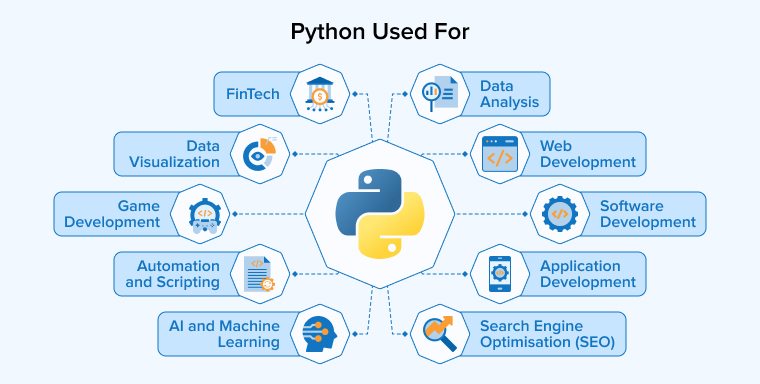
Python is a versatile programming language, which leads to its application across multiple areas of technology development. Some of the most popular ones are as follows:
Python In Web Development
Python helps developers build and maintain the server-side components of websites and web applications, making it a popular choice for backend web development. You don’t need to build every feature from scratch; Python frameworks like Django and Flask handle common tasks such as managing URLs, working with databases, processing requests, user authentication, and protecting applications. Django provides a more complete set of tools and is useful for larger applications where many features need to work together. Flask provides developers more freedom when creating smaller applications or APIs.
Frameworks such as Pyramid and Tornado can also support different development requirements, including applications that need asynchronous operations. Python’s simple syntax, extensive library support, and flexibility make it useful for projects of different sizes. From business websites and database-driven applications to large online platforms, Python can provide a reliable foundation for building web-based solutions. The availability of frameworks and community support also makes it easier for developers to create, improve, and scale their applications over time.
Python in Data Analysis
Python is used for data collection and extraction to find useful information from it due to its multiple tools and libraries that ease data analysis tasks. Libraries such as NumPy and Pandas help you in organizing, cleaning, examining, and processing large amounts of information. You can also use these libraries to calculate values such as averages, minimums, maximums, and standard deviations without manually performing every calculation. Python allows developers to automate repetitive tasks by creating reusable functions that they can call whenever needed.
Python supports data collection through methods such as web scraping and provides tools for statistical analysis and hypothesis testing. It has become an important language in data analysis and data science as it provides a powerful combination of flexibility, diverse libraries, and simple ways to handle data. There is a huge scope for exploring Python to find ways to study information, identify problems, discover useful patterns, and make better-informed decisions.
Python in AI and Machine Learning
Python is well-known for its use in artificial intelligence and machine learning to make machines intelligent so that they can think like humans. One of the main reasons that developers in AI development companies prefer it is its simple syntax, which allows them to focus more on solving problems than on writing complicated code. Python even has a strong collection of specific libraries and frameworks that simplify many stages of development of AI/ML projects.
Python machine learning libraries like scikit-learn can help with common ML-related tasks. Developers widely use deep learning libraries like TensorFlow and PyTorch to build and train advanced models. They are also useful in areas such as natural language processing and computer vision, where applications need to understand text, speech, images, or video. Libraries such as spaCy, NLTK, OpenCV, and other specialised tools provide ready-made functionality that developers can build upon.
ML models can be trained to recognize patterns in existing data and use those patterns to generate predictions or recommendations. These capabilities are useful in many real-world applications such as product recommendations, fraud detection, customer behavior analysis, image recognition, and automated language services. The availability of pre-trained models and a large developer community can reduce development time and make advanced technologies easier to explore.
Python in Game Development
Although Python is not the primary language for professional game development, developers can use it for various tasks throughout the game development process. Its simple syntax and easy learning curve allow developers to turn ideas into working programs quickly. This makes Python especially helpful when creating small games, testing concepts, or building early prototypes before moving to more complex tools. It can also be used to design dialogue systems, including dialogue trees that control conversations and choices between characters.
Beginners can start with text-based games, which provide a simple way to understand programming concepts while learning how games work. Python also supports both 2D and 3D development through libraries and frameworks such as Pygame and Panda3D. These tools give developers useful features for graphics, sound, movement, and interaction.
Python in Data Visualization
Data visualization is an important and inseparable component of data analysis because it helps to understand information more easily through pictures, charts, and graphs. Using visualization techniques, you can notice patterns, changes, comparisons, and unusual values from visual elements more quickly instead of looking at large amounts of numbers or text. Python supports data visualization by providing a wide range of libraries for creating different types of visualizations. Developers commonly use Matplotlib to create basic charts, including line graphs, bar charts, and histograms. Seaborn works with Matplotlib and provides a simpler way to create attractive and informative statistical graphics.
Python also has several other visualization options. Plotly, Bokeh, and Altair are multipurpose libraries that can be used for interactive and flexible visual presentations. Libraries such as missingo focus on visualizing missing data. GeoPandas is useful when information needs to be displayed on maps. These tools are helpful in many areas such as business reporting, research, and data-driven decision-making. For example, Python can support visual analysis in platforms such as Tableau, Power BI, IBM analytics solutions, and other data systems.
Python in Application Development
Python is a useful choice for application development as its flexibility makes it suitable for both prototyping and large business applications. It can also work with many popular databases, including MySQL, PostgreSQL, Oracle, and Microsoft SQL Server, which makes handling stored information easier. You can use PyPI, a large collection of packages, to directly include features in the application without writing code for everything. If a required solution is not available, Python’s open-source nature even allows you to create your own package and share it with others.
Python is also useful for developing applications that can run on different operating systems. Frameworks such as Kivy and BeeWare support cross-platform development and can be used for creating mobile applications. Kivy also provides support for touch-based interfaces and different platforms.
Python in FinTech
Financial companies deal with huge amounts of information every day, and Python can help collect, organize, analyze, and process this data efficiently. Its simple syntax allows developers and finance professionals to build and test applications without getting too much involved in coding. Python is useful in areas such as market analysis, risk assessment, algorithmic trading, fraud detection, financial modelling, and process automation. Its large collection of libraries provides ready-made tools and modules for tasks dealing with mathematics, statistics, machine learning, and data science.
Python helps employees and professionals to focus more on logical tasks by automating repetitive workflows and connecting different data sources to derive comprehensive solutions. Several major financial organizations, such as J.P. Morgan, Bank of America, Citigroup, and Stripe, are actively using Python in different areas of their technology operations. However, keep in mind that choosing a technology for a fintech application also requires attention to security, scalability, performance, and long-term maintenance.
Python in Automation and Scripting
Python can help you avoid doing the regular tasks repeatedly by just writing a script to automate them. This can make your work faster, easier, and less prone to human errors. Python helps developers organize files, rename folders, find duplicate information, convert file formats, and identify data issues. It can also help with web-related tasks such as collecting information from websites, working with online services, or sending regular messages and emails. Automation libraries such as Selenium and BeautifulSoup make it possible to manage web browsers and collect useful information from web pages.
Python is also widely used in testing, data processing, and connecting different applications through APIs. In areas such as DevOps and Infrastructure as Code, Python works with libraries like Ansible and Terraform to automate technical processes. One of the main advantages of Python is that its code is generally easy to understand, so even people without deep programming knowledge can learn to automate simple office tasks.
Python in Search Engine Optimisation (SEO)
The intersection of programming and digital marketing has made Python an essential toolkit for modern search engine optimization. Now SEO professionals do not need to check hundreds or thousands of web pages manually. They can use automated Python scripts to scan massive websites for technical flaws like dead links, delays in page loading, missing alt text from images, and pages with repeated titles and meta descriptions, etc. Python can also help organize keyword lists by removing repeated terms and grouping related search phrases or long-tail keywords.
SEO teams can use Python to analyze server logs to determine how search engine crawlers move through a website and which pages they access, to collect ranking information over time, and notice important changes in search performance. With suitable data sources, developers can display these results in regularly updated dashboards. It is also useful when working with natural language processing (NLP), as it can help analyse language and search queries.
Python in Software Development
Python is a useful programming language throughout the software development process, not only for a particular stage of it. You can use it during your requirements analysis and planning phase, development, testing the code, finding problems, and maintaining the software after it is released. Python is flexible enough to support both small programs and large applications that need to handle complicated calculations or communicate with different systems. Python enables developers to process audio and video, develop websites and APIs, and build interactive graphical user interfaces.
Python’s collection of diverse libraries and tools makes it easier to add different functions without creating everything from scratch. Well-known online services have also used Python for important parts of their systems. For example, Dropbox and Reddit have used Python for backend development, while YouTube has used it for video processing and application development.
List of Companies that Use Python
Let us now discuss how some of the major technology giants use Python for their operations and how they benefit from it:
Instagram relies heavily on Python and the Django framework to support its large and growing platform. Python offers a simple and practical environment that helps developers build features efficiently without unnecessary complexity. Django also contributes to secure and quick development. As Instagram expanded, the company strengthened its infrastructure to handle increasing demand. Today, Python continues to play an important role in supporting its ability to serve users at a massive scale.
Dropbox
Dropbox is a well-known cloud storage platform that uses Python extensively in its technology stack. Python helped the company build and manage its services because of its simple syntax, readability, and cross-platform capabilities. As Dropbox grew from a small startup to a platform serving millions of users, Python remained an important part of its development. The company later introduced the Go programming language for certain areas while continuing its use of Python for many backend tasks.
Spotify
Spotify is a well-known example of Python being used in a large-scale technology platform. The company uses Python for backend development, data processing, and systems that support personalized recommendations. It helps Spotify handle large amounts of listening data and turn it into useful insights for users. Python also allows engineers to build and improve data-driven features efficiently, which makes it an important part of Spotify’s technology ecosystem.
Final Thoughts
Python has become a useful part of modern technology because it can handle many different types of work. Developers use it to build websites, automate tasks, analyze data, create AI and machine learning solutions, and develop software for different industries. From small automation scripts to large-scale applications, Python can support projects of different sizes. As technology continues to evolve, Python can help developers build practical skills and adapt to new opportunities across software development and other technology-driven fields.
FAQs
Python is highly popular for web development, artificial intelligence, and data analysis. Programmers frequently use it to automate repetitive tasks, build software applications, and create video games. Its clean syntax also makes it the top choice for academic research, financial modeling, and scraping information from the internet.
Python is easy to learn, simple to read, and useful for many types of projects. It helps you create software quickly, automate repetitive work, and handle data efficiently. Its large collection of libraries and strong community support also make problem-solving easier and reduce development time.
Python is primarily used to develop automation tools, websites, software, data analysis, AI, and machine learning tasks. It is also widely used to process data, create applications, automate repetitive work, and build intelligent technology solutions.
Yes, Python can be used to build websites and web applications. Developers commonly use frameworks such as Django and Flask to create the server-side part of a website. Python can manage databases, process user requests, handle application logic, and connect different services.

Niket Shah oversees technology projects at TatvaSoft, blending hands-on expertise with a passion for crafting innovative solutions. He thrives on turning complex challenges into impactful results.


Comments
Leave a message...