

Python is becoming the most in-demand programming language in the software development world. The 2025 Stack Overflow developer survey recorded a 7% point jump in Python adoption in a single year, with 57.9% of professional developers now working with the language. Python’s high scalability, versatility, simplicity, and powerful libraries that help integrate emerging technologies like AI and ML into the software are the leading factors behind its increasing popularity.
This surge in Python adoption increases the need for Python development companies to hire proficient Python developers who can meet the quality standards of the project within the predetermined timeline. However, it’s becoming quite difficult to hire developers with real-world experience in product development rather than just those who perform well in interview rounds in such a competitive market.
This blog is a practical guide on how to hire Python developers for your business. It covers the key skills to evaluate, a structured hiring process, the real costs across regions, the common challenges you’ll come across, and how to choose a partner that fits your project needs.
Why Hire Python Developers for Your Next Project?
Python has become the default choice for businesses building modern software. The reasons go far beyond its popularity in developer surveys. Below are the major requirements of businesses leading them to hire Python developers:
- Enterprise Software Applications: Python is widely used to build secure, large-scale enterprise software. That supports complex business workflows, integrations, and high data volumes without compromising performance.
- Software Testing: With mature testing libraries like pytest and unittest, Python developers help businesses run automated test suites that catch issues early and improve overall code quality before each release.
- Expertise in AI and Machine Learning: Python is the leading programming language for artificial intelligence and machine learning projects, owing to its libraries such as TensorFlow, PyTorch, and scikit-learn that accelerate model development and production deployment.
- Scalable and Versatile Backend Development: Python frameworks like Django and FastAPI allow businesses to build scalable backend systems. APIs that grow alongside the product, from early MVP stages to high-traffic production environments.
- Workflow Automation: Python is widely used to automate tasks across operations, finance, marketing, and engineering, helping businesses reduce manual work, improve accuracy, and free up internal teams for higher-value activities.
What Are the Key Skills to Consider Before Hiring Python Developers?
It’s important to know the core technical skills and soft skills a Python developer must have before you hire one:
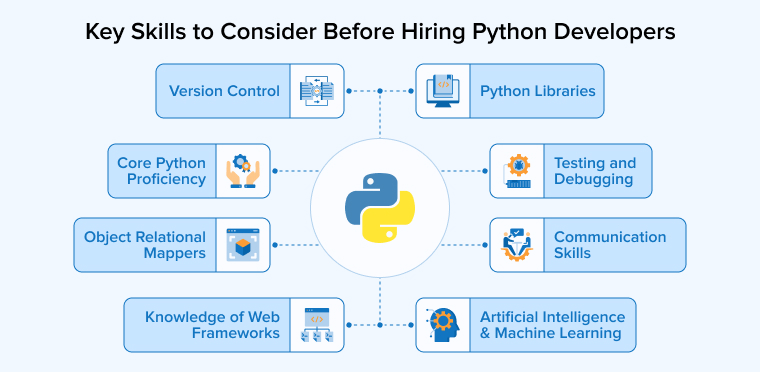
Core Python Proficiency
The most essential thing is having a strong grip on Python fundamentals. The developer should be confident in data structures, object-oriented programming concepts, exception handling, and writing clean Python code according to the relevant standards and best practices. Strong Python programming fundamentals directly impact code readability, debugging speed, and the time taken by the developer to adapt to your project requirements without rewriting the same logic in different ways.
Knowledge of Web Frameworks
Most business applications depend on a reliable backend, so familiarity with popular Python frameworks is essential. Look for developers possessing hands-on experience with Django, Flask, or FastAPI, as these are highly used to develop web applications, REST APIs, and SaaS backends. A strong developer should also understand RESTful API design principles, request handling, authentication, and how to structure endpoints that other systems can integrate with reliably.
Version Control
Version control is non-negotiable in any professional development process. The candidate should be experienced with Git, including branching strategies, pull requests, code reviews, and conflict resolution. This ensures smooth collaboration in a distributed team, protects your codebase from avoidable errors during active development, and supports a clean history that future engineers can trust.
Object Relational Mappers
ORMs help developers interact with databases using Python objects instead of raw SQL queries. Search for developers who have experience with tools like Django ORM, SQLAlchemy, or Peewee. This indicates their understanding of database management, query optimization, and data manipulation in a structured way. They must also have a working knowledge of relational databases, such as PostgreSQL or MySQL, as it is equally important, especially for data-heavy applications, reporting systems, and products that depend on complex business logic at the data layer.
Python Libraries
Python’s most important strength is its powerful and extensive libraries that cover almost every business use case. A professional Python developer knows which libraries to use for data processing, web scraping, API development, and automation, instead of writing everything from scratch. This awareness directly affects development speed, reduces bugs, and helps the developer build only those features whose code is not directly available. There’s no need to reinvent solutions that the open-source community has already solved.
Artificial Intelligence and Machine Learning
If your project involves AI or analytics. The developer should have hands-on exposure to Python machine learning libraries like TensorFlow, PyTorch, scikit-learn, and pandas. If they have practical experience with model training, data analysis, and natural language processing. They can contribute to real machine learning projects and not only theoretical work. For enterprise-level, look for developers who also understand model evaluation, data pipelines, and the knowledge of moving trained models from experimentation into production.
Testing and Debugging
A developer who deploys code without testing it is a long-term risk for any business. Look for someone experienced in writing unit tests with pytest or unittest, along with debugging tools, logging, and performance profiling. It is an added advantage if the developer is also familiar with deployment basics. Such as Docker, CI/CD pipelines, and cloud environments such as AWS or Google Cloud. This shows that they not only have coding knowledge but also understand what happens after development when the product goes into the production environment.
Communication Skills
Strong communication skills are equally important as technical depth. The developer should be able to explain technical decisions in simple words, raise blockers early, and collaborate with product managers, designers, and other engineers. Good problem-solving ability and soft skills directly improve delivery speed and reduce misunderstandings during the project. And it helps the team make better decisions when requirements evolve mid-development.
How to Hire Python Developers: Step-by-Step Process
A clear, well-structured hiring process helps reduce the time and cost associated with it. The following are the six steps to follow while hiring Python developers.
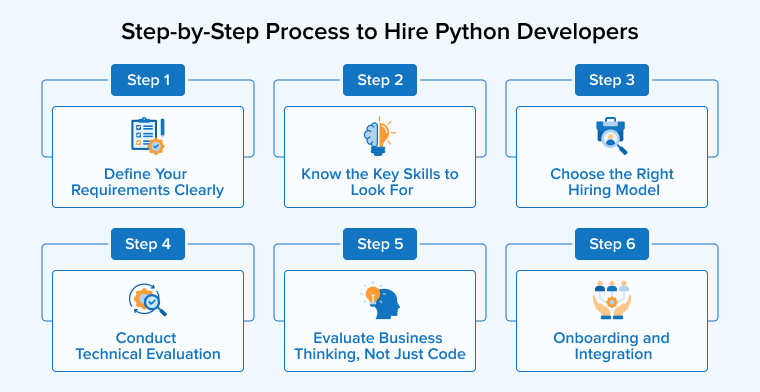
Step 1: Define Your Requirements Clearly
Firstly, you should be crystal clear about what the project is for which you’re hiring. Focus on having a clear definition of what you actually need before starting the candidate evaluation process. It helps you avoid mismatched hires, reduces time wasted on filtering and clarifying details during shortlisting, and explains the idea of success for the project they are being hired for.
Consider the following Key things at this stage:
- Project goals and the business problem the application is solving
- Type of application, whether it’s a web platform, AI product, internal tool, or data system
- Technology stack, integrations, and any compliance requirements
- Whether you need junior developers, mid-level developers, or senior engineers
- Expected timeline, team size, and budget for the engagement
Step 2: Know the Key Skills to Look For
Once your requirements are clear, it’s time to map them to the right technical and behavioural skills. The skill set varies based on the type of project you are developing, and matching the right developer profile to the right need helps you avoid expensive mismatches later.
Skills to prioritize based on project type:
- Backend or SaaS product: Framework expertise, API design, database knowledge
- AI or analytics product: Machine learning, data engineering, library depth
- Automation or scripting work: Integration knowledge, scripting experience, system tools
- For every role: Problem-solving ability, communication, and code quality awareness
Step 3: Choose the Right Hiring Model
Different projects need different engagement structures. Choosing the right hiring model is one of the most important decisions in the entire process. The right model depends on your project duration, control needs, and budget flexibility.
You can consider the following common hiring models :
- Dedicated Python developers for long-term product engineering and full ownership
- In-house team for sensitive, mission-critical systems requiring daily oversight
- Staff augmentation, if you need to scale your existing team without hiring permanent members in-house
- Engage offshore partners when you want dedicated talent at competitive costs without the overhead of full-time hiring
Step 4: Conduct Technical Evaluation
A structured technical evaluation helps you find out the developers who are actually good at applying their knowledge in the program, instead of those with only theoretical knowledge. Do not use standard algorithm puzzles to test candidates, as they often reveal practice patterns rather than real engineering ability.
What a strong evaluation should include:
- A coding task or take an assignment based on a real project scenario
- A live problem-solving round to observe thinking and decision-making in real time
- A code review discussion where the candidate explains a past piece of code
- Review of past projects, GitHub contributions, or production work samples
- Questions about how they handle edge cases, debugging, and scalability concerns
Step 5: Evaluate Business Thinking, Not Just Coding Skills
Python experts know that code is only valuable when it solves a business problem. Developers who can connect technical decisions with business outcomes are far more reliable contributors, especially in long-term projects where requirements keep evolving.
Ask the following questions to evaluate business thinking:
- How would you scale this system if user load grows ten times next year?
- How would you prioritize features under a tight deadline with limited resources?
- How would you handle a production issue impacting paying customers?
- What trade-offs would you consider between delivery speed and code quality?
- How would you approach a feature where business and engineering goals conflict?
Step 6: Onboarding & Integration
No matter how effectively you’ve hired top-notch talent. If there’s no proper onboarding plan, you cannot leverage the actual potential of the hired developers. A structured onboarding helps new developers integrate quickly with your existing team, understand their responsibilities, and start contributing early to production, which every business looks for when hiring Python developers.
A good onboarding plan should include:
- A clear product roadmap and overview of the business goals
- Access to the codebase, documentation, and coding standards from day one
- Communication guidelines covering tools, response times, and meeting schedules
- Defined ownership areas and short-term deliverables for the first few weeks
- A regular check-in rhythm with the project manager to track progress and resolve blockers
Cost of Hiring Python Developers
Understanding various cost drivers of the hiring process helps you plan a realistic budget and avoid chances of coming up with unplanned expenses later in the project. Businesses commonly come across the following cost-affecting factors of the Python developer hiring process:
- The biggest cost factor is geography. North American and Western European markets have the highest pricing range, while regions like India and Eastern Europe offer skilled Python programmers at far more competitive rates without compromising on quality. Below is a practical view of average hourly rates based on region, according to the widely reported 2026 industry benchmarks.
- United States and Canada: 80 to 150 USD per hour, with senior engineers and AI specialists often charging more
- Western Europe (UK, Germany, France): 70 to 120 USD per hour, with strong demand pushing rates up steadily
- Eastern Europe (Poland, Ukraine, Romania): 40 to 80 USD per hour, balancing quality and cost effectively
- Latin America (Brazil, Colombia, Argentina): 35 to 70 USD per hour, with good time zone overlap for US-based teams
- India: 20 to 45 USD per hour, offering one of the deepest Python talent pools in the world at competitive rates
- Experience level is the second major driver. Junior developers manage routine work at lower rates, while mid-level developers take independent ownership across the development process. The senior Python engineers are the ones who design the product architecture, which is the most complex task of any project, especially large ones. Hence, they command the highest rates.
- The engagement model also shapes total cost. Hiring a freelance Python developer may look cheaper, but the hidden onboarding and continuity costs increase the total amount significantly. Dedicated Python developers and staff augmentation models offer predictable rates and full-time focus that deliver better long-term value.
- Other influencing factors include required Python skill set, technology stack complexity, project duration, and compliance needs in industries like healthcare or fintech. For most growing businesses, offshore staff augmentation in regions like India offers the best balance of cost, quality, and continuity, with engineering cost savings of 40 to 60 percent compared to equivalent in-house hiring in the US or Western Europe.
Challenges in Hiring Python Developers
Hiring Python developers in 2026 is more competitive than ever, and most businesses face a familiar set of challenges when they enter the market. Knowing these challenges in advance, along with their practical solutions, helps you build a stronger hiring strategy and avoid expensive mistakes during the process. So let’s discuss them:
Shortage of Senior Python Talent
Challenge: The availability of Python talent pool has tightened sharply in recent years, especially for engineers with deep AI, machine learning, and large-scale backend experience. Many businesses spend months on hiring rounds and still struggle to find candidates who can independently own complex systems.
Solution: Expand your search beyond local markets and consider working with offshore partners in regions like India and Eastern Europe, where a large pool of senior Python talent is available. Engagement models like staff augmentation give you direct access to vetted senior engineers without the time-consuming traditional recruitment process.
Difficulty in Evaluating Real-World Skills
Challenge: Many candidates clear standard coding tests and theoretical interviews but struggle when placed inside a real production codebase. Traditional algorithm-style screening rarely reflects how a developer thinks about scalability, debugging, or business-critical decisions.
Solution: Replace generic coding puzzles with project-based assessments, real codebase walkthroughs, and problem-solving discussions. A short paid trial on a defined deliverable is one of the most reliable ways to evaluate a developer before making a long-term commitment.
Rising Hiring Costs and Salary Pressure
Challenge: As demand for Python developers continues to grow, hiring costs in the US and Western Europe markets have risen significantly. For mid-sized businesses and growing startups, this puts pressure on engineering budgets and slows down product roadmaps.
Solution: Choose a hiring model that fits your budget without compromising on quality. Offshore staff augmentation, dedicated developer engagements, and hybrid team structures help you control costs while still accessing experienced developers who can deliver production-grade work.
Long Hiring Cycles and Slow Time-to-Hire
Challenge: Hiring Python developers through traditional hiring processes often takes several weeks or months. By the time you send an offer, strong candidates are already hired by competing companies. This delay directly impacts product timelines and team capacity.
Solution: Work with a partner who maintains a pre-vetted bench of Python developers who can start within days, not months. A rigorous vetting process by an experienced partner reduces your internal team’s workload and significantly shortens the hiring time.
Limited Visibility into Code Quality and Communication
Challenge: Many businesses notice issues like poor code quality, weak documentation, or communication gaps only after the developer has been working for weeks. By then, the cost of rework or replacement has already increased quite high.
Solution: Make code reviews, written documentation, and structured communication a part of the evaluation process from day one. Choose a hiring partner that follows a rigorous screening process covering technical depth, communication clarity, and collaboration style before placing any developer on your project.
Cultural and Time Zone Differences in Remote Hiring
Challenge: Hiring offshore or remote Python developers can become a limitation in terms of working hours, communication style, and project management expectations if a proper management structure isn’t there.
Solution: Set clear overlap hours, define communication protocols, and choose partners with proven experience in working with global clients. Structured daily stand-ups, weekly reviews, and a dedicated project manager help bridge time zone gaps and keep delivery on track.
Why Choose TatvaSoft to Hire Python Developers
When you decide to hire Python developers, choosing the right partner matters as much as choosing the right developer. You can trust TatvaSoft as your partner, thanks to its outstanding achievements and capabilities listed below:
Proven Python Engineering Expertise
TatvaSoft has delivered Python projects such as web platforms, AI-powered applications, data engineering systems, and enterprise SaaS products. We have Python experts experienced in modern frameworks like Django, Flask, and FastAPI who work on such diverse projects.
Rigorous Vetting and Pre-Trained Talent Pool
Every developer at TatvaSoft goes through a rigorous vetting process covering Python fundamentals, framework expertise, and real project scenarios, so they’re ready to work in different environments from day one.
Flexible Engagement Models
TatvaSoft offers flexible hiring options for dedicated Python developers, whether you need long-term support, opt for staff augmentation to scale your existing team, or choose a fixed-scope project model based on your project needs.
Enterprise-Grade Process and Compliance
TatvaSoft follows a CMMI Level 3-aligned development process, supported by ISO 27001 and SOC 2 certifications, making us a trusted partner for businesses in regulated industries where code quality and data protection are critical.
Transparent Communication and Project Management
Every engagement includes a dedicated project manager, structured reporting, and clear communication cadences, giving you full visibility into progress, blockers, and delivery timelines.
Cost-Effective Global Delivery
With delivery centres in India and a global presence across the USA, UK, Canada, Europe, Saudi Arabia, Japan, and Australia, TatvaSoft helps businesses access top Python developers who deliver quality outcomes at competitive rates.
Together, these strengths make TatvaSoft a dependable partner for businesses looking to hire Python developers who can deliver real and long-term value to their projects.
Conclusion
Hiring the right Python developers is a strategic decision that directly shapes the quality, speed, and long-term success of your project. There are multiple aspects to address to ensure a smooth, successful hiring process aligned with your development goals and team culture. Continuous learning and improvement must become a key focus after onboarding Python developers, so their skills remain relevant to changing trends and project demands.
FAQs
Hiring a Python developer takes 6 to 12 weeks through traditional in-house recruitment. A freelance Python developer can be onboarded within a few days, but screening responsibility stays with your team. The fastest option is staff augmentation, where a provider maintains a pre-vetted bench of Python developers and can onboard a developer within 48 to 72 hours.
Common red flags include weak Python fundamentals, inability to explain past projects clearly, over-reliance on AI tools without understanding the logic, a portfolio without production-grade work samples, poor communication during interviews, vague answers on debugging or scalability, and reluctance to take a paid trial. A history of short, inconsistent project engagements is another strong red flag.
Yes, hiring remote Python developers is a smart choice for most businesses. It gives you access to experienced talent from regions like India and Eastern Europe at lower rates than local hiring in the US or Western Europe.

Niket Shah oversees technology projects at TatvaSoft, blending hands-on expertise with a passion for crafting innovative solutions. He thrives on turning complex challenges into impactful results.



Comments
Leave a message...