

Choosing the right technology is an important part of turning a software idea into a functional product. Software developers and teams at a software development company rely on programming languages to define the behavior and responses of their applications, whether they be mobile apps, e-commerce platforms, workplace systems, or data-driven products.
The problem is that different kinds of software don’t necessarily benefit from the same programming language. When it comes to building web applications, data analysis tools, automation systems, or enterprise-level applications, some languages are more suited for speed and system-level programming. A number of factors can impact the decision, including the project’s needs, technology stack, performance, security, development time, and available talent.
There are a lot of programming languages out there, and it might be difficult to choose the best one. This article talks about some of the most popular and useful computer languages for developing software. It also talks about what these languages are usually used for and when each might be a good choice for a project.
Top Programming Languages for Software Development
Various programming languages are designed to address specific types of issues. Some are well-suited to particular platforms, workloads, or sectors, while others are sufficiently flexible to accommodate multiple areas of development. The goals of the project should take the lead over the popularity of the language when deciding which one to use.
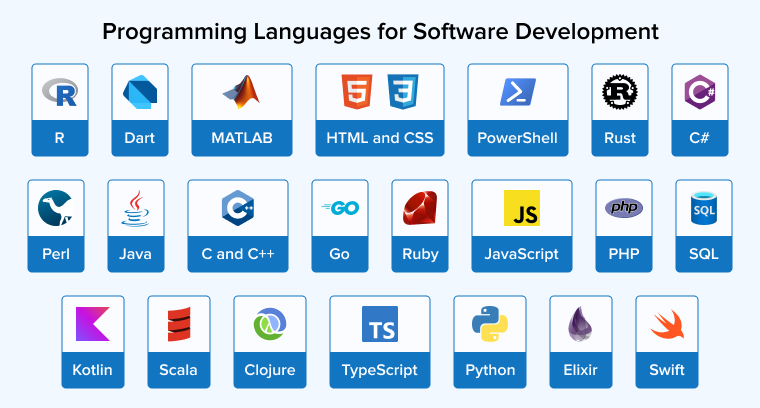
Listed here are a few of the most popular development technologies and languages.
Python
Python is a popular high-level programming language that has several advantages over other languages. Its syntax is easy for beginners to understand and use, and it has a large library and framework ecosystem. Its structure is both beginner-friendly and powerful enough for complex software applications. The fields of web development, data research, automation, AI, ML, and scientific computing all make extensive use of Python. Python’s large developer community and extensive library ecosystem make it easy to find the tools needed for many development tasks. Although other technologies may be used to implement performance-sensitive components, Python can be used to build both small applications and larger systems.
When to Use?
- The Python programming language has several common uses, including machine learning, artificial intelligence, scripting, web applications, automation, data analysis, backend development, and scientific computing. Python frameworks such as Django and Flask further support web application development.
When to Choose?
- If you seek rapid development, clear documentation, adaptability, data handling, and support for artificial intelligence and machine learning, Python is the way to go. It shines in initiatives focused on a large ecosystem and quick development.
JavaScript
Modern web development relies on a number of technologies, one of which is JavaScript. It enables developers to build interactive functionality for web pages on the frontend, while environments like Node.js allow JavaScript to be used for backend and server-side development. The versatility of JavaScript extends to its usage in both the frontend and backend of an application. Web apps, APIs, real-time apps, and server-side services are all supported by its extensive ecosystem of JavaScript frameworks and tools. JavaScript works well with many browsers, which makes it a good choice for apps that need to work on many systems and devices. Businesses can usually locate developers and widely used tools for developing and managing apps built using JavaScript due to its broad popularity.
When to Use?
- JavaScript’s primary use cases involve building dynamic websites or web applications, as well as APIs, real-time software, and cross-platform apps. Its features can be expanded with popular technologies like Node.js, React, and Angular.
When to Choose?
- When developing cutting-edge web apps, JavaScript is the way to go, especially if you need to implement features that are exclusive to browsers or if you want to use the same language for both the front end and the back end.
Java
Java continues to see heavy usage in commercial and large-scale software development due to its general-purpose nature and object-oriented syntax. One of Java’s main strengths is that its applications can run on different operating systems through platform-dependent JVMs.
Enterprise application development is made easier by Java’s mature ecosystem, strong development tools, and Java frameworks like Spring. Its performance, security features, and capacity to manage massive applications are also well-known. Android, enterprise apps, financial platforms, and backend systems continue to use Java extensively. For businesses that value long-term reliability in their technology, it’s a good bet thanks to its extensive history and big development community.
When to Use?
- Java is a popular choice for many enterprise applications, web applications, backend systems, financial software, cloud services, large-scale platforms, and Android development.
When to Choose?
- If longevity, security, and an established ecosystem are paramount for developing large, long-term apps, then Java is the way to go.
SQL
Structured Query Language (SQL) is a programming language with a focus on relational databases. Data storage, retrieval, updating, and organization are SQL’s primary concerns, in contrast to more general-purpose languages like Python or Java. Developing with SQL allows programmers to build databases, perform queries on records, edit data, and create reports based on data. Compatible relational database systems include Microsoft SQL Server, Oracle Database, PostgreSQL, and MySQL. It is more common to utilize SQL in conjunction with another language than to rely solely on SQL when developing an application. Knowledge of Structured Query Language (SQL) is highly valued in software development, backend engineering, analytics, and data-related fields because it is applicable to nearly all applications that require organized data management.
When to Use?
- With SQL, you can build and administer relational databases, access records, modify data, filter data, create reports, and execute database queries.
When to Choose?
- If your project calls for organized relational data management, SQL is the way to go. This is crucial for any application that deals with financial data, reporting, inventories, transactions, or customers.
C and C++
When people think about developing software at the system level or with an emphasis on performance, they usually think of C and C++. While C gives you low-level access to the hardware and memory, C++ adds object-oriented features and more to C. When efficiency, performance, and direct system access are important, developers often choose C or C++ to build high-performance software.
The C programming language has many commonalities with OSes, embedded systems, firmware, and system software. Game engines, desktop apps, browsers, HPC, and other software that requires a lot of processing power frequently rely on C++. Applications that value efficiency and predictable performance can benefit from their control, despite the fact that their learning curve is steeper than that of higher-level languages.
When to Use?
- Programming languages like C are used to make low-level tools, embedded software, and operating systems. Whereas C++ is often used for desktop apps, browsers, games, graphics, embedded systems, and fast software.
When to Choose?
- If your project requires a significant amount of memory management, hardware interface, performance, or efficient use of resources, then C or C++ are the languages to use.
PHP
Server-side coding languages like PHP are commonly used for developing websites. With its extensive ecosystem of PHP frameworks, CMSes, and development tools, it is ideal for building dynamic web pages and backend functionality. You can use PHP to create server-side services, web apps, APIs, and webpages. PHP also has a large developer community and plenty of hosting options, libraries, and development resources.
Additional structure for modern application development is provided by frameworks like Laravel. Businesses that rely on web-based systems or are responsible for managing existing PHP applications find PHP to be a particularly relevant language because of the importance of development speed and access to established tools.
When to Use?
- Web applications, content management systems, e-commerce platforms, dynamic websites, and server-side web development are PHP’s primary uses.
When to Choose?
- Choose PHP if you’re building an app with a web focus, especially if there’s an existing PHP ecosystem, CMS, or PHP-savvy staff you can collaborate with.
C#
Created by Microsoft and closely integrated with the .NET ecosystem, C# is a general-purpose, object-oriented programming language. It offers a wide variety of frameworks and libraries for developing applications across various platforms, including the web, desktop, cloud, enterprise, and gaming. C# is widely used in Unity for game development and is particularly common in apps created with Microsoft’s .NET platform. Its powerful tools, automatic memory management, and modern language features make it suitable for creating maintainable applications. C# isn’t limited to Windows-only apps anymore because .NET supports multiple OSes. It is a practical choice for teams building enterprise apps, APIs, cloud services, or interactive software, and organizations already invested in Microsoft technologies,
When to Use?
- C# is used for enterprise applications, web applications, APIs, desktop software, cloud services, and game development, particularly through the Unity engine.
When to Choose?
- Choose C# when building .NET-based applications, enterprise software, Microsoft-oriented technology stacks, or games that require Unity.
Go
An open-source programming language created by Google, Go (or Golang) prioritizes simplicity, efficiency, and concurrent programming. Backend services, application programming interfaces, cloud apps, and distributed systems are its strong suits. Applications that require the execution of multiple activities simultaneously will find Go’s capacity to manage concurrent operations via lightweight goroutines to be an asset. Its simple syntax can help simplify the maintenance of large codebases. Since it offers high performance without the complexity of some lower-level languages, Go has become popular in cloud-native programming and network applications.
When to Use?
- Cloud services, application programming interfaces (APIs), backend systems, distributed applications, networking tools, microservices, and infrastructure software are among the most prominent uses of Go.
When to Choose?
- For distributed systems or large backend services that prioritize simplicity, speed, concurrency, and effective use of resources, Go is the language to choose.
R
R is an environment and programming language that focuses on statistics, data analysis, and data visualization. It offers a wide variety of tools that can be used for research-oriented computing, data processing, visualization, and statistical modeling. R is widely used by researchers, statisticians, data analysts, and data scientists for exploring and interpreting large datasets. Although it isn’t commonly used for building apps in general, it works well when complex statistical analysis is at the heart of the project. Companies can utilize R for analytical workloads while another language takes care of the main application because R can work alongside other technologies.
When to Use?
- Data science, research, visualization, predictive modeling, business analytics, and statistical analysis are some of the many uses for R.
When to Choose?
- If your project will primarily involve research-oriented analysis, data visualization, exploration, or advanced statistics, R is the way to go.
Swift
For all of Apple’s ecosystem software development needs, the company uses the Swift programming language. Its goal was to improve application development while delivering modern syntax, speed, and security. Many people think about Swift when they think of apps for iOS, macOS, Apple Watch, and other Apple devices. It is a perfect fit for teams creating native Apple apps because of how well it integrates with Apple’s development tools and frameworks. Features that aim to improve code dependability and minimize common programming errors are also included in Swift. Swift offers a development experience that is closely linked with Apple’s software frameworks and tools, as well as access to native platform features, which can be beneficial for firms targeting Apple’s ecosystem.
When to Use?
- Native applications for iOS, macOS, watchOS, tvOS, and other platforms in Apple’s ecosystem are built using Swift.
When to Choose?
- When developing apps that run natively on Apple devices and making use of features and APIs that are particular to the Apple platform, Swift is the way to go.
Perl
Perl is a high-level, all-purpose programming language used for system administration, scripting, text processing, and automation. Processing huge quantities of data, automating routine operations, and working with text and files all gained widespread adoption. Legacy systems, infrastructure, system management, and specialized data-processing environments still use Perl, even though newer languages are more frequent for many recent development projects. It seems easy to maintain current Perl programs using its mature ecosystem and large array of modules. When starting a new project, it’s more important to consider the specific needs and the availability of relevant knowledge than to prioritize popularity.
When to Use?
- When considering scripting, text processing, automation, data processing, file manipulation, system administration, and maintenance of legacy applications.
When to Choose?
- If you’re managing an existing Perl-based system or if your project could use its robust text processing and scripting features, then Perl is the way to go.
TypeScript
TypeScript is an extension of JavaScript that includes static typing and other capabilities to help with the development and maintenance of large codebases. Any environment that supports JavaScript can run TypeScript because it compiles to JavaScript. This means it can work with the existing JavaScript ecosystem. As applications grow, its type system can help developers spot issues sooner and make code easier to understand. Enterprise web apps, full-stack development, and projects with big development teams have seen TypeScript’s popularity soar. Since it is compatible with widely used JavaScript frameworks, it can be seamlessly integrated into ongoing JavaScript projects.
When to Use?
- Front-end apps, back-end services, full-stack development, enterprise web apps, application programming interfaces, and large JavaScript-based projects all make use of TypeScript.
When to Choose?
- When dealing with large or complicated JavaScript projects that prioritize higher security, maintainability, and developer tooling, choose TypeScript.
PowerShell
Microsoft PowerShell is a scripting and automation language designed for automating tasks and system administration. It allows for the management of infrastructure, cloud environments, apps, servers, and operating systems through scripting and commands. With PowerShell, scripts can work with data more consistently since it is based on organized objects, unlike traditional command-line tools. Although it is compatible with Windows, it finds most of its use in Windows administration. In order to automate configuration chores, deployments, monitoring, and repetitive operational work, PowerShell is invaluable for administrators and DevOps teams.
When to Use?
- PowerShell is a versatile tool that can be used to automate system administration, configuration, infrastructure management, DevOps workflows, cloud management, and deployment.
When to Choose?
- When working in a Microsoft environment, automating infrastructure, performing administrative scripting, or performing DevOps operations that necessitate repeatable system management, PowerShell is the right choice.
HTML and CSS
Rather than being “traditional” programming languages, HTML and CSS are essential web technologies. HyperText Markup Language (HTML) organizes the text and images on web pages; Cascading Style Sheets (CSS) manages how such pages look and feel. They work together with JavaScript to create modern user interfaces for websites.
JavaScript adds behavior and interaction, CSS controls how it looks, and HTML defines what displays on a page. Frontend developers must have a solid grasp of these technologies since they are essential to the operation of almost all browser-based applications.
When to Use?
- Websites and web apps use CSS to govern the visual display and layout, whereas HTML is used to structure web content.
When to Choose?
- Always build user interfaces that run in a web browser using HTML and CSS. They are commonly used in conjunction with JavaScript or TypeScript and are crucial for front-end applications and websites.
Ruby
With its easy-to-understand syntax and developer-centric philosophy, Ruby has become a popular high-level object-oriented programming language. Ruby on Rails, a framework that was built to simplify application development, contributed to its rapid rise to popularity in the web development community. For startups and organizations that need to validate concepts or deliver web products rapidly, Ruby’s support for rapid development and its ability to generate expressive code can be a great asset. Data processing, scripting, and automation technologies are also part of its ecosystem. Ruby still has an active developer community and is used for web applications, even though its market share is lower than languages like Python or JavaScript.
When to Use?
- Web application development, automation, scripting, backend services, and Ruby on Rails are the primary uses of Ruby.
When to Choose?
- Ruby is the way to go if you’re looking for fast web development, intuitive syntax, developer efficiency, and a well-established Ruby on Rails community for your project.
Kotlin
The JetBrains team created the advanced, statically typed programming language Kotlin. Running on the Java Virtual Machine, it integrates smoothly with Java and lets developers leverage pre-existing libraries and tools. Kotlin has been known for its Android programming, and Google even endorses it for use in Android apps. Other software projects that benefit from JVM compatibility also use it, such as backend development. While offering capabilities that can enhance developer productivity and code safety, Kotlin aims to minimize repetitive code. Since both Kotlin and Java may coexist in the same project, it can be a much smarter decision for teams that are already using Java.
When to Use?
- Android apps, backend development, JVM apps, and projects requiring Java compatibility are all extensive use cases of Kotlin.
When to Choose?
- If you’re building for the latest Android version or working on a project that uses the JVM and needs a compact language that can coexist with Java, Kotlin is the way to go.
Scala
Scala is an object-oriented and functional programming language with static typing. Built on top of the Java Virtual Machine, it lets programmers take advantage of Java libraries with the clarity and efficiency of Scala’s syntax. Scala has been used for distributed systems, backend services, data processing, and large-scale applications. Apache Spark and other big data technologies have also been linked to it. For developers looking for functional programming features that work with the Java environment or for apps that process large amounts of data, Scala can be a good choice. On the other hand, you should think about whether or not there are enough experienced developers available, since its more complex concepts might make it harder to learn than simpler languages.
When to Use?
- Backend apps, distributed systems, data engineering, processing large amounts of data, and JVM applications are all built using Scala.
When to Choose?
- If your project calls for functional programming, JVM compatibility, distributed computing, or processing of massive amounts of data, Scala is the way to go.
Rust
Rust is a systems programming language that is meant to be quick while maintaining memory safety and reliability. It provides low-level control like C and C++, but it helps prevent some common memory-related problems with its ownership and borrowing model. When developing software, Rust is being explored more for scenarios where safety and performance are paramount. Rust is a popular choice for those who prioritize security when creating applications. Teams should think about developer experience and project complexity before deciding to utilize it, since its concepts can be difficult to grasp at first.
When to Use?
- Embedded software, systems programming, infrastructure, command-line tools, and backend services that are performance-sensitive are all possible uses.
When to Choose?
- For projects that demand top-notch performance and robust memory safety, Rust is the way to go. This is especially true for systems or infrastructure that must be reliable.
Dart
Dart is a Google-developed programming language that has gained popularity due to its integration with Flutter, Google’s user interface toolkit for creating applications that can run on several platforms. Dart enables programmers to target several platforms with a single codebase, including desktop, web, iOS, and Android. Developers accustomed to C-style languages should find its syntax to be quite simple, and it has strong ties to the Flutter ecosystem. Due to this, Dart is a great choice for teams who wish to create apps that run on multiple platforms without having to deal with separate native codebases.
When to Use?
- Developing application interfaces for mobile, web, desktop, and other platforms is where Dart and Flutter really shine.
When to Choose?
- Dart is the way to go when working with Flutter and your project can benefit from building cross-platform apps from a single codebase.
MATLAB
MATLAB is a programming language and computing environment widely used for numerical computing, mathematical modeling, simulation, engineering, and data analysis. Additionally, it can be utilized to create working prototypes of algorithms prior to their incorporation into other programming languages or production settings. Technical projects requiring advanced mathematical and engineering procedures often find MATLAB to be a useful resource.
When to Use?
- Numerous scientific and technical projects, as well as numerical analysis, mathematical modeling, simulations, data visualization, and algorithm development, make use of MATLAB.
When to Choose?
- MATLAB is the way to go whether your project is around mathematical computing, simulation, engineering analysis, or developing algorithms for research.
Clojure
An up-to-date functional programming language, Clojure is most commonly used with the JVM. It is a Lisp variant that prioritizes clear and simple code, functional programming, and immutability. Organizations already working within the Java environment may find Clojure practical because it runs on the JVM and can leverage Java libraries and existing infrastructure. Clojure shines when the project needs a functional programming approach, and the development team has prior expertise with the language.
When to Use?
- Projects involving functional programming, distributed systems, data processing, concurrent applications, and backend development on the JVM are all suitable for Clojure.
When to Choose?
- If the team’s priorities include functional programming, immutability, concurrency, and integration with the Java environment, then Clojure is the way to go.
Elixir
The Elixir programming language is a functional language that is compatible with the Erlang Virtual Machine. It is made for programs that need to handle a lot of users at once, handle errors, and work reliably across multiple computers. When dealing with numerous connections or processes at once, Elixir shines, making it ideal for online apps and backend systems.
When to Use?
- Elixir is used for high-concurrency software, web apps, messaging systems, real-time apps, and backend services.
When to Choose?
- If your application needs fault tolerance, real-time communication, dependable distributed processing, high concurrency, or both, Elixir is the way to go.
Conclusion
Software development relies on selecting a programming language, although there is no single best option, as each differs from the others. Python could be a great choice for fast development, data science, and artificial intelligence, but Java would be a better choice for enterprise apps. While C and C++ shine in applications that demand low-level control and performance, JavaScript and TypeScript continue to play an essential role in contemporary web development.
In the end, the software you’re developing, the platforms it must serve, the development team’s skill set, and the needs it will have in the future will determine the best course of action.
Companies shouldn’t choose a language based on its popularity alone, but rather on how well it fits their product and their technical objectives. Development can be made more efficient, future growth can be supported, and dependable software can be built on top of a well-chosen programming language.

Itesh Sharma is core member of Sales Department at TatvaSoft. He has got more than 6 years of experience in handling the task related to Customer Management and Project Management. Apart from his profession he also has keen interest in sharing the insight on different methodologies of software development.


There are plenty of programming languages for the IT industry. We can not learn every language at the same time. Here comes this article. It mentioned all important programming languages which are mostly used. It also mentions its features and where it is used.