

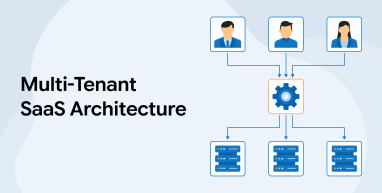
The SaaS (Software as a Service) market is flourishing daily with the advent of multi-tenant architecture. Designing SaaS applications that can efficiently serve many customers has become essential in today’s cloud-driven marketplace. As businesses seek solutions that are scalable, secure, and cost-effective, multi-tenant architecture has emerged as a leading approach. Instead of creating separate setups for every client, this model allows a single application to support multiple users while keeping their data isolated and protected.
For any software development company building modern SaaS products, understanding how multitenancy works is a crucial step toward delivering flexible and high-performing applications. It enables businesses to scale smoothly as their customer base grows, without constantly rebuilding or restructuring their systems.
This blog will introduce you to the core concepts behind multi-tenant SaaS architecture, explaining how it works, its components, how it differs from single-tenant architecture, its advantages and disadvantages, real-life examples, and best practices.
What is Multi-Tenant Architecture?
Multi-tenant architecture is a design approach where a single application runs on shared infrastructure, such as shared servers and databases, while serving many different customers, each with their own separate space. Instead of creating multiple installations for every client, the system uses a single codebase that organizes and protects each tenant’s data through logical separation. This allows businesses to offer a unified platform while giving every tenant the freedom to maintain their own preferences, workflows, and branding. Because all users rely on the same underlying resources, scaling becomes easier and more affordable, especially in cloud-based environments.
Providers can roll out updates, improvements, and fixes once, and all tenants benefit instantly without needing individual maintenance. Although this setup is efficient, it requires strong isolation methods to ensure that information belonging to one tenant is never visible to another. Techniques such as tenant-specific identifiers, access controls, and schema-level separation help maintain this boundary. When designed well, multi-tenant architecture offers a secure and cost-effective foundation for modern SaaS platforms serving diverse customer groups simultaneously.
How Does Multi-Tenant Architecture Work?
Multi-tenant architecture operates by running a single application instance that serves multiple customers simultaneously while ensuring complete privacy for each tenant’s data.
- Data Partitioning: The system begins with a shared deployment accessible to all tenants; however, their data is stored in separate logical spaces. This separation can be achieved by assigning each tenant its own schema, dividing the database into tenant-specific sections, or applying isolation rules directly within the application code. Although tenants share the same servers, storage, and networking components, strict access controls prevent them from viewing or affecting one another’s data.
- Centralized Management: The shared environment enables providers to manage updates, security enhancements, and maintenance tasks from a single centralized point instead of handling them individually for each tenant.
- Scalability: As demand increases, modern cloud tools automatically allocate additional computing resources to maintain consistent performance without impacting other tenants.
- Customizations: Custom settings, such as branding or feature preferences, are stored as metadata, allowing each tenant to personalize the application without altering the overall system.
By combining shared resources with secure isolation, multi-tenant architecture delivers efficiency, scalability, and controlled personalization.
Core Components of Multi-Tenant Systems
There are four main components of multi-tenant solutions:
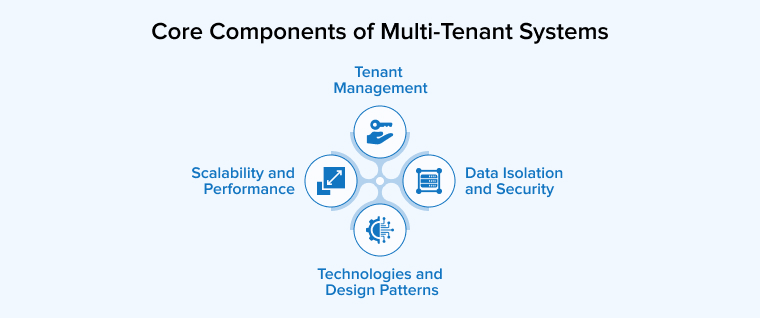
Tenant Management
A tenant is a distinct user group that operates within shared tools while maintaining its own settings and data. Although multiple tenants use the same platform, each interacts with the system independently, giving a private and personalized experience within a common environment for their daily operational needs.
- Tenant Provisioning: This involves the setup of new tenant spaces by automatically preparing their data storage, assigning the required resources, and applying configurations so each tenant starts with a ready-to-use environment.
- Tenant Isolation: It focuses on keeping every tenant’s information and settings fully independent, even when operating on shared systems. By separating data through methods like distinct schemas, partitioned storage, or controlled application logic, the platform ensures privacy and prevents unauthorized access. Strong isolation maintains security, stability, and trust across all tenant environments.
Data Isolation and Security
Data isolation and security in a multitenant system focus on protecting, organizing, and completely separating each tenant’s information from others using the same application.
- Logical Separation: Even though the platform is shared, each tenant is allocated a controlled space through techniques such as dedicated schemas, isolated tables, or separate databases.
- Access controls: Strong access rules ensure that only authorized users can view or update their own records, preventing accidental or intentional exposure. Identity management enables each tenant to customize user authentication and permission management.
- Data Encryption: To protect sensitive information, data is encrypted both at rest and in transit, reducing the risk of interception. Backup and recovery strategies ensure that tenant data can be restored quickly if issues occur, supporting continuous operations.
- Compliance: These practices help organizations meet legal and industry requirements, ensuring adherence to standards governing privacy and data protection. Together, these measures create a secure and trustworthy environment for all tenants.
Scalability and Performance
Scalability and performance in a multitenant system focus on delivering smooth and reliable operation as the number of users grows.
- Load Balancers: The platform distributes incoming traffic across multiple servers to prevent overload and automatically expands resources when demand increases.
- Resource Management: By monitoring usage, the system allocates resources fairly and limits excessive consumption to protect all tenants.
- Auto-Scaling: When needed, new servers can be added seamlessly, enabling the application to handle multiple tenants efficiently.
Together, these techniques help maintain consistent speed, prevent bottlenecks, and ensure every tenant experiences stable performance even during peak activity.
Technologies and Design Patterns
Multi-tenant systems rely on a combination of technologies and architectural patterns to support shared applications effectively:
- Databases: Modern databases like MySQL, PostgreSQL, or MongoDB provide mechanisms to organize tenant information efficiently.
- Cloud platforms: Platforms like AWS, Azure, and Google Cloud offer tools for hosting, scaling, and securing tenant workloads.
- Containerization: Container technologies like Docker, along with orchestration tools like Kubernetes, streamline deployment and maintain consistent environments.
Differences Between Multi-Tenant vs Single-Tenant Architecture
The following is a tabular comparison between single-tenant and multi-tenant architecture:
| Parameters | Single-Tenant | Multi-Tenant |
|---|---|---|
| Infrastructure Cost | High resource requirements for every customer. | Infrastructure is shared amongst multiple tenants, so the cost associated is lower. |
| Customizations | As there is a single tenant involved, customisation can be done at an individual scale. | Changes in the shared infrastructure affect other tenants, making individual customisation quite difficult. |
| Resource utilization | Potential for resource wastage; less efficient. | Shared environment leads to more efficient use of available resources. |
| Updates and Maintenance | Updates must be applied separately to each system, which may cause version drift. | Updates are deployed to the shared application, so all tenants receive changes simultaneously; maintenance is centralised (one environment to manage). |
| Environment | The environment is basically on-premises or private cloud. | Operates in a shared cloud environment managed centrally by the vendor. |
| Performance | There is no compromise on the performance. | Workloads of other tenants can impact overall cluster performance due to resource sharing. |
| Scalability | Scaling requires adding resources per customer, leading to operational overhead. | Efficient scaling of a shared system, resource additions benefit all the tenants. |
| Security & Isolation | High security with dedicated databases per tenant; minimal risk of cross-tenant data access. | Potential security risks due to shared resources; customer data remains logically isolated, but strict controls are necessary. |
| Use Cases | Best for heavily regulated or highly security-conscious apps, and high-paying enterprise clients needing isolation or custom deployments. Often seen in healthcare, finance, or on-premise enterprise solutions. | Best for most modern SaaS solutions targeting a broad market. Ideal for serving many customers with uniform service (e.g., SMBs, mid-market) where cost efficiency and ease of scaling are crucial. |
Five Benefits of Multi-Tenant Architecture
Let’s discuss some key advantages of the multi-tenant architecture in SaaS applications that make it a preferable choice for both tenants and SaaS providers:
Efficient Resource Utilization
Efficient resource utilization in a multi-tenant setup focuses on maximizing shared infrastructure by distributing computing power, storage, and memory according to real-time demand. Instead of maintaining separate, often underused resources for each tenant, the system pools its capacity and allocates it where it is needed most.
This balanced approach reduces waste, improves performance during high-traffic periods, and lowers overall costs. With technologies like load balancing, dynamic scaling, and intelligent allocation, tenants receive consistent service quality while providers maximize the value of their hardware and operational investments.
Cost-Effectiveness
Cost-efficiency is one of the strongest advantages of multitenant architecture, as it allows multiple customers to share the same platform without requiring separate hardware or dedicated setups. By combining infrastructure and application resources into a shared environment, providers avoid the high expenses of maintaining individual systems for each tenant. Updates, patches, and routine maintenance are performed once and automatically benefit all users, reducing labor and operational workloads. As more tenants join, the overall cost per tenant decreases, allowing providers to scale efficiently while keeping pricing competitive.
Businesses also benefit from flexible billing models, where they pay only for the capacity they actually consume instead of committing to large upfront investments. The ability to scale resources up or down quickly helps organizations manage spending during growth or low-usage periods. With optimized resource sharing, reduced maintenance demands, and economies of scale, multitenant systems ensure a financially sustainable model that supports both providers and customers.
Simplified Maintenance and Upgrades
This central architecture of a multitenant system allows providers to introduce updates, security fixes, and new features through a single controlled process that simultaneously reaches all tenants. Teams are no longer required to handle multiple environments or coordinate individual releases, which reduces complexity and avoids delays. Centralized management also supports efficient monitoring, faster troubleshooting, and smoother deployment strategies that help limit downtime. As a result, both providers and customers benefit from a consistently improved platform with less operational effort and quicker access to enhancements.
Customization Without Coding
Customization without coding in a multitenant setup allows tenants to adjust the application to their needs through simple configuration options instead of building separate solutions. Users can modify layouts, access rules, and certain interface elements without modifying the core software. Because these adjustments are made within a shared framework, providers maintain one codebase while still offering personalized experiences. This approach reduces technical effort, lowers risk, and ensures that updates continue to work smoothly for every tenant.
Faster Time to Market
Faster time to market is a key benefit of multitenant systems because new features are built and deployed once for the entire user base. Development teams maintain a single codebase, allowing them to test and release updates more efficiently. Onboarding new customers also becomes quicker since provisioning requires minimal setup and no separate environment.
With automated pipelines delivering changes continuously, improvements reach all tenants at the same time. This streamlined process helps providers respond rapidly to market needs, introduce innovations sooner, and offer customers timely access to updated capabilities.
What Are the Challenges of Multi-Tenant Architecture?
The following are some of the significant roadblocks companies come across when implementing multi-tenant architecture:
Compliance and Regulatory Considerations
In a multitenant environment, meeting compliance requirements becomes more complex because multiple customers may need to follow different laws and industry rules. Since all tenants share the same platform, the provider must design the system in a way that keeps every tenant’s data protected and private, regardless of their specific regulations. This means implementing strong security measures, creating options that allow each tenant to meet their own compliance standards, and constantly updating policies as laws change. Providers must carefully manage these responsibilities to ensure the entire system stays trustworthy and legally compliant for every user.
Single Point of Failure
A single point of failure is a major concern in multitenant systems because one malfunction in the shared environment can interrupt service for every tenant at once. When all customers rely on the same database, server, or application instance, an unexpected crash or security flaw can create wide-scale disruption. To reduce this risk, providers must implement strong backup systems, build redundancy into critical components, and maintain a clear disaster recovery strategy. Careful monitoring and preventive safeguards help ensure that issues are detected early and do not bring down the entire platform.
Additional Knowledge Requirements
Multitenant systems often require teams to understand extra technical concepts because a single application must correctly identify and separate each tenant’s data. Developers and administrators need knowledge of filtering rules, tenant-aware logic, and security controls to keep environments safe and organized. Even with good documentation, customers may still face challenges during setup or configuration. In such cases, the provider must offer reliable support and guidance to help users navigate these complexities. This added need for expertise can make operating and managing a multitenant platform more demanding compared to simpler, single-tenant solutions.
Security Concerns
Security concerns in multitenant systems arise because many tenants store and access their information within the same overall environment. If data separation is not designed correctly, a simple mistake, such as a poorly written query or misconfigured access rule, could allow one tenant to see information belonging to another. This places significant responsibility on providers to enforce strict isolation at both the application and database layers.
Encryption, permission controls, and constant monitoring become essential to protect sensitive data and detect suspicious activity early. When hardware and infrastructure are shared, vulnerabilities affecting one tenant can potentially create risks for others, especially in industries that handle confidential records. To maintain trust, providers must invest in strong security practices, thorough testing, and continuous updates to keep every tenant’s data protected from breaches or accidental exposure. You can also go for applications like Okta, Auth0, and Azure Active Directory for authenticating and authorizing end users.
Data Management and Monitoring
Data management and monitoring pose significant challenges in multitenant environments because the system must track and organize information for many tenants within a shared structure. Each tenant’s data must remain separate, accurate, and accessible without interfering with others, which adds complexity to storage design and access control. At the same time, administrators must continuously observe system behavior to detect performance issues, uneven resource usage, or emerging security risks.
Real-time insights help prevent one tenant’s activity from overwhelming the platform and ensure that all users receive stable service. Without strong monitoring and carefully planned data management, maintaining reliability and compliance becomes difficult as the number of tenants grows.
Top Examples of Multi-Tenant Architecture
Multi-tenant architecture transforms how businesses utilize cloud services. It’s increasingly getting popular as it provides customized and cost-effective solutions for a variety of use cases:
SaaS Applications
SaaS applications are a clear example of how multi-tenant architecture supports large-scale, shared software environments. Platforms like Salesforce, Slack, and Google Workspace allow multiple organizations to use the same application while keeping their data separate and secure. Each tenant can customize settings, access controls, and features to suit their specific needs without affecting others. Multi-tenant analytics further enhance these applications by providing dashboards, reports, and insights tailored to each tenant while maintaining strict data isolation.
This enables organizations to monitor performance, make informed decisions, and even explore new revenue opportunities through tenant-specific modules. By efficiently managing shared resources, these platforms deliver scalable, reliable, and consistent experiences for thousands of users. The combination of customization, data security, and resource efficiency makes multi-tenant SaaS applications a powerful solution for modern businesses seeking flexible, cost-effective, and highly maintainable software services.
Healthcare Analytics
Multi-tenancy in healthcare analytics allows hospitals and clinics to study patient data securely while keeping it private. It supports detailed clinical insights and overall administrative reporting. By using secure databases and rate-limiting tools, providers can manage large datasets efficiently, maintain compliance, and improve patient care across multiple departments.
Educational Platforms
Multi-tenant learning management systems (LMS) provide unique, customized experiences for various educational institutions from a single and shared infrastructure. These platforms implement robust security measures, such as application firewall services and efficient deployment services, to manage data securely across all tenants.
Virtualization-Based SaaS
Virtualization-based SaaS allows multiple customers to share a single physical server while keeping their environments separate using virtual machines or containers. Each tenant functions independently, almost like having a personal server, which ensures strong security and isolation.
This setup helps providers use server resources efficiently and adjust capacity as needed. It is especially useful for applications that demand high performance but must remain cost-effective. Companies can expand their services without investing heavily in new hardware, making it a flexible and scalable solution. Overall, it combines security, efficiency, and growth potential in one approach.
Enterprise Applications
Large organizations use multi-tenant ERP systems to coordinate activities across departments efficiently, avoiding repeated use of resources. These platforms often include embedded analytics that deliver instant insights, helping managers make faster and smarter decisions. By employing technologies such as rate-limiting algorithms and concurrency tools like Google Guava, the systems ensure smooth performance and balanced resource use.
Many business applications, including CRM, ERP, and accounting software, are now built on multi-tenant frameworks. This design allows multiple clients to access the same software instance while keeping their data separate and secure, supporting scalability, cost savings, and operational efficiency.
Best Practices for Multi-Tenant SaaS Architecture
The following are the five best practices to make the most of a multi-tenant SaaS application:
1. Provide Customization Options Carefully
Customization is important for tenants, but it must be handled in a controlled way to protect the core application. Providers should create systems with configurable options so users can tailor features without affecting the shared infrastructure. Using APIs, extensions, and modular settings allows flexibility while keeping the platform stable and manageable.
It is essential to assess customization requests to ensure they do not harm performance or security. Many users also expect smooth connections with tools like management systems, security solutions, portals, or payment services, so supporting third-party integrations through well-designed APIs becomes crucial for a dependable and adaptable product.
2. Optimize Resource Allocation
Optimizing resource allocation in a multi-tenant setup requires smart balancing techniques that keep performance steady for every user. Tools like Kubernetes help adjust computing power automatically as demand changes, preventing slowdowns. Setting clear resource limits ensures no tenant consumes more than needed, keeping usage fair. Traffic can also be spread across servers with load balancers to avoid overload. Together, these practices reduce performance conflicts and maintain a smooth experience for all tenants.
3. Monitor Performance and Resource Usage
Monitoring performance in a multi-tenant system requires detailed visibility into how each tenant uses resources. Tracking metrics such as response time, errors, and usage patterns helps detect issues early and maintain smooth operations. Real-time alerts and strong logging practices support quick action when unusual activity appears.
Using advanced tools for analytics ensures that bottlenecks, security risks, or noisy neighbors are identified quickly. This focused monitoring approach strengthens reliability, improves decision-making, and supports long-term scalability for all tenants.
4. Plan for Scalability
Planning for scalability in a multi-tenant system requires building an architecture that can grow smoothly as demand increases. Using microservices, modular design, and cloud auto-scaling helps add capacity without interruptions. Predictive analytics can estimate future needs, allowing systems to scale ahead of time and maintain consistent performance for all tenants.
5. Streamline Updates and Maintenance
Streamlining updates in a multi-tenant system requires managing one codebase and applying changes consistently across all users. Metadata-based settings allow tenant-specific behavior without separate versions. Using staged or incremental releases reduces disruption, while clear communication through release notes helps tenants prepare. This approach keeps maintenance predictable, efficient, and reliable.
Final Thoughts
Multi-tenant SaaS architecture has become a core approach for building modern cloud applications, offering the right mix of efficiency, security, and scalability. By allowing several customers to use a single software instance while keeping their data separate, it helps businesses reduce costs and simplify maintenance. As demand for flexible digital solutions continues to rise, this model will play an even bigger role in powering cloud platforms across different industries. With thoughtful design, smart monitoring, and strong governance, organizations can fully unlock the benefits of multi-tenancy.

Itesh Sharma is core member of Sales Department at TatvaSoft. He has got more than 6 years of experience in handling the task related to Customer Management and Project Management. Apart from his profession he also has keen interest in sharing the insight on different methodologies of software development.



Comments
Leave a message...