


Businesses find it difficult to keep pace with the rapidly changing IT services market if they rely on in-house development. They can adopt agile principles to cope, but they still face many hurdles, such as the high cost of infrastructure setup and the challenge of recruiting expert IT professionals, especially when IT services aren’t their core operations.
The alternative is to collaborate with an agile offshore software development company to build innovative solutions. The combination of an agile approach with offshore outsourcing offers numerous benefits, enabling iterative development, delivering high-quality outcomes, and allowing efficient resource management, resulting in reduced costs. It also helps maintain constant communication, cross-functional teamwork, and a faster time to market.
Therefore, this article explores the concept of agile offshore software development, discussing the benefits, limitations, and best practices to yield effective outcomes.
What is Agile Development?
Agile offshore software development is an approach that applies agile methodologies to offshore outsourcing. Agile methodology is a set of principles and practices that enable the development team to build software in short cycles.
Agile encourages customer collaboration, continuous feedback, and adaptability to changes. Meanwhile, offshore software outsourcing refers to the practice of outsourcing software development projects to vendors in other countries.
Feedback and changes are accepted throughout the agile offshore development process, allowing the team to build a product that fulfills customers’ requirements. Let’s take a quick peek at a few widely used agile methodologies.
- Scrum: A framework to handle complex projects.
- Kanban: Specially used for visualization work and limiting the work in progress.
- Lean: Encourages maximizing customer value and minimizing waste.
Benefits of Hiring an Agile Offshore Development Team
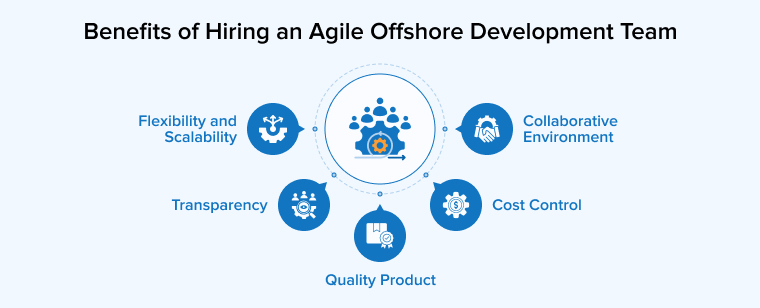
The strategic combination of an agile approach with offshore outsourcing, when implemented effectively, can provide a large array of advantages, including but not limited to:
Quality Product
Unlike other technologies, when conducting an agile project, it is crucial to recognize that testing plays a vital role. Continuous integration and unit testing are involved at the iteration stage during the agile development process. To execute the entire project easily, it’s important to focus on the final product’s quality and functionality. Additionally, the client remains connected from the beginning, with the ability to request changes depending on the market realities.
Cost Control
In agile development, clients only pay for what they use. If a feature becomes an unnecessary partway through the project, it can be removed easily.
Agile encourages continuous feedback, helping resolve errors early in the development cycle—errors that would be more expensive to address later. Moreover, in the case of offshore outsourcing, you get to hire experts at relatively lower costs without compromising the quality of the product.
Collaborative Environment
Many people believe that offshore teams can never offer a healthy collaborative development environment. However, this is not true, especially when working with an offshore agile development team. Agile methodology values individuals as well as their collaborations & interactions. Here, all team members actively participate and collaborate throughout the software development process.
Transparency
Agile best practices promote communication and transparency. You can monitor and inspect your development team’s activities. Specific agile approaches also allow you to test the product feature by feature while it is being developed, keeping it realistic about how the project is progressing.
Communication is essential in offshoring to discuss progress, issues, and ensure that proper measures are in place. Agile offshoring ensures regular updates, frequent deliverables, and sprint reviews. Such openness provides a clear understanding of the product, giving insights into potential risks and reducing the chances of misaligned expectations.
Flexibility and Scalability
Agile offshore development gives businesses unmatched flexibility to scale their operations to meet market requirements. Agile methodologies are designed to help teams adapt to changing requirements. The development process is iterative, making it easy to add new modules or modify the existing ones. The same modularity of the software architecture also grants easy scalability.
Challenges of Agile Offshore Software Development
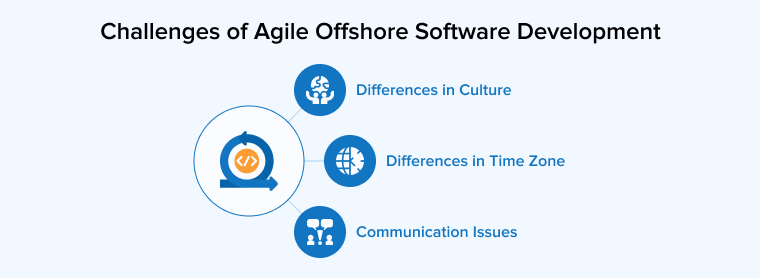
Apart from these benefits, offshore teams also face some challenges, and the agility of the solution varies.
Differences in Culture
When working with geographically distributed teams, cultural differences and a language barrier are common challenges. As a result, several issues can be faced, such as due to different languages, you don’t understand each other, varying working styles, miscommunication, and a lack of common professional etiquette.
When you hire an agile outsourcing team, you can begin by exchanging certain cultural values and communicating effectively. This approach helps both the in-house team and the offshore team members understand and appreciate cultural differences. Additionally, it allows you to identify and resolve any language issues early. It’s all about setting up a robust workflow.
Differences in Time Zone
Time zone differences are a significant limitation of agile offshoring because they cause delays. Agile methodologies are highly dependent on communication, quick feedback, and real-time collaboration. But that won’t be seamless when you have two teams working in two different time zones.
Daily updates, coordination meetings, and responses will be delayed because of time zone differences. As a result, decision-making and error management will also be delayed. The lack of real-time communication and immediate action can render the development process inefficient and lead to severe financial losses.
In short, a significant time zone difference is a big barrier to communication, a core aspect of agile offshore software development, to ensure expected outcomes.
Communication Issues
Offshore development means outsourcing a software project to a vendor in a distant region. In such cases, the vendor is not only from a different country but also in a different time zone and a different cultural background. They often speak a different language, causing various communication barriers.
If you don’t share a common language like English, effective communication is difficult. Even if others learn your language as a second language, there tend to be communication issues. Miscommunication and misunderstanding can cause delays, reworks, and budget overruns, increasing the development cost.
The communication issues can also stem from using unreliable or outdated channels. Not having a proper communication protocol can also hurt your project. Establishing timelines for regular project updates, feedback loops, and communication SOPs for various scenarios is essential.
Best Practices Agile Offshore Development Teams Must Consider
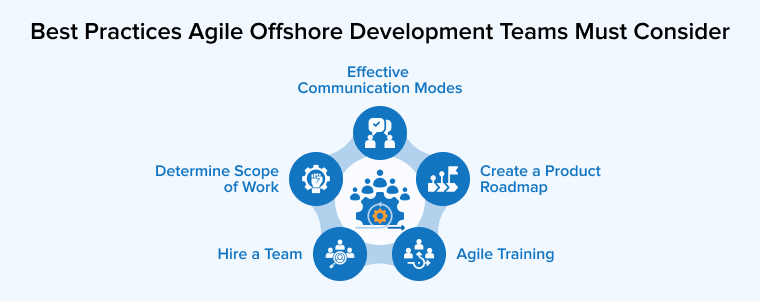
Adhering to agile best practices improves the efficiency of the development process and overall productivity of the team. It goes without saying that agile best practices help deliver exceptional results. Here are a few key practices your development team must follow:
1. Determine Scope of Work
Defining the scope of work for the development team to follow is crucial in a software project. The scope of work is a document that outlines project requirements, deliverables, and tasks for the team to complete. It breaks down the project into several segments, where completion of each segment is called a milestone.
These milestones are separated through different iterations, and each task is assigned an estimated due date. The scope of work also lists each project stage, the expected results for every iteration, reporting channels, and more. An SOW makes agile offshore software development more effective.
2. Create a Product RoadMap
A product roadmap is basically a list of general tasks created by dividing the scope of work into time intervals. The functionalities and deadlines in the roadmap are susceptible to changes depending on external factors like user requirements and development speed.
The purpose of the product roadmap is to paint a clear picture of the product development process for every team member. It gives a comprehensive view of the process to build a product that fulfills the customer’s requirements.
The project is divided into small iterations called sprints. The team plans each sprint with a list of tasks, descriptions, and an estimated timeline.
3. Hire a Team
Agile offshore development demands a team competent in agile methodologies and offshoring practices. Evaluate whether your candidates have the required skill set and experience that can help achieve the product vision. Technological skills are important, but candidates also need to be proficient in collaboration and communication abilities.
Look for candidates who can work in harmony with the team, i.e., who can communicate and collaborate effectively and contribute to the project’s success. You must also check if they are the right cultural fit in the offshore team.
4. Effective Communication Modes
Agile development teams must balance synchronous and asynchronous communication to overcome cultural and time zone differences and ensure effective offshoring collaboration.
Synchronous modes include daily meetings, instant messaging apps like Zoom, real-time collaboration, and quick issue resolution. Meanwhile, Asynchronous modes include detailed documentation, emails, work-tracking platforms such as Jira to accommodate varying work hours and flexibility, and recorded video updates.
You can prevent any miscommunication and misunderstandings by clearly establishing the communication channels and protocols for response times beforehand. Meanwhile, kanban boards, shared whiteboards, and other visual tools would help foster teamwork and transparency.
It is also important to schedule some overlapping work hours for core meetings to ensure essential interactions. Arrange for virtual social activities to strengthen team cohesion. These practices help promote a flexible environment that supports effective communication and success in agile offshore development.
5. Agile Training
Although you will need to hire a few team members with experience in agile development, not all hires will necessarily have that background. Regardless, every team member must receive agile training to familiarize themselves with agile principles and best practices. It is necessary to maintain agile standards consistently throughout the project lifecycle.
Moreover, agile training also clarifies the project objectives and methodologies. Practicing agile development fosters collaboration and transparency. Following agile principles helps avoid errors and achieve desired results, increasing overall efficiency. Agile training will set the context for the team regarding the development approach, helping them maintain the standards for quality outcomes.
Conclusion
Agile offshore software development is a robust approach for businesses looking to build high-quality solutions. It provides faster time to market, cost advantages, access to a global talent pool, but more importantly, it helps build a flexible product that can adapt to the changing requirements.
But it’s easier said than done. Combining agile methodologies with offshore development practices requires strategic planning and efficient execution that brings the best of both.
It is not just about selecting the right partner or adhering to agile standards; it’s about crafting a balanced team, using appropriate tools, establishing clear communication protocols, and continuously improving the product over time based on feedback.
In short, the benefits of agile offshore development can be tempting, but you should be aware of its limitations and stick to the best practices to achieve desired outcomes.

Itesh Sharma is core member of Sales Department at TatvaSoft. He has got more than 6 years of experience in handling the task related to Customer Management and Project Management. Apart from his profession he also has keen interest in sharing the insight on different methodologies of software development.



Comments
Leave a message...