

Choosing between C# and Python can be confusing. C# is backed by Microsoft and the .NET framework; Python is an open-source, community-supported language. One language is complex but is used by top .NET development services providers to deliver scalable and reliable enterprise-grade solutions, whereas the other is simple, enabling developers to build the project quickly.
The contrast is clear, but the choice is not. If you are unsure whether to use Python or C# for your upcoming project and want a clear comparison of the two languages, this article is for you.
Understanding C#
Developed by Microsoft, C# is an object-oriented programming language. It also qualifies as a structured programming language and uses objects and classes to create software, allowing developers to reuse code and accelerate the development process. C# is a statically typed language that requires variables to be defined at compile time. This helps eliminate certain errors before the code is converted into machine language, reducing the likelihood of runtime errors.
The syntax of C# is similar to Java. Having familiarity with C, C++, and Java makes it easy to get started with C#. The language integrates well with Windows and can also be used to build desktop applications, games, mobile apps, and more.
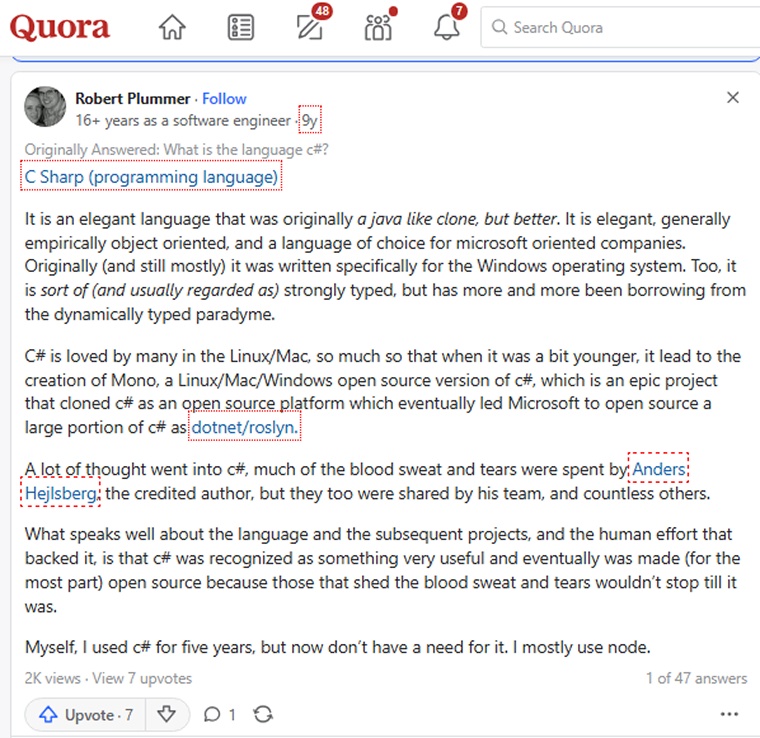
Take a look at what a Quora user says about C#.
Advantages of C#
- Object-Oriented: It leverages the concepts of encapsulation, polymorphism, inheritance, classes, and objects to enable developers to write organized, modular code. It makes code maintainable and reusable.
- Learning: C# has a low learning curve because its syntax is similar to that of Java, JavaScript, C, and C++. Therefore, you do not need to learn many additional concepts or programming methods to get started with C#.
- Open-Source: One of the best reasons to use C# is that it is open-source. This means it is free to use, and it benefits from a large active developer community that continually contributes to the language’s advancement.
- Rapid Development: Using C# enables you to write code quickly, with a minimum of bugs and errors.
- Memory Management: Unlike other C languages, C# relieves developers of memory management by providing a built-in garbage collector. When an object is no longer needed, the garbage collector automatically reclaims its memory for new allocations.
Disadvantages of C#
- Windows-Centric: C# is an integral part of the .NET ecosystem and was historically limited to targeting Windows. However, the language has started offering cross-platform capabilities with newer versions of .NET.
- Performance Overhead: Unlike other languages in the C family, C# provides garbage collection and a runtime environment, which introduces additional overhead. This can reduce application performance and make the language less suitable for building game engines and other real-time systems.
- Dependency on the Framework: C# depends heavily on the .NET ecosystem, including its frameworks and libraries. If the .NET tools cannot meet your project requirements, you must either find compatible alternatives or develop custom solutions.
Example of C#
using System; public class Program { public static void Main() { Car car = new Car("Safari", 300, "Adventure"); car.CarInfo(); } } class Car { public string Name { get; set; } public int TopSpeed { get; set; } public string ModelName { get; set; } public Car(string Name, int TopSpeed, string ModelName) { this.Name = Name; this.TopSpeed = TopSpeed; this.ModelName = ModelName; } public void CarInfo() { Console.WriteLine($"The car name is {Name}, the model is {ModelName}, and its maximum speed is {TopSpeed} km/h."); } } |
The program uses a Car class that stores a vehicle’s name, model, and top speed. Use the constructor to create a car object inside the Main() method and pass the values Safari, Adventure, and 300, respectively, for name, model, and top speed. These details will be displayed as readable sentences through the CarInfo() method.
Understanding Python
Python is one of the most widely used programming languages. Its syntax is similar to the English language and uses whitespace to define code structure, which improves readability. Python is a high-level, interpreted language that supports multiple programming paradigms, including functional, object-oriented, and procedural programming.
Python is a versatile language that offers numerous modules, packages, and libraries for projects ranging from simple web development to complex data analytics and AI. Its usefulness across different domains and contributions to technological advancements have made it widely popular. The language provides an interpreter that facilitates developing applications compatible with multiple platforms.
Let’s see what a Reddit user says about Python.
Comment
byu/Huts2004 from discussion
inPythonLearning
Advantages of Python
- Readable Syntax: Python was designed to make code more readable. It uses a simple, clean syntax similar to English. So, learning and understanding Python is easy even for beginners.
- Fast development speed: You can implement functionality in Python using far fewer lines of code than in Java or C. This lets you develop the product more quickly and bring it to the market sooner.
- Extensive support libraries: Python includes a comprehensive set of libraries for different purposes, such as pandas for data analysis and NumPy for numerical calculations. This makes Python an ideal choice for building data-driven and computational applications.
- Automatic Memory Management: There is no need to allocate or deallocate memory when using Python. It provides automatic garbage collection, allowing developers to focus on writing efficient logic.
- Versatility: As a general-purpose language, Python supports a wide range of use cases, including web application development, data processing and analysis, ML model development, and automation. In addition to an extensive standard library, Python supports third-party packages that address virtually every programming need.
Disadvantages of Python
- Performance: Compared with C languages, Python is slower because it is interpreted. This limits its suitability for developing high-performance applications such as computational software or a game engine.
- Memory Consumption: Python’s memory usage is higher than that of many other programming languages because of its object-oriented design and dynamic typing. This can cause problems when working with limited resources.
- Mobile Development: Python is not an ideal choice for mobile development. Support for mobile platforms is limited, and Python is generally less optimized and less effective for native mobile apps than languages such as Java, Swift, and Kotlin.
Example of Python
class Car: def __init__(self,Name, TopSpeed,ModelName): self.Name = Name self.TopSpeed = TopSpeed self.ModelName = ModelName def car_info(self): print(f"The car name is {self.Name}, the model is {self.ModelName}, and its maximum speed is {self.TopSpeed} km/h.") def main(): car=Car("Safari", 300, "Adventure") car.car_info() if __name__ == "__main__": main() |
The program above defines a Car class that provides information about a car’s name, model, and top speed. After creating a Car object, the __init__ method acts as a constructor to establish its initial value. To present the car’s details in a readable sentence, we used the car_info() method.
We created a Car class in the main() function and assigned it the values “Safari”, 300, and “Adventure”. The car_info() method prints the car’s details. While the code line “if __name__ == “__main__”:” makes sure that the main() function runs only when the script is directly executed and not when importing to another program.
Key Differences Between Python and C#
After exploring the pros and cons of each language individually, it’s time to compare them head-to-head across key industry parameters. Comparing C# and Python will help determine the better option for your upcoming project.
Performance and Speed
Both Python and C# have their pros and cons in terms of speed and performance. C# uses static typing and compilation, which typically yields better runtime performance. C# code is more readily compiled into machine code, allowing the processor to execute it more efficiently. This leads to faster execution and improved performance, even when you are working on resource-intensive operations. As a result, C# is an ideal choice for enterprise app development, game development, and other projects that require high processing power.
Python offers an advantage in development speed. With dynamic typing, easy-to-read syntax, and libraries consisting of ready-made code, developers can quickly iterate and build prototypes. So, Python is well-suited to projects with tight deadlines and to rapid prototyping.
Learning Curve
Learning C# is more difficult than Python. C# requires a thorough understanding of concepts such as object-oriented programming, data types, loops, and conditionals. In addition, learners need a working knowledge of the .NET framework. C# seems easy to learn only if you are already familiar with other C languages.
Meanwhile, learning and using Python is quite simple. There is no need to have any prior knowledge or experience, and its syntax is easily readable. So, understanding the Python code is also not difficult, allowing you to get started with Python development as soon as possible.
Popularity and Community Support
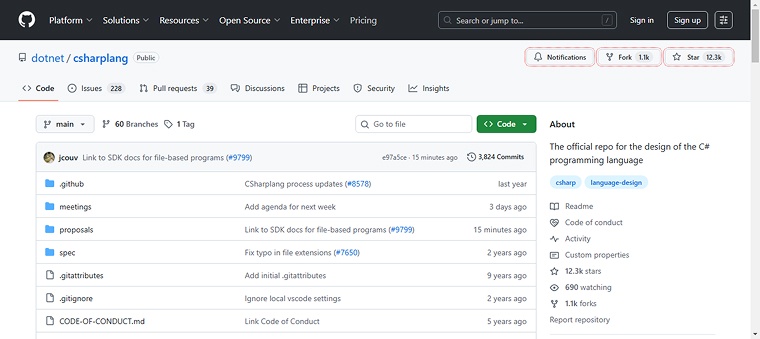
Both Python and C# are popular programming languages with substantial community support. To determine which language is more widely used, consider the Stack Overflow Developer Survey 2023. It ranks Python as the most popular language and places C# fourth. Python’s general-purpose design and high flexibility are likely primary reasons for its widespread adoption.
Python has a large, active community that provides guidance and resources to help developers with their projects. In the case of C#, you have to pay for Microsoft support. Since C# is mainly used for large and complex projects, getting support from Microsoft experts can be especially valuable for both developers and businesses.
Integrations
Being an integral part of the .NET ecosystem, C# enables seamless integration with the .NET framework. It is a primary tool in a C# developer’s stack for building Windows, desktop, and mobile apps. Even within the .NET framework, C# still remains highly interoperable with other languages like VB.NET, JavaScript, and Python.
On the other hand, Python integrates smoothly with a wide range of programming languages and frameworks. As a result, developers have access to shared code and numerous libraries providing different types of functionalities to build and scale a Python application. Python developers don’t have to worry about breaking existing integrations when modifying REST APIs, thanks to its API versioning.
Tools, Libraries, and Frameworks
The more resources a language offers, the more requirements it can fulfill for developers and businesses. C# is integrated with the .NET ecosystem, giving you access to tools such as Xamarin, Entity, and .NET Core. These provide robust features for developing applications within the Microsoft ecosystem. Moreover, the C# developers can also use Visual Studio.NET, Redgate.NET, and far to streamline their development process.
The Python language provides a comprehensive set of libraries for different purposes, such as Django for web development, NumPy for numerical computations, TensorFlow for machine learning, and pandas for data manipulation. Its framework offerings include Bottle, Django, Pyramid, and Flask, which come with tools and packages specific to different types of development projects.
Typing: Dynamic vs. Static
C# uses static typing and supports both implicit and explicit variable declarations. The ‘var’ needs to be defined when the code is compiled. Moreover, errors are checked during compilation, which reduces runtime errors and can improve performance. However, developers must take care to ensure that type declarations are correct.
On the other hand, writing code in Python is easy because of dynamic typing. It helps build apps quickly. It assigns variables to different data types without any declaration. This makes the code flexible as well as concise. However, it can also increase runtime errors caused by incorrect or unexpected data types.
C# vs Python: Comparison at a Glance
Choosing the right programming language is critical to a project’s success. Both C# and Python are powerful, modern languages that excel in different areas. Here, we take a glance at the most important differences between C# and Python to make an informed decision.
| Aspect | Python | C# |
|---|---|---|
| Syntax | Simple, intuitive, and minimal syntax; focuses on readability | Structured and verbose, similar to C++, and Java. |
| Performance | Interpreted language, generally slower execution; suitable for I/O-bound tasks and rapid prototyping. | Structured and verbose, similar to C++ and Java. |
| Application Areas | Data Science, AI/ML, scripting, web development, and automation. | Enterprise software, game development, cross-platform mobile, Windows desktop apps. |
| Type System | Dynamically typed language, where type checking occurs during runtime. Offers flexibility but leads to runtime errors. | Statically typed with strong type checking during compile time. Enforces type safety, reducing runtime errors. |
| Development Speed | Rapid prototyping and development due to simpler syntax and vast libraries. | Slower initial development due to more verbose syntax and static typing requirements. |
| Ecosystem & Libraries | Vast and diverse, specifically providing libraries for data and science like NumPy, Pandas, and TensorFlow. | Provides automatic garbage collection, but overall memory consumption in Python apps remains higher than in C#. |
| Platform Dependency | Designed to be cross-platform. | Provides cross-platform capabilities through .NET frameworks, but is mainly Windows-centric. |
| Learning Curve | Easy to learn, hence beginner-friendly. | Steep learning curve due to many complex concepts in the language. Only easy if you are familiar with other C languages. |
| Concurrency | Limited support for parallel processing. | Provides built-in support for multi-threading. |
| Memory Management | Supports automatic garbage collection, and its memory management is more efficient than Python, especially in large applications. | Supports automatic garbage collection and its memory management is more efficient than Python, especially in large applications. |
When to Use C#?
C# is a high-performance language used for resource-intensive tasks such as:
Enterprise App Development
C#’s integration with Microsoft’s .NET framework is useful when developing enterprise-grade solutions. Its object-oriented design and strong type-checking help developers write maintainable code, ensuring the reliability and scalability of large projects.
Interactive Media and Game Development
C# has strong integration with Unity, one of the most popular and robust game engines in the world, making it a go-to option for game development. Unity lets developers use C# to script 2D, 3D, and AR/VR games. The flexibility and performance of C# enable developers to build high-quality games.
Windows-Based Applications
C# is highly compatible with frameworks such as Windows Presentation Foundation (WPF) and Windows Forms, making it a common choice for Windows desktop application development. You can also build custom applications for the Windows ecosystem using tools and libraries available for C#.
Performance-Critical Applications
If your project requires efficiency and high performance, C#, because it is a compiled language, can deliver optimal memory usage and fast execution. For this reason, many developers prefer C# for building resource-intensive, performance-critical applications such as games, real-time systems, and financial software.
When to Use Python?
Python is a versatile language that can be used for a variety of projects, including:
AI, Data Science, and Machine Learning
Python is an obvious choice for data-driven applications. It provides libraries such as TensorFlow, NumPy, and Pandas to streamline data processing and develop AI models. Businesses that want to build solutions capable of analyzing large volumes of data and deriving valuable insights will find Python ideal. The language can also automate routine tasks to improve individual productivity and operational efficiency.
Web Development
Developing scalable, dynamic web applications is straightforward with Python frameworks, such as Flask and Django. Popular real-time apps like Spotify and Instagram use Python to power their back ends.
Rapid Prototyping and Faster Time to Market
Startups with short development cycles or projects requiring rapid iterations rely on Python for its simple syntax and comprehensive standard and third-party libraries. This accelerates the development and makes the code easier to maintain.
Education and Training
Python has a simple, intuitive syntax that resembles natural English, making it easy to learn, write, and understand. It is an ideal language for educational programs and for training beginners. Python requires no large or complex setup, and it is both approachable and effective.
Conclusion
Both C# and Python are popular, powerful languages, each with its own strengths and limitations. C# uses concepts such as static typing and object-oriented design; although these concepts can be complex, they enable building robust features for large projects. Meanwhile, Python’s straightforward syntax enables developers to prototype quickly and meet deadlines. Although both Python and C# are used for web and app development, they differ in nature and therefore suit distinct use cases. The debate of C# vs Python is rendered meaningless. Because ultimately, it all boils down to your specific project requirements. Define them clearly, and then you will know which option is the right fit.
FAQs
Though a few similarities exist, the two languages are of different natures and hence serve different purposes. So, none of these languages can replace one another.
C# is a highly structured programming language with consistent formatting and syntax. On the other hand, Python is easier to read and uses fewer symbols. As a result, it is easy to learn, but you can’t use Python for managing complex scenarios like C#.
Python.NET(pythonnet) is a robust tool that enables C# code to call Python programs directly and use their libraries. It provides seamless integration between Python and C# environments, allowing smooth interactions between the two languages and helping developers build better solutions.

Rakesh Patel is a technology expert working at TatvaSoft. He is looking after .NET development projects and also work along side with business analyst team. He developed his passion of writing while working and writes whenever he got the time.



Comments
Leave a message...