

React.js and Node.js are two of the most popular technologies in the JavaScript ecosystem, each serving a distinct objective in the web development process. While both belong to the JavaScript family, they function in different areas of the development stack. React.js is a front-end library used widely for building dynamic and interactive user interfaces, while Node.js is a runtime environment that enables developers to execute JavaScript code on the server side for handling backend-related operations.
Understanding the differences between Node.js and React.js is important for building efficient, scalable, and modern web applications. Businesses partner with Node.js development companies to build real-time applications capable of handling multiple requests from multiple users at the same time. They also use React to deliver responsive and engaging front-end interfaces.
In this blog, we’ll explore the distinct roles, advantages, and use cases of both Node.js and React.js, helping you determine which technology best fits your project’s needs and long-term development goals.
What is NodeJS?
Node.js is a free, open-source, cross-platform runtime environment that allows developers to run JavaScript outside the user’s web browser, enabling them to build server-side applications using JavaScript. Developed by Ryan Dahl, Node.js runs on Google’s V8 JavaScript engine, which compiles JavaScript into native machine code, resulting in outstanding speed and performance. Its event-driven, non-blocking I/O architecture enables it to handle multiple requests at the same time, making it ideal for real-time applications such as chat platforms, streaming services, and collaborative tools.
With its growing community, rich ecosystem, and high-performance capabilities, Node.js has become a solid basis of modern web development, powering everything from startups to large-scale enterprise software.
What Are the Features of Node.js?
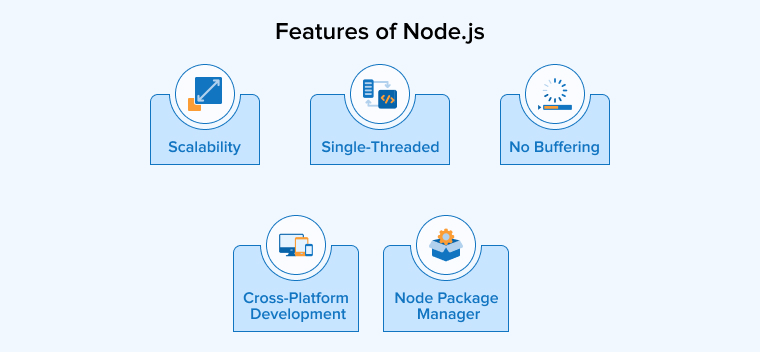
Let’s go through the five key characteristics of Node.js:
- Single-Threaded: Node.js uses a single-threaded event loop to manage multiple client requests efficiently. This non-blocking, asynchronous model decreases overhead, improves performance, and enables real-time application development.
- Node Package Manager: NPM, or the Node Package Manager, is Node.js’s built-in tool that manages project dependencies. It offers more than a thousand reusable libraries, simplifying code sharing, collaboration, and accelerating the development process.
- Cross-Platform Development: Node.js is a cross-platform runtime that runs seamlessly on Windows, macOS, Unix, and Linux, facilitating easy deployment across multiple environments.
- No Buffering: Node.js uses callback functions to process data in smaller units, enabling faster responses and preventing buffering during operations such as file uploads or real-time data handling.
- Scalability: Node.js handles multiple requests efficiently using its single-threaded, non-blocking architecture. The event loop enables high scalability, allowing applications to manage simultaneous connections with minimal resource usage.
What is React.js?
React.js is an open-source JavaScript library developed by Facebook for building speedy and interactive user interfaces. It focuses on the view layer of web applications and follows a declarative approach, allowing developers to describe how the user interface should look based on the current state.
React uses components, small, reusable pieces of code, to create complex interfaces efficiently. It updates the user interface dynamically using a virtual DOM (Document Object Model), ensuring smooth performance. A React.js development company commonly uses it for single-page applications. React powers popular platforms like Facebook, Instagram, and Netflix due to its flexibility, speed, and modular design.
What Are the Features of React.js?
Let’s go through the five key characteristics of React.js:
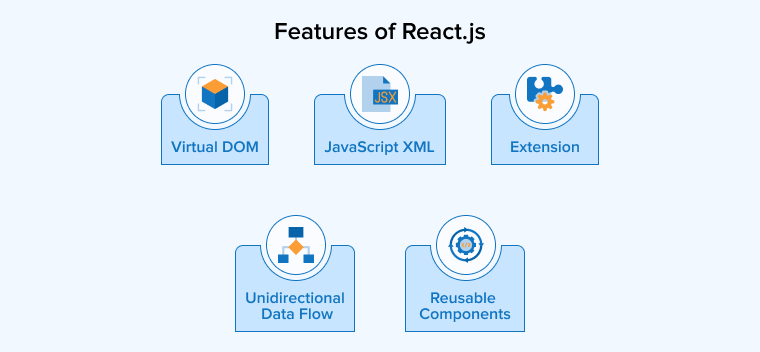
- Unidirectional Data Flow: React uses one-way data flow, where data moves from parent to child components. This approach makes applications easier to manage, debug, and maintain predictable data updates.
- JavaScript XML: JSX is a syntax extension that combines HTML and JavaScript, allowing developers to write HTML-like code inside JavaScript. It improves readability, simplifies React component creation, and makes UI structure easier to understand.
- Reusable Components: React follows a component-based structure, where each part of the interface is built as a reusable component. This approach reduces code repetition, improves consistency, and makes applications easier to maintain.
- Extension: React offers extensions like Redux, Flux, and React Native, enabling mobile app development and server-side rendering while supporting dynamic, interactive UIs through conditional rendering and one-way data binding.
- Virtual DOM: React uses a Virtual DOM, a lightweight copy of the real DOM, to update only changed elements. This selective rendering improves speed and makes applications more efficient.
Difference Between ReactJS and NodeJS
The following is a quick overview of significant distinctions between React and Node:
| Parameters | React.js | Node.js |
|---|---|---|
| Purpose | React is a front-end library for creating attractive UIs. | Node.js is a JS runtime environment to execute JS code on the server side |
| Primary Usage | It is used to create dynamic user interfaces and SPAs | It is used for developing server-side applications |
| Execution Environment | React.js code executes in the client’s browser | Node.js code executes on the server |
| Server | React does not have a built-in web server | Node.js can be used as a web server |
| Architecture | React follows a component-based architecture and a virtual DOM | Node.js works on an event-driven, non-blocking I/O model |
| Ecosystem | React has a rich ecosystem of frontend tools | Node.js consists of an extensive package repository available via npm |
| Framework & Library | React is compatible with libraries like Redux, React Router, etc. | Node.js is compatible with frameworks like Express, Koa, etc. |
| Scalability | Scaling in React is simplified by the system’s modular, independent components. | Node.js is scalable enough to handle numerous simultaneous requests. |
| Use Cases | React is used to build complex user interfaces, SPAs, mobile apps, etc. | Node.js is used in developing data streaming apps, RESTful APIs, microservices, etc. |
| Learning Curve | React has a Moderate learning curve | Node.js has a Gentle learning curve |
ReactJS vs NodeJS – Detailed Comparison
We’ll now walk through the eight comparison parameters to understand the differences between Node.js and React.js:
1. Architecture
- React.js: React.js follows a component-based architecture where the user interface is divided into small, reusable UI components. Each component manages its own logic and state, making the application easier to build and maintain. React uses a virtual DOM to efficiently update only the changed parts of the UI, enhancing rendering speed and performance on the client side.
- Node.js: Node.js uses an event-driven, non-blocking I/O architecture, allowing it to handle multiple connections simultaneously using a single thread. This makes it suitable for building scalable, data-intensive, real-time applications. Running on the server side, Node.js processes client requests and delivers dynamic content efficiently across distributed systems.
2. Community Support
- React.js: Developed and maintained by Facebook, React has strong community support with frequent updates that enhance app performance and developer productivity. Its large community actively contributes to new tools, libraries, and learning resources. Popular platforms like Netflix and Airbnb depend on React, reflecting its reliability and widespread use. Developers benefit from continuous learning opportunities and rapid issue resolution through community collaboration.
- Node.js: Node.js also thrives within a vast open-source community that keeps on working to improve the platform and fix bugs. Supported by the OpenJS Foundation, it offers access to endless libraries, Node.js frameworks, and shared developer insights. This collaborative environment provides developers with valuable resources, software development best practices, and innovative solutions, ensuring ongoing growth and faster development of scalable, efficient server-side applications.
3. Primary Usage
- React.js: React is mainly used for client-side development to create dynamic and interactive user interfaces. It follows a component-based architecture, making it easier to manage and update complex UIs. React focuses on rendering fast, responsive web pages and is often paired with tools like Redux and React Router for state management and navigation.
- Node.js: Node.js is mainly used for server-side development, enabling the creation of fast, scalable, and efficient network applications. It allows JavaScript to run outside the browser, unifying front-end and back-end development. Developers use Node.js for building APIs, real-time web apps, microservices, and server-side rendering, making it essential for full-stack JavaScript development.
4. Execution Environment
- React.js: React operates primarily on the client side, running within the user’s browser to create intuitive and dynamic user interfaces. It efficiently manages UI updates and rendering, ensuring a smooth user experience. Additionally, React can also run in mobile environments through React Native and support server-side rendering using Node.js for better performance.
- Node.js: Node.js runs on the server side, enabling JavaScript to execute outside the browser environment. It handles backend processes such as API requests, database operations, authentication, and server logic. By managing these tasks asynchronously, Node.js ensures high performance and scalability, serving as the backbone for many modern real-time and web applications.
5. Scalability
- React.js: React achieves scalability through its built-in component-based architecture, which allows developers to build complex and maintainable user interfaces using reusable components. Each component operates independently, making it easier to manage large-scale front-end applications. This modular structure simplifies updates, increases collaboration among teams, and ensures consistent UI performance even as applications expand in size and complexity.
- Node.js: Node.js is highly scalable owing to its event-driven, non-blocking I/O model, which efficiently handles thousands of concurrent connections. It is well-suited for building scalable back-end systems, especially in real-time applications like chat or streaming platforms. Additionally, its support for microservices architecture enables horizontal scaling by deploying multiple service instances as per demand.
6. Framework and Library
- React.js: React offers a huge and mature ecosystem filled with numerous libraries and tools that ease front-end development. Popular libraries like Redux help manage complex application states, while React Router enables smooth client-side navigation. This extensive ecosystem allows developers to build feature-rich, interactive, and scalable user interfaces efficiently, enhancing productivity and flexibility.
- Node.js: Node.js boasts a strong ecosystem supported by npm, the world’s largest package registry. It provides access to countless open-source libraries and frameworks such as Koa.js, Express.js, and Hapi.js that streamline server-side development. This vast ecosystem allows developers to build, customize, and scale back-end solutions quickly and effectively for a variety of use cases.
7. Microservices
- React.js: React supports the concept of micro frontends, where large applications are divided into smaller, independent UI modules managed by different teams. This structure allows for easier maintenance, scalability, and faster deployment. Each micro frontend can function separately, enabling teams to develop, test, and update features without affecting the overall application.
- Node.js: Node.js aligns perfectly with microservices architecture, allowing developers to build modular, scalable, and high-performing backend systems. Its non-blocking, event-driven model efficiently handles multiple independent services. With Node.js microservices, teams can develop, scale, and deploy backend components separately, improving agility, reducing downtime, and enhancing overall system performance.
8. Performance
- React.js: ReactJS ensures high performance by efficiently managing UI updates through its Virtual DOM. Instead of reloading the whole page, it updates only the necessary components, resulting in faster rendering and smoother interactions. Features like lazy loading and server-side rendering further enrich speed and responsiveness, making React ideal for dynamic, user-interactive applications requiring quick interface updates.
- Node.js: NodeJS delivers exceptional backend performance through its non-blocking, event-driven architecture, allowing it to handle multiple requests simultaneously with minimal resource usage. It’s particularly effective for I/O-intensive and real-time applications like chat platforms or streaming services. By efficiently processing concurrent connections, NodeJS enables developers to build scalable, lightweight, and high-performing server-side applications that respond swiftly under heavy loads.
When to Use React.js?
Go for React when:
- Building User Interfaces: React is best suited for building interactive web or mobile app UIs because it efficiently updates components based on user actions, ensuring smooth, responsive, and dynamic experiences across a range of applications.
- Code Management is Required: React is ideal for managing large, complex codebases because its component-based structure keeps code organized, reusable, and easy to maintain as projects scale and grow.
- Developing SPAs: You can build single-page applications using React, as it updates content dynamically, offering fast navigation and a smooth, app-like user experience without full page reloads.
- App Needs Reusable Components: If your project requires reusable UI components, choose React as it allows you to maintain consistency, reduce repetition, and efficiently manage shared UI elements across various parts or projects.
When to Use Node.js?
Node.js is suited for the development of the following:
- APIs and Microservices: Node.js excels at building lightweight APIs and scalable microservices architectures that can handle numerous simultaneous client requests without blocking operations.
- Streaming Services: For apps handling continuous data streams, such as video or audio platforms, Node.js efficiently processes and delivers data chunks without performance lags.
- Real-Time Applications: Node.js is perfect for real-time web apps like chat platforms or gaming servers, where fast data exchange and minimal delay between client and server are essential.
- Microservices Architecture: When creating distributed systems, Node.js allows independent services to communicate efficiently through APIs, improving scalability and ease of maintenance.
Final Thoughts
ReactJS and NodeJS are two powerful JavaScript technologies that serve distinct yet complementary purposes in web app development. Analyse the project requirements and if priority is front-end web development, go for React, whereas for building a server-side application, select Node.js. Choosing between ReactJS and NodeJS depends on the project’s requirements; ReactJS for front-end web development and NodeJS for server-side functionality. In many modern web applications, both technologies are used together to build complete, high-performing full-stack solutions. Ultimately, using ReactJS and NodeJS in collaboration enables developers to create seamless, scalable, and efficient web experiences that meet today’s digital demands.
FAQs
Yes, Node.js has a very good future as it is the most important backend development technology used worldwide to build scalable and efficient real-time applications.
Yes, React is a prominent library in Netflix’s technology stack for frontend development to make interactive and intuitive interfaces.
React powers popular social media platforms like Meta and Instagram, streaming platforms like Netflix and Disney+, ecommerce platforms like Wallmat and Shopify, and other major applications like Trello and Asana.
Node.js and React.js cannot be compared as both serve different purposes. React is used for developing frontend applications, while Node.js is a prominent server-side technology.
Yes, Node.js can be used for AI, such as connecting front-end interfaces to AI models via APIs, running AI models without a Python backend using specialized libraries, etc.
Node.js is a major backend development technology to write server-side logic, develop APIs, and build real-time applications.
This depends on the project requirements completely. There are good alternatives like Svelte, Next.js, Vue.js, Angular, and Solid.js.

Dipal Patel is a technology expert at TatvaSoft, proficient in backend technologies. His years of experience in software development enable TatvaSoft to effectively meet client needs and create robust software products.



Comments
Leave a message...