

Digital transformation has become a business priority across industries, including healthcare, finance, retail, and manufacturing. Companies have started using technology-driven solutions to improve operations, deliver services, and engage with customers. Companies ignoring this shift risk being left behind by competitors who are already building smarter, faster, and more connected systems.
The real challenge lies in executing digital transformation. Digital transformation projects demand specialized skills in AI, cloud computing, DevOps, and data analytics, but most internal teams are already preoccupied with managing daily operations. As per the statistics from market.us, the global spending on digital transformation is projected to reach $3.9 trillion by 2027 as a result of continuous investments by different industries. This business growth reflects a clear trend where enterprises are partnering with IT outsourcing service providers to move faster and reduce implementation risk.
This blog covers what digital transformation really means, why outsourcing has become a preferred strategy for enterprises, the key benefits and challenges involved, and how to overcome them with a proper approach by selecting the right partner.
What is Digital Transformation?
What is Digital Transformation
by u/DashaDD in Infographics
Digital transformation is the process of embedding digital technologies across every function of a business to reshape how it operates and delivers value. It involves adopting cloud infrastructure, artificial intelligence, data analytics, and workflow automation to streamline operations, sharpen decision-making, and improve experiences for both internal teams and customers.
For a CTO or VP of Engineering, digital transformation goes beyond upgrading legacy systems or migrating to AWS. It means rethinking how your revenue model works, how distributed teams collaborate across time zones, and how quickly you can respond to competitive shifts.
A manufacturing company might deploy IoT sensors with predictive analytics to cut equipment downtime by 30%. A financial services firm could implement ML-based fraud detection that flags suspicious transactions in under 200 milliseconds. A healthcare provider might launch a HIPAA-compliant telemedicine platform to serve patients in underserved regions. Thus, different industries leverage digitalization in different ways to suit their business needs. The scope varies by industry and organizational maturity, but the objective stays the same. The aim is to build a technology-driven foundation that supports growth, resilience, and competitive positioning. Many organizations want to transform, but the question is whether they have the engineering depth, specialized talent, and delivery frameworks to execute at scale without hampering their existing operations. If not, outsourcing is the best available solution to all such problems.
What Are the Benefits of Digital Transformation Outsourcing?
Today, every business, from small to large, is moving towards digital transformation to leverage its advantages as follows:
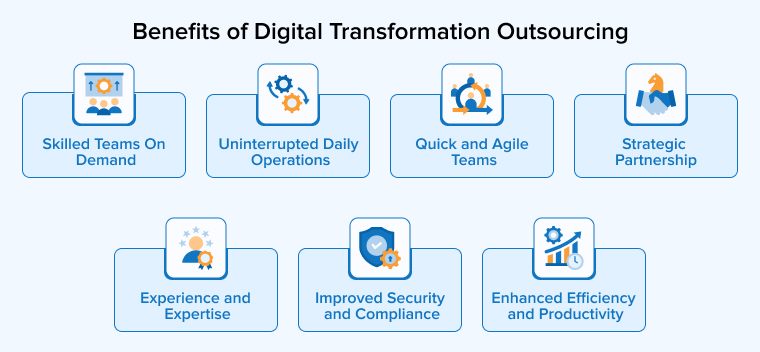
Skilled Teams On Demand
Digital transformation demands specialized skills in cloud architecture, AI/ML integration, data pipeline engineering, and DevOps automation. Recruiting for these roles in-house may take three to six months for each person, plus the extra time needed for onboarding and training.
An outsourcing partner already has these teams assembled, thoroughly reviewed, and ready to deploy. These teams have experience in carrying out similar transformations across healthcare, financial services, manufacturing, and SaaS. This implies that they bring proven technical approaches rather than learning on your timeline.
Uninterrupted Daily Operations
Resource conflict is one of the primary reasons behind the mid-way disruption in digital transformation projects. Your senior engineers have to ensure the stability of production systems while building the next-generation platform.
Outsourcing creates a parallel execution track where your internal team maintains revenue-critical operations while a dedicated outsourced squad handles the transformation workstream. You get faster delivery, and your existing team stays productive instead of being overloaded.
Quick and Agile Teams
Outsourcing partners move faster because digital transformation is their core business, not a side project. They operate with established delivery frameworks, pre-built accelerators, and cross-functional teams that bring down the deployment time from months to weeks.
When you’re trying to modernize a legacy platform or roll out an AI-powered workflow, speed becomes a major advantage. Internal teams often need months just to align on tooling and architecture decisions. An experienced outsourcing partner uses insights gained from dozens of similar engagements.
Strategic Partnership
The outsourcing model moves beyond the traditional development approach, where requirement analysis and design are performed by one team, whereas development, testing, and deployment are performed by another. Today, the best outsourcing firms function as strategic collaborators. They don’t just write code but also advise on technology selection, help define transformation roadmaps, flag risks early, and adapt their approach with evolving business needs.
This shift changes the dynamic entirely. You’re working with a partner who understands your business context, reevaluates underlying challenges, and brings ideas not even thought of by the internal teams to the table.
Experience and Expertise
There’s a meaningful difference between a team attempting enterprise digital transformation for the first time and a team that has guided dozens of enterprises through it. Experienced outsourcing partners bring institutional knowledge about what works, what doesn’t, and where most organizations make mistakes.
They’ve seen the patterns, so they are well aware of the fact that running a cloud migration to AWS or Azure without proper data governance will trigger GDPR or HIPAA compliance violations six months later. They understand that deploying an ML model without clean, normalized data pipelines produces unreliable outputs that impact stakeholder trust. This pattern recognition saves you costly rework cycles.
Improved Security and Compliance
Data security is the most common objection enterprises raise when considering outsourcing. It’s a valid concern, but the reality is that established outsourcing partners often maintain stronger security protocols than mid-size in-house IT teams. Their revenue depends on trust, so they earn top-level certifications demonstrating their expertise and reliability. Certifications like ISO 27001, SOC 2, and CMMI Level 3 aren’t marketing badges. They represent annually audited processes for encrypting sensitive data, enforcing role-based access controls, and maintaining regulatory compliance across client engagements.
A strong outsourcing partner also brings compliance expertise specific to your industry, such as HIPAA for healthcare data, PCI DSS for payment processing, or GDPR for European user data. They embed security into the SDLC through code reviews, quarterly penetration testing, multi-factor authentication, and documented incident response playbooks. You get a security framework stress-tested across dozens of client engagements rather than one assembled from scratch by a team that’s doing it for the first time.
Enhanced Efficiency and Productivity
Outsourcing IT functions can make businesses more efficient by bringing in experts who follow proven processes and keep improving them over time. Experienced external teams stay updated with the new technologies and methods, which speeds up projects and reduces common delays. For example, an outsourcing partner can handle IT incidents faster, reducing downtime from hours to minutes through automated monitoring and 24/7 support. They also identify areas for improvement that internal teams might miss.
Clear service agreements and measurable KPIs ensure consistent results. By offloading routine tasks, internal staff can focus on strategic priorities. Automation and outsourcing together boost productivity across IT, HR, and finance teams.
What Are the Top Digital Transformation Challenges & Solutions?
Let’s understand the five most common challenges your organization may come across on its way to digital transformation outsourcing, and what the digital solutions are to overcome them:
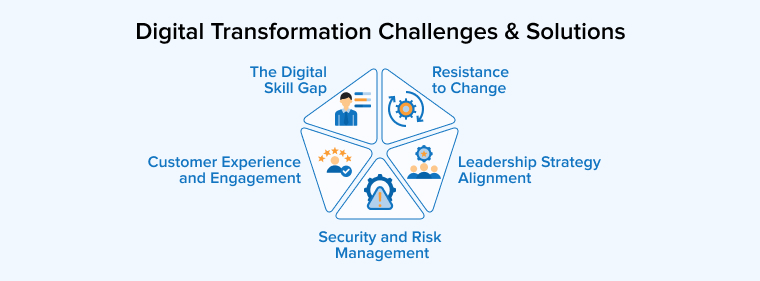
Resistance to Change
Challenge: The most significant roadblock in the digital transformation initiative is not the technology but the organizational culture that has existed for a long time. Department heads may not want to lose control over workflows they’ve owned for five or ten years. Senior engineers may not agree to the replacement of tools they’re proficient with. Teams excluded from the planning phase may not show interest during execution, slowing adoption across the organization.
Solution: Involve department leads and senior ICs in architecture and tooling decisions before they’re finalized. Run role-specific training sessions that show each team exactly how the new systems improve their daily work. An experienced outsourcing partner can design step-by-step change management programs, track their adoption across departments, and handle resistance at all levels instead of waiting to deal with it after launch.
Leadership Strategy Alignment
Challenge: Successful Digital transformation fails when leadership treats it as a technology upgrade rather than a business strategy. A conflicting priority struggle arises when your CTO wants to move to Kubernetes, the CFO wants to reduce infrastructure costs by 20%, and the CEO wants to launch a new product quickly. This misalignment spreads to every engineering and product team doing the actual work.
Solution: Before engaging with any outsourcing partner or writing a single line of code, make sure your leadership team is on the same page about key goals. Decide on the revenue or total cost metrics, measurable milestones for the first 90 and 180 days, and acceptable trade-offs among timeline, project scope, and budget. This upfront clarity reduces the possibility of strategy refinement during the project. This avoids costly changes and gives your outsourcing partner a defined target to build against.
Security & Risk Management
Challenge: As businesses adopt more digital technologies, they face an increasing range of cyber threats, from ransomware and phishing to advanced attacks by skilled hackers. Vulnerabilities such as outdated software, weak passwords, and unprotected data increase risks, while IoT devices and remote work expand the attack surface. Protecting sensitive data and meeting global privacy regulations are essential, as poor cybersecurity can lead to financial loss, reputational damage, and slow digital transformation.
Solution: Build security into the digital transformation process from day one. Conduct thorough risk assessments before development begins, implement zero-trust architecture principles, and establish clear data governance policies. Choose outsourcing partners whose certifications, such as ISO 27001, SOC 2, and CMMI Level 3, match your compliance requirements, and run regular audits throughout the process to catch vulnerabilities early.
The Digital Skill Gap
Challenge: Hiring for senior roles in ML engineering, cloud architecture, cybersecurity, and data science is the most difficult. It takes an average hiring time of four to six months per position. For enterprises planning multi-workstream transformations, this talent shortage delays architecture decisions, slows development sprints, and pushes deployment dates by quarters rather than weeks.
Solution: This is where software outsourcing delivers its most immediate value. Instead of competing for hard-to-find talent in an overheated job market, you tap into a global pool of skilled professionals ready to contribute from week one. Outsourcing partners invest continuously in training their teams on emerging technologies, giving you access to a skill set that would take years to build internally.
Customer Experience and Engagement
Challenge: Organizations often spend time on backend process improvements that often degrade the customer experience. You migrate to Salesforce, but the customer-facing self-service portal loads 3x slower. You automate support ticket routing, but resolution quality drops because the workflow wasn’t mapped to actual customer pain points and escalation paths.
Solution: Map your top 5 customer journeys (onboarding, support, renewal, billing, feature requests) before redesigning any backend process. Run usability tests with 10-15 real users before rolling out new digital touchpoints at scale. Track NPS and CSAT scores alongside operational efficiency metrics, so you have visibility into both sides. When working with an outsourcing partner, ensure they study your customer personas and support ticket patterns before making technology decisions.
Conclusion
Digital transformation outsourcing helps enterprises bridge the gap between strategic ambition and execution capacity by providing access to specialized talent, proven delivery frameworks, and the operational flexibility to scale as needs evolve.
AI-driven development workflows, cloud-first infrastructure strategies, and hybrid delivery models will continue reshaping how enterprises approach transformation. Organizations that build strong digital outsourcing partnerships now will have a meaningful advantage in adopting these emerging approaches and adapting quickly as both technology and market demands evolve over the coming years.
FAQs
Digital transformation can be categorized into process transformation, business model transformation, domain transformation, cultural transformation, and cloud transformation.
The four pillars of digital transformation are technology, people, process, and data. Technology covers the tools and platforms, people refer to the workforce skills, process involves redesigning or automating operational workflows, and data focuses on collecting, managing, and analyzing business information to drive smarter decisions and personalized customer experiences.
Digital transformation outsourcing costs depend on project scope, technology requirements, team size, and engagement model. Small-to-mid-scale initiatives typically range from $50,000 to $500,000, while large-scale enterprise transformations can range from $500,000 to several million dollars.
When choosing a digital transformation outsourcing partner, focus on those with proven industry experience, strong processes and certifications, great technical skills in areas such as cloud, AI, data, and DevOps, and the ability to scale teams as projects change. Good communication, transparent reporting, and business expertise are also essential.

Itesh Sharma is core member of Sales Department at TatvaSoft. He has got more than 6 years of experience in handling the task related to Customer Management and Project Management. Apart from his profession he also has keen interest in sharing the insight on different methodologies of software development.



Comments
Leave a message...