

The way developers build software with Java in 2026 looks very different from how it was done even five years ago. According to the Stack Overflow Developer Survey 2025, Java remains the third most used language among professional developers worldwide, with 29.4% reporting active use over the past year. This shows how deeply established Java systems remain inside the global software stack. From cloud native development and virtual threads to GraalVM, reactive programming, and seamless AI integration, the entire Java ecosystem is shifting toward faster, lighter, and more intelligent applications.
The ongoing evolution in the Java development environment shapes the hiring and architecture choices of Java development companies, while developers use them to write cleaner and more efficient Java code.
This blog explains the reasons behind the rising use of Java and the key Java trends shaping modern development.
Why Java Technology?
Java continues to power a large share of enterprise software because it offers:
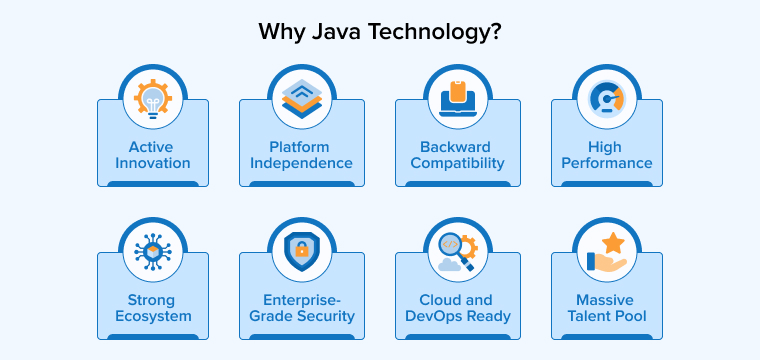
- Platform independence: Java runs on any operating system through the Java Virtual Machine. Therefore, developers can use the same code across servers, desktops, and cloud platforms without rewrites.
- Strong ecosystem: From Spring Boot and Hibernate to Kafka and Apache Spark, Java’s robust frameworks cover almost every use case, including web, mobile, data, and AI workloads.
- Enterprise-grade security: Java provides built-in security features such as bytecode verification, sandboxing, and strong cryptography support, which makes it well-suited for handling sensitive data in regulated industries.
- High performance: Modern JVM optimizations, virtual threads, and GraalVM native compilation help Java deliver high-performance Java applications that scale across millions of users.
- Backward compatibility: Java’s strong backward compatibility allows established Java systems to be modernized without breaking existing code. As a result, organizations can protect their long-term technology investments.
- Massive talent pool: Java remains one of the most widely taught and used programming languages, giving enterprises easy access to skilled Java developers for hiring and team scaling.
- Active innovation: Recent releases introduce features such as pattern matching, sealed classes, records, virtual threads, and improved AI integration, indicating the evolution of the language with modern needs.
- Cloud and DevOps ready: Java works smoothly with Docker, Kubernetes, CI/CD pipelines, and major cloud platforms. That makes it a natural choice for cloud native applications and modern delivery models.
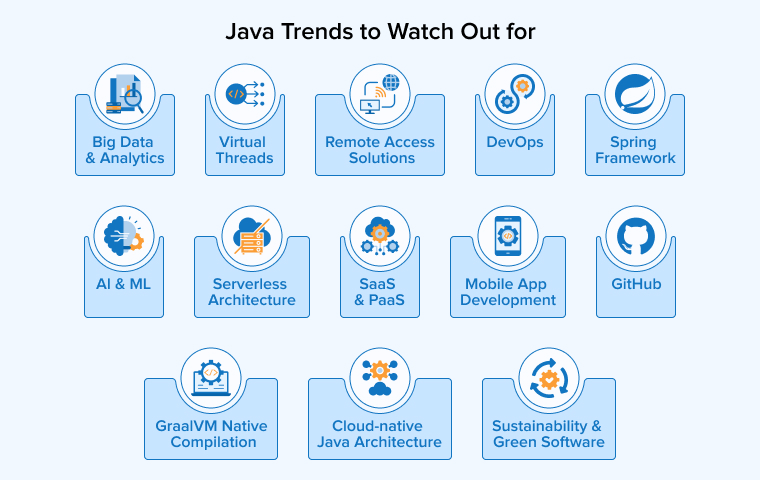
Top Java Trends to Watch Out for
The following key Java trends are shaping how developers and enterprises build, scale, and modernize Java applications in 2026.
Cloud-native Java Architecture
Cloud-native Java architecture is one of the strongest trends in modern Java development. This is because organizations need applications that scale on demand and run efficiently inside containers.
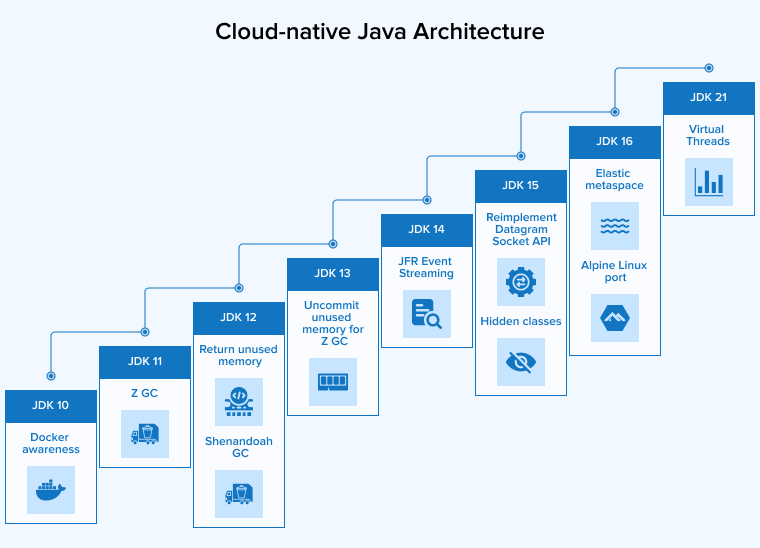
Why it matters: Enterprises are moving away from monolithic deployments toward microservices. Each service can run independently in lightweight container images on cloud platforms like AWS, Azure, and GCP. As a result, development teams can release updates faster and more frequently. In addition, this approach improves cloud resource management and provides clearer ownership across services. Furthermore, independent services simplify scaling and maintenance. Consequently, organizations can respond to changing business requirements more efficiently while improving application reliability.
What is driving it: Frameworks like Spring Boot, Quarkus, and Micronaut now offer built-in support for fast startup times, low memory usage, and native compilation. This makes Java a strong fit for building cloud native applications. When combined with Kubernetes, these tools allow Java apps to scale up and down based on real traffic without wasting resources.
Business impact: For decision-makers, cloud-native development directly reduces infrastructure cost, improves uptime, and supports global deployments with streamlined time zone management. For developers, it brings cleaner code structures, easier testing, and faster feedback loops in production.
Artificial Intelligence (AI) and Machine Learning (ML)
AI and machine learning are quickly becoming a core part of modern Java development, with enterprises using Java to build, deploy, and scale intelligent features inside existing systems.
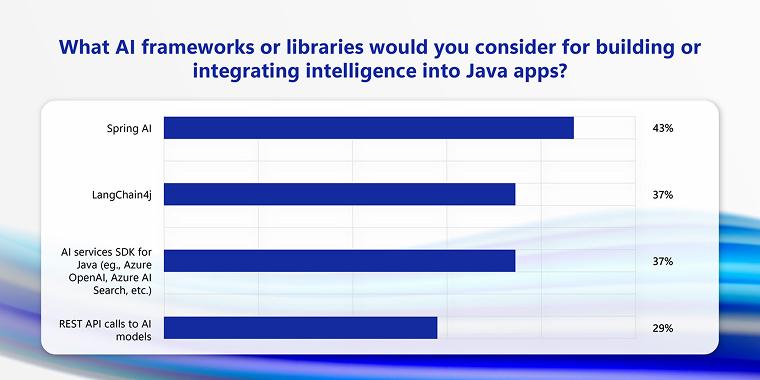
Why it matters: Most large organizations already run their core platforms on Java, making it the natural choice for integrating AI without rewriting legacy systems. Java enables teams to bring AI directly into production applications, from recommendation engines and fraud detection to chatbots and predictive analytics.
What is driving it: Java’s robust frameworks like Deeplearning4j, Tribuo, and Spring AI now support training and serving AI models, while libraries make it easier to connect Java services with Python-based AI microservices through REST and gRPC. This setup gives teams the flexibility to use Python for model development and Java for high-performance in production.
Business impact: For decision-makers, integrating AI in Java means faster ROI on existing platforms, while lowering migration risk and enabling the delivery of innovative solutions without disrupting stable systems. In addition, it helps organizations maximize the value of their existing technology investments. For developers, meanwhile, it opens the door to machine learning Java workflows and automated AI deployments inside familiar tooling. As a result, teams can build, deploy, and maintain AI-powered applications more efficiently. Ultimately, this accelerates innovation while reducing development complexity.
Spring Framework
The Spring Framework continues to be the most widely used Java framework, evolving fast to meet the demands of cloud, AI, and reactive development.
Why it matters: Spring Boot remains the default choice for building enterprise-grade Java applications, since it removes most of the boilerplate and gives a production-ready setup to teams. The rise of Spring Cloud, Spring AI, and Spring Native shows how the framework is moving beyond traditional web apps into AI integration, microservices, and lightweight container images.
What is driving it: Modern Spring Boot versions focus on reactive programming, virtual threads support, and faster startup through GraalVM native compilation. Developers can now build applications that process real-time data streams, scale efficiently, and run as native binaries, with cutting memory usage in cloud deployments.
Business impact: For enterprises, Spring delivers proven scalability, strong security, and a large hiring pool of skilled Java developers. For developers, it offers a stable yet modern ecosystem that supports everything from simple APIs to complex AI-powered platforms.
DevOps
DevOps is no longer optional in modern Java projects. Teams are using it to release software faster and with fewer errors.
Why it matters: Java applications today are rarely deployed manually, since CI/CD pipelines, infrastructure as code, and automated testing are now standard practice. This shift reduces release cycles from weeks to hours and makes it easier to maintain stability across production environments.
What is driving it: Java tools like Jenkins, GitHub Actions, GitLab CI, Docker, Kubernetes, and Terraform integrate easily with applications, giving developers full control over build, test, and deployment stages. Combined with monitoring tools such as Prometheus, Grafana, and ELK, brings observability that helps teams optimize performance in real time.
Business impact: For decision-makers, DevOps means faster time-to-market, fewer outages, and a clearer view of system health. For developers, it removes repetitive manual work and provides more time to focus on solving real business problems.
Virtual Threads
Virtual threads, introduced through Project Loom, are one of the most important changes in Java in the last decade and are now production-ready in modern Java versions.
Why it matters: Traditional Java threads are heavy and tied to operating system threads, which limits the number of concurrent tasks a single server can handle. Virtual threads change this by offering lightweight, JVM-managed threads that allow Java applications to handle millions of concurrent operations with much lower resource usage.

What is driving it: The arrival of Project Loom in Java 21 and beyond introduced built-in virtual threads, and frameworks such as Spring Boot and Tomcat now support them directly. This is a major win for high-throughput services such as APIs, real-time data streams, and chat platforms.
Business impact: For enterprises, virtual threads mean better hardware utilization, lower cloud bills, and the ability to scale Java applications without rewriting them. For developers, they simplify concurrent code and remove the complexity of reactive programming for many common use cases.
Serverless Architecture
Serverless architecture is gaining strong traction in the Java ecosystem, especially for event-driven and short-running workloads.
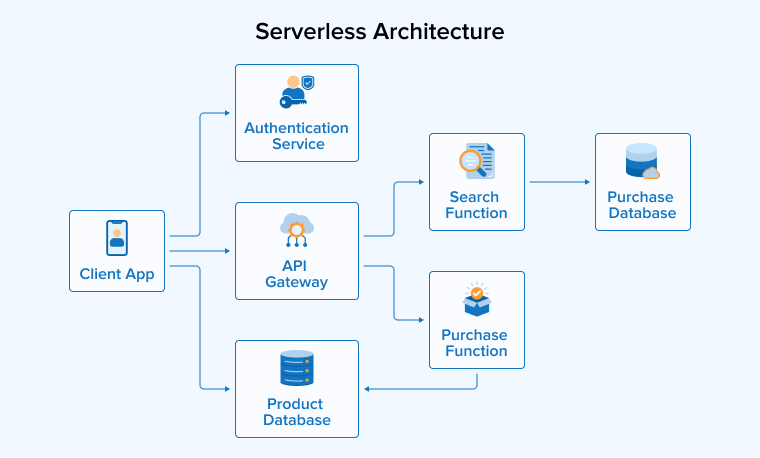
Why it matters: With serverless, developers focus on writing business logic while the cloud provider handles scaling, infrastructure, and availability. Java is increasingly being used on serverless platforms like AWS Lambda, Azure Functions, and Google Cloud Functions for tasks such as data processing, scheduled jobs, and API endpoints.
What is driving it: Frameworks such as Quarkus, Micronaut, and Spring Cloud Function are designed for fast cold starts and low memory usage, solving problems that Java previously had in serverless setups. GraalVM native compilation further reduces startup time, making it a strong fit for modern serverless workloads.
Business impact: For decision-makers, serverless cuts infrastructure cost and removes the need to manage servers around the clock. For developers, it simplifies deployments and supports fast iteration on small services.
GitHub
GitHub has become the central platform for modern Java development, going far beyond simple version control.
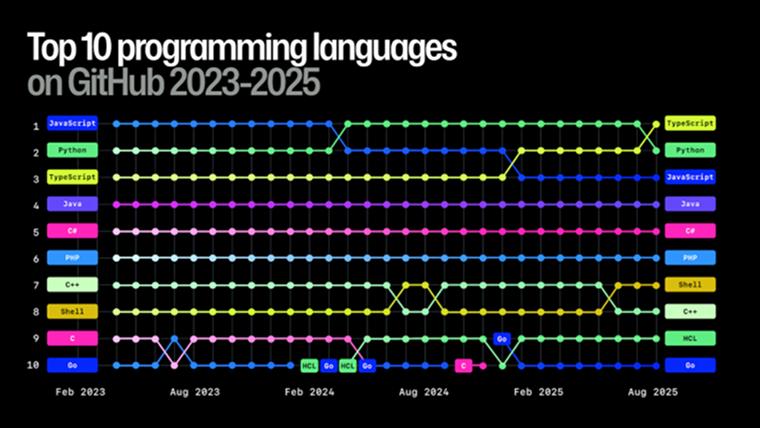
Why it matters: Most Java projects today live on GitHub, where teams collaborate through pull requests, code reviews, and automated workflows. The platform is now a key part of the developer experience, influencing how teams write, release, and maintain Java code.
What is driving it: GitHub Actions makes it easy to set up CI/CD pipelines for Java applications, while GitHub Copilot is changing how developers write code with AI-assisted suggestions. Tools like Dependabot, CodeQL, and GitHub Advanced Security help teams catch vulnerabilities early and reduce technical debt across long-running projects.
Business impact: For enterprises, GitHub offers strong governance, secure code management, and tight integration with cloud platforms. For developers, it acts as the single hub for collaboration, automation, and AI-assisted coding inside the Java ecosystem.
SaaS & PaaS
SaaS and PaaS models are reshaping how Java applications are delivered and consumed. Instead of installing software, most new products are now offered as services.
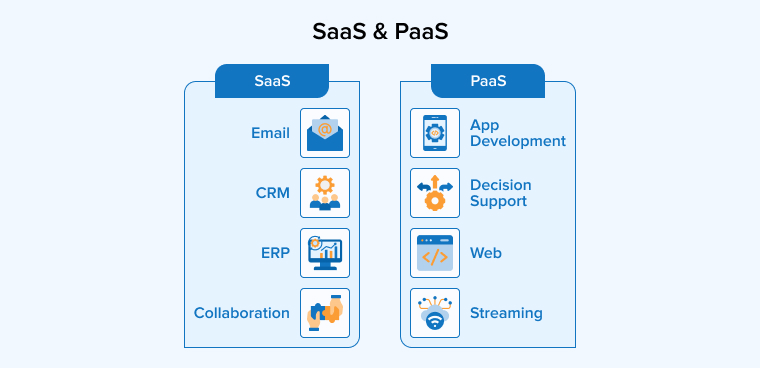
Why it matters: Customers now expect software to be accessible from anywhere, updated continuously, and offered through subscription-based pricing. This pushes Java teams toward multi-tenant and cloud-hosted designs that support thousands of customers from a single codebase.
What is driving it: Cloud solutions from AWS, Azure, and GCP, combined with Java’s robust frameworks, make it easier to build scalable SaaS platforms with strong security, data isolation, and seamless integration capabilities. PaaS offerings like Heroku, Render, and managed Kubernetes services reduce the operational burden for Java developers building new products.
Business impact: For decision-makers, SaaS and PaaS models bring recurring revenue, faster customer onboarding, and lower upfront cost. For developers, they encourage clean APIs, strong tenant separation, and well-designed Java applications that are easy to extend.
Big Data and Analytics
Big data and analytics continue to rely heavily on Java, especially for high-throughput data pipelines and real-time data streams.
Why it matters: Many of the most widely used big data tools, including Apache Kafka, Apache Spark, Apache Flink, and Hadoop, are built on Java or run on the Java Virtual Machine. This makes Java a key technology for any organization working with large-scale data processing, analytics, or event streaming.
What is driving it: Modern enterprises need to process huge volumes of data from IoT devices, transactions, and user behavior in near real time. Java provides reliable tools and strong ecosystem support to build efficient data flow pipelines, run analytics jobs, and feed data into AI models for prediction and personalization.
Business impact: For decision-makers, Java-based data platforms deliver scalability, fault tolerance, and long-term maintainability. For developers, they offer mature libraries, strong tooling, and a clear path to building advanced middleware for data-driven products.
Mobile App Development
Java is still a major player in mobile app development, particularly on Android, where it remains a core language alongside Kotlin.
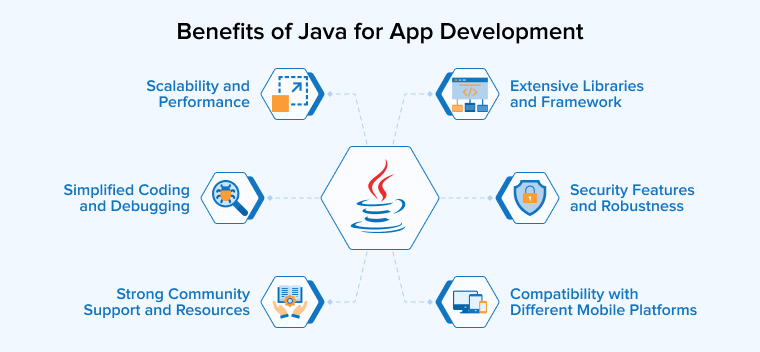
Why it matters: A large share of existing Android apps are written in Java. Therefore, new development, maintenance, and feature work continue to require strong Java skills. Many enterprises also use Java on the backend to power the APIs that mobile apps depend on.
What is driving it: Even as Kotlin grows, Java continues to be supported on Android and is heavily used in cross-platform tools, SDKs, and backend services. Frameworks like Spring Boot are commonly paired with Android and iOS clients to build secure, scalable, and seamless experiences.
Business impact: For enterprises, Java offers a stable foundation for long-term mobile products, with a large talent pool and proven libraries. For developers, it allows the reuse of existing Java code, facilitates smooth backend integration, and makes maintenance of large mobile codebases easier.
Remote Access Solutions
Remote access solutions have become a permanent part of enterprise IT, and Java continues to play a strong role in building them.
Why it matters: Hybrid and remote work models require secure and reliable tools that allow employees to access internal systems, dashboards, and applications from anywhere. Java’s stability and strong security features make it a preferred choice for VPN clients, remote desktop tools, and internal portals.
What is driving it: Java applications support strong encryption, SSO integrations, and role-based access controls, which are essential for protecting sensitive data in remote environments. Combined with cloud platforms, Java helps teams develop scalable remote access solutions without compromising performance or security.
Business impact: For decision-makers, this trend supports business continuity, regulatory compliance, and global team operations. For developers, this creates clear opportunities to build secure and scalable Java applications that can handle real-world load effectively.
GraalVM Native Compilation
GraalVM native compilation is changing Java deployment by allowing applications to run as native binaries with faster startup times.
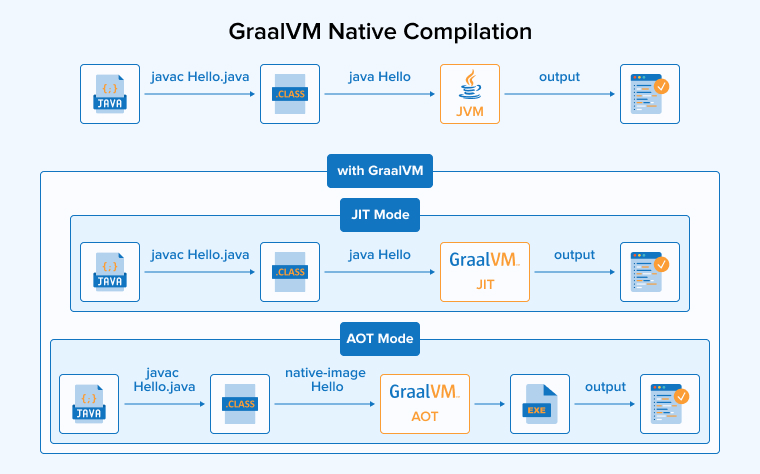
Why it matters: Standard Java applications run on the Java Virtual Machine, which is powerful but slower to start and uses significant memory space. GraalVM native compilation builds Java apps into native executables that start in milliseconds and use far less RAM, making them suitable for containers, serverless, and CLI tools.
What is driving it: Frameworks such as Quarkus, Micronaut, and Spring Native work with GraalVM to help developers create lightweight container images that use very little memory and storage. This shift directly supports cloud native applications and improves density on Kubernetes clusters.
Business impact: For enterprises, GraalVM reduces cloud cost, improves response times, and supports more aggressive scaling strategies. For developers, it brings the benefits of native performance to existing Java code without leaving the language.
Sustainability and Green Software
Sustainability and green software are emerging as important focus areas in Java development, as organizations look to reduce the energy footprint of their systems.
Why it matters: Large-scale Java applications consume significant compute, memory, and network resources that directly affect energy use and operating cost. Cutting unnecessary resource usage is now both an environmental and a financial priority.
What is driving it: Modern Java features like virtual threads, GraalVM native compilation, and efficient data flow pipelines help teams build leaner, faster, and more efficient systems while using less hardware. Green software development practices, including better caching, smarter scaling, and right-sized cloud resources, are becoming part of standard Java engineering work.
Business impact: For decision-makers, green Java software aligns with ESG goals, lowers cloud bills, and supports long-term sustainability targets. For developers, it brings a clear technical focus on optimizing Java performance, cutting memory usage, and writing code that is both user and environment-friendly.
Final Thoughts
The trends covered above show that the Java ecosystem continues to evolve in ways that directly address complex challenges faced by modern enterprises. For decision-makers, these shifts mean lower infrastructure costs, faster delivery, and a stronger foundation for long-term technology investments. For developers, they bring better tooling, cleaner code, and the chance to work on real-world Java applications that combine stability with innovation. Teams that stay close to these key trends and adopt them at the right time will be best placed to build high-performing, future-ready Java systems.
FAQs
Java is still relevant in 2026 because it powers a large share of enterprise systems, runs across all major platforms, and continues to evolve with modern features like virtual threads and GraalVM native compilation. Its strong ecosystem, security, and large talent pool make it a default choice for long-term and business-critical applications.
Cloud native development plays a central role in current Java trends, since most new Java applications are now built as microservices that run inside containers on cloud platforms like AWS, Azure, and GCP. Frameworks like Spring Boot, Quarkus, and Micronaut make it easier to build cloud native applications with fast startup, low memory usage, and smooth integration with Kubernetes.
Project Loom is changing Java development by introducing lightweight, and JVM-managed virtual threads that allow Java applications to handle millions of concurrent tasks with very low resource usage. This simplifies concurrent code, removes reactive programming complexity for many use cases, and helps enterprises scale Java apps without major rewrites.
Yes, Java is highly suitable for microservices architecture as frameworks like Spring Boot, Quarkus, and Micronaut offer fast startup, lightweight container images, GraalVM native compilation support, and seamless integration capabilities.
Upgrading from an outdated Java version to modern Java releases brings better performance, lower memory usage, stronger security, and access to features such as virtual threads, records, sealed classes, and pattern matching. It also reduces technical debt, improves compatibility with cloud platforms, and ensures long-term vendor support for established Java systems.
The future of Java development is shaped by AI integration, cloud native applications, virtual threads, GraalVM, and Project Loom, and a growing focus on sustainability and green software. Java will continue to act as a key technology for enterprise software, with steady innovation, strong tooling, and broad industry adoption keeping it relevant for years to come.

Rakshit Toke is a Java technology innovator and has been managing various Java teams for several years to deliver high-quality software products at TatvaSoft. His profound intelligence and comprehensive technological expertise empower the company to provide innovative solutions and stand out in the marketplace.



Comments
Leave a message...