

The rapid shift of people toward AI-based technology makes it necessary for existing businesses to begin adopting digital platforms to reach a larger customer base and remain competitive in the market. This heavy dependence has created a challenge for modern businesses because only high-quality software can fulfill the desired goals of any business owner. A software testing company must ensure that an application performs smoothly and without errors during customer interactions, transactions, or any business operation. There can be serious repercussions both in terms of money and market reputation with any kind of glitch in the software.
It’s necessary that there is a consistent set of quality standards followed throughout the organization. However, this has become quite difficult due to expanding technologies, increasing team size, and the rise of complex systems. Traditional testing methods that work for individual projects often fail to deliver the speed, scalability, and standardization required by modern enterprises.
This is where a Testing Center of Excellence (TCoE) comes into play. A TCoE is a centralized framework that brings together best practices, advanced tools, technical experts, and quality-driven strategies under one vision. This increases not just software quality but also release cycles and customer satisfaction.
In this blog, we’ll understand TCoE in detail, understanding its components, different models, advantages, challenges, best practices, and why it’s important to establish TCoE.
What is a Testing Center of Excellence (TCoE)?
A Testing Center of Excellence (TCoE) is a dedicated department within an organization that helps improve software quality by creating common testing practices, tools, and standards for all teams. Instead of handling all testing work itself, it guides and supports project teams so they can follow consistent and effective quality processes. A TCoE brings together skilled professionals, testing resources, and proven methods to reduce duplication, improve coordination, and manage risks better.
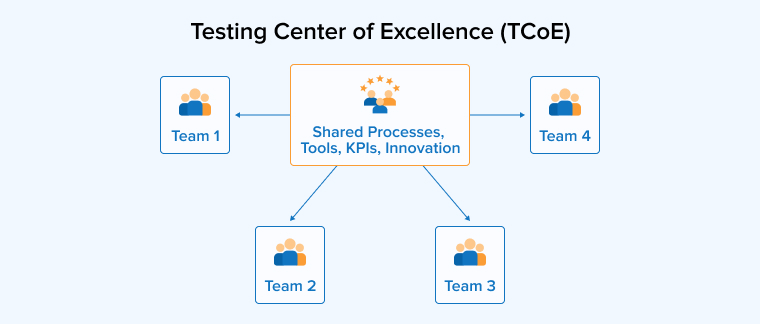
It also encourages continuous improvement by introducing better techniques, test automation, and innovation in testing activities. In modern organizations, a TCoE acts as a support and governance system that helps teams deliver reliable software faster while maintaining high quality across different projects and departments.
What Are the Key Components of a TCoE?
The following are the major components of a testing centre of excellence:
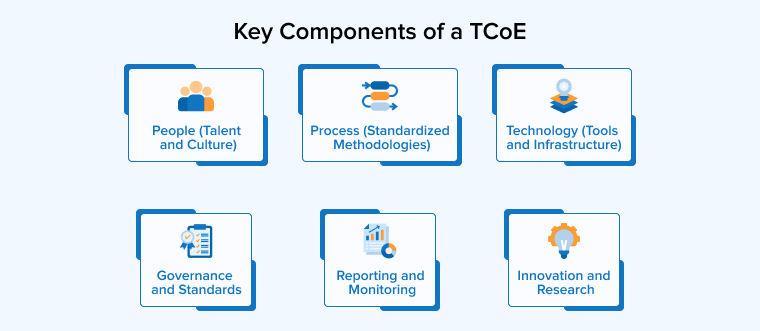
People (Talent and Culture)
A TCoE identifies capability gaps and helps testing professionals build expertise in modern quality practices, thus supporting continuous skill development. It brings together specialists with different strengths, including software test strategy, test automation, ensuring quality measurement, performance, security, and emerging technologies. The TCoE ensures teams remain prepared for evolving industry demands through training, mentoring, and knowledge-sharing initiatives, without compromising testing effectiveness or overall software quality.
Process (Standardized Methodologies)
A TCoE helps organizations follow a consistent approach to quality assurance by creating common testing methods, templates, and guidelines for all teams. It supports proper planning, execution, and reporting while ensuring every stage meets defined quality standards. A TCoE helps teams deliver reliable software with better coordination and consistency across projects
by encouraging feedback, sharing best practices, and improving processes continuously,
Technology (Tools and Infrastructure)
A TCoE manages software testing tools and shared infrastructure to help teams work more efficiently and consistently. It selects suitable tools for automation, defect tracking, performance testing, and CI/CD integration while avoiding unnecessary duplication across projects. It also supports test environments, test data, and reporting systems through a self-service approach. Thus, teams can use resources independently while maintaining common standards and smooth collaboration.
Governance and Standards
A modern TCoE creates common testing standards and governance practices to maintain consistent quality across all projects. It aligns testing activities with business goals and ensures teams follow defined quality and compliance requirements. These standards are developed with input from different teams that making them practical and effective. Regular reviews and feedback help to improve processes and maintain better control over software quality and performance.
Reporting and Monitoring
A TCoE makes use of well-defined KPIs, metrics, and reporting systems to track testing performance to measure quality and efficiency across projects. It provides dashboards and reports for teams, managers, and executives to monitor progress, identify risks, and support better decision-making. It continuously analyzes trends and software delivery results to help organizations improve testing practices and maintain consistent software quality over time.
Innovation and Research
Innovation and research are an important function of a TCoE that helps organizations continuously improve their testing capabilities. It evaluates emerging technologies, testing approaches, and industry developments to identify opportunities for better quality and efficiency. TCoE goes for thorough and multiple experimentation, pilot initiatives, and process refinement to assess the validity of any new idea before adopting it across the organization. As a result, organizations get better opportunities to modernize QA practices, optimize testing efforts, and respond more effectively to evolving business requirements and technological advancements.
What Are the Testing Center of Excellence Models?
There are four primary models of the Testing Centre of Excellence adopted by organizations based on their structure, risk profile, agility, and scale.

1. Centralized TCoE Model
A centralized TCoE model brings all testing activities under one dedicated quality assurance department. This team manages testing standards, tools, and skilled professionals who support different projects across the organization. It helps companies maintain consistent quality, improve collaboration, and reduce repeated work by sharing resources and best practices.
The centralized model is especially useful for large organizations that require strong compliance and security controls. However, it may also create delays in resource allocation and reduce close coordination with individual development teams.
2. Federated TCoE Model
A federated TCoE model provides freedom to individual teams to manage testing and release activities as per the guidance provided by a central quality group. The central team provides standards, reusable frameworks, and governance support, whereas the daily execution remains with product teams.
This contributes to increased flexibility, innovation, and faster scaling across large organizations. Keep in mind that strong communication between teams is essential to avoid duplicated efforts, inconsistent practices, and governance challenges. If the organization has mature Agile processes and shared quality ownership, this model will be very beneficial.
3. Platform-led TCoE Model
A platform-led TCoE offers testing tools, environments, and automation as shared services to help organizations improve their software quality. There’s no need to depend on a separate QA department as development teams can directly access ready-made frameworks, test data, and CI/CD integrations whenever needed.
This model encourages consistent testing practices while giving teams more independence and speed. It also reduces duplicated efforts, lowers operational costs, and supports continuous testing. Therefore, businesses can deliver reliable software faster and more efficiently across large-scale projects.
4. Hybrid TCoE Model
A hybrid TCoE model combines centralized guidance with team-level flexibility. The central group mainly handles critical areas like security, compliance, and software performance testing, while product teams manage regular testing activities independently. It also provides common tools, standards, and support to maintain consistency across projects.
This approach increases flexibility and collaboration in organizations while ensuring necessary controls. However, it requires strong coordination to avoid confusion, resource conflicts, and overdependence on centralized testing functions.
What Are the Benefits of Implementing a Testing Center of Excellence (TCoE)?
There are multiple advantages organizations get after establishing a TCoE, of which the following are the most common ones:
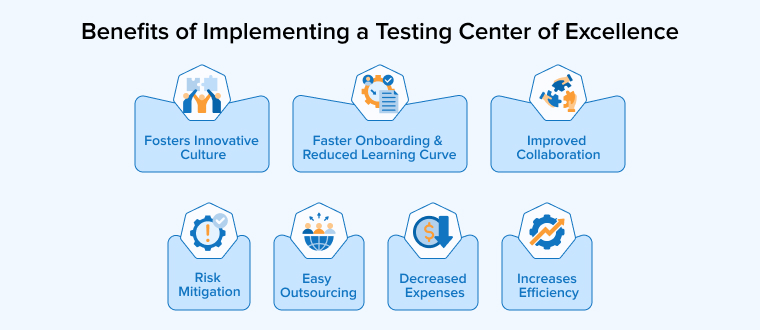
Increases Efficiency
A Testing Center of Excellence (TCoE) is a medium that helps organizations bring testing knowledge, resources, and tools together in one place. It helps create common guidelines, reusable resources such as documentation templates and automation frameworks, and efficient processes that teams can follow consistently. As a result, there is less duplication, improved productivity, better utilization of resources, and thus increased efficiency of the employees to deliver projects faster and more timely.
Faster Onboarding and Reduced Learning Curve
A TCoE provides clear processes, shared tools, and organized learning resources to new employees, which helps increase their productivity. We know that TCoE maintains consistency in testing tools and methodologies across teams, which allows newcomers to easily understand expectations and begin testing with minimal guidance. It becomes easy for them to integrate into the assigned projects without any confusion due to access to reusable resources and expert support.
Improved Collaboration
A TCoE improves collaboration among teams working across the organization by creating a shared space for knowledge, experience, and testing expertise. It improves communication between different functions, helps teams solve issues more effectively, and promotes consistent quality goals. Organizations try to break barriers between departments and achieve better coordination throughout the software delivery process by sharing resources and skills.
Decreased Expenses
Organizations can control their testing expenses through TCoE by promoting shared resources, common tools, and reusable assets across projects. The use of automation reduces the need for repetitive manual work, whereas early defect detection prevents costly fixes later in software development. There’s no need to invest in parallel in similar testing solutions that improve operational efficiency, allowing organizations to complete testing activities faster and with lower overall costs.
Risk Mitigation
A TCoE improves risk management strategy and capability by ensuring software quality issues are identified and addressed early in the development process. The implementation of consistent testing practices, comprehensive test coverage, and centralized knowledge sharing helps identify potential problems before software release. As a result, the chances of system failures, security concerns, compliance issues, and costly business disruptions are reduced significantly, which increases software reliability.
Fosters Innovative Culture
A TCoE promotes the adoption of modern testing practices, tools, and technologies across the organization. It supports skill development by providing continuous training on new and emerging technologies, structured onboarding, and knowledge sharing. The higher management evaluates new ideas, scales successful innovations, and provides quality insights so that a culture of innovation grows without affecting testing effectiveness and operational efficiency.
Easy Outsourcing
With TCoE, it is easier to work with outsourced testing teams as there is a set of established processes, shared resources, and clear quality standards. External testers can quickly align with existing practices and use reusable testing assets without much effort and setup required. TCoE enables flexibility in scaling teams as per the demand cycle and uses a single dashboard to track KPIs, facilitating easy integration between in-house and outsourced teams.
When to Establish a Testing Center of Excellence (TCoE)?
The huge benefits of a modern Testing Center of Excellence (TCoE) make it highly popular among businesses. However, keep in mind that universal adoption of TCoE does not make it a default structure. An organization may face unexpected challenges and overhead if it implements TCoE just because of its growing popularity.
It’s important to know the right time and favorable scenarios to think about TCoE implementation. The following factors or scenarios make TCoE implementation worth it:
- If there is a large number of applications to be tested, your organization cannot just go for manual testing. It’s time to opt for a centralized testing service to make the best utilization of testing resources.
- If there is a strict requirement to ensure regulatory compliance and security guidelines, TCoE will help your organization achieve this with minimal effort.
- If your organization is dealing with multiple platforms, shared services, or legacy systems, TCoE will provide centralized ownership of test architecture, environments, and non-functional testing.
- If your organization develops complex products, it’s important to ensure that every aspect of the application is thoroughly covered in testing.
- If every testing team in your organization follows its own testing methods and tools, and you want to bring consistency to get reliable results.
- If your product is delivered across multiple locations or to different vendors, it’s important to maintain a shared and non-negotiable quality framework.
Best Practices for Building a Testing Center of Excellence
Keep the following best practices in mind while forming a strategy, as well as during the implementation of a Testing Center of Excellence (TCoE):
1. Focus on Standardization and Reusability
A successful TCoE must work on establishing common testing practices, tools, and workflows across the organization. There must be a shared repository of reusable test cases, automation scripts, documentation, and guidelines, as it helps teams to avoid repeating work and improve efficiency.
Standardized environments and processes make cross-functional collaboration easier, simplify knowledge transfer, and ensure reliable test execution.
2. Automate Thoughtfully and Shift Left
Strengthens automation by extending it beyond basic regression testing to areas like test data generation and environment setup. Start integrating testing into early development stages to find out issues early in the software development process, instead of after completing the builds. Using a unified framework across different test levels improves consistency and coverage.
Implement continuous learning and improvement programs for testers so they can upgrade to more advanced and technical roles like SDET (Software Development Engineer in Test). This will help enable faster execution, better accuracy, and continuous testing within Agile and DevOps practices.
3. Preserve Team Ownership of Testing Execution
TCoE’s main focus is on defining testing standards, reusable frameworks, and governance for critical areas, while Agile or product teams deal with actual test execution. Maintain a set of common tools and clear guidelines to ensure consistency across teams.
Work on encouraging collaboration and feedback between central experts and delivery teams instead of maintaining strict control. This provides double benefits, as teams can work independently within defined boundaries while simultaneously improving quality through shared practices, mentoring, and continuous support.
4. Scalability and Resource Management
A successful TCoE improves scalability by combining centralized expertise, i.e., the TCoE hub containing QAs, architects, and automation experts, with close collaboration across delivery teams. Shared testing assets, flexible resource allocation, and specialized skills help organizations respond efficiently to changing project demands.
Go for automated testing, integrated development pipelines, cloud-based environments, and reliable test data management to enable faster execution and continuous feedback. This approach increases testing capacity, reduces duplication of effort, and supports consistent quality as business and technology needs grow.
Challenges in Implementing a Testing CoE
Teams can tackle the challenges effectively that may come across the path of implementing TCoE if they know the following common challenges in advance:
High Initial Investment
One of the major challenges of establishing a TCoE is the initial investment required for tools, infrastructure, training, and skilled resources. Organizations may hesitate because the benefits are not always immediate. A practical way to address this is by introducing the TCoE gradually and focusing on areas that deliver visible results quickly. Early achievements build confidence, demonstrate business value, and support future investment. They also keep costs manageable through efficient technology choices.
Integration Complexity
Integration of tools and methodologies to support Agile, DevOps, and CI/CD with the existing workflow can be challenging. Organizations often need to connect automation, testing environments, and supporting tools with their current workflows, which can be complex in diverse or legacy systems. This can be addressed by evaluating current processes, introducing changes in manageable stages, and validating them through pilot implementations. Proper training and careful alignment with delivery pipelines ensure a smooth transition and long-term success.
Centralization Risks
A TCoE should support and guide teams without creating unnecessary approval layers or slowing decision-making. When the central team exercises too much control, project progress can be delayed, and flexibility may be reduced. The most effective approach to overcome this is to provide common standards and necessary support to teams. As a result, they can work independently with efficiency and respond quickly to project needs.
Final Thoughts
A Testing Centre of Excellence (TCoE) turns software testing into a strategic asset as it enhances the quality assurance practices of an organization. Setting up a TCoE is a critical step as it demands a great understanding of different testing methodologies and standards, as well as a huge upfront cost. However, with the right strategy, it can be established to provide the expected advantage in the long run.
FAQs
A Testing Center of Excellence (TCoE) is a centralized framework standardizing QA processes, tools, and metrics to boost efficiency, software quality, and testing maturity.
Yes, in today’s world, where security attacks have become so common, there can be no compromise in testing accuracy. TCoEs are an effective way to standardize testing processes and tools to ensure consistent software quality.
Establishing a testing centre of excellence requires defining clear quality metrics, securing executive sponsorship, consolidating testing tools, centralizing skilled resources, and standardizing automated QA processes.
A Hybrid TCoE (Testing Center of Excellence) combines centralized governance with decentralized and agile testing teams. It standardizes QA frameworks while allowing flexible execution.
No, a TCoE is not only for large organizations. Smaller enterprises can also benefit from it by scaling it to their needs.
Measuring the ROI of a Testing Center of Excellence (TCoE) is done by calculating the financial and operational benefits, such as reduced bug-fixing costs, faster releases, divided by your total TCoE investment, be it tools, labor, or infrastructure.

Badal Patel is a Project Manager at TatvaSoft, overseeing a large team of software developers and ensuring the highest quality standards throughout the development process. He has over ten years of experience delivering reliable solutions across various industries.



Comments
Leave a message...