

Rapid digitalization has made software development quite competitive. The dependence on technology in any industry for performing day-to-day operations is forcing software development companies to release software updates quickly, but without compromising reliability. Businesses are working on shortening the deployment cycles and increasing deployment frequencies. This makes maintaining software quality a major challenge for development teams and software testing companies.
This is where a well-defined DevOps testing strategy becomes essential. DevOps testing integrates testing into every stage of the development process, making quality assurance the top priority. It’s a unique and modern development paradigm that brings development and operations teams together. It is not just a change in development methodology but also a cultural shift in the technology industry.
In this blog, we will explore the key principles, types, strategy development process, challenges to consider, and tools used for DevOps testing.
What is DevOps Testing?
DevOps testing is a modern approach where software is checked continuously throughout the entire development process rather than only at the end. Testing starts early and continues during coding, building, deployment, and even after the application is released. Automated tests play a major role by quickly identifying problems whenever changes are made. This helps teams to fix issues before they become costly.
Unlike traditional methods, where a separate QA team mainly handled testing after development was complete. DevOps encourages developers, QAs, and operations teams to work together. This shared responsibility improves software quality, speeds up delivery, and reduces risks. And helps ensure that applications perform reliably across different test environments.
What Are the Core Principles Driving Successful DevOps Testing?
DevOps testing is based on the following five fundamental principles:
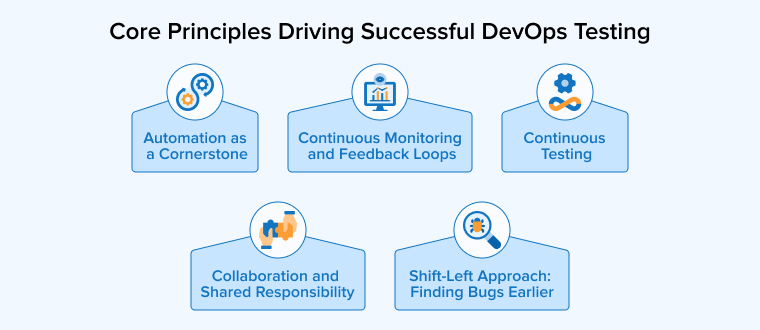
Continuous Testing
In DevOps, it’s crucial to perform testing continuously throughout the software delivery process. You don’t need to wait until development is complete because automated tests run whenever you update, merge, or build the code. This allows teams to identify and correct issues quickly, preventing them from affecting the proceeding stages.
Different types of software tests are carried out at various points in the pipeline to verify that the application works as expected. The build must successfully pass all required checks before it can move forward. This approach improves software quality, reduces delays, and supports a faster and more reliable release process.
Automation as a Cornerstone
Automation plays a central role in DevOps by handling repetitive tasks throughout the software development lifecycle. Automated processes help maintain speed and consistency from submitting code to deployment and application monitoring.
You can automatically run various tests, such as unit, API, regression, and performance tests, whenever you introduce changes. This allows teams to detect problems quickly and respond before they impact users. The dependency on manual testing methods for routine tasks is highly reduced, which allows skilled team members to focus on more complex quality and validation activities.
Shift-Left Approach: Finding Bugs Earlier
Shift-left testing focuses on checking software quality as early as possible in the development process. Developers and testers collaborate from the beginning to identify potential issues instead of waiting for code completion. They create tests alongside the code and run automated checks before sharing changes with the team.
Involvement from the initial stages of planning and requirement analysis also helps prevent misunderstandings and defects. Software development teams can resolve the defects quickly with less effort, thus reducing development costs and improving the overall quality and stability of the final product.
Continuous Monitoring and Feedback Loops
In DevOps, testing continues even after an application is released. Teams keep a track of system behavior, errors, and user experiences to observe how the software performs in real environments. This information helps identify issues that may not have appeared during earlier testing stages.
Continuous feedback from monitoring tools, stakeholders, and end users allows teams to make informed improvements and respond quickly to potential problems. Alerts, performance reports, and analytics provide valuable insights that support ongoing refinement. As a result, software becomes more reliable, efficient, and better aligned with user expectations over time.
Collaboration and Shared Responsibility
Strong teamwork across different roles is an important pillar of a successful DevOps testing culture. Ensuring software quality is not the responsibility of only a specific team but of a group of developers, testers, operations staff, and security specialists. Each team contributes in its own way, from creating tests and reviewing code to monitoring systems and identifying risks.
Open communication and shared objectives keep everyone aligned throughout the software development process. The distribution of responsibility across teams leads to earlier problem identification, smoother collaboration, and overall software quality improvement.
What Are the Types of DevOps Testing?
In DevOps, each type of testing is automated and integrated into the CI/CD pipeline. The following are the main types of testing:
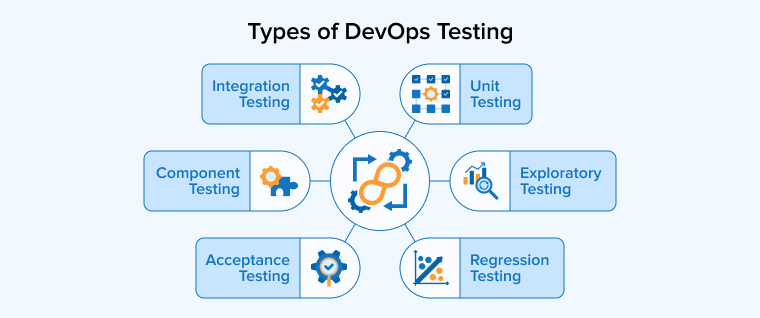
1. Unit Testing
Unit testing is a white box testing method that tests the smallest individual components of the codebase, such as functions or methods. Software developers mainly develop the unit test cases to test the code before handing it over to the QAs. There are even SDETs (Software Development Engineers in Test) who are automation experts and write unit test cases to help development teams. You can select unit testing frameworks based on the language in which your code is written, such as JUnit for Java, pytest and unittest for Python, Jest and Vitest for JavaScript/TypeScript, etc.
2. Component Testing
Component testing, also known as module testing, evaluates individual modules in complete isolation against user requirements and functional use cases. A module consists of different units that developers have already tested through unit testing. Component testing is a black-box testing technique executed by developers or QA engineers with the help of simulation tools such as stubs, drivers, or mocks.
3. Integration Testing
Integration testing follows component testing, where integrated components are checked for the effective working of the core functionality. It helps detect problems in the interfaces, data flows, and dependencies between separate modules. CI/CD pipelines automate integration tests using testing frameworks like Playwright, SuperTest, Cucumber, etc.
4. Acceptance Testing
End users and business stakeholders perform acceptance testing to check that the software meets their expected requirements and real-world needs in an environment similar to the production environment. Acceptance testing can be User Acceptance Testing (UAT), Business Acceptance Testing (BAT), Contract Acceptance Testing (CAT), and Regulatory Acceptance Testing (RAT), depending on the type of assessment.
5. Regression Testing
Regression tests check whether bug fixes, system updates, or code changes affect the existing features or functionalities. Automated regression tests are run after each change, be it code refactoring, new feature implementation, or environment changes. Automated tools like Playwright and Selenium automate the re-execution of previously passed test cases to ensure functionality is the same as before.
6. Exploratory Testing
In this testing type, testers just randomly explore the application like a normal user without any predefined test cases or test scripts to discover any abnormalities a user can detect while using the application. It is a way to discover those defects that even automated tests can miss.
What Are the Common Challenges in DevOps Testing?
There are certain challenges that stop organizations from automating their testing technology even though they’re following DevOps and agile methodologies. We’ll look at the most common DevOps testing roadblocks in the section below:
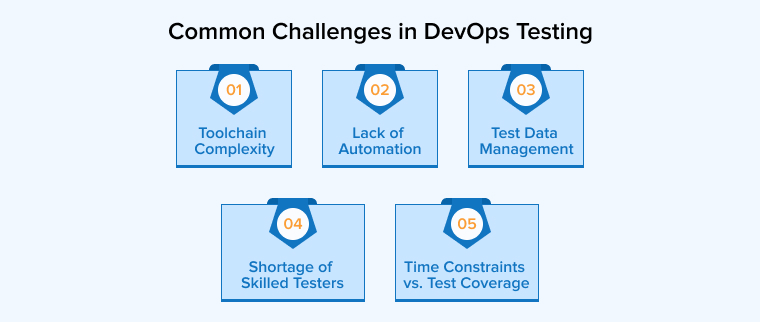
Toolchain Complexity
Many teams struggle with scattered software testing tools that create confusion, slow feedback, and extra maintenance work. To avoid this, they must simplify the tool ecosystem, automate environment setup, and rely on standardized integrations. This helps improve reliability, reduce operational effort, strengthen security, and accelerate software delivery.
Lack of Automation
Automation delivers better results when teams introduce it with clear priorities rather than trying to automate everything at once. First of all, focus on tests like API and unit tests that provide quick and consistent benefits for creating a strong foundation. After a period of time, move towards building reusable components and expanding gradually to improve efficiency and ensure long-term testing success.
Test Data Management
Modern DevOps teams often struggle to provide reliable test data quickly while keeping software development pipelines moving. Thus, it becomes hard to identify real-world issues before the product is released in the live environment. They must protect sensitive information, maintain consistent data across tests, and support multiple test environments without excessive storage costs.
Shortage of Skilled Testers
Many software testing teams find it difficult to adapt to modern DevOps practices because they lack the required technical knowledge and communication skills to collaborate closely with other teams. Targeted skill audits, training in test automation, cloud, and deployment concepts, and encouraging cross-functional collaboration can help bridge these gaps.
Time Constraints vs. Test Coverage
DevOps teams have to ensure that software is delivered quickly without compromising quality and that testing does not take too long. This becomes difficult and can be managed using efficient software testing strategies that focus on the most important areas, automate checks early, and use scalable environments to speed up execution.
How to Develop a DevOps Testing Strategy?
An effective testing strategy is made according to the needs and circumstances of a particular organization. Therefore, build a customised DevOps testing strategy following the steps given below:
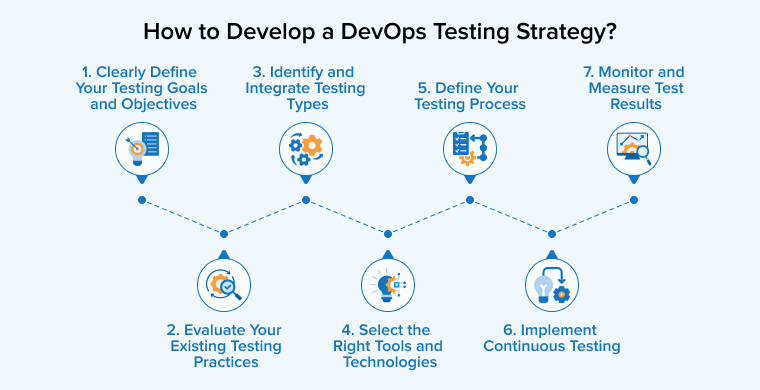
1. Clearly Define Your Testing Goals and Objectives
You must be clear about why your organization must opt for DevOps testing, whether it’s about decreasing the delivery time, reducing bugs, lowering the production cost, etc. Keep in mind that testing goals must align with your business goals and stakeholders’ expectations. The goals must transform into the establishment of measurable metrics, for example, increasing automation coverage to 50%, reducing defect density by 40%, or decreasing the MTTR from hours to minutes.
Without defined targets, it becomes difficult to measure progress or determine whether testing efforts are delivering real value. This step will define your eventual testing strategy, such as guiding decisions related to testing practices, resource allocation, and technology adoption.
2. Evaluate Your Existing Testing Practices
You might wonder why this step comes after defining test goals. This is because it will help you judge whether the current testing practices are as per your defined targets in the above step, and what the gap is between them. The goal is to check the scope of refinement in the existing practices instead of completely overthrowing them from the system.
Conduct a thorough assessment of the different types of testing performed, the tools used, and the problem-solving strategies your team adopts in different scenarios. See to it that the practices followed keep pace with the rapidly changing DevOps environment, are comprehensive, and consider how they integrate with other development processes.
3. Identify and Integrate Testing Types
An effective DevOps testing process relies on selecting the most appropriate tests at different stages of your software delivery workflow. You do not have to apply the same testing approach to all the stages, as it will not give the desired and accurate results. Therefore, teams should match testing activities to the purpose of each stage. In the early development stages, lightweight checks like running unit tests help identify coding issues quickly and prevent defects from moving further into the pipeline.
In the build stage, component and continuous integration testing can verify that different components work together correctly and that core functionality remains stable. In the pre-deploy and deployment stages, focus on targeted validation and regression tests to ensure user interactions perform as expected without introducing unnecessary delays. After the deployment is over, conduct regular monitoring and specialized assessments to help maintain reliability, security, and overall system performance.
4. Select the Right Tools and Technologies
There are a variety of tools available in the market that help perform both manual and automated testing, which may confuse you, and you might choose the inappropriate ones. You must ensure that the tools you select are in accordance with your testing goals and easily integrable with the current DevOps pipeline. It’s wrong to assume that the newest tools will provide the best solutions.
Every testing type requires a different set of tool capabilities, such as generating API requests, static code analysis, simulating multiple users, and so on. There are some tools specialized for specific types of tests, such as Selenium for UI testing and JMeter for performance testing. Therefore, combine multiple tools to support areas such as code validation, API verification, performance evaluation, infrastructure testing, and automated delivery. However, simply collecting tools is not enough. You will benefit when these technologies work together within a unified ecosystem and integrate smoothly with existing workflows to reduce complexity and unnecessary switching between platforms.
5. Define Your Testing Process
DevOps testing is not only about running tests at different stages of development. A well-defined plan must outline when testing activities will take place, how teams will perform them, and who will handle each task. Assigning tasks among team members creates accountability and ensures they address issues without confusion or delay. It is also important to establish a consistent method for investigating failures, resolving defects, and verifying fixes so that problems do not repeatedly affect the development cycle.
In a DevOps environment, every team member must remember that software quality is a shared responsibility, not the duty of a single group. Developers, testers, operations teams, and other stakeholders must work together, exchange information openly, and contribute to continuous improvement efforts. It will help teams respond to challenges more effectively and make better decisions throughout the delivery process.
6. Implement Continuous Testing
Continuous testing must become a natural part of the software delivery process rather than a separate activity performed at the end of software development. Teams must execute tests after every change to identify issues early and reduce the risk of defects reaching production. Developers must immediately access testing results through automated notifications and centralized reporting so that they can respond quickly as soon as any issue arises.
Strong integration between testing and deployment processes also enables faster releases because verified changes can move forward with greater confidence. However, automation should be introduced carefully. The first focus must be on high-value tests and on building reusable testing components to create a base for an automation strategy. Teams should regularly evaluate test effectiveness, improve execution efficiency, and maintain automation code with the same care as application code.
7. Monitor and Measure Test Results
Testing alone is not enough. It’s equally important to monitor the test results regularly to verify if the current approach is actually working. Therefore, instead of relying only on assumptions, DevOps teams must regularly review data to understand how testing activities perform and where they need adjustments. Key indicators include the number of defects teams find before release, test execution speed, the frequency of unreliable test results, and pipeline completion time.
These indicators will guide teams in assessing the impact of introducing new tools, workflows, or automation practices. If there is an improvement in the results, it means the adopted strategy is correct, and if not, changes may be required.
DevOps Testing Strategy Best Practices
The following best practices will guide you in forming a robust DevOps testing strategy:
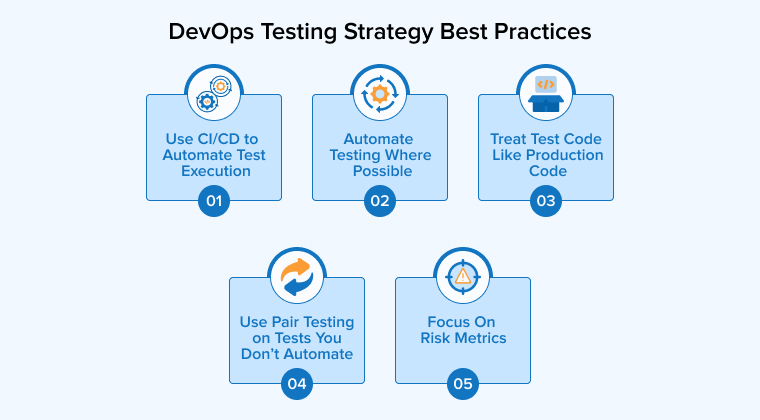
1. Use CI/CD to Automate Test Execution
You’ll get the best results from DevOps testing when checks are automatically built into the CI/CD pipeline. Instead of running every test after committing every change, use different test levels at different stages to keep pipelines efficient. Automated quality controls will immediately stop faulty code from moving forward in the pipeline.
2. Automate Testing Where Possible
If your company is entirely dependent on manual testing, it can slow down software delivery and increase the chance of overlooked issues. Automated testing provides repeatable and dependable verification, allowing applications to be checked more quickly. Integrate it into your software development workflow to detect issues in the early stages and ensure smoother and more reliable software releases.
3. Treat Test Code Like Production Code
Test automation becomes fully effective when teams manage testing scripts with the same discipline as application development. Teams must apply the same quality controls, consistent practices, and regular reviews to testing code to reduce unstable results. Well-organized test code is easier to maintain, improves accuracy, and supports long-term efficiency across development teams.
4. Use Pair Testing on Tests You Don’t Automate
In pair testing, one person performs the tests, and the other observes, reviews, and shares ideas. It thus encourages better communication across different roles, spreads knowledge faster, and strengthens teamwork. Pair testing helps cover those edge cases that even automated test scripts miss. However, it is most valuable for complex testing tasks rather than routine or repetitive checks.
5. Focus on Risk Metrics
Test automation should focus on application areas that have the greatest impact on business operations. The testing team should prioritize critical processes, transactions, and functions to detect serious issues earlier and prevent major problems from reaching users.
Top Tools for DevOps Testing
Selecting the right set of test automation tools is key to lowering costs, decreasing software release times, and providing real-time insights into software functioning and quality.
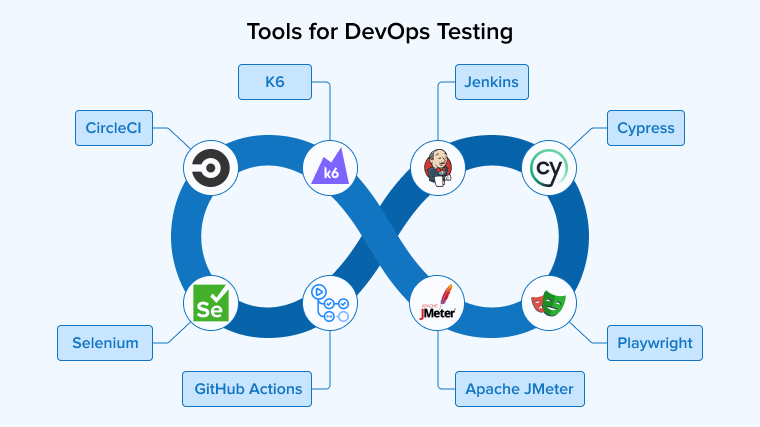
We’ll learn about the most popular DevOps testing tools as per their categories across the DevOps lifecycle:
CI/CD Pipeline Orchestrators
These tools automate the building, testing, and deployment of code, serving as the central nervous system of a DevOps pipeline. Some of the common orchestration tools:
- Jenkins: It is a Java-built open-source automation server that automates the development, testing, and deployment of applications across multiple environments.
- GitHub Actions: It is a CI/CD automation platform from GitHub to automate tasks directly within the software repositories. It works based on the five core components, i.e., Event, Workflow, Job, Step, and Action.
- CircleCI: It is a cloud-based CI/CD platform providing smooth integration with version control systems like GitHub, Bitbucket, and GitLab. Features like intelligent caching and parallel execution speed up the software development process.
Web UI & End-to-End (E2E) Testing
Web UI testing ensures a pleasant look and feel by evaluating the front end of the application. End-to-end testing assesses the entire application’s workflow to ensure the smooth working of the application. Tools to facilitate this include:
- Selenium: It is an open-source web automation testing framework to ensure the smooth working of websites across different browser environments.
- Playwright: It is a Microsoft-built open-source web automation framework that supports multiple browsers and programming languages.
- Cypress: It is a modern JS-based open-source automation framework for web applications. Its core components are Test Runner, Cypress Dashboard, Cypress Framework Engine, and Plugins & Support Layer.
Performance Testing
Performance testing in the DevOps methodology focuses on continuous assessment of the application’s speed, stability, and scalability by embedding automated non-functional testing directly into the CI/CD pipeline. The popular performance testing tools are as follows:
- Apache JMeter: It is an open-source, Java-based versatile software application to simulate heavy traffic on servers, networks, or objects to analyze their performance under stress.
- K6: Grafana K6 is an open-source load and stress testing tool that allows developers and QAs to write test scripts in JavaScript, even though the tool is written in Go.
Final Thoughts
DevOps testing is about maintaining quality while increasing the delivery speed. It will give the best results only when the entire team is clear about what DevOps is and why it’s becoming a default demand. Implementation of a DevOps testing strategy with incomplete knowledge of its various aspects will prove costly and time-consuming over time. Hence, gain an in-depth understanding and implement it in a phase-wise manner.
FAQs
DevOps uses a shift-left, continuous, and automated testing approach. Tests run automatically at every development stage, provide instant feedback, and ensure high-quality software delivery at speed.
DevOps testing means integrating automated testing into a CI/CD pipeline. There must be early, frequent, and continuous testing with every code change so that defects can be caught and fixed rapidly before production.
Unit testing, integration testing, regression testing, end-to-end testing, acceptance testing, performance testing, and security testing are the types of testing in DevOps.

Badal Patel is a Project Manager at TatvaSoft, overseeing a large team of software developers and ensuring the highest quality standards throughout the development process. He has over ten years of experience delivering reliable solutions across various industries.



Comments
Leave a message...